Tenet to close 232-bed Phoenix hospital

https://www.beckershospitalreview.com/finance/tenet-to-close-232-bed-phoenix-hospital.html

Image result for hospital closure

Dallas-based Tenet Healthcare will close Abrazo Maryvale Campus, a 232-bed hospital in Phoenix, by the end of the year.

The hospital is closing primarily because of dwindling patient volumes, said Frank Molinaro, market CEO for Abrazo Community Health Network, which encompasses six acute care hospitals.

“Over the past several years Abrazo Maryvale has experienced a significant decline in community demand for its services,” said Mr. Molinaro. “The Abrazo Community Health Network’s top priority is delivering high-quality, cost-effective care to residents of the greater Phoenix area, and we are properly allocating our resources to meet our patients’ and our communities’ healthcare needs.”

Although the hospital will remain open until Dec. 18, it will no longer admit patients after Dec. 1. “We will assist patients and their physicians in transitioning their care to other Abrazo Network facilities or the healthcare provider of their choice,” said Mr. Molinaro.

Officials said the closure of Abrazo Maryvale should not impact the community’s access to care, as there are four acute care hospitals and 11 urgent care centers within the 6-mile area surrounding Abrazo Maryvale.

The closure of the hospital will affect around 300 employees. All Abrazo Maryvale employees who are in good standing will receive priority for open positions within Abrazo Community Health Network and its affiliated partners, said Mr. Molinaro.

Tenet, Abrazo Maryvale’s parent company, is exploring a number of strategic options, including the sale of assets, divisions or the entire company. The 77-hospital chain ended the second quarter of this year with a net loss of $56 million, compared to a net loss of $44 million in the same period of the year prior. Tenet will release its earnings for the third quarter in November.

The rise of the hybrid operating room

The rise of the hybrid operating room

Recent advancements in heart valves and minimally invasive surgery technology have paved the way for even more patients to qualify for endovascular/interventional procedures.  Yet these patients present with very complex medical conditions and are at a high risk for poor outcomes. In an effort to improve these poor outcomes and accommodate surgeon and interventionist needs, many hospitals have implemented hybrid operating rooms (typically an OR with a fixed C-arm angiographic system), and many more are considering it.

Hybrid ORs come with steep price tags—some may cost more than $2 million. Add on another $3 million or more for the appropriate OR equipment, integration systems, and facility renovation costs, and your project may now cost north of $5 million.

Cardiac surgeons clearly have a vested interest in hybrid ORs. But how can a hospital ensure that other physicians, their support staff and senior hospital/system leadership are also engaged in the planning of this very complex set-up?

Every successful project starts with an actively engaged foundational team. A hybrid OR project team should include vascular, neurovascular, and cardiothoracic surgeons; interventional cardiologists; interventional radiologists; OR nursing staff; cath lab nursing staff; and the radiology technicians from both the cath lab and interventional radiology. Involvement by the IT team is essential, as they will be key personnel in the integration of equipment booms, the system’s table, and the video monitors. The biomedical engineering department should be part of this initial team as well — they will be the “first responders” whenever there’s a technical glitch. Finally, administrative leaders from the surgical, cardiac, and radiology departments need to be on board as volume projections must be made and Finance has to be engaged to determine if the cost can be justified.

Managing this very large team is challenging with so many different opinions and interests to consider.  Each clinical specialty has somewhat unique needs requiring specific equipment placements.  While room drawings from various suppliers are helpful, only the most adept clinical user generally has the ability to imagine what they mean for your planned space. The 2-dimensional AutoCAD drawings an architect might develop during the planning stages are tough to interpret if you are not used to reading them. While 3-dimensional and REVIT models are more useful than the 2-D ones, an actual live space—or even a mock-up—really allows clinicians to understand the spatial relationships much more clearly.

One of the best ways to see how hybrid ORs work in actual practice is to visit clinical sites where they are currently installed and talk with frontline staff about their specific challenges. Ask users how they changed the room’s configuration when new clinical services began using the room. Delve into how they manage consumable supplies and where they are stored. Where are their video monitors placed? Are there any limitations due to the size of the room? Did they choose a floor-mounted or a ceiling-mounted C-arm? Why? Ask why they selected their particular angiographic system and how they coordinated the various installation efforts. In addition to all your fact-finding, you must keep your CEO, COO, and other leadership up-to-date with your progress. This may be one of the largest capital expenditures of the year, and in some hospitals it may be the largest of the decade.

After all the fact-finding and installation challenges, your hybrid OR is almost ready. But before it’s fully operational, conduct some role-playing exercises to ensure that staff are well versed in how things will work in advance of the first official hybrid procedure. You may want OR staff to observe a cath procedure and for cath lab staff to observe an OR procedure. Slight differences – or actually major differences—in practice can create cause a great deal of confusion when staff expectations are mixed in a hybrid OR.  Make sure credentialing and quality criteria are in place.

Once the hybrid OR is finally in full swing, monitor surgeon and interventionalist usage—monitor “actual” versus “projected” in the number of procedures to assure that goals are met.

With proper planning, a hybrid OR benefits both patients and your hospital’s performance. You may be so successful that you have to start all over again—with planning a second hybrid OR.


Kaufman Hall: 2017 Hospital M&A activity to potentially outpace 2016

https://www.beckershospitalreview.com/hospital-transactions-and-valuation/kaufman-hall-2017-hospital-m-a-activity-to-potentially-outpace-2016.html

Image result for hospital consolidation


Eighty-seven hospital and health system transactions have occurred as of the end of the third quarter of 2017, leading some experts to suggest the total number of deals in 2017 may exceed the 102 deals completed in 2016, according to a recent analysis from Kaufman, Hall & Associates.

Kaufman Hall analysts report 29 transactions were announced during the third quarter, down slightly from the 31 deals announced during the second quarter of 2017.

Here are five findings from the analysis.

1. Eight transactions exceeding $1 billion in revenue have been announced in 2017 thus far. The figure is double the four such transactions announced in all of 2016.

2. The two largest transactions announced during the third quarter included the proposed merger between Charlotte, N.C.-based Carolinas HealthCare System and Chapel Hill, N.C.-based UNC Health Care — announced in September — and St. Louis-based Ascension’s proposed acquisition of Chicago-based Presence Health, announced in August.

3. Eight transactions announced during the third quarter of 2017 involved acquisitions by for-profit organizations, while 19 involved acquisitions by nonprofit institutions.

4. Three transactions announced thus far this year involved academic medical centers partnering with for-profit entities.

5. The three states with the highest number of transactions announced during the third quarter include New York, Pennsylvania and Illinois.

“Transactions among larger and like-sized organizations are rising as health systems across the country look to build scale and new capabilities for an uncertain healthcare environment,” said Anu Singh, managing director of Kaufman Hall. “These transactions are driven primarily by strategic imperatives and less so, by financial drivers … We’re also seeing an uptick in creative affiliations, with partnerships using non-traditional models to achieve their strategic goals in response to a new set of market factors that were not present a decade ago.”

The value of hospitals’ tax exemptions

http://www.aha.org/content/17/benefit-of-tax-exemption.pdf?utm_source=newsletter&utm_medium=email&utm_campaign=newsletter_axiosvitals&stream=health-care

Image result for community benefit


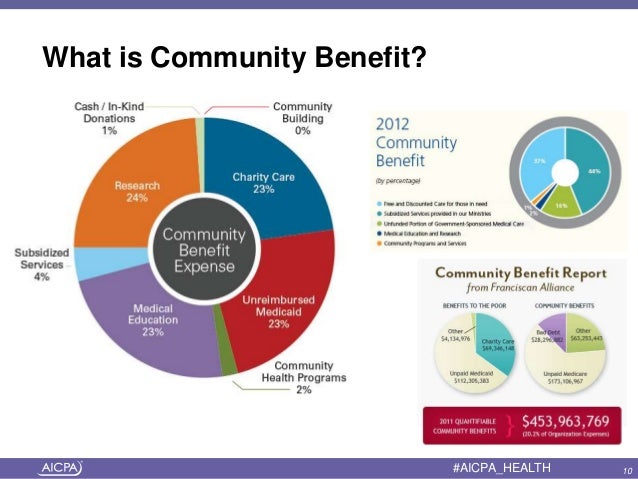
The American Hospital Association released a report last week that said the benefits that not-for-profit hospitals provide to their local communities far outweigh foregone federal tax revenue. But Axios’ Bob Herman talked to some experts who said the AHA’s report has flaws and omissions that exaggerate hospitals’ community roles and understate the power of their tax exemptions.

  • The AHA did not account for the giant tax break hospitals get on their property, “which is just a joke,” said Craig Garthwaite, a health economist at Northwestern University.
  • “Exclusion of property taxes would be a very major problem,” added Gary Young, a health policy professor at Northeastern University who has studied tax exemptions for not-for-profit hospitals.
  • Calculating shortfalls from Medicare as a community benefit also raises a red flag. For-profit hospitals that pay taxes treat Medicare patients. The IRS doesn’t acknowledge Medicare shortfalls as a community benefit.
  • Plus, research shows hospitals often lose money from Medicare because of their high fixed costs and inefficiency, not because payments are too low. “That’s really just trying to get that (community benefits) number as high as possible,” Garthwaite said.

AHA’s response: Mindy Hatton, the AHA’s top lawyer, responded with a statement to Axios. The report did not include property tax values, she said, because the analysis only covered federal exemptions, which “Congress has jurisdiction over.”

Analysis: Is healthcare spending growth past the ACA bump?

http://www.healthcaredive.com/news/analysis-is-healthcare-spending-growth-past-the-aca-bump/507073/

Image result for us healthcare spending


9 Vermont hospitals join state’s all-payer program

http://www.fiercehealthcare.com/finance/9-vermont-hospitals-join-state-s-all-payer-program?utm_medium=nl&utm_source=internal&mrkid=959610&mkt_tok=eyJpIjoiWkRSalkyTXpOV0V4WkRkayIsInQiOiJHQUVNRTJhUmhhSkpXVk80NkJoOWo5R21nNW5iV0hQS3NxRzc4SUQrbmRyMFwveXlBUFEwRm83TXFUemp0ZE9aNWlBTmYzSVJWb0dzbXV0RTczYnZSTEFMaGhEeFZKYk9LMWJuaXNxUlRUd2V6WEZnZ3lqRUpYaWp6SU0rbUhUd0cifQ==

sign that says "welcome to vermont"

Nine hospitals in Vermont have signed on to participate next year in the state’s all-payer pilot.

OneCare Vermont, the accountable care organization that is heading the effort, estimated that 120,000 Vermont residents will be covered under the program in its second year, according to an article from Seven Days, compared with 30,000 in year one.

In all-payer models, providers are reimbursed based on patient outcomes, not on how many procedures are performed.

“It’s a huge step—120,000. I’m happy with it,” OneCare CEO Todd Moore told the publication.

OneCare announced that a variety of providers would be joining the model for 2018 in addition to the hospitals, according to an article from Vermont Business Magazine. The all-payer program will also include one hospital in New Hampshire, two federally qualified health centers and 19 skilled nursing facilities.

Twenty-four independent physician practices and 30 independent specialty practices have signed on as well, the magazine reports.

However, some major Vermont providers are hesitant, Seven Days reports. Community Health Centers of Burlington, for instance, has passed on joining the program for 2018 because it’s not prepared yet. Peter Gunther, the system’s chief medical officer, told the publication that joining would “take a lot of work” and officials are concerned that the program could increase the administrative burden on providers.

Vermont isn’t the only state to test an all-payer system; Maryland has operated under one for several years. By 2014, 95% of hospital revenue in the state had shifted to alternative payment models. Much of the success was related to its ability to form effective partnerships early on.

But the outlook isn’t completely sunny. Economists have argued that the program should shut down, as it’s more expensive than other models for operating healthcare.The head of the state’s hospital association has also noted that challenges, like allocating resources to mitigate risk, remain for providers.

Hospitals Brace For Unpaid Bills If GOP Balks On Children’s Healthcare

https://www.forbes.com/sites/brucejapsen/2017/10/05/hospitals-brace-for-unpaid-bills-if-gop-balks-on-childrens-healthcare/#6b40118272e9

Image result for children's health insurance program (chip)


Hospitals are bracing for an increase in unpaid medical bills and related uncompensated care after the Republican-led Congress let funding for the Children’s Health Insurance Program lapse.

Congressional committees this week are working on language to renew the CHIP program after federal funding expired Saturday, Sept. 30, leaving coverage of 9 million children in doubt. What was thought to be a done deal with bipartisan agreement a month ago that CHIP would be renewed for five years has lately become bogged down in Congressional gridlock and charges of ineptitude against Republicans and the Trump White House.

U.S. Speaker of the House Rep. Paul Ryan (R-WI) (L) speaks as Senate Majority Leader Sen. Mitch McConnell (R-KY) (3rd L), Sen. Ted Cruz (R-TX) (2nd L) and Sen. Pat Toomey (R-PA) (R) listen during a press event on tax reform September 27, 2017 at the Capitol in Washington, DC. (Photo by Alex Wong/Getty Images)

“States will not have access to additional funds and either will have to scramble to find money to pay for the health care costs for some of the most vulnerable patients or hospitals likely will experience a surge in uncompensated care,” Mizuho Securities USAresearch director Sheryl Skolnick said in a report Wednesday. “The need to reauthorize CHIP was well-known and the failure seems symptomatic of the larger issue of a dysfunctional political process.”

Some states could begin to run out of money to cover children over the next three months, triggering an uptick in medical bills that could lead to layoffs and a freeze on capital spending.

Hospitals generally account for CHIP funds in their Medicaid revenues, which can be 10% and 20% of some facility revenues. For-profit hospital operators like Tenet Healthcare, HCA Holdings and Community Health Systems, though, have less than 10% of their operations funded by Medicaid, Mizuho’s report this week shows.

Since the Affordable Care Act expanded coverage to more than 20 million Americans, hospital charity care and related uncompensated care expenses that include bad debt have dropped significantly.

Uncompensated care costs for the nation’s 4,862 hospitals dropped below 5% to 4.2%, or $35.7 billion in 2015, the American Hospital Association’s most recent tally showsThe 2015 level of uncompensated care costs were the lowest amount since 2007 , the AHA figures show.

But a loss in money from millions of children covered by CHIP would reverse the uncompensated care trend and certainly hit hospitals hard.

The healthcare industry was still hopeful momentum would return in Congress and CHIP funding would be renewed before providers and their patients would be harmed.

“Given CHIP’s immensely positive impact on children’s health, MHPA is very gratified that the House language released on Monday, October 2 extends the CHIP funding for another five years,” Medicaid Health Plans of America said in a letter to Congress. “We also appreciate that the language acknowledges any changes to funding must be made carefully and over time by gradually reducing the temporary 23 percent increase to 11.5 percent in October 2019, before allowing the program to resume the regular CHIP funding in October 2020. MHPA also appreciates that the funding, once extended, will be retroactive thus ensuring states’ current budgets will not be negatively affected.”

MHPA members include Aetna, Centene, Cigna and UnitedHealth Group.

How U.S. Hospitals and Health Systems Can Reverse Their Sliding Financial Performance

https://hbr.org/2017/10/how-u-s-hospitals-and-health-systems-can-reverse-their-sliding-financial-performance

Image result for declining


Since the beginning of 2016, the financial performance of hospitals and health systems in the United States has significantly worsened. This deterioration is striking because it is occurring at the top of an economic cycle with, as yet, no funding cuts from the Republican Congress.

The root cause is twofold: a mismatch between organizations’ strategies and actual market demand, and a lack of operational discipline. To be financially sustainable, hospitals and health systems must revamp their strategies and insist that their investments in new payment models and physician employees generate solid returns.

For the past decade, the consensus strategy among hospital and health-system leaders has been to achieve scale in regional markets via mergers and acquisitions, to make medical staffs employees, and to assume more financial risk in insurance contracts and sponsored health plans. In the past 18 months, the bill for this strategy has come due, posing serious financial challenges for many leading U.S. health systems.

MD Anderson Cancer Center lost $266 million on operations in FY 2016 and another $170 million in the first months of FY 2017. Prestigious Partners HealthCare in Boston lost $108 million on operations in FY 2016, its second operating loss in four years. The Cleveland Clinic suffered a 71% decline in its operating income in FY 2016.

On the Pacific Coast, Providence Health & Services, the nation’s second largest Catholic health system, suffered a $512 million drop in operating income and a $252 million operating loss in FY 2016. Two large chains — Catholic Health Initiatives  and  Dignity Health — saw comparably steep declines in operating income and announced merger plans. Regional powers such as California’s Sutter Health, New York’s NorthWell Health, and  UnityPoint Health, which operates in Iowa, Illinois, and Wisconsin, reported sharply lower operating earnings in early 2017 despite their dominant positions in their markets.

While some of these financial problems can be traced to troubled IT installations or losses suffered by provider-sponsored health plans, all have a common foundation: Increases in operating expenses outpaced growth in revenues. After a modest surge in inpatient admissions from the Affordable Care Act’s coverage expansion in the fall of 2014, hospitals have settled in to a lengthy period of declining hospital admissions.

At the same time, hospitals have seen their prices growing at a slower rate than inflation. Revenues from private insurance have not fully offset the reductions in Medicare payments stemming from the Affordable Care Act and federal budget sequestration initiated in 2012. Many hospitals and health systems strove to gain market share at the expense of competitors by deeply discounting their rates for new “narrow network” health planstargeted at public and private health exchanges, enrollments from which have far underperformed expectations.

The main cause of the operating losses, however, has been organizations’ lack of discipline in managing the size of their workforces, which account for roughly half of all hospital expenses. Despite declining inpatient demand and modest outpatient growth, hospitals have added 540,000 workers in the past decade.

To achieve sustainable financial performance, health systems must match their strategy to the actual market demand. The following areas deserve special management attention.

The march toward risk. Most health system leaders believe that population-based payment is just around the corner and have invested billions of dollars in infrastructure getting ready for it. But for population-based payment to happen, health plans must be willing to pay hospitals a fixed percentage of their income from premiums rather than pay per admission or per procedure. Yet, according to the American Hospital Association, only 8% of hospitals reported any capitated payment in 2014 (the last year reported by the AHA) down from 12% in 2003.

Contrary to widely held belief, the market demand from health insurers for provider-based risk arrangements has not only been declining nationally but even fell in California where it all began more than two decades ago. This decline parallels the decline in HMO enrollment. Crucially, there is marked regional variation in the interest of insurers in passing premium risk to providers. In a 2016 American Medical Group Association survey, 64% of respondents indicated that either no or very limited commercial risk products were offered in their markets.

The same mismatch has plagued provider-sponsored health-plan offerings. Instead of asking whether there are unmet needs in their markets reachable by provider-sponsored insurance or what unique skills or competencies they can bring to the health benefits market, many health systems have simply assumed that their brands are attractive enough to float new, poorly configured insurance offerings.

Launching complex insurance products in the face of competition from well-entrenched Blue Cross plans with lavish reserves and powerful national firms like UnitedHealth Group, Kaiser, and Aetna is an extremely risky bet. Many hospital-sponsored plans have drowned rapidly in poor risks or failed to achieve their enrollment goals. A recent analysis for the Robert Wood Johnson Foundation shows that only four of the 37 provider-sponsored health plans established since Obamacare was signed into law were profitable in 2015.

The regular Medicare and commercial business. Most hospitals are losing money on conventional fee-for-service Medicare patients because their incurred costs exceed Medicare’s fixed, per-admission, DRG payments. Moreover, there is widespread failure to manage basic revenue-cycle functions for commercial patients related to “revenue integrity” (having an appropriately documented, justifiable medical bill that can be  collected), billing, and collection. All these problems contribute to diminished cash flows.

Physician employees. For many health care system, physician “integration” — making physicians employees of the system — seems to have become an end in itself. Yet many hospitals are losing upwards of $200,000 per physician per year with no obvious return on the investment.

Health systems should have a solid reason for making physicians their employees and then should stick to it. If the goal is control over hospital clinical processes and episode-related expenses, then the physician enterprise should be built around clinical process managers (emergency physicians, intensivists, and hospitalists). If the goal is control over geographies or increasing the loyalty of patients to the health care system, the physician enterprise should be built around primary care physicians and advanced-practice nurses, whose distribution is based on the demand in each geography. If the goal is achieving specialty excellence, it should be built around defensible clusters of subspecialty internal medicine and surgical practitioners in key service lines (e.g., cardiology, orthopedics, oncology).

To create value by employing physicians, health systems must actually manage their physicians’ practices. This means standardizing compensation and support staffing, centralizing revenue-cycle functions and the negotiations of health plan rates, and reducing needless variation in prescribing and diagnostic-testing patterns. Health system all too often neglect these key elements.

***

If health systems are to improve their financial performance, they must achieve both strategic and operational discipline. If they don’t, their current travails almost certainly will deepen.

New York City Health+Hospitals to sue state over $380 million in withheld DSH payments

http://www.healthcarefinancenews.com/news/new-york-city-healthhospitals-sue-state-over-380-million-withheld-dsh-payments?mkt_tok=eyJpIjoiWXpabVkyVTNNR1U1WVdFeiIsInQiOiJHQWw3aVJJbjVuT2JhM3NsUW1Ub0M5Yk5iSXVxSVNuc0lKSE1oa0F3MmhzU2gwaVE4MkJZTExVSHd6OE90VEFIZ3ZUOVhSUllXenBnZGtiK0QzRVpYbHVKRjFUZG1ZUzJjR3FnM3pOZ2R6bENFaFJKZndoTzVMMnlweHhOUTdFciJ9

System is already cutting hiring, using attrition to conserve cash and will end the week with only 13 days cash on hand.

NYC H+H plans to sue New York state over the $380 million in disproportionate share hospital payments they claim should have been delivered to them by Sept. 30, NYC H+H interim CEO Stan Brezenoff said on Friday.

City spokeswoman Freddie Goldstein said the suit would be filed sometime next week, though she couldn’t specify whether it would be filed in state or federal court. She also couldn’t specify exactly what state entities would be named as respondents or whether it would include the federal government.

More details will be forthcoming in the coming days, but regarding the purpose of the lawsuit, she said the payments in question were allocated by the federal government for the purpose of reimbursing the city for services already rendered in fiscal 2017. She said the state has no role other than to be a vessel for this funding.

“They can’t change the purpose of the funding once it’s been allocated by the feds.”

Dean Fuleihan, director of the NYC Office of Management and Budget said pursuant to state law it’s clear the $380 million has to go H+H. While he recognizes that there are reconciliations after every fiscal year, he said the $380 million in DSH payments has nothing to do with that.

“That can not turn into we are not giving you the $380 million that you expected, that we knew you expected, that we never objected to and that had to be paid in the prior federal fiscal year.”

The state has argued that the impending massive federal cuts to the DSH program are the reason for not releasing the funds, and that the state will be conducting detailed financial analysis of each hospital that receives funds from the program to assess their situation and need. Gov. Andrew Cuomo said the $1.1 billion cut that will unfold over the next 18 months will mean the state can’t fund any public hospital 100 percent, and they have not made any DSH payments since Oct. 1, when the law went into effect. The cuts are a caveat of the Affordable Care Act.

Fuleihan also conceded that there is no actual statute stipulating the Sept. 30 deadline. Rather, the past pattern of payment dictated it, and the payments are for expenses incurred in fiscal 2017, which ended Sept.30. He said the state’s decision to withhold the funds is a first.
And there was no federal cut to DSH funding in fiscal 2017, so the money should come.

“Is there anyone in the state of New York that does not recognize that NYC H+H is the major provider of care to Medicaid recipients and the uninsured. One-third of our patients are uninsured and we don’t get any of the FY17 DSH money? The voluntaries got their money. We’re not getting anything,” said Brezenoff.

About a third of the system’s patients are uninsured and large number of them are not eligible for insurance.

Brezenoff has already told staff that they will using attrition and drastic cuts to hiring to try and conserve cash. He said by the end of Friday they’ll have only $255 million, equal to 13 days of cash on hand.

“You can see just how precarious our situation is…We have begun painful process of adjusting our operations in ways that will almost certainly impact services to patients and put additional strain on our hard working employees.”

He said they will now be looking closely at each position that becomes open and deciding whether or not to fill it, and that those decisions could ultimately impact clinical staff and patient care.

“It is definitely conceivable that some physician positions will not be filled,” Brezenoff said.

They are also slowing down payments to vendors, which could impact future pricing and maintaining of supplies.

“The longer this goes on, it will require more and more difficult things to conserve cash. That’s the mode NYC H+H is in.”

Between last fiscal year and this one, NYC H+H is looking at a more than $700 million gap, including the currently withheld DSH funds as well as a possible $330 million cut for fiscal 2018 if Congress does not repeal the cuts.

Brezenoff said they have no plans to ask the city for more funds, as the traditional amount that comes from the city to NYC H+H is between $1 billion and $1.3 billion. The city is currently slated to contribute $1.8 billion, with commitment for $2 billion in their financial plan. NYC is facing their own $3.5 billion budget gap for fiscal 2019.

Why for-profit hospitals in Chicago are losing

http://www.modernhealthcare.com/article/20171002/NEWS/171009998?utm_source=Sailthru&utm_medium=email&utm_campaign=Newsletter%20Weekly%20Roundup:%20Healthcare%20Dive%2010-07-2017&utm_term=Healthcare%20Dive%20Weekender#

Image result for hospitals losing money

The Chicago-area hospital market is notoriously fragmented, competitive and dominated by not-for-profits. The few for-profit players there, notably national hospital chains Quorum Health and Tenet Healthcare Corp., have failed to gain share while their charitable rivals bulk up and expand. Tenet and Quorum each accounted for roughly 2% of the market in 2015, according to an analysis by independent Minneapolis-based consultant Allan Baumgarten.

Now the for-profits might be skipping town. Quorum, which owns Vista Health System in north suburban Waukegan, has already inked a deal to sell one of Vista’s two hospitals to a for-profit behavioral health company. Tenet is apparently entertaining offers from potential suitors for its four Chicago-area hospitals. In fact, the entire company might be for sale, according to the Wall Street Journal.

So why is it so hard for investor-run health systems to succeed in the Chicago area?

For one, for-profit health systems have shareholders to answer to, so they aren’t inclined to balance services that generate revenue like orthopedics and cancer treatments with ones that don’t. Plus, Chicago’s population isn’t growing. Actually, it’s shrinking. And unlike in some other states, Illinois regulators control the fate of big-ticket items, like a new hospital wing or a pricey outpatient building.

“If you think about the amount of capital a for-profit has, where are they going to place their bets?” asks Elyse Forkosh Cutler, president of Chicago-based Sage Health Strategy. “If they’re looking for low regulatory barriers and population growth, Chicago is not going to be where they come.”

There’s also this: The hospital industry in the Chicago metro area is one of the most fragmented in the nation, with 95 medical centers in the six-county area. Of those, 16 are defined as for-profit, and nearly half are general hospitals. The rest are specialty, according to 2015 state records, the most recent available.

The competition for patients and doctors is fierce. Add margin pressures for for-profits, and it’s even tougher.

“Each (hospital) fights in its own little niche for something,” says Brian Sanderson, Chicago-based national managing partner for healthcare at tax and advisory firm Crowe Horwath. “If you can’t differentiate, and there’s a number of ways to do that, then you can’t really position yourself any better to garner more market share.”

Representatives for Dallas-based Tenet, Quorum in Brentwood, Tenn., and some of its hospitals in the Chicago area didn’t return phone calls or declined to comment.

Large local not-for-profits, such as Advocate Health Care (the biggest hospital network in the state), UChicago Medicine, Northwestern Medicine and Rush are either scooping up community hospitals, forging less formal affiliations with them or investing heavily in outpatient facilities to feed back patients to their main campuses. “They’re leveraging themselves to create volume and expand the breadth of services,” says Dan Marino, a Chicago-based executive vice president at consultancy GE Healthcare Camden Group. “I don’t see the for-profits doing that. Historically, it’s a very traditional old-school model.”

To be sure, Vista has tried. With fewer dollars (about $203.2 million in 2015 net patient revenue) and a higher share of low-income patients than billionaire rivals such as Advocate and Northwestern, the system in recent years has expanded its intensive-care unit at its main general hospital, Vista Medical Center East in Waukegan, and opened a free-standing emergency center in wealthier Lindenhurst.

The system won state regulators’ approval to make all patient rooms at Vista East private, too, a move many hospitals have already made. But in June, Quorum put that project on hold, according to a letter interim Vista CEO Norman Stephens sent to state regulators. Perhaps the biggest blow was regulators rejecting Vista’s pitch to build a hospital in Lindenhurst, which the system argued would have been a lifeline to support its Waukegan facilities.

Quorum also owns MetroSouth Medical Center, a community hospital in south suburban Blue Island.

Some winners, more losers

Tenet arrived in the Chicago area in 2013, paying a premium for Vanguard Health Systems, which had four local hospitals. They are Weiss Memorial Hospital in Chicago’s Uptown neighborhood and three hospitals in the western suburbs: Westlake Hospital in Melrose Park, West Suburban Medical Center in Oak Park and MacNeal Hospital in Berwyn.

MacNeal was the most profitable of its sister hospitals by far, with $48.2 million in net income in 2015, according to Baumgarten’s analysis. Weiss and Westlake were money-losers, with losses of $2.8 million and $4.3 million, respectively, he said.

Weiss in particular is in one of the most competitive pockets of the Chicago area. Located along Lake Shore Drive, Weiss sits within a few miles of several hospitals with stronger branding power and cachet, including Advocate, and big Catholic provider Presence Health. Doctors and patients alike have plenty of options in terms of employment and care.

The Tenet hospitals in recent years have focused on smaller investments, too. Instead of glitzy new towers, improvements include renovations to an operating room waiting area, building a food pantry and buying software, state records show.

It’s not clear what the fate of Tenet’s investment is in the Chicago market. The company has been hustling to sell off weak hospitals in markets across the country that aren’t core to the brand. That could include Chicago: Piper Jaffray research analyst Sarah James says the market isn’t considered a major one for Tenet.

With a potential sale of the entire company, not-for-profit hospitals in the Chicago area would continue to dominate.