Bon Secours Richmond CEO orders managers, others to take paid leave to reduce expenses

http://www.beckershospitalreview.com/finance/bon-secours-richmond-ceo-orders-managers-others-to-take-paid-leave-to-reduce-expenses.html

Image result for Bon Secours RichmondPer


Bon Secours Richmond (Va.) Health System CEO Toni Ardabell, BSN, issued an order July 19 mandating select salaried workers at the health system take five paid days off to reduce the health system’s expenses by the end of its fiscal year Aug. 31, according to the Richmond Times-Dispatch.

A health system spokesperson said in a written statement to the Times-Dispatch Aug. 10 the order applies only to salaried management and professional personnel who accrued a large number of paid vacation days but had not used them during the first 10 and a half months of the fiscal year. The rule does not apply to employees who “have little or no accrued PTO … [or] those who have just returned from a leave of absence or those who may be getting ready to take one,” the spokesperson said.

Ms. Ardabell’s memorandum, obtained by the Times-Dispatch, called for “full compliance with these instructions,” provided the stipulation does not affect patient care or reduce patient volume. She also wrote management should not attempt to replace employees on leave with “other workers in a way that adds incremental expense.”

“Replacing a salaried employee with an hourly employee you have to pay doesn’t help,” Ms. Ardabell wrote. “However, if another salaried employee who is being paid anyway simply stretches to cover the work of two people for a few days, then we realize the savings.”

The spokesperson said the order does not reflect any financial distress at the health system. Bon Secours is “a financially strong and fiscally sound organization with consistently high bond ratings and financial performance,” she told the Times-Dispatch.

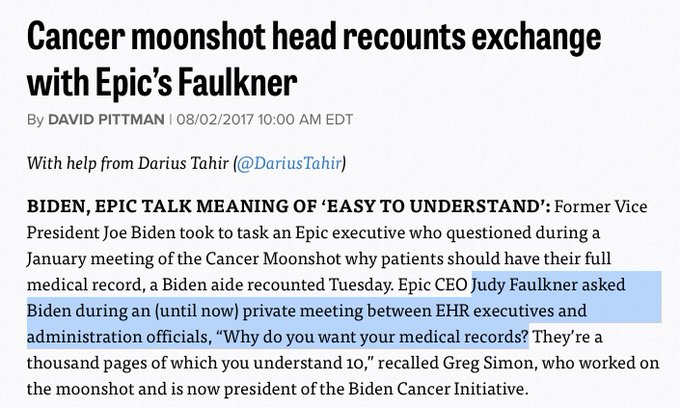
Editor’s Corner—Why the Biden-Faulkner exchange over EHR access touched a nerve

http://www.fiercehealthcare.com/ehr/editor-s-corner-why-biden-faulkner-exchange-over-ehr-access-touched-a-nerve?mkt_tok=eyJpIjoiTWpnMFlUY3dNREExTUdReSIsInQiOiJ4WGdTalwvWk9ZTVFSaXQ0Y2R4OEVqUHFBWFE5NllQc2xHVEl2Z2VYc1d0aTJwUnZwczE5Y1pNVGcxSGFIa2lhZFZaaVRHc0FhSGhwaVRiR3NuNWJRZDhFNW5COTAyRXpQODdJR2VIcDlHTHBcL0RDZ2ZFU2lCSWxyRWNKRTdEdXE3In0%3D&mrkid=959610&utm_medium=nl&utm_source=internal

Joe Biden

It’s hard to say exactly what transpired at that January meeting between then-Vice President Joe Biden and Epic CEO Judy Faulkner.

What we do know is that it triggered a visceral online reaction over the importance of interoperability and access to health data—and even some Twitter threads on the nuances of HIPAA. But that might be more telling about where the industry currently stands and the direction it’s quickly heading.

It began last week when Politico recounted the exchange between Biden and Faulkner as told by the vice president’s aide Greg Simon, who now serves as president of the Biden Cancer Initiative. The short version: Faulkner reportedly asked Biden why he wanted 1,000 pages of medical records to which Biden retorted, “None of your business.”

“It went downhill from there,” Simon said.

The story developed more on Monday, when former White House Chief Technology Officer Aneesh Chopra told CNBC the meeting was cordial and there “was a motivation and desire to work together to improve data access.” An Epic spokesperson told Health IT News that the company “supports patients’ rights to access their entire record,” adding that Biden was “consistently polite and positive” during the meeting.

By then, Twitter had worked itself into a full lather. Many were particularly incensed at Faulkner’s insinuation that that length and complexity of a medical record somehow rendered it useless to patients.

The reactions to Biden’s exchange with Faulkner may say more about the state of health IT than the interaction itself that was either contentious or cordial, depending on who you ask. There’s still a lot of frustration over the amount of money invested in EHR adoption and the fact that interoperability is still a challenging task.

At the same time, the vast majority of the industry is embracing the concept of replacing medical paternalism with patient-centered care, and more healthcare consumers are recognizing the benefits of having all of your health information at your fingertips.

In other words, demand is growing, but healthcare is still short on supply. That might explain the visceral reactions.

This week, Chilmark Research analyst Brian Eastwood argued that the debate over patient access to data revolves more around culture than software, and that’s probably true. Embracing the idea that patients should be able to access their medical record is a basic hurdle before anyone can tackle the technology that can make that happen.

But the heated debate that followed shows how much people across the healthcare industry see this as a core priority. It may not have infiltrated every corner of the ecosystem, but it touched a nerve that was far more basic than the technical minutia of interoperability or data standardization. It’s clear that the broader notion that patient records aren’t just the property of the health system—or even the software vendor—is carving out a substantial role in healthcare’s ongoing transformation. Any insinuation to the contrary is seen as shortsighted.

Clearly, it’s not ubiquitous yet, but there’s a strong undercurrent pushing the industry beyond the question of why patients might want their data and into the how. Perhaps that’s a small measure of progress. – Evan | @DB_Sweeney@FierceHealthIT

Dynamics of Decline: The Truth About HMOs

http://www.chcf.org/articles/2016/11/dynamics-decline-truth-hmos

California Commercial HMO Enrollment, Kaiser Foundation Health Plan ("Kaiser") vs. Non-Kaiser, 2004-2015

California’s commercial health maintenance organization population shrank from 11.9 million to 9.8 million enrollees between 2004 and 2015 (see figure below), a 17.5% decline. But the decline has not been consistent across all HMOs — Kaiser’s commercial enrollment has actually grown during this period.

Two new publications from CHCF take a closer look at how commercial managed care enrollment (including individual enrollment) and the public sector’s embrace of managed care are shifting the way physician organizations are paid — important trends that could affect California’s delivery system.

The first report, As Commercial Capitation Sinks, Can California’s Physician Organizations Stay Afloat?, by Laura Tollen uses quantitative data and findings from stakeholder interviews to shed light on the extent to which commercial capitation is losing ground in California.

A companion set of charts and graphics compiled by Katherine Wilson provides additional detail on health plan enrollment and changes in HMO participation over the past decade.

It is important to look separately at Kaiser and non-Kaiser enrollment. Kaiser is characterized by a mutually exclusive relationship between the health plan (Kaiser Foundation Health Plan) and its two associated Permanente Medical Groups in Northern and Southern California. While Kaiser is by far the largest HMO in California, the health plan offers capitated contracts only to these two medical groups.

Kaiser HMO enrollment increased from 5.6 million to 6.1 million in the last decade, while commercial HMO enrollment for all non-Kaiser plans plummeted, from 6.3 million in 2004 to the current 3.6 million — a loss of more than 40%.

Uncertain Future

The impact of these trends on the state’s non-Permanente physician organizations is uncertain. While declining commercial capitation has not yet had a big effect on their operations, medical group leaders suspect it will soon, according to interviews. The change in commercial payment methods has been slow enough that their organizations have been able to adapt, repurposing some of their HMO-based infrastructure (utilization management tools, for example) for value-oriented payment programs that are FFS-based, such as private accountable care organizations (ACOs).

Among the other findings from the interviews were:

  • Declining capitation and rising fee-for-service will not influence individual physicians’ clinical decisions. All interviewees noted that their organizations’ strong culture of providing high-value care would prevent them from fundamentally changing the way they practice, regardless of payment type.
  • Despite commercial trends, capitation from Medicare Advantage and Medi-Cal managed care plans is on the rise. However, neither of these types of capitation is seen as a substitute for commercial capitation in terms of supporting infrastructure. While the perception is that Medicare Advantage capitation rates are generous, there is also recognition that these patients are costly. Interviewees said Medi-Cal capitation rates are inadequate.
  • Along with the decline in commercial capitation, interviewees expressed alarm at the large increases they observed in patient cost-sharing requirements. All said they fear that patients will not obtain the care recommended by their providers because of high out-of-pocket costs, and some said they already see this happen frequently.

Why This Matters

As more employers shift coverage from HMOs to preferred provider organizations (PPOs) and other non-capitated plans to achieve lower premium rates, they are sacrificing quality and financial protection for employees in exchange for short-term premium savings.

A recent CHCF blog post by Jeff Rideout of the Integrated Healthcare Association highlights the patterns of higher quality / lower cost that distinguish HMO plans in the state (compared to PPOs and other plan types). Large multispecialty physician organizations, which have flourished in California, have a long history and significant expertise in managing risk and coordinating care. These are the very skills that health care purchasers demand from value-based payment programs. Without sufficient infrastructure — which is supported by capitation/prepayment — the foundation of high-value care could crumble.

Given these trends, are employers being penny-wise but pound-foolish in pursuing short-term savings at the expense of longer-term value?


In California, What’s Driving the Variation in Total Cost of Care — Volume or Price?

http://www.chcf.org/articles/2017/02/variation-total-cost-care

Linking Hospital Utilization and Total Cost of Care for Commercially Insured Californians, by Product Type, 2013

As the “repeal and replace” debate continues in Washington over the future of the Affordable Care Act, policymakers considering new legislation should not lose sight of the key concept of the ACA — affordability. High and rising costs are among the most intractable health care issues facing consumers across California and the nation, and any discussion must keep underlying cost drivers at the forefront.

But where should the focus be? At the most elementary level, total health care spending boils down to two main factors: how much care we use (volume, or utilization) and what we pay for that care (price). Teasing out how each factor — utilization or price — contributes to costs is important because cost-control solutions vary depending on the answer.

Across 19 regions in California, the annual risk-adjusted, per capita total cost of care for commercially insured people varies dramatically — from an average high of $5,400 in San Francisco to a low of $3,600 in Kern County, according to 2013 data in the California Regional Health Care Cost & Quality Atlas, a web-based interactive tool produced by the Integrated Healthcare Association (IHA) to monitor cost and quality trends across the state.

Adjusted to reflect differences in population health status, the atlas shows a clear geographic cost pattern. All Northern California regions have higher costs than the statewide average of $4,300, all Southern California regions have lower costs than the state average, and Central California regions have mixed costs.

Three Key Measures

What is driving these differences? Is it variation in per capita utilization, or is it price? While the atlas does not have unit price information, it does include three important hospital utilization measures: emergency department (ED) visits, all-cause readmissions, and inpatient bed days. This allows for basic comparisons of total cost per enrollee vs. three critical measures of utilization. If hospital utilization were driving the overall cost of care, there would be a positive correlation between the cost and utilization measures. However, an analysis of atlas information actually shows the opposite. When considering all commercial health maintenance organization (HMO) and preferred provider organization (PPO) products and regions, cost and volume tend to move moderately in opposite directions.

The quadrant chart below illustrates the relationship between total cost of care and hospital utilization, based on a composite score representing the three utilization metrics. Each orange circle represents a region’s PPO products, and each blue triangle represents a region’s HMO products. With the exception of one outlier region, the data show a moderate negative correlation between hospital utilization and cost. In other words, lower hospital utilization is associated with higher total costs of care.

In the atlas data, total cost of care includes both what the enrollee pays — for example, deductibles and coinsurance — as well as the insurance payments that go to providers. That means cost variation can’t be explained by differences in benefit design among commercial products. Because higher total costs are not driven by greater hospital utilization, and not accounted for by benefit design differences, price seems to be playing a strong role.

There is also an alternative but less likely explanation. Because the atlas only looks at hospital utilization, it’s possible that the total cost of care could be driven by nonhospital utilization as much as the price of care. But because hospital utilization accounts for almost one-third of overall spending on average, it is unlikely that utilization of other services, such as physician and other ambulatory care, has as great an impact on cost variation.

Much of the focus to date on making health care more affordable has involved transferring more financial responsibility to individual patients, the idea being that if consumers have “skin in the game” they will be more discriminating in their care purchases. But if the cost problem is primarily driven by price, which is related to market forces prevalent in a geographic region, is shopping really the solution?

The next version of the atlas, scheduled for release in 2017, will include additional utilization measures and cost information. These will offer a clearer picture of the roles of utilization and price in determining health care costs for commercially insured Californians. Until then the atlas findings stress the need for a better understanding of how pricing differences contribute to total cost variation and encourage us to search for more effective strategies to influence prices as well as utilization.

UCSF, Dignity to expand Bay Area accountable care network

http://www.sfchronicle.com/business/article/UCSF-Dignity-to-expand-Bay-Area-accountable-care-11740465.php

St. Mary's Medical Center in San Francisco, Ca., on Mon. August 7, 2017. UCSF will be taking its resources and bringing it over to Dignity. Photo: Michael Macor, The Chronicle

Canopy Health, the Bay Area accountable care organization co-founded by UCSF in 2015, is adding three Dignity Health hospitals to its growing list of in-network providers.

With the new Dignity additions — St. Mary’s Medical Center and St. Francis Memorial Hospital in San Francisco, and Sequoia Hospital in Redwood City — the Canopy network will have 4,000 physicians, 16 hospitals and about 15,000 patients, or “members.”

This means that any Dignity patient who gets insurance through Health Net Blue & Gold HMO — the approved insurance plan for the Canopy network — will have access to UCSF doctors, and vice versa.

The Canopy network currently has health providers in six Bay Area counties and intends to be in all nine in the next two years. It plans to add a second insurance provider, Western Health Advantage, in January 2018. That is expected to expand the network to 200,000 members.

Accountable care organizations are groups of hospitals and doctors that coordinate patient care and assume shared financial responsibility for that care. They essentially join many independent doctor’s offices and hospital systems as part of one large network that can more easily share records, among other benefits. The model has been on the rise since the Affordable Care Act enacted new payment incentives, rewarding providers for improving overall quality of patient care rather than what’s known as “fee for service” — paying providers for each service they order for patients.

“We all realize the days of fee for service are over,” said Dr. Todd Strumwasser, senior vice president of operations for Dignity Health Bay Area. “We’re going to be paid for providing value, which means keeping a population healthy. To do that, you have to partner with the right groups to take care of entire populations.”

The expansion of the Canopy network is part of a broader push by providers to better compete with Kaiser Permanente and Sutter Health, the two dominant health systems in the Bay Area. Kaiser, an integrated network, has about 4 million members in Northern California. Sutter and its affiliates have about 3 million Northern California patients, and recently started introducing insurance products. Canopy is far smaller.

Nationally and in California, independent providers are moving toward the integrated Kaiser model, said Dan Mendelson of the health care consulting firm Avalere Health.

“The Bay Area market is much more evolved than most areas of the country,” Mendelson said. “The strong presence of Kaiser, where you have close integration between provider and payer, means that the physicians practicing in the Bay Area are probably more accustomed to the concept of taking accountability for quality.”

St. Mary’s Medical Center in San Francisco, Ca., on Mon. August 7, 2017. UCSF will be taking its resources and bringing it over to Dignity.

Shelby Decosta, senior vice president of UCSF Health, said Canopy’s model is distinct because, unlike Kaiser and Sutter, it is a network of independent providers.

As part of the agreement, UCSF doctors will work to bring some of the health system’s programs and practices — including robotic surgery, acute rehabilitation, vascular podiatry and cardiology — to Dignity hospitals.

Formerly called the Bay Area Accountable Care Network, Canopy Health was co-founded in 2015 by UCSF and John Muir Health, which operates hospitals in Contra Costa, Alameda and Solano counties.

The 16 hospitals that are now part of Canopy are: Alameda Hospital, Highland Hospital, John Muir Medical Centers in Concord and Walnut Creek, Marin General Hospital, San Leandro Hospital, San Ramon Regional Medical Center, Sequoia Hospital, Sonoma Valley Hospital, St. Francis Memorial Hospital, St. Mary’s Medical Center, UCSF Benioff Children’s Hospitals in San Francisco and Oakland, UCSF Medical Center at Mission Bay, UCSF Medical Center at Parnassus and Washington Hospital. The network also includes three medical groups: Meritage Medical Network, Hill Physicians and Muir Medical Group IPA.

Hospital Rankings by Specialty

http://health.usnews.com/best-hospitals/rankings

Image result for hospital honor roll 2017-18

The top three hospitals in each of 16 specialties are listed below. For a list of the best hospitals overall, see the ones that made our 2017-18 Honor Roll.


2017-18 Best Hospitals Honor Roll and Overview

http://health.usnews.com/health-care/best-hospitals/articles/best-hospitals-honor-roll-and-overview

Image result for hospital honor roll 2017-18

U.S. News ranks the top 20 hospitals in the nation, plus the best hospitals in each state and metro area.

Somewhere in America, at a pace of about once per second, a patient checks into a hospital. With more than 33 million hospitalizations a year and so many patients on whom to sharpen their skills, hospitals could be expected to meet the most demanding standards for quality and safety.

Yet too many hospitals fail even those whose medical needs are relatively straightforward – such as hip replacement, uncomplicated heart bypass surgery or removal of a cancerous section of colon. The hospital that makes treating patients like these its bread and butter is the very definition of a community hospital, and it should perform at a high standard.

Even fewer hospitals excel at caring for patients with especially challenging or complex diagnoses, for whom the stakes may be a matter of life or death. For those patients, venturing beyond a trusted community hospital to seek care at a truly exceptional medical center, even one farther from home, may be the wisest option.

To help readers narrow their search for hospitals that best match their needs, U.S. News ranks hospital performance in 16 areas of complex specialty care and also rates hospitals in nine bellwether procedures and conditions such as heart bypass, hip and knee replacement, heart failure and lung cancer surgery.

The Best Hospitals Honor Roll takes both the specialty rankings and the procedure and condition ratings into account. Hospitals received points if they were nationally ranked in one of the 16 specialties – the more specialties and the higher their rank, the more points they got – and also if they were rated “high performing”in the nine procedures and conditions. The top 20 point-getters made up the Honor Roll, which has a maximum total of 480 points.


CMS Finalizes 2018 Meaningful Use Requirement Flexibilities

https://ehrintelligence.com/news/cms-finalizes-2018-meaningful-use-requirement-flexibilities?elqTrackId=8c2c1a1e8db84c7ca8e1b67ce5b14336&elq=2d2e530ff2ce491481cadbe37c8b232e&elqaid=3157&elqat=1&elqCampaignId=2929

CMS revises 2018 meaningful use requirements

Revisions include a 90-day reporting period, exceptions for decertified EHR technology, and acceptable versions of certified EHR technology.

As part of a final rule for hospital inpatient reimbursement for 2018, CMS has also finalized a host of revision to the meaningful use requirements for eligible providers participating in the EHR Incentive Programs next year.

Chief among the revisions is the reduction of the EHR reporting period next year to 90 days for “new and returning participants attesting to CMS or their Stage Medicaid agency,” states the final rule to be published on August 14. The revised reporting period must comprise a continuous 90 days between Jan. 1, 2018 and Dec. 31, 2018.

According to the final rule, the motivation for finalizing revisions to meaningful use requirements in 2018 is “to continue advanced of certified EHR technology utilization, focusing on interoperability and data sharing.”

Many of the other finalized changes owe much to mandates included in the 21st Century Cures Act, such as an exception for Medicare payments adjustments for eligible professionals and hospitals affected by EHR decertification. For those providers unable to satisfy meaningful use requirements because their certified EHR technology is now or becomes decertify, they will be able to avoid meaningful use penalties (but also miss out on EHR incentives). EPs will have until Oct. 1, 2017 to submit their applications; hospitals, July 1, 2017 — barring further changes made by CMS.

Additionally, EPs who provide “substantially all” of their services in ambulatory surgical centers (ASC) will avoid Medicare payment adjustments in 2017 and 2018:

We proposed to define an ASC-based EP under § 495.4 as an EP who furnishes 75 percent or more (or alternatively, 90 percent or more) of his or her covered professional services in sites of service identified by the codes used in the HIPAA standard transaction as an ASC setting in the calendar year that is two years before the payment adjustment year. In addition, we proposed to use Place of Service (POS) Code 24 to identify services furnished in an ASC and requested public comment on whether other POS codes or mechanisms should be used to identify sites of service in addition to or in lieu of POS code 24. For the reasons discussed in section IX.G.4. of the preamble of this final rule, we are finalizing the definition of an ASC-based EP as an EP who furnishes 75 percent or more of his or her covered professional services in sites of service identified by POS 24.

As for the type of CEHRT required for meaningful use attestation, CMS has finalized a policy that allows eligible professionals to use 2014 Edition, 2015 Edition, of a combination of the two for the purposes of EHR reporting in 2018.

That being said, the federal agency determined that calls to revise meaningful use objectives and measures, meaningful use audits, the Merit-Based Incentive Payment System (MIPS), and CEHRT grant funding were beyond the scope of the final rule and therefore not met.

The federal agency faced considerable pushback from industry groups advocating for significant change to the EHR Incentive Programs. Last month, the American Hospital Association (AHA) called for the cancellation of Stage 3 Meaningful Use, which is set to begin in 2018. The association claimed that the phase’s meaningful use requirements were overly burdensome.

“These excessive requirements are set to become even more onerous when Stage 3 begins in 2018,” AHA stated in a letter to CMS. “They also will raise costs by forcing hospitals to spend large sums upgrading their EHRs solely for the purpose of meeting regulatory requirements.

Based on this final rule, the EHR Incentive Programs will carry on as planned.

Most Significant Epic, Cerner Health IT Achievements of 2017

https://ehrintelligence.com/news/most-significant-epic-cerner-health-it-achievements-of-2017?elqTrackId=4b11abd211d24c9f83ccaccd2971835c&elq=2d2e530ff2ce491481cadbe37c8b232e&elqaid=3157&elqat=1&elqCampaignId=2929

Epic EHR, Cerner EHR


Epic and Cerner continue to dominate the healthcare industry and this year the two health IT companies have made key additions to their portfolios.

Epic Systems and Cerner Corporation solidified their status as top dogs in the health IT industry in 2017.

Both health IT companies scored massive contracts this year, with Epic continuing to gain popularity among the private sector and Cerner expanding its presence in the public sphere.

Cerner and Epic have also found success expanding their health IT offerings into other areas of care management, including population health and revenue cycle management. The companies have proven their ability to stay ahead of the curve by continuing to add more products and technologies to their arsenal in keeping with developments in the industry.

Over midway through 2017, here are a few of the most significant achievements of the year by the biggest players in health IT: