

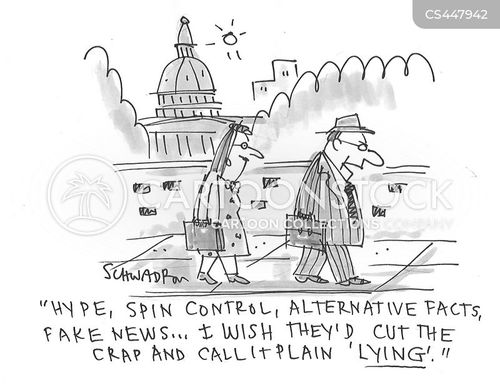
Cartoon – Spin Control
Spin Belongs in The Gym, Not The Workplace – 4 Ways to Increase Transparency

I have a motto when it comes to honesty and transparency at work: Spin belongs in the gym, not the workplace.
Spinning the truth is a way of shaping our communications to make our self, the company, or the situation appear better than it is in reality. It’s become so commonplace in the corporate world that many times we don’t even realize we’re doing it. We “spin” by selectively sharing the facts, overemphasizing the positive, minimizing the negative, or avoiding the obvious, all in an attempt to manipulate the perception of others. See if a few of these spins on the truth sound familiar:
Spinning the truth is one of the most common ways leaders bust trust. It also leads to tremendous inefficiencies because people are confused about roles, they duplicate work, balls get dropped, and people resort to blaming others. Poor morale, cynicism, and political infighting become the norm when honesty and transparency are disregarded.
There are macro-level societal events and trends driving the need for greater transparency in the workplace. We’re all familiar with the digital privacy concerns related to the pervasiveness of technology in our lives, and we’ve witnessed the corporate scandals of blatant deceit and dishonesty that’s contributed to record low levels of trust. The global meltdown of trust in business, government, and other institutions over the last several years has generated cries for more transparency in communications, legislation, and governance. Oddly enough, research has shown that in our attempts to be more transparent, we may actually be suffering an illusion of transparency—the belief that people are perceiving and understanding our motivations, intents, and communications more than they actually are.
But at the individual, team, and organization levels, what can we do to build greater trust, honesty, and transparency? I have four suggestions:
Spin is a great activity for the gym and it keeps you in fantastic shape. However, in the workplace, spin is deadly to your health as a leader. It leads to low trust, poor morale, and cynicism in your team. Keep spin in the gym and out of the workplace.

Leadership changes are more common and important than ever. But most companies don’t get it right.
Every leadership transition creates uncertainty. Will the new leader uncover and seize opportunities and assemble the right team? Will the changes be sustainable? Will a worthy successor be developed? These questions boil down to one: Will the leader be successful?
Hardly anything that happens at a company is more important than a high-level executive transition. By the nature of the role, a new senior leader’s action or inaction will significantly influence the course of the business, for better or for worse. Yet in spite of these high stakes, leaders are typically underprepared for—and undersupported during—the transition to new roles.
Executive transitions are typically high-stakes, high-tension events: when asked to rank life’s challenges in order of difficulty, the top one is “making a transition at work”—ahead of bereavement, divorce, and health issues.2 If the transition succeeds, the leader’s company will probably be successful; nine out of ten teams whose leader had a successful transition go on to meet their three-year performance goals (Exhibit 1). Moreover, the attrition risk for such teams is 13 percent lower, their level of discretionary effort is 2 percent higher, and they generate 5 percent more revenue and profit than average. But when leaders struggle through a transition, the performance of their direct reports is 15 percent lower than it would be with high-performing leaders. The direct reports are also 20 percent more likely to be disengaged or to leave the organization.
Successful or not, transitions have direct expenses—typically, for advertising, searches, relocation, sign-on bonuses, referral awards, and the overhead of HR professionals and other leaders involved in the process. For senior-executive roles, these outlays have been estimated at 213 percent of the annual salary.4Yet perhaps the most significant cost is losing six, 12, or 18 months while the competition races ahead.
Studies show that two years after executive transitions, anywhere between 27 and 46 percent of them are regarded as failures or disappointments.5Leaders rank organizational politics as the main challenge: 68 percent of transitions founder on issues related to politics, culture, and people, and 67 percent of leaders wish they had moved faster to change the culture. These matters aren’t problems only for leaders who come in from the outside: 79 percent of external and 69 percent of internal hires report that implementing culture change is difficult. Bear in mind that these are senior leaders who demonstrated success and showed intelligence, initiative, and results in their previous roles. It would seem that Marshall Goldsmith’s advice—“What got you here won’t get you there”6—is fully applicable to executive transitions.
The pace and magnitude of change are constantly rising in the business world, so it is no surprise that senior-executive transitions are increasingly common: CEO turnover rates have shot up from 11.6 percent in 2010 to 16.6 percent in 2015.7Since 69 percent of new CEOs reshuffle their management teams within the first two years, transitions then cascade through the senior ranks. Sixty-seven percent of leaders report that their organizations now experience “some or many more” transitions than they did in the previous year.

In this special Speaker Series, Becker’s Healthcare caught up with Mark R. Anderson, CEO of AC Group, a healthcare technology and advisory research firm based in Montgomery, Texas.
Mr. Anderson will speak on a panel at Becker’s Hospital Review 7th Annual CEO + CFO Roundtable titled “The CEO paradox: Can you really have volume and value?” at 12:00 p.m. on Monday, Nov. 12. Learn more about the event and register to attend in Chicago.
Question: What keeps you excited and motivated to come to work each day?
Mark Anderson: The knowledge that we are finally moving away from fee-for-service billing to value-based reimbursement. For example, at AC Group, we have been able to cut medical costs for diabetic patients by 38 percent just by tracking blood sugar levels at home. Pay for results — don’t pay for just seeing the patient.
Q: What major challenges, financial or otherwise, are affecting hospitals in the markets you serve? How is your hospital responding?
MA: With hospital bankruptcies on the rise, we need to change how we deliver cost effective care and how we are paid. Because of high deductible health plans, the patient portion of the bill has increased from 9.4 percent in 2019 to 26.9 percent in 2017. How do we collect from the patient? How can we share clinical information about the patient with all providers without hurting our financial position?
Q: What initially piqued your interest in healthcare?
MA: It was my high school graduation present from my father. I wanted a trip to Hawaii and all I got was a letter stating, “Congratulations for finishing in the top 4 percent of your high school class. For your reward, you start work on Monday as the statistician for the hospital CEO.” Forty-five years and 250 hospitals later, I am still in hospital executive management.
Q: What is one of the most interesting healthcare industry changes you’ve observed in recent years?
MA: To name a few: Moving to electronic billing in 1985, moving from spending 2.1 percent on IT in 2005 to over 6.5 percent today (was it worth it?), forcing physicians to become data entry clerks so we can maximize coding with very little improvement in “health,” and moving to value-based reimbursement from fee-for-service so we are finally paid on quality, outcomes and our ability to lower costs through care coordination and remote patient monitoring. The four walls of the hospital are not the only care delivery system. Ninety-five percent of healthcare is delivered in the home.
Q: What is one piece of professional advice you would give to your younger self?
MA: Don’t enter the healthcare market without a strong financial knowledge base. Healthcare is a business. As the nuns told me back in 1976, no profit — no mission to help the poor and disadvantaged.


When providers identify a potential M&A candidate and perform due diligence, there are no guarantees that a formal agreement will be concluded. In fact, there are a number of financial and operational ways that a potential deal can be derailed.
According to the 2018 HealthLeaders Media Mergers, Acquisitions, and Partnerships Survey, respondents report that the top three financial reasons an M&A involving their organization was abandoned before or during the due diligence phase are concerns about assumption of liabilities (21%), costs to support the transaction were too high (19%), and concerns about price (19%).
Note that the full extent of a prospective organization’s financial liabilities may not be apparent until the due diligence phase is completed, which may explain why this aspect plays a major role as a deal breaker.
Operational challenges
Respondents say that the top three operational reasons that an M&A involving their organization was abandoned before or during the due diligence phase are incompatible cultures (30%), concerns about governance (24%), and concerns about the operational transition plan (21%).
Interestingly, based on net patient revenue, a greater share of large organizations (47%) than small (25%) and medium (17%) organizations mention incompatible cultures, an indication of some of the challenges providers face when integrating large organizations with disparate cultures.
Pamela Stoyanoff, MBA, CPA, FACHE, executive vice president, chief operating officer at Methodist Health System, a Dallas-based nonprofit integrated healthcare network with 10 hospitals and 28 family health centers, says that organizational culture exists both at the senior leadership level as well as throughout an organization, and problems can arise because sometimes they can be different.
“You have two senior leadership teams sitting in a room trying to agree on deal points and reach a philosophical agreement. Oftentimes, you have cultural compatibility at the senior level (those who are consummating the deal) but find that culture throughout the remaining levels of the organization is not as conducive to a merger. That is something you don’t necessarily see until later, after the deal is done,” she says.

 HENRY KOTULA