UNC Health Care, Atrium execs reportedly frustrated by issue of control over merged entity

https://www.beckershospitalreview.com/hospital-transactions-and-valuation/unc-health-care-atrium-execs-reportedly-frustrated-by-issue-of-control-over-merged-entity.html

Image result for who's driving the bus


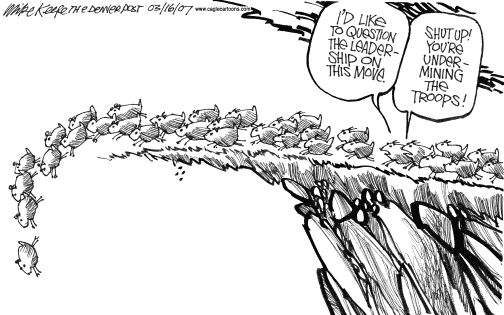
Executives at Chapel Hill, N.C.-based UNC Health Care and Charlotte, N.C.-based Atrium Health have reportedly addressed a number of shared concerns regarding their proposed merger. However, the issue of control over the merged organization has yet to be decided — a decision that will have ramifications for both institutions, according to The News & Observer.

William L. Roper, MD, CEO of UNC Health Care and dean of the UNC School of Medicine, provided an update about the organizations’ negotiations Feb. 20 following a closed-door session with a special committee of the UNC System’s board of directors earlier that same day.

“I had a lengthy conversation with our Charlotte friends this morning, and I think we are making some progress in narrowing the differences but we have not yet reached agreement,” Dr. Roper told The News & Observer. “Both sides are interested in the key questions of who’s in charge, how are decisions going to be made, how can we balance the interests so that both sides feel fairly represented in the decision-making process. Those are the big questions and we’re still working on them.”

The decision of who maintains control over the merged entity, which would comprise 60 hospitals and at least 90,000 employees, would have significant effects on UNC’s medical research and the UNC School of Medicine, a state-owned entity belonging to the UNC System.

The organizations entered into negotiations regarding a potential merger last August. At that time, officials selected Atrium Health CEO Gene Woods to serve as CEO and Dr. Roper as chair of the combined system’s board of directors. Dr. Roper said Feb. 20 that following the completion of his term as chairman, Atrium Health’s board chairman would assume the role. After that, UNC Health Care and Atrium Health would alternate appointing leaders to the role.

Dr. Roper’s update comes after multiple organizations, including the state’s largest insurer, Blue Cross Blue Shield of North Carolina, said they could not support the proposed merger. North Carolina Attorney General Josh Stein wrote a letter Feb. 15 to the chief executives of both health systems demanding additional information regarding the proposed deal, stating the systems had not provided enough information about how the transaction would affect healthcare costs for consumers.

Dr. Roper’s announcement Tuesday also reportedly did not satisfy concerns voiced by North Carolina Treasurer Dale Folwell, who last week called on UNC Health Care to issue a $1 billion performance bond to guarantee cost savings from the proposed deal.

Mr. Folwell said Tuesday Dr. Roper’s update did not provide assurance healthcare costs would decrease and that the update underscores the huge stakes involved in the negotiations, according to the report.

CHI Health CEO Dr. Cliff Robertson on the greatest misconception about CEOs

https://www.beckershospitalreview.com/hospital-management-administration/chi-health-ceo-dr-cliff-robertson-on-the-greatest-misconception-about-ceos.html

Image result for dr cliff robertson

Cliff Robertson, MD, is senior vice president of divisional operations at Englewood, Colo.-based CHI and CEO of CHI Health, the system’s Nebraska/Southwest Iowa Division.

As CEO of CHI Health, he oversees 14 hospitals, 136 clinical locations and over 12,500 employees. Prior to joining the system in 2014, Dr. Robertson simultaneously served as interim CEO of Houston-based St. Luke’s Health System and COO of CHI Franciscan Health in Tacoma, Wash.

Dr. Robertson took the time to answer three key leadership questions from Becker’s.

Editor’s note: Responses have been lightly edited for length and style.

Question: Is it important for CEOs to have a public presence?

Cliff Robertson: A public presence is critically important for a CEO; in fact it was one of the biggest changes I experienced when I transitioned from COO to CEO.

I believe a CEO has an obligation to dedicate time toward community engagement because that leads to a public presence for the organization. I actively participate in the local Chamber of Commerce, am willing to meet with media to discuss the issues of the day and specifically meet with business leaders. These gatherings are not only “meet and greets,” but they give me an opportunity to share information about our organization’s strategic direction and initiatives. I also make a point of communicating with community stakeholders directly through monthly updates and video blogs. All of these efforts can be valuable and are designed to create a more public presence for CHI Health.

Q: What is the biggest challenge you face right now as a CEO?

CR: The biggest challenge all CEOs face is explaining the “why” to front-line staff and clinicians. The considerable changes taking place in healthcare today and accompanying disruption create doubt about the future and anxiety for all of us in healthcare.

I focus on helping our team understand “what” is changing and then the “why” behind the decisions we make as an organization. I learned a while ago the best thing I can do as CEO is help our team understand where we are going and at the same time answer their question of, “What does this change mean for me?”

Q: What is the greatest misconception people have about being a CEO?

CR: I think some folks assume I make decisions all the time. I actually believe in the wisdom of groups. That includes having our front-line staff involved in deciding how best to resolve our organizational problems. I see my role as a facilitator of groups that have to “get their hands dirty” as they help us solve the many challenges we face.

George Washington on Leadership & Vision

https://www.c-span.org/video/?403436-1/george-washingtons-journey

Image result for george washington's journey

An exciting introduction to a George Washington we rarely see, a president who strategically traveled to all thirteen states and transformed American political culture. “Breen’s clearly written account of these sojourns give readers a fresh understanding of the president’s personality, his public and private lives, and the political and social climate of the time” (Library Journal).

During his first term as President, George Washington made arduous journeys to each of the thirteen new states. He understood that Americans did not yet feel part of a nation, and that he alone could bring them to that conviction. For Washington, the stakes were high. In scores of communities, he communicated a powerful and enduring message—that America was now a nation, not a loose collection of states. And the people responded to his invitation in ways that he could never have predicted.

In George Washington’s Journey, T.H. Breen introduces us to a George Washington we rarely meet. By nature shy and reserved, the brand new president decided that he would visit the new citizens in their own states, that only by showing himself could he make them feel part of a new nation. He displayed himself as victorious general (he wore his regal uniform and rode his white stallion) and as President (grand dinners, military parades, arcs of triumph, and fancy balls). He travelled by open carriage on terrible roads, in awful weather, staying and eating at lousy inns.

Breen takes us on Washington’s journeys. We see the country through his eyes and listen through his ears. Washington drew on his immense popularity, even hero worship, to send a powerful and lasting message—that America was now a nation, not a collection of states. In George Washington’s Journey, we come to understand why the first president is the indispensable Founding Father.


Rise of the Permanent Interim Executive

https://www.linkedin.com/pulse/rise-permanent-interim-executive-zachary-n-besheer-mha-fache/

ZACHARY N. BESHEER, MANAGING DIRECTOR  - Integrated Healthcare Strategies

You have a dilemma: your big, mission-critical project needs full-time, executive-level leadership for the next year. You cannot spare anyone from your current executive team, and no one in the leadership pipeline has the proven skills needed for the job. You don’t want to hire someone new, because you don’t expect to have an opening for the new hire a year from now.

Situations like this occur every day throughout the healthcare industry, and increasingly, hospitals and health systems are turning to interim executives to fill this need. With market demand growing, more and more experienced executives are opting to become permanent interims.

Isn’t permanent interim an oxymoron?

Permanent interim executives are highly-skilled leaders who have a burning desire to make sustainable change, produce quantifiable financial gains, and improve clinical outcomes – all on a temporary, full-time basis.

Executive positions are stressful jobs that demand an exceptional commitment of time and energy. People who hold these positions often dream of finding careers that are equally rewarding, but allow for a different work-life balance. Today, some executives are finding that life as a permanent interim gives them an opportunity to use the skills gained over a career, while exercising more control over when and where they work.

Permanent interims are often retired, or approaching retirement, but not ready to quit working altogether. They are typically over-qualified for the temporary jobs they fill, so they are able to step into a role and make an impact from day one. They are usually self-employed, providing for their own health insurance and pension benefits. Most all reputable interim executives work through firms such as Integrated Healthcare Strategies (Gallagher Integrated), a division of Gallagher Benefit Services, Inc.

In Peter Drucker’s book, Managing in the Next Society, he wrote, “One prediction I’ve heard is that in a few years the people who are not employees of the organization for which they work will greatly exceed the number who are.” Hospitals subcontract for housekeeping services with outside firms who pay the cleaning staff. They contract with physician groups to staff the emergency department. They occasionally hire clerical employees through temp agencies to reduce a billing backlog. These are examples of the phenomenon Drucker was talking about, but they are hardly the only ones.

MBO Partners, a firm offering operating infrastructure for independent workers, reports that in 2015, 2.9 million American workers earned $100,000 or more as full-time interims. Drucker called contract work at the upper level “intellectual capital on demand.” Gallagher Integrated fields many requests for people with executive experience to fill jobs that are not expected to be permanent. These projects are most often related to a key leadership vacancy or a major project that needs additional attention. One frequent request we receive is for an interim chief financial officer. We also field calls for an interim chief nursing officer or nursing director. We place interim chief human resources officers and CEOs in interim positions as well.

Why not consider hiring a recently retired CFO with merger experience as an interim executive to manage the financial side of your next major acquisition? Why not hire a seasoned HR officer as an interim executive to assist your hospital with a major reorganization? Why not look for the best available leader for your project, instead of assigning it to someone who is merely adequate to the task? Doesn’t the availability of well-qualified executives willing work on an interim basis open up the possibility of obtaining better leadership for your organization?

Increasingly, we are living in an “on-demand” world, and our workplaces are reflecting the changes happening in society. Healthcare, with its breathtaking pace of change and exceptional pressures on costs, is an industry where interim executives can make a meaningful impact. Fortunately, there is a ready pool of highly qualified and experienced healthcare executives who have chosen careers as permanent interims.


Singleness of Purpose

http://www.engagingleader.com/el168-singleness-purpose/?utm_source=Engaging+Leader+and%2For+Aspendale+Communications+newsletters&utm_campaign=a3d874f27e-RSS_EL_NEWSLETTER_WEEKLY&utm_medium=email&utm_term=0_43e4506512-a3d874f27e-90181157

Success demands singleness of purpose.
~ Vince Lombardi, arguably the greatest football coach of all time

Extraordinarily successful people, companies, and teams always have one product/service/idea they’re most known for or that makes them the most money. They may have other important things too, but only one of them is the most important.

Having clarity on a single purpose — especially one that combines your top passion and skill — is the simplestand smartest thing you can do to propel yourself toward the success you want. This principle shows up consistently in the lives of successful people and companies because it’s a fundamental truth.

It is those who concentrate on but one thing at a time who advance in this world.
~ Og Mandino

Technological innovations, cultural shifts, and competitive forces often require that your ONE Thing evolve or transform. The most successful leaders and organizations are always asking, “What’s our ONE Thing?” If you don’t currently know what your ONE Thing is, then your ONE Thing is to find out. And as a leader, you need to engage your team to find out, get clear, and stay focused.In this episode, Jesse shares what he’s learned from chapter 3 of the book The ONE Thing and provides examples of applying the lessons.


Learn and apply these leadership traits in an afternoon

Learn and apply these leadership traits in an afternoon

7 Traits