


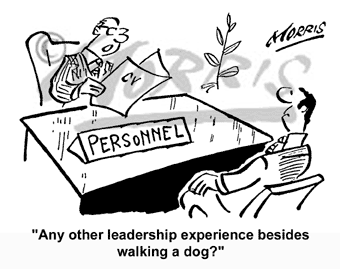
Cartoon – Importance of Focus
http://www.healthcaredive.com/news/wanted-leaders-for-tomorrows-emergency-room/448757/

A conversation with Bill Haylon, CEO of Leaders For Today
Economic anxieties need not correlate with a high unemployment rate. Take it from business leaders across multiple U.S. industries: Their biggest challenge is not a lack of job openings for thousands of qualified candidates — it’s a lack of candidates for thousands of openings.
HR professionals are used to hearing about skill shortages in manufacturingand other blue-collar work, but perhaps more understated are gaps in the STEM fields.
Careers in nursing and medicine, which often require years of additional, specialized education are hard to fill. Physician assistant openings were one of the most in-demand fields near the end of 2016, according to the American Staffing Association. But hospitals aren’t just struggling to find people to staff operating rooms. They face a much bigger challenge in a lack of leadership skills.
HR Dive/Healthcare Dive spoke with staffing firm Leaders For Today’s CEO Bill Haylon about the root of leadership gaps in healthcare, and how hospital HR departments can confront the problem. Our conversation has been lightly edited for length and clarity.
HR Dive: When hospitals come to a healthcare staffing firm like Leaders For Today, what are they asking for?
Bill Haylon: What we’re really doing is helping them find people who have particular sets of skills. We provide staffing on an interim basis. A hospital or healthcare system comes to us and says, “we really need somebody who can fix and lead our case management department,” “we need somebody who’s got certain technical skills and leadership skills.” We’re not actually training individuals, we’re finding people who fill those slots.
We’re going out and finding people, who they can either hire full time or on an interim basis. We’ll look for, on average, a little more than six spots, and we’ll start from a pool of people that we have that we’ve worked with before.
We’re not really doing training, but training is one of the problems in the healthcare world.
HR Dive: When you look for potential staffers, what kind of skills do they have? What stands out the most to the healthcare systems you work with?
Haylon: There are certain skills that go across all positions, and there are certain skills that are specific to a position because we can hire for. For example, we have a team that focuses on OR people, while others focus on case management, hospital finance, physician management, practice management, etc.
Across the board, what we focus on is, first and foremost, trying to find people who have been steady with or who have stayed with an organization for some period of time and developed within that. In other words, we try and stay away from what we call “jumpers” — people that have a job for a year, two years, and then try and go on their next role.
Unfortunately, that’s counter to what occurs in the industry. People in the hospital industry jump all the time.
We try and get some stability in their job, because we believe they learn more that way [when it comes to] both the technical skills and leadership skills. Of course, you look for the basic things: education, undergraduate work, master’s degree and other certifications.
You’re trying to vet the person along, so a lot of time you’re talking about different situations, different experiences, how they’ve handled them in the past or how they might handle them in the future. It could be a difficult position to deal with, a union situation, a quality situation, a safety situation. And you try to understand what their thought-making process is.
HR Dive: What skills are hardest to come by in the medical world, given that a lot of industries are seeing skills shortages?
Haylon: There’s an enormous shortage of talent within the hospital industry in all key levels. It was going on before Obamacare, and now with Obamacare and more people being covered, each organization is seeing a big uptick in the number of patients they see. It’s really gotten to be a very critical moment.
The most difficult job category is the O.R., the second hardest is case management and the third hardest is physician practice management.
From a skill set perspective, it’s leadership. Most of those in leadership positions are people who were nurses or doctors. When you go to school, you do not learn about financial statements, management skills or leadership. You’re learning how to suture, avoid infections and open up rib cages.
You take a person who has been a staff nurse for [a certain number] of years, and they decide they want to go into a leadership role. Because there’s a shortage of people, they are put in those spots well before they’re ready. They don’t have any training; hospitals do not train people for career development or leadership, and so you’re just kind of winging it. You get people who are very quickly over their head in their positions.
HR Dive: What can hospitals change about the way they operate to help develop those skills, or is that simply not possible given their bandwidth?
Haylon: They make it harder than it is. The reality is that hospitals consolidate, so they’re parts of bigger systems. You have a director in the O.R. who could be managing 440 people. That’s a lot of people. This was the case for one hospital we worked with, and the person running that OR had been a staff nurse and morphed to this role. But her [previous] role had been running a small hospital where she had 30 people, and now she’s up to 440 people, and it’s over her head.
So the reality is that they need to start thinking about different skill sets, and the obvious one is an MBA. When you’re the director of a 440-person O.R., you’re not seeing patients anymore. You’re doing hiring and scheduling. You’re developing quality programs and safety programs. You’re trying to get the surgeons on board. You’re never seeing a patient; that’s a different set of skills.
You don’t need to be clinical, you need to be a manager and a leader. It could be an MBA, it could be a master’s in health. But you need more than clinical training.
So what hospitals do [by recruiting for a certain skillset] is totally reactive as opposed to being proactive and developing people.
HR Dive: Do you see a shift in terms of the skills that physicians and other professionals are being taught in school?
Haylon: You’re being taught technical skills, clinical skills, whatever your specialty is. You go to medical school, do your residency, maybe followed by a fellowship, and it’s all technical skills. Physicians [are also] getting way more specialized than they used to be.
Typically the people who have jobs [in healthcare leadership] have gone and gotten additional training and education on their own.
Physicians and nurses are not trained in school to run big organizations. Plus, they’re doing research, and they’ve got to handle anybody that comes into the OR and the ER. It’s hard enough to get training for it, and it’s beyond belief if you don’t have training.
HR Dive: What else should hospital systems be mindful of when looking for leadership in the medical workforce?
Haylon: When you look at survey data from across the hospital industry, you see that people are staying in positions for incredibly short periods of time. Forty percent of people right now in key positions in hospitals have been in their position two years or less. Another 40% expect to leave in the next two years. What happens is that hospitals have a hole, and they need better leaders, so they poach from somebody else.
So the director of a surgical department will be a manager at a small hospital, then become a manager at a bigger hospital, then a manager at a bigger hospital, then a director at a small hospital, then a director at a bigger hospital, and finally a director at a bigger hospital. They just keep poaching from each other.
The problem is it’s the same people who are circling through. The people you’re hiring never had the time to put in place good, quality programs, [including] safety programs and productivity programs, because they’re not there long enough. They can’t make it stick in just two years; these are very complicated things.
And so that’s the result of what you’re talking about. The lack of training and development shows itself in this poaching and job hopping in the hospital world. It is like no industry you have ever seen before.
In other industries, an enormous amount of resources are put into training, so people stay in those industries and move up. You take up greater responsibilities, but they invest a lot in you as a developing person. The hospitals invest almost nothing. It’s up to the individual to go and figure it out on your own. Get your MBA, take this class, get a certification from the hospital association. But you’re not developing your own people.
Other organizations develop their own people because they want to be the best at what they do — they want to differentiate themselves. The only way they can do that is to develop their own people. Because hospitals don’t do that, there really is no differentiation, and hence, they struggle.
So this lack of training and the lack of development ends up creating an industry where everybody knows they’re going to jump all the time. You’ve got hospitals that have hired their sixth CEO in seven years. So the question is: If you’re a patient and you have knowledge of this, would you want to go to that hospital?
If you have that sort of instability at the top spot, then it’s going to trickle all the way down. Healthcare is complicated; it takes a while to figure out orders in place that are going to work. If they have quality problems, or safety problems, you can’t fix them that quickly. You’ve got to have someone who understands the lay of the land and can make a difference.


As a natural process of a ship being in the water for extended periods of time, barnacles and other marine life grow and attach themselves to the ship’s hull. If left unattended, the barnacles can increase drag up to 60%. This can decrease speed by 10% and result in the ship using 40% more fuel. In essence, the ship works harder, spends more energy, and performs worse over time.
The same principle applies in our leadership journey. Over the course of time we accumulate habits and practices that increase drag on our performance. Everything seems to take more time and energy than it should require. It builds up almost imperceptibly until one day we wake up and feel like we’re burned out. Just like ships are periodically removed from the water to have their hulls cleaned, leaders need to regularly remove the barnacles that are holding them back from performing at their best. Here are six common barnacles that weigh you down over time:
1. Meetings — Let’s face it, even though meetings are the bane of our existence, they serve a vital purpose in organizational life. It’s a primary way information is shared, relationships built, and work is accomplished. However, we too often let meetings run us instead of us running meetings. Review your calendar and examine each of your regular meetings. Are they still serving the purpose for which they were created? Do the meetings have specific agendas with desired outcomes identified? Are the right people involved to make decisions? Are there alternative ways to accomplish the goal of the meeting without bringing everyone together? Those are all valuable questions to ask. If the meetings aren’t providing the return on investment that makes them worth your time, cancel them or reshape them to be more productive.
2. Policies, Procedures, Processes — We institute policies, procedures, or processes to handle new activities that arise over the course of time. When money, staffing, and time isn’t an issue, we don’t give much thought to adding new work into the system. But when resources become scarce, it can prove very difficult to reduce or eliminate activities or services that have become the norm. It can be helpful to apply the Pareto Principle, or 80/20 rule, to your leadership practices. What are the 20% of your activities that produce 80% of your results? Focus on the 20% and remove the 80% that are barnacles.
3. Committees — Collaboration is an important and valuable practice but sometimes we take it a bit too far by trying to do everything by committee. It slows down the process and frustrates everyone involved. If a committee is truly needed, make sure it has a clear purpose, goals, and clear decision-making authority. If you’re a member of a committee that doesn’t have a clear purpose and goals, reevaluate your membership. Maybe it’s time to remove this barnacle.
4. No-No People — Every organization has naysayers; it’s a fact of life. However, there is a big difference between people who express doubts or ask questions in a genuine effort to understand the proposed change and make the best decision possible, versus those who are No-No’s—their answer will always be “no,” no matter what. No-No’s are huge barnacles that cause tremendous drag on your leadership. They require enormous amounts of emotional and mental energy that distract you from more important priorities. Removing this barnacle will dramatically increase your productivity and personal satisfaction of being a leader.
5. No Vision or Goals — In a paradoxical sort of way, the lack of something, in this case vision and goals, can actually be something that weighs you down. A clear vision and specific goals help to focus your energy and streamline your efforts. When you know what you’re striving for, you can pare away all the non-essentials that get in your way. Without a clear vision or goals, your leadership energies are widely dispersed and less effective. If you feel like your days are consumed with fighting fires and you go to bed at night exhausted from chasing every squirrel that crosses your path, then chances are you don’t have a clear vision or goals driving your actions.
6. Seeking the Approval of Others — You will always be unfulfilled as a leader (or person) if your self-worth is determined by the approval of others. Striving to please all people in all circumstances is a barnacle that will slow you down to a crawl. Leaders sometimes have to make decisions that benefit one group of people over another and that inevitably leads to conflict. The best thing you can do as a leader to remove this barnacle is to act with integrity in all circumstances. Not every decision you make will be a popular one, but as long as you consistently live your values you will earn the respect and trust of your colleagues.
7. Lack of Self-Care — Imagine your leadership capacity as a large pitcher of water. The water represents your time, energy, and abilities as a leader to influence others. If all you do is pour yourself into others, without periodically refilling your own reserves, you’ll eventually run dry. To maintain your leadership effectiveness, it’s important to nurture yourself through reading, sharing experiences with other leaders, and having mentors or coaches who stretch you and cause you to grow in your own leadership journey.
The buildup of these different leadership barnacles is inevitable but it doesn’t have to be final. Perform a regular cleansing to remove the barnacles and restore your leadership performance to its full potential.



As efforts to stabilize the Affordable Care Act exchanges begin to take shape, it’s become increasingly clear that states will play a major role.
On Tuesday, Sen. Lamar Alexander, R-Tenn., and Sen. Patty Murray, R-Wash., announced that the Senate’s upcoming bipartisan healthcare hearings will feature testimony from “those closest to the problem”—state insurance commissioners and governors. The hearings are planned for Sept. 6 and 7.
“These state leaders understand full well the challenges facing healthcare today, and many have been outspoken about how the uncertainty caused by this administration has impacted the individual insurance market and therefore families’ premiums for 2018,” Murray said.
Alexander said the goal is to pass a “small, bipartisan and balanced” ACA exchange stabilization package before the Sept. 27 deadline for insurers to lock in their final plans for 2018. He also wants the package to fund cost-sharing reduction payments and “give states more flexibility in approving insurance policies” by improving section 1332 of the ACA.
Two state governors, meanwhile, are preparing to offer up their own healthcare plan even before the Senate hearings begin. Ohio Governor John Kasich, a Republican, and Colorado Gov. John Hickenlooper, a Democrat, told Colorado Public Radio on Monday that they hope to unveil the plan within a week.
Previously, Hickenlooper and Kasich joined other state governors in speaking out against the House version of an ACA repeal-and-replace bill, arguing in a letter to Senate leaders that it “calls into question coverage for the vulnerable and fails to provide the necessary resources to ensure that no one is left out, while shifting significant costs to the states.”
That letter, as well as a Washington Post op-ed authored by Kasich and Hickenlooper, outlined a set of core principles for bipartisan healthcare reform—principles that their upcoming ACA stabilization plan will build upon, according to the CPR article. They include improving affordability, restoring stability to insurance markets, providing state flexibility, encouraging innovation and improving the regulatory environment.
At least one state, though, isn’t waiting on Congress to rescue its individual health insurance market.
On Monday, Iowa officials submitted their application for federal regulators to approve the “Iowa Stopgap Measure,” a short-term stabilization plan formulated by the state’s insurance commissioner with the help of local health plans.
In the application (PDF), Iowa Gov. Kim Reynolds urged federal officials to quickly approve the measure, noting the state faces “an immediate collapsing market that could leave thousands without health insurance and the rest with 56% or higher premium rate increases.”
The plan, which requires the use of a section 1332 waiver, would redirect the $305 million in federal funding that currently goes toward the ACA’s premium tax credits and instead fund fixed, age- and income-based premium subsidies for consumers.
It would also use federal funds to implement a reinsurance program that will reimburse insurers for high-cost individuals who incur claims greater than $100,000 on an annual basis. As part of the program, insurers would have to agree to care-management protocols.


 HENRY KOTULA