


Cartoon – Who’s up for some Leadership?


As hospitals and health systems seek ways to fortify their organizational strategies amid the transition to value-based care, the drive to forge new partnerships will continue. Although analysts forecast the consolidation trend will carry on, strategic organizations are increasingly realizing the value of establishing other relationships, such as affiliations and joint ventures.
The local forces at play in a given region are a significant determinant of an organization’s need to merge with, acquire or be acquired by another hospital or health system. And while transactional deals will always be necessary, ongoing financial pressures stemming from the transition to value-based reimbursement and the overall emphasis on population health management have prompted health care leaders to partner with their likeminded peers to deliver better, more cost-effective care.
The key is figuring out where your organization can do a better job working with a partner than alone, and more importantly, who to collaborate with.
In some cases, this has led to the union of unlikely bedfellows — organizations that were formerly competitors are, in some cases, coming together to pursue a joint goal. In other cases, hospitals and health systems may benefit from establishing partnerships with pharmaceutical companies, medical device makers, retail clinics or even non-healthcare entities. For example, Northwell Health has worked with The Ritz-Carlton and Tiffany & Co. as part of our efforts to improve the patient experience and our operational processes.
As with all relationships, the most positive and high functioning are symbiotic; both partners must satisfy and complement the other. They must also — at the most basic level — get along. Here are five more ideas on successful partnerships, affiliations and joint ventures.
1. Know what you need and what you can offer. Partnerships create opportunities to expand into new markets and broaden your reach. But when it comes to selecting a partner, it’s important to clarify what it is they have that you want — and visa versa.
For example, we have a strategic affiliation with Cold Spring Harbor (N.Y.) Laboratory, a premier cancer research facility on Long Island. They have an international reputation, with several Nobel laureates in their ranks. We needed to strengthen our cancer research, and they needed a clinical partner that would allow them to connect with patients. We entered into a long-term partnership in 2015. Even though we’re very different organizations, we both benefit from the relationship.
2. Don’t overemphasize the short-term benefits. Focus as much on the short-term benefits of a partnership or affiliation as you do on your goals for five or 10 years down the line. Most relationships hit a rough patch in the beginning, but if you give up on the partnership because your troubles are making you doubt the viability of your short-term goals, you’re being too impetuous. In other words, success takes time. Take steps to solve short-term complications, but hang in there and try to make it work.
3. Be open to new partners. Keep an open mind when it comes to discussing new relationships with different partners — even those that don’t seem to make much sense in the beginning. The rapid pace of change in healthcare and our collective pursuit of innovation oblige us to at least listen to others’ ideas and consider new possibilities.
4. Don’t get stuck in an abusive relationship. New partners might hit a rough patch or need to adjust their communication style to meet one another’s needs, but it is also important to know when it’s better to cut your losses and call it quits. If a relationship becomes abusive or dysfunctional and there is no longer any benefit for being involved, then it’s time to re-evaluate the situation.
5. Determine whether you’re truly compatible with a potential partner. If your organization is looking for a long-term partner — not just a fling — the two entities must mesh culturally. When considering a potential partner, ask yourself if there is mutual respect on both sides. Do those who are in charge of communication and collaboration work well together? Is the relationship riddled with conflicts or is it smooth sailing? Keep in mind, however, that conflicts are not necessarily a symptom of an impending breakup. Sometimes the issue can be resolved by changing the people or metrics at hand.
Most importantly, there must be ongoing and open communication. Two partners can disagree, but in most cases they can work it out.

Real leaders change us effortlessly. Who they are influences us more than what they do. Comfort with themselves and their belief in us gives us courage to open our hearts to their influence.
Authentic leaders give us courage to see strength in ourselves because they don’t need us to affirm their worth. Phony leaders fear power in others and work to control rather than release.
Jim Parker, former CEO of Southwest Airlines said his favorite word of advice to leaders is, “Be yourself.” Warren Bennis said, “Becoming a leader is synonymous with becoming yourself.”
The leader on a white horse is a myth propagated by our own fears and neediness.
Jot down memories of people and events. Who comes to mind when you think of your past? How are they living in you today?
Authenticity consists of your responses to influential individuals and formative circumstances combined with your genetic code. You can’t change genetics. You can interpret and assimilate circumstances and relationships.
Say what you really think. “Candor says, ‘Here’s what I think. What do you think?’” Kim Scott, author of, Radical Candor. The courage to say what you think is formative. Our words impact who we become.
If you can’t say what you think, you can’t become who you were meant to be.
Abandon yourself to a grand idea and live it in small ways everyday. Don’t dabble on the edges of purposeful work. There is no authority except in submission to something meaningful that lies outside ourselves – a calling that finds expression in a cause.
I mentioned that our responses to circumstances and people combined with genetics constitutes authenticity. What other components of authenticity do you see?
How might leaders become themselves?
http://www.beckershospitalreview.com/finance/broward-health-fires-another-auditor.html

Fort Lauderdale, Fla.-based Broward Health will terminate a contract with its outside CPA at the end of this month after a 29-year working relationship. The fired audit director sees the break-up as the health system’s attempt to curb independent examination of the public system, according to the Sun Sentinel.
Joel Mutnick, audit director for Plantation, Fla.-based Fiske & Co., abstained from a vote to approve a draft of the firm’s audit since the documentation did not disclose several key events, including the suicide of late CEO Nabil El Sanadi, MD, in January 2016, the governor’s suspension of two board members and the lawsuit filed against the board by Pauline Grant, interim CEO who was fired in December 2016.
The audit covered the year ending June 30, 2016. Mr. Mutnick served on the committee of Broward board members and executives that supervised a third-party annual audit of the five-hospital system.
“They didn’t like not having control of me,” Mr. Mutnick told the Sun Sentinel. “Clearly they didn’t like the idea of me turning down the financial statements because of their inadequate disclosure. I don’t think they liked an outside auditor telling them or questioning the financial statement results.”
The chairman of Broward Health’s audit committee, Chris Ure, refused accounts that Mr. Mutnick’s departure involved his voting record or his independence. Mr. Ure said the committee is operating under new bylaws that impose term limits on members to strengthen independence and fresh perspectives, according to the Sun Sentinel. Under those new bylaws, Mr. Ure said outside members will no longer be paid.
Last September, Broward Health cut ties with KPMG after the accounting firm refused a contract addendum that would have extensively restricted its inquiry powers into Broward’s activities. Broward officials said they added the addendum over concerns KPMG would be unable to certify the system’s financial statements by the end of the year, due to the length of KPMG’s possible investigation into corruption allegations against the system.

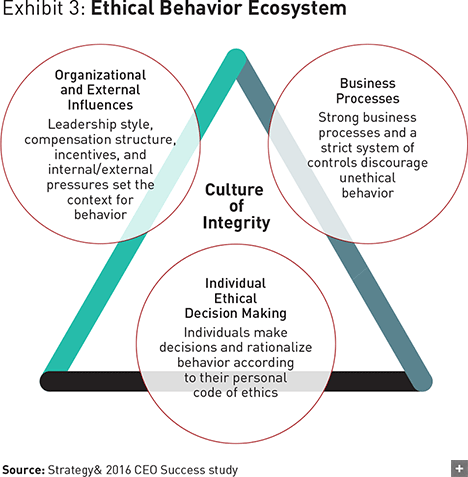
The job of a chief executive officer at a large publicly held company may seem to be quite comfortable — high pay, excellent benefits, elevated social status, and access to private jets. But the comfortable perch is increasingly becoming a hot seat, especially when CEOs and their employees cross red lines.
As this year’s CEO Success study shows, boards of directors, institutional investors, governments, and the media are holding chief executives to a far higher level of accountability for corporate fraud and ethical lapses than they did in the past. Over the last several years, CEOs have often garnered headlines for all the wrong reasons: for misleading regulators and investors; for cutting corners; and for failing to detect, correct, or prevent unethical or illegal conduct in their organization. Some high-profile cases, involving some of the world’s largest corporations, have featured oil companies bribing government officials and banks defrauding customers.
To be sure, the number of CEOs who are forced from office for ethical lapses remains quite small: There were only 18 such cases at the world’s 2,500 largest public companies in 2016. But firings for ethical lapses have been rising as a percentage of all CEO successions. (We define dismissals for ethical lapses as the removal of the CEO as the result of a scandal or improper conduct by the CEO or other employees; examples include fraud, bribery, insider trading, environmental disasters, inflated resumes, and sexual indiscretions. See “Methodology,” below.) Globally, dismissals for ethical lapses rose from 3.9 percent of all successions in 2007–11 to 5.3 percent in 2012–16, a 36 percent increase. The increase was more dramatic in North America and Western Europe. In our sample of successions at the largest companies there (those in the top quartile by market capitalization globally), dismissals for ethical lapses rose from 4.6 percent of all successions in 2007–11 to 7.8 percent in 2012–16, a 68 percent increase.
 Mother’s Day 2017
Dear Leaders,
Today is a time we set aside to celebrate our mothers. Motherhood is often a thankless and tiring endeavor. It’s easy to take for granted the hard work, sacrifice, and love that moms contribute to our lives. So today we pause to appreciate the countless ways our mothers have positively influenced us and shaped us into the people we are today.
In many ways, moms are the ultimate picture of servant leadership in action. They always have the best interests of their children in mind and will go to great lengths to help them grow, develop, and succeed in life. They are able to harmonize the polarities of unconditional love and tough love, and do so in such a way that their children always know that mom has their back. Mothers are simply amazing leaders.
Using the acronym MOTHER, here are six ways leaders can improve their effectiveness by embodying the characteristics and behaviors of great mothers:

If you’re flexible, rigid people seem pigheaded, narrow minded, and self-centered. Why can’t everyone be flexible like you?
If you have an inflexible boss or team member, they always drive the train.
Change, innovation, and progress slow to a snail’s pace when rigid people drive the train.
Stability is the advantage of rigidity.
Organizations need rigid people even if some think they’re evil. You don’t need the dark-side of their strength. But without them, inconsistency escalates into instability.
Sure, they stress themselves and others. They complain about missed commons. But, they’re great at following procedures and delivering consistent results.
Inflexible people love systems that prevent failure.
What if your boss is inflexible?
What suggestions do you have for navigating an inflexible boss or teammate?
 HENRY KOTULA