Anthem Now Requiring Pre-approval for Hospital MRIs, CT Scans

http://www.healthleadersmedia.com/finance/anthem-now-requiring-pre-approval-hospital-mris-ct-scans?spMailingID=11861186&spUserID=MTY3ODg4NTg1MzQ4S0&spJobID=1240498373&spReportId=MTI0MDQ5ODM3MwS2

Image result for medical necessity

The insurer no longer allows outpatient imaging in hospitals. Hospitals may feel the financial loss.

In a bid to cut costs, Anthem is now informing consumers that it must pre-approve any hospital-based MRIs and CT-scans, and that approval won’t come easily.

The insurer’s new policy forbids hospital imaging services on an outpatient basis and requires proof that inpatient imaging is medically necessary.

The Anthem change in policy is likely to be a financial blow to hospitals, which have seen outpatient imaging as a profit center in recent years.

Anthem announced recently that outpatient MRIs and CT scans must be performed at lower-priced facilities, citing its commitment to the Institute for Healthcare Improvement (IHI) Triple Aim Initiative, which calls for improving the patient experience, improving population health, and reducing costs.

The insurer says clinical research has shown the safety of imaging services in free-standing facilities, so the additional cost of a hospital setting is unnecessary.

“Anthem’s primary concern is to provide access to quality and safe healthcare for our members. We are also committed to reducing overall medical cost where possible when the safety of the member is not put at risk,” the company says.

Anthem notes that imaging costs can vary widely without any effect on quality of care, with scans costing as little as $350 and as much as $2,000.

The company also notified providers of the change in policy, explaining that physicians must obtain pre-certification approval for inpatient hospital imaging. Anthem told consumers that it will provide assistance in finding imaging facilities other than hospitals.

The change in policy could reduce a member’s out-of-pocket costs, Anthem notes.

“If the member has a benefit plan where he or she pays a percentage of the cost, it is possible that his or her percentage of out-of-pocket cost may be reduced,” Anthem says. “This is because the cost to undergo a CT or MRI scan administered in a freestanding imaging facility may be less than what a hospital-based facility would charge. If the member has a facility copay, there may not be a reduction in a member’s out of pocket cost.”

However, the policy still stands even if using a freestanding facility would not reduce the consumer’s out-of-pocket cost, the insurer explains. The approval or denial of the site of service is based only on medical necessity.

In the unlikely event that the physician ignores the policy and the patient receives imaging services in a hospital outpatient setting, the hospital would be responsible for the cost, Anthem says. The patient would not be held responsible unless he or she signed a statement acknowledging the deviation from Anthem policy and agreed to be financially responsible.

Bipartisan group of governors calls on Congress to shore up elements of Affordable Care Act

https://www.washingtonpost.com/national/health-science/bipartisan-group-of-governors-calls-on-congress-to-shore-up-elements-of-affordable-care-act/2017/08/31/7853b978-8e71-11e7-84c0-02cc069f2c37_story.html?utm_term=.3975c59ec12b

Image result for bipartisanship

A bipartisan group of governors is trying to jump-start efforts to strengthen private insurance under the Affordable Care Act, urging Congress to take prompt steps to stabilize marketplaces created by law while giving states more freedom from its rules.

In a blueprint issued Thursday, the eight governors ask House and Senate leaders of both parties to take several steps to reverse the rising rates and dwindling choices facing many of the 10 million Americans who buy health plans on their own through ACA marketplaces.

Specifically, the state leaders say Congress should devote money for at least two years toward “cost-sharing subsidies” that the 2010 health-care law promises to pay ACA insurers to offset deductibles and other out-of-pocket expenses for lower-income customers. The House sued the Obama administration over the subsidies’ legality, and President Trump has repeatedly suggested that he might halt the payments — sending tremors through insurance companies in the marketplaces.

Five days before the House and Senate return to Washington, the governors also recommend preserving “for now” the ACA’s requirement that most Americans carry health insurance. Though this rule is unpopular, they concluded that it is “for the time being … perhaps the most important incentive for healthy people to enroll in coverage.”

The proposal also calls for a federal fund, to be available for two years, to buffer insurers from high-cost customers, and for the government to foster competition in ACA marketplaces by encouraging insurers to move into counties with only one company. Those that do would have the law’s insurer taxes waived on health plans sold in those locations.

Led by Ohio Gov. John Kasich (R) and Colorado Gov. John Hickenlooper (D), the blueprint essentially fleshes out the contours of four principals that many of the same governors recommended to Senate leaders in June. It focuses on the insurance market for individuals and families that buy coverage on their own — a fraction of the country’s consumers with private insurance but a perennially shaky part of the industry that the ACA was designed to strengthen.

Greg Moody, a longtime health-care aide to Kasich, said the blueprint is also an acknowledgment of the failure this year of Republicans who control Congress to deliver on their years-long goal of replacing the ACA. “We’ve recently seen how difficult that is,” Moody said.

The blueprint envisions a quick federal boost to shore up the marketplace for the coming year, while deferring to states longer term to experiment with potential changes in insurance subsidies, for instance, or different forms of penalties for consumers who drop coverage.

The proposal was released Thursday so that it would attract attention before two days of hearings scheduled next week by the Senate’s health committee, which will explore bipartisan ideas for improving the law and its marketplaces.

The other governors who signed on are Brian Sandoval (R-Nev.), Tom Wolf (D-Pa.), Bill Walker (I-Alaska), Terry McAuliffe (D-Va.), John Bel Edwards (D-La.) and Steve Bullock (D-Mont.).

After repeal scare, Obamacare has never been more popular

https://www.cbsnews.com/news/obamacare-repeal-has-never-been-more-popular/

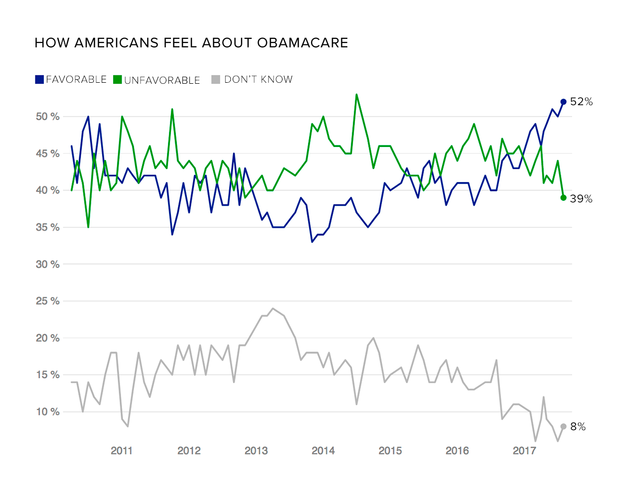
obamacare-sentiment.png

Underscoring the adage that you don’t know what you’ve got until it’s (almost) gone, the popularity of Obamacare is surging.

Only weeks after Republicans in Congress failed to repeal the landmark health reform law, 52 percent of respondents hold a favorable view of the Affordable Care Act (ACA), according to a recent Kaiser Family Foundation August poll. That’s up 10 percentage points since June of last year and nearly 20 points since November 2013, when public support for the ACA was at its nadir.

A July poll by CBS News after the repeal effort collapsed found that a plurality of Americans favor a bipartisan push in Congress to improve Obamacare.

The shift in sentiment coincides with other positive developments for Obamacare following its close call in Washington. With several large, and some smaller, insurers pulling out of the program over the past year or so, until recently it looked as if more than 92,000 participants spread out over 82 counties would have no insurer in their local health care exchanges, Cynthia Cox, associate director of Kaiser Family Foundation, said. But state insurance commissioners and other officials in states in jeopardy of losing Obamacare coverage have worked closely with insurers to negotiate continued coverage.

In Ohio, for instance, there were 20 counties without insurers, but officials ultimately convinced five health plans to cover all but one. Then, on August 24, the Ohio Department of Insurance announced that Paulding County, the last “bare county” in the country, would be covered by insurer CareSource.

In addition, the exchange marketplace overall has shown signs of stabilizing. After big financial losses in 2014 and 2015, individual market insurers saw improved performance in 2016, a trend that has continued this year, according to a different Kaiser Family Foundation study.

If Obamacare’s popularity is up, the program’s shortcomings remain clear. At last count, more than 2.6 million enrollees across 1,300 counties were expected to have only one insurer in their exchanges. More insurers also could pull out or move to sharply increase their premiums. The deadline for insurance companies to commit to participate in an exchange is September 27.

Until then, many insurers are watching closely to see if the Trump Administration will continue funding the federal cost-sharing subsidies that help low-income members pay for deductibles, co-pays and other out-of-pocket costs. Industry players are also waiting or Senate hearings to start after Labor Day in which which insurance commissioners, lawmakers and state governors are expected to testify about what can be done to stabilize the individual marketplace.

Meanwhile, some states are beginning to take matters into their own hands, moving to rewrite the ACA rules by applying for what’s known as a “Section 1332” waiver. Oklahoma is asking for a waiver to establish its own reinsurance program using some federal funds, which would cover the highest-cost individual marketplace cases. Alaska recently received approval for a similar reinsurance waiver. Oklahoma, however, is also looking ahead to more major structural changes that may spur debate.

Iowa, which is undergoing huge premium increases in its individual marketplace, has submitted a waiver that would overhaul the state’s insurance marketplace by redistributing federal tax credit money. The plan would create a single standard health plan and offer a flat tax credit based on age and income.

Critics argue this would increase health care costs significantly for Iowa’s low-income population, putting coverage out of reach for many. Proponents argue that increasing Iowa’s pool of healthy insured people is the best way to stabilize Iowa’s individual market and lower premiums for everyone.

5 Outside-The-Box Ideas For Fixing The Individual Insurance Market

http://khn.org/news/5-outside-the-box-ideas-for-fixing-the-individual-insurance-market/?utm_campaign=KHN%3A%20First%20Edition&utm_source=hs_email&utm_medium=email&utm_content=55788948&_hsenc=p2ANqtz-8Lj78cF_NmoRuvutfOaMAjSMxSBfQwO9kWGZQ0tmdcqApzatJ32_CKq88odmT7deaTbnhlF9vd6ud7OAaZQtm97RS4AA&_hsmi=55788948


With Republican efforts to “repeal and replace” the Affordable Care Act stalled, tentative bipartisan initiatives are in the works to shore up the fragile individual insurance market that serves roughly 17 million Americans.

The Senate Health, Education, Labor and Pensions Committee launches hearings the week Congress returns in September on “stabilizing premiums in the individual insurance market” that will feature state governors and insurance commissioners. A bipartisan group in the House is also working to come up with compromise proposals.

Both before and after implementation of the federal health law, this market — serving people who don’t get coverage through work or the government — has proved problematic. Before the law, many people with preexisting health conditions could not get insurance at any price. Now, consumers in the individual market often face higher out-of-pocket costs and fewer choices of health care providers and insurers than in past years. More than 12 million people buy that insurance through the ACA’s marketplaces, while another 5 million buy it outside of the exchanges.

Policymakers generally agree on what immediate efforts to stabilize the market might include. At the top of most lists is ensuring federal payment of subsidies to insurers to pay the out-of-pocket expenses — such as deductibles and copayments — to protect customers with the lowest incomes. Insurers also want the federal government to continue enforcing the requirement that most Americans either have insurance or pay a tax penalty, and continuing efforts to get uninsured people to sign up for coverage during the upcoming open enrollment period, from Nov. 1 to Dec. 15. Those efforts are essential, insurers say, to help keep healthy customers in their risk pools to defray the costs of beneficiaries with medical needs.

But what about ideas that go beyond the oft-repeated ones? Here are five proposals that are more controversial but generating buzz.

Medicaid Expansion Out of Pocket Spending Low Income

http://www.commonwealthfund.org/publications/newsletters/ealerts/2017/aug/low-income-families-in-medicaid-expansion-states-have-much-lower-oop-spending?view=newsletter_email&email_web=true&omnicid=EALERT1260685&mid=henrykotula@yahoo.com

New Commonwealth Fund research out today demonstrates how states that expanded Medicaid eligibility have not only improved low-income residents’ access to health care but have also reduced what families must spend out of pocket on premiums, cost-sharing, and other related expenses.

Prior studies had shown that low-income residents of states that expanded Medicaid under the Affordable Care Act (ACA) are less likely to experience financial barriers to health care access. But the impact on people’s out-of-pocket spending had not been measured until now.

The new analysis, conducted by a team headed by Sherry Glied, dean of New York University’s Robert F. Wagner Graduate School of Public Service, found that the average low-income family in a Medicaid expansion state saves about $382 annually relative to a comparable family in a nonexpansion state. Moreover, low-income families in states that expanded Medicaid are less likely than their counterparts to have any out-of-pocket health care costs at all.

The authors say there was no statistically significant difference in outcomes for states that expanded through conventional Medicaid or through a waiver program.

http://www.commonwealthfund.org/publications/issue-briefs/2017/aug/medicaid-expansion-out-of-pocket-spending-low-income?omnicid=EALERT1260685&mid=henrykotula@yahoo.com


Often Missing From The Current Health Care Debate: Women’s Voices

http://www.npr.org/sections/health-shots/2017/08/16/543723927/often-missing-from-the-current-health-care-debate-womens-voices?utm_campaign=KFF%3A%20The%20Latest&utm_source=hs_email&utm_medium=email&utm_content=55441015&_hsenc=p2ANqtz-9nhXUhC_zqpJNwIaw0vOuF3PfAn3PBrmE3HVyeYM_l7-5vAx-FPWjwuS3F0Ac1H67HXbfu9Hfyvmuf37WeEGpqXqf-Sw&_hsmi=55441015

Women have a lot at stake in the fight over the future of health care.

Not only do many depend on insurance coverage for maternity care and contraception, they are struck more often by autoimmune conditions, osteoporosis, breast cancer and depression. They are more likely to be poor and depend on Medicaid, and to live longer and depend on Medicare. And it commonly falls to them to plan health care and coverage for the whole family.

Yet in recent months, as leaders in Washington discussed the future of American health care, women were not always invited. To hammer out the Senate’s initial version of a bill to replace Obamacare, Majority Leader Mitch McConnell appointed 12 colleagues, all male, to closed-door sessions – a fact that was not lost on female Senators. Some members of Congress say they don’t see issues like childbirth as a male concern. Why, two GOP representatives wondered aloud during the House debate this spring, should men pay for maternity or prenatal coverage?

As the debate over health care continues, one of the challenges in addressing women’s health concerns is that they have different priorities, depending on their stage in life. A 20-year-old may care more about how to get free contraception, while a 30-year-old may be more concerned about maternity coverage. Women in their 50s might be worried about access to mammograms, and those in their 60s may fear not being able to afford insurance before Medicare kicks in at 65.

To get a richer sense of women’s varied viewpoints on health care, we asked several women around the country of different ages, backgrounds, and political views to share their thoughts and personal experiences.

Patricia Loftman, 68, New York City

Loftman spent 30 years as a certified nurse-midwife at Harlem Hospital Center and remembers treating women coming in after having botched abortions.

Some didn’t survive.

“It was a really bad time,” Loftman says. “Women should not have to die just because they don’t want to have a child.”

When the Supreme Court ruled that women had a constitutional right to an abortion in 1973, Loftman remembers feeling relieved. Now she’s angry and scared about the prospect of stricter controls. “Those of us who lived through it just cannot imagine going back,” she says.

A mother and grandmother, Loftman also recalls clearly when the birth control pill became legal in the 1960s. She was in nursing school in upstate New York and glad to have another, more convenient option for contraception. Already, women were gaining more independence, and the Pill “just added to that sense of increased freedom and choice.”

To her, conservatives’ attack on Planned Parenthood, which has already closed many clinics in several states, is frustrating because the organization also provides primary and reproductive health care to many poor women who wouldn’t be able to get it otherwise.

Now retired, Loftman sits on the board of the American College of Nurse-Midwivesand advocates for better care for minority women. “There continues to be a dramatic racial and ethnic disparity in the outcome of pregnancy and health for African-American women and women of color,” she says.

Terrisa Bukovinac, 36, San Francisco

Bukovinac calls herself a passionate pro-lifer. As president of Pro-Life Future of San Francisco, she participates in marches and protests to demonstrate her opposition to abortion.

“Our preliminary goal is defunding Planned Parenthood,” she says. “That is crucial to our mission.”

As much as the organization touts itself as being a place where people get primary care and contraception, “abortion is their primary business model,” Bukovinac says.

She said the vast majority of abortions are not justifiable and that she supports a woman’s right to an abortion only in cases that threaten her life. “We are opposed to what we consider elective abortions,” she says.

Bukovinac says she also tries to help women in crisis get financial assistance so they don’t end their pregnancies just because they can’t afford to have a baby. She supports women’s access to health insurance and health care, both of which are costly for many. “Certainly, the more people who are covered, the better it is” for both the mother and baby.

Bukovinac herself is uninsured because she says the premiums cost more than she would typically pay for care. Self-employed, Bukovinac has a disorder that causes vertigo and ringing in the ear and spends about $300 per month on medication for that and for anxiety.

She doesn’t know if the Affordable Care Act is to blame, but she said that before the law “I was able to afford health insurance and now I’m not.”

Irma Castaneda, 49, Huntington Beach, Calif.

Castaneda is a breast cancer survivor. She’s been in remission for several years but still sees her oncologist annually and undergoes mammograms, ultrasounds, and blood tests.

The married mom of three, a teacher’s aide to special education students, is worried that Republicans may make insurance more expensive for people like her with pre-existing conditions. “They could make our premiums go sky high,” she says.

Her family previously purchased a plan on Covered California, the state’s Obamacare exchange. But there was a high deductible, so she had to come up with a lot out-of-pocket money before insurance kicked in. “I was paying medical bills up the yin yang,” she says. “I felt like I was paying so much for this crappy plan.”

Then, about a year ago, Castaneda’s husband got injured at work and the family’s income dropped by half. Now they rely on Medicaid. At least now they have fewer out-of-pocket expenses for health care.

Whatever the coverage, Castaneda says, she needs high-quality health care. “God forbid I get sick again,” she says. And she worries about her daughter, who is transgender and receives specialized physical and mental health care.

“Right now she is pretty lucky because there is coverage for her,” Castaneda says. “With the Trump stuff, what’s going to happen then?”

Celene Wong, 39, Boston

The choice was agonizing for Wong. A few months into her pregnancy, she and her husband learned that her fetus had chromosomal abnormalities. The baby would have had severe special needs, she said.

“We always said we couldn’t handle that,” Wong recalls. “We had to make a tough decision, and it is not a decision that most people ever have to face.”

The couple terminated the pregnancy in January 2016, when she was about 18 weeks pregnant. “At the end of the day, everybody is going to go away except for your husband and you and this little baby,” she says. “We did our research. We knew what we would’ve been getting into.”

Wong, who works to improve the experience for patients at a local hospital, says she is fortunate to have been able to make the choice that was right for her family.

“If the [abortion] law changes, what is going to happen with that next generation?” she wonders.

Lorin Ditzler, 33, Des Moines, Iowa

Ditzler is frustrated that her insurance coverage may be a deciding factor in her family planning. She quit her job last year to take care of her 2-year-old son and was able to get on her husband’s plan, which doesn’t cover maternity care.

“To me it seems very obvious that our system isn’t set up in a way to support giving birth and raising very small children,” she says.

While maternity benefits are required under the Affordable Care Act, her husband’s plan is grandfathered under the old rules, which is not uncommon among employers that offer coverage. Skirting maternity coverage might become more common if Republicans in Congress pass legislation allowing states to drop maternity coverage an “essential benefit.”

Ditzler looked into switching to an Obamacare plan that they could buy through the exchange, but the rates were much higher than what she pays now.

If she goes back to work, she could get on a better insurance plan that covers maternity care. But that makes little sense to her. “I would go back to a full-time job so I could have a second child, but if I do that, it will be less appealing and less feasible to have a second child because I’d be working full time.”

Ashley Bennett, 34, Spartanburg, S.C.

Bennett describes herself as devoutly Christian. She is grateful that she was able to plan her family the way she wanted, with the help of birth control. She had her daughter at 22 and her son two years later.

“I felt free to make that choice, which I think is an awesome thing,” she says. She’s advised her 12-year-old daughter to wait for sex until marriage but has also been open with her about birth control within the context of marriage.

But she draws the line at abortion. “I just feel like we’re playing God. If that conception happens, then I feel like it was meant to be.”

Bennett had apprehensions about Trump but voted for him because he was the anti-abortion candidate. “That was the deciding factor for me, [more than] him yelling about how he’s going to build a wall.”

For her, opposition to abortion must be coupled with support for babies once they are born. She supports adoption and is planning to become a foster parent.

She also is concerned about the mental and physical well-being of young women. Bennett teaches seventh-grade math and coaches the school’s cheerleading and dance teams.

She watches the girls take dozens of photos of themselves to get the perfect shot, then add filters to add makeup or slim them down.

“There’s going to be an aftermath that we haven’t even thought about,” she says. “I worry we’re going to have more and more kids suffering from depression, eating disorders and even suicide because of the effects of the social media.”

Maya Guillén, 24, El Paso, Texas

When Guillén was growing up, her family spent years without health insurance. They crossed the border into Juárez, Mexico, for dental care, doctor appointments, and optometry visits.

Guillén is now on her parents’ insurance plan under a provision of the Affordable Care Act that allows children to stay on until they turn 26. She’s been disheartened by Republicans’ proposed changes to contraception and abortion coverage, she says.

In high school, Guillén received abstinence-only sex education. She watched her friends get pregnant before they graduated.

When it came time to consider sex, she thought she’d be able to count on Planned Parenthood, but the clinic in El Paso closed, as have 20 other women’s health clinics in Texas. She worries that if Republicans defund Planned Parenthood, more young girls, especially those in predominantly Hispanic communities like hers, will not be able to get contraceptives.

Jaimie Kelton, 39, New York City

When Jaimie Kelton’s wife gave birth to their baby 3½ years ago, she thought the country was finally becoming more open-minded toward gays and lesbians.

“Now I am coming to realize that we are the bubble and they are the majority and that’s really scary,” says Kelton, now pregnant with her second child.

Kelton says it seems as though Republicans have launched a war against women in general, with reproductive rights and maternity care at risk.

“It is crazy to think that most of the people making these laws are men,” she said. “Why do they feel the need to take away health care rights from women?”

What’s the Near-Term Outlook for the Affordable Care Act?

http://www.kff.org/health-reform/issue-brief/whats-the-near-term-outlook-for-the-affordable-care-act/?utm_campaign=KFF-2017-August-Health-Reform-Outlook-ACA&utm_medium=email&_hsenc=p2ANqtz-_EbLjzmzMtjCe5gWysdKFOYAKOhLUxytBE9QiRYkFON8iXqISeYScKKovbN72gQpEReUlNwoqtEivO7NiGu6poWGxL1A&utm_content=54950542&utm_source=hs_email&hsCtaTracking=b35f36e5-60c0-4e14-ba27-3e14c4025b79%7Cf0a0cb87-2715-4168-b499-2000076067bf

If Congress abandons efforts to repeal and replace the Affordable Care Act (ACA), President Trump has said he would “let Obamacare fail.” This Q&A examines what could happen if the Affordable Care Act, also called “Obamacare,” remains the law and what it might mean to let Obamacare fail.

Is Obamacare failing?

The Affordable Care Act was a major piece of legislation that affects virtually all payers in the U.S. health system, including Medicaid, Medicare, employer-sponsored insurance, and coverage people buy on their own. One of the biggest changes under the health reform law was the expansion of the Medicaid program, which now covers nearly 75 million people, about 14 million of whom are signed up under the expansion. Most Americans, including most Republicans, believe the Medicaid program is working well.

When people talk about the idea of the ACA failing, they are usually referring to the exchange markets, also called Marketplaces. These markets, which first opened in 2014, are part of the broader individual insurance market where just 5-7% of the U.S. population gets their insurance. People who get insurance from other sources like their work or Medicaid are not directly affected by what happens in the individual insurance market.

The exchange markets have not been without problems: There have been some notable exits by insurance companies and premium increases going into 2017, and in the early years of the exchanges, insurers were losing money. The structure of the ACA’s premium subsidies – which rise along with premiums and cap what consumers have to pay for a benchmark plans a percentage of their income – prevents the market from deteriorating into a “death spiral.” However, premiums could become unaffordable in some parts of the country for people with incomes in excess of 400% of the poverty level, who are ineligible for premium assistance.

Insurer participation in this market has received a great deal of attention, as about 1 in 3 counties – primarily rural areas – have only one insurer on exchange. Rural counties have historically had limited competition even before the ACA, but data now available because of the Affordable Care Act brings the urban/rural divide into sharper focus. On average at the state level, competition in the individual market has been relatively stable – neither improving nor worsening.

Premiums in the reformed individual market started out relatively low and remained low in the first few years – about 12% lower than the Congressional Budget Office had projected as of 2016 –before increasing more rapidly in 2017. Most (83%) of the 12 million people buying their own coverage on the exchange receive subsidies and therefore are not as affected by the premium increases, but many of the approximately 9 million people buying off-exchange may have difficulty affording coverage, despite having higher incomes. As might be expected, after taking into account financial assistance and protections for people with pre-existing conditions, some people ended up paying more and others paying less than they did before the ACA. Our early polling in this market found that people in this market were nearly evenly split between paying more and paying less. About 3 millionpeople who remain uninsured are not eligible for assistance or employer coverage and many of them may be going without coverage due to costs.

Our recent analysis of first quarter 2017 insurer financial results finds that the market is not showing signs of collapse. Rather, insurers are on track to be profitable and the market appears to be stabilizing in the country overall. In other words, those premium increases going into 2017 may have been enough to make the market stable without discouraging too many healthy people from signing up. However, there are still markets – particularly rural ones – that are fragile.

How would administrative actions affect market stability?

Despite signs that the individual insurance market is generally stabilizing on its own, certain administrative actions could cause the market to destabilize again. Actions the Administration might take that would weaken the market include:

STOP ENFORCING OR WEAKEN THE INDIVIDUAL MANDATE

The individual mandate is the Obamacare requirement that most people either have insurance or pay a penalty. The purpose of it is to get young and healthy people into the market to bring down average costs. If there are not enough young and healthy people signing up, insurers have to raise premiums. If the administration signals it will either stop enforcement of the individual mandate or give broad exemptions, insurers will respond by raising premiums or exiting the market. The Congressional Budget Office (CBO) estimates that without the individual mandate, premiums in the individual insurance market could rise by 20%.

SCALE BACK OUTREACH AND CONSUMER ASSISTANCE

The individual market is often a transitional source of insurance when life circumstances change. People who are temporality unemployed, in school, or early retirees make up a substantial share of the individual market. Additionally, people in this market often experience income volatility and may cycle between Medicaid and subsidized exchange coverage. Those who are sick will be most likely to seek insurance coverage on their own when they go through a change in life circumstances, but outreach and consumer assistance programs – particularly those targeted at young and healthy individuals – can help balance out the risk pool and bring down average costs.

This coming open enrollment period (November 1 – December 15, 2017) is shorter than previous periods and may require more outreach to get people signed up before the deadline. This will also be the first enrollment period run from start to finish by the Trump administration and it is not yet clear how much outreach the administration will take on. Toward the end of the last open enrollment period, the Trump administration cut marketing and more recently has used outreach funds for messages critical of the health care law.

STOP MAKING COST-SHARING SUBSIDY PAYMENTS

Under the Affordable Care Act, insurers are required to offer low-deductible plans to low-income people (58% of marketplace enrollees benefit from these cost-sharing subsidies). For the lowest-income enrollees, these subsidies can bring down the deductible from a few thousand dollars to a couple hundred dollars (Figure 2 below). Providing these higher-value plans to low-income enrollees costs insurers more money (an estimated $10 billion dollars in 2018), so under the ACA the federal government reimburses insurers in the form of a cost-sharing subsidy payment. However, these payments are the subject of a lawsuit and the Administration has signaled they might stop making payments.

If these payments stop, we estimate that insurers would need to raise rates on silver-level plans – which are the only plans where consumers can access cost-sharing reductions – by 19 percent, with states that did not expand Medicaid (primarily red states) facing higher premium increases (Figure 3 below). Lower-income marketplace enrollees receiving premium subsidies would be protected from premium increases because subsidies would rise as well. However, higher-income enrollees not receiving premium subsidies would face higher premiums if insurers expect cost-sharing subsidy payments to end.

The combined effect of these policy changes (not enforcing the individual mandate and defunding cost-sharing subsidies) could cause some insurers to raise premiums on some plans by as much as 40 percentage points higher than they otherwise would. Because premium subsidies increase as premiums rise, administrative actions that cause premiums to rise can also cause taxpayer costs to increase. For example, we estimate that ending cost-sharing subsidy payments could increase net federal costs by about $2.3 billion per year.

Insurers have already submitted their preliminary premiums for the upcoming calendar year to state regulators. Since there has not been clarity on these issues, some insurers are already assuming that the Trump Administration or Congress may take an action that would destabilize the market. Some companies have either significantly raised premiums for next year, scaled back their footprints, or made plans to exit the exchange or individual market all together. Insurers are still negotiating rates for 2018, so if they do not get clarity soon, premiums could go up even more or more insurers could leave.

Again, these premium increases would only affect people who buy their own insurance (particularly middle-income or upper-middle-income people who buy their own insurance without a subsidy to offset the costs), and this group does not make up a large share of the American public. Nonetheless, more insurer exits or large premium increases on the exchange markets could be seen as Obamacare failing. It is worth noting, though, that a majority (64 percent) of the public – including 53 percent of Republicans – say that because President Trump and Republicans in Congress are now in control of the government, they are responsible for any problems with the ACA moving forward.

What happens if the market fails?

Following some announcements of 2018 exits by major insurers, there are some counties at risk of having no insurer on the exchange next year. This would be a first; thus far, all counties have had at least one insurer on the exchange. As negotiations between insurers and state regulators are still underway, there is still time for other insurers to come in and fill these gaps. Thus far, in most cases, a new or expanding insurer has already moved in to cover counties once thought to be “bare.” However, administrative actions that destabilize the market could encourage more insurers to exit.

If no exchange insurer ultimately moves in to some of these counties, people buying their own insurance will not be able to get subsidies and would have to pay full price for insurance. Paying for unsubsidized insurance would be particularly difficult for low-income and older adults living in high-cost areas like many rural parts of the country. Our subsidy calculator can show the difference in cost. For example, in Knox County Ohio, a low-income 60-year-old could get a silver plan for $83 per month but would have to pay $775 per month if he bought that plan without a subsidy, plus he would have a higher deductible because he would no longer benefit from cost sharing subsidies that are only available on the exchange. That same person would also qualify for a free ($0 premium) bronze plan if he buys on exchange, but off-exchange without a subsidy he would have to pay more than $600 per month for a similar plan. People shopping for coverage off-exchange in a county left without an exchange insurer – particularly lower income or older exchange shoppers – may not be able to afford any option and may drop their coverage.

If the market becomes destabilized, and particularly if the individual mandate is not enforced, insurers may decide to exit the off-exchange market as well. This would mean that people in these counties who would otherwise buy their own insurance may not have any option even if they could afford to pay full price.

What might be done to strengthen the Marketplaces?

Although the individual health insurance market is stabilizing on average, insurer financial performance varies and some companies in some states are still struggling. Additionally, some insurers have already decided to increase premiums significantly or exit the market in 2018 on the assumption that the Trump Administration or Congress will take actions that destabilize the market. Although there are many ideas on both the left and the right for how to improve these markets, there are not many options that have bipartisan support.

One possible policy response that could receive bipartisan support would be to reestablish a reinsuranceprogram. Reinsurance programs provide funds to insurers that enroll high-cost (sicker) individuals and can work to lower premiums. The Affordable Care Act included a reinsurance program but it was temporary and phased out in 2016. Republicans in Congress and the Administration have also signaled a willingness to establish reinsurance programs: Both the House and Senate repeal bills included stability funds for reinsurance and Health and Human Services Secretary Price has supported Alaska’s request for a waiver to support its reinsurance program. Though such a program could receive bipartisan support, it would require additional funds (for example, taxing insurers in other markets).

Additional state flexibility to address local challenges in implementing the health care law may also receive some bipartisan support. The challenge of attracting insurers to rural areas or certain states, for example, may warrant state-specific solutions – either as part of the ACA’s waiver program or by Congress giving states additional flexibility.

CBO: ObamaCare premiums could rise 20 percent if Trump ends payments

CBO: ObamaCare premiums could rise 20 percent if Trump ends payments

Image result for congressional budget office

Insurance companies would raise premium prices about 20 percent for ObamaCare plans if President Trump ends key payments to insurers, according to the Congressional Budget Office (CBO).

At the request of House Democratic leadership, CBO estimated what would happen if the payments to insurers ended after December. It found that halting payments would increase the federal deficit by $194 billion through 2026.

Many people would be cushioned from the impact of the increases because federal tax credits rise automatically when premiums do.

If the payments ended, some carriers would withdraw from ObamaCare and about 5 percent of people would live in an area without any options on the exchanges in 2018, according to CBO. But by 2020, CBO estimates more insurers would participate again, so that most areas would be covered.

The number of people without insurance would be slightly higher next year but a little lower in 2020, according to the analysis.

Cost-sharing reduction payments are made to insurers, compensating them for discounting out-of-pocket costs for certain enrollees.

Insurers have been pleading for certainty from the administration on whether they’ll continue to receive the payments, which total about $7 billion for fiscal 2017.

The administration has been making these payments on a monthly basis. But Trump has threatened to halt the funds, calling the money “bailouts” for insurance companies.

The issue has also been caught up in court, and if Trump decides to stop appealing a court ruling against the administration, CSR payments could stop. The deadline for another update is coming up quick — Aug. 20. The case has been on hold for months and could be delayed again.

Additionally, the Senate Health Committee will hold hearings on a bipartisan, short-term stabilization measure the first week of September. The goal, according to Chairman Lamar Alexander (R-Tenn.), is to craft a bill by mid-September that includes funding the payments to insurers.

But insurers are bumping up against major deadlines.

Last week, the administration extended the deadline for carriers to finalize how much their premiums will cost on HealthCare.gov. That date is now Sept. 5, and insurers sign contracts locking them into selling plans Sept. 27.

If insurers don’t know if CSRs will be funded, they could exit the marketplaces, health experts warn. That could possibly lead to some areas have no insurers selling plans on their exchanges.


Why ACA market upheaval still looms large despite failure to repeal the law

http://www.healthcaredive.com/news/why-aca-market-upheaval-still-looms-large-despite-failure-to-repeal-the-law/449117/

Whether lawmakers are done with efforts to repeal the ACA or not, some important changes for healthcare could be on the horizon.

Facing Trump Subsidy Cuts, Health Insurance Officials Seek a Backup Plan

Image result for Facing Trump Subsidy Cuts, Health Insurance Officials Seek a Backup Plan

Congress is on vacation, but state insurance commissioners have no time off. They have spent the past three days debating what to do if President Trump stops subsidies paid to insurance companies on behalf of millions of low-income people.

For administration officials and many in Congress, the subsidies are a political and legal issue in a fight over the future of the Affordable Care Act. But for state officials, gathered here at the summer meeting of the National Association of Insurance Commissioners, the subsidies are a more immediate, practical concern.

The insurance commissioners are frustrated with the gridlock in Washington, which they say threatens coverage for consumers and the solvency of some insurers. Without the payments, they say, consumers will face higher premiums in 2018, and more insurers will pull back from the individual insurance market.

Mr. Trump has repeatedly threatened to cut off the payments, which reimburse insurers for reducing the deductibles, co-payments and other out-of-pocket costs for low-income people.

If the government continues providing funds for the subsidies, insurers will have “a small profit,” said Craig Wright, the chief actuary at the Florida Office of Insurance Regulation. “If the subsidies are not funded, carriers would face the prospect of large financial losses, which could increase the risk to their solvency.”

“It could be very damaging,” Mr. Wright said. “Our market wouldn’t recover.”

With no guidance or clarity from the Trump administration, state officials are agonizing over what to do. Many expressed a sense of urgency, saying they needed to make decisions soon on rates to be charged in 2018.

Trump administration officials were invited to speak to state insurance regulators and were listed in the program for at least one public session, but they did not show up at that event to provide the promised update on federal policy.

“Most of us are hoping and praying that this gets resolved,” said David Shea, a health actuary at the Virginia Bureau of Insurance. “But that’s not the case right now.”

Without the federal subsidies, insurers would need to get the money — estimated at $7 billion to $10 billion next year — from another source. And that means higher premiums, state officials said.

The officials here are wrestling with several questions: How much should premiums be increased? Who should pay the higher premiums? Is there any way to minimize the effect on low-income people? Is it better to assume that the cost-sharing subsidy payments will or will not be made in 2018? What happens if state officials guess wrong?

State officials said they would allow insurers to impose a surcharge on premiums if the federal government cuts off funds for the cost-sharing subsidies.

Paul Lombardo, a health actuary at the Connecticut Insurance Department, said officials there might direct insurers to spread the cost across all of their health plans, both on and off the insurance exchange created under the Affordable Care Act.

By contrast, Florida has asked insurers to load all of the extra cost into the prices charged for midlevel “silver plans” sold on the exchange. The federal government would then absorb almost all of the cost through another subsidy program, which provides tax credits to help low-income people pay premiums, Mr. Wright said. The tax credits generally increase when premiums rise.

J. P. Wieske, the deputy insurance commissioner in Wisconsin, said that two companies, Anthem and Molina Healthcare, were leaving the state’s marketplace in 2018 and that two others, Humana and UnitedHealth, exited in previous years. As a result, he said, more people will be enrolled in smaller local health plans that could be more affected by a termination of federal subsidy payments.

“Carriers left in the Wisconsin market are smaller, local plans,” Mr. Wieske said. “Particular carriers could have huge surges in population, going from 7 or 8 percent of their business in the individual market to 30 or 40 percent. If that’s the case, if it’s 30 or 40 percent of their business in the individual market, that’s obviously a gargantuan risk.”

The risks for consumers are also high, Mr. Wieske said. “Consumers,” he said, “could be stuck in a zombie plan, an insurer that is essentially no longer able to do business in the worst-case scenario, or consumers may have to move to another insurer with different health care providers.”

Officials in many states must decide this month on insurance rates for next year.

“We are holding off making those decisions until the very last possible minute,” said Julie Mix McPeak, the Tennessee insurance commissioner. “In doing so, we are really making it difficult for consumers who need information about open enrollment — who’s participating in the market and what the rates might be. We don’t know the answers to any of those questions.”

The uncertainty stems not only from the White House and Congress, but also from federal courts.

House Republicans challenged the cost-sharing payments in a lawsuit in 2014. A federal judge ruled last year that the Obama administration had been illegally making the payments, in the absence of a law explicitly providing money for the purpose. The case is pending before the United States Court of Appeals for the District of Columbia Circuit, which has held it “in abeyance” at the request of House Republicans and the Trump administration.

The administration has been providing funds for cost-sharing subsidies month to month, with no commitment to pay for the remainder of this year, much less for 2018.

“I am very fearful that we’ll have insurers make a decision to leave markets as a result of the uncertainty,” said Ms. McPeak, who is the president-elect of the National Association of Insurance Commissioners. “It’s somewhat inequitable to ask insurers to sign a contract that binds them but may not bind the federal government.”

The Affordable Care Act requires an annual review of health insurance rate increases, and states are taking different approaches.

Nebraska initially told insurers to file 2018 rates on the assumption that the cost-sharing subsidies would continue. But “because of the confusion in Washington,” said Martin W. Swanson of the Nebraska Insurance Department, the state later told insurers to assume that they would not receive the subsidy payments.

Mike Chaney, the Mississippi insurance commissioner, and Allen W. Kerr, the Arkansas insurance commissioner, said they had instructed companies to assume that they would receive the cost-sharing subsidies next year. Michigan has told insurers to submit two sets of rates, one with the subsidies and one without.

Michael F. Consedine, the chief executive of the National Association of Insurance Commissioners, said that without a firm commitment of federal funds for the cost-sharing subsidies, “we have grave concerns about the long-term viability of the individual health insurance market in a number of states.”

“We need some step right away,” Mr. Consedine said, “either by action of Congress or by direction of the administration, to ensure that Americans continue to have access to coverage.”