Healthcare Triage: Donald Trump and Healthcare Cost Sharing

Healthcare Triage: Donald Trump and Healthcare Cost Sharing

Image result for Healthcare Triage: Donald Trump and Healthcare Cost Sharing

One of the few things that both Donald trump and Hilary Clinton seemed to agree on is that high out-of-pocket spending, specifically as it relates to the Affordable Care Act, is a problem. One of Clinton’s most popular health care proposals during her campaign was to reduce out of pocket spending to more “manageable” levels for many Americans. President-elect Trump sought to fix this problem by repealing the ACA and replacing it with something better.

Reducing out-of-pocket spending, however, will require some tradeoffs. No easy solution exists, but there are examples out there worthy of consideration. That’s the topic of this week’s Healthcare Triage.

In Through the Out Door: A Comprehensive Look at Surprise Medical Bills

http://www.realclearhealth.com/articles/2017/01/09/in_through_the_out_door_a_comprehensive_look_at_surprise_medical_bills__110368.html?utm_source=RealClearHealth+Morning+Scan&utm_campaign=79f64f1189-EMAIL_CAMPAIGN_2017_01_09&utm_medium=email&utm_term=0_b4baf6b587-79f64f1189-84752421

Image result for In Through the Out Door: A Comprehensive Look at Surprise Medical Bills

Imagine receiving medical care at an emergency department (ED) you know is in your insurance network only to find out later, after receiving a large medical bill, that the treating emergency physician was not an in-network provider in your health plan. Or diligently shopping for the best in-network hospital and in-network surgeon to perform an elective surgery, after which you find out that an out-of-network physician assisted in the procedure and expects payment for the portion of her bill not covered by your insurance. Imagine needing an ambulance, only to find out there are no ambulances available in your area that are covered by your insurance.

Only 20 Percent Of Americans Support Health Law Repeal Without Replacement Plan

http://khn.org/news/only-20-of-americans-support-health-law-repeal-without-replacement-plan/

0106117-kff-fig7

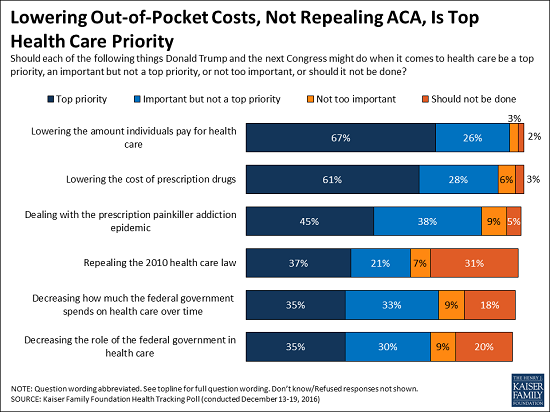
The Republican strategy of repealing the Affordable Health Care Act before devising a replacement plan has the support of only one in five Americans, a poll released Friday finds.

The Kaiser Family Foundation survey also disclosed that shrinking the federal government’s involvement and spending in health care — the long-sought goal of House Speaker Paul Ryan and other Republican lawmakers — is less important to most Americans than is ensuring medical care is affordable and available. (Kaiser Health News is an editorially independent project of the foundation.)

Views split not only on partisan lines but also within the Republican Party, where nearly four in 10 think that the government should guarantee health care is available to the elderly and to low-income people, even if it means more federal involvement.

Despite the rout of Democrats in the election, which gave the GOP control of both the White House and Congress, the public’s view on the Affordable Care Act remains as divided as it has been since it was passed by President Barack Obama and congressional Democrats in 2010.  Currently, 47 percent of the public wants to keep the law, which upended the way insurers do business and expanded coverage to 20 million Americans.


The Complex Mess of Health Insurance

The Kaiser Family Foundation is one of the best sources of information on health care, and it recently convened some focus groups in the Midwest and Pennsylvania. These groups included people who received health insurance through an Obamacare exchange and who also voted for Donald Trump.

You can read about the results in an Op-Ed today by Drew Altman, Kaiser’s chief executive. It underscores how messy and uncertain the coming debate over Obamacare’s future will likely be.

I want to point out one theme that keeps popping up in Altman’s piece — and existed long before Obamcare: A lot of Americans are deeply frustrated by the logistical headaches built into our health care system.

As Altman writes: “They were especially upset by surprise bills for services they believed were covered. They said their coverage was hopelessly complex.” If they had their way, Altman says, their insurance would become “much more understandable.”

I share their frustration, and I imagine most of you do, too. Just this week, a member of my family endured the Kafkaesque experience of being told that she needed to show up for an appointment even if she were no longer sick or face a penalty, thanks to insurance rules.

The Health Care Plan Trump Voters Really Want

This week Republicans in Congress began their effort to repeal and potentially replace the Affordable Care Act. But after listening to working-class supporters of Donald J. Trump — people who are enrolled in the very health care marketplaces created by the law — one comes away feeling that the Washington debate is sadly disconnected from the concerns of working people.

Those voters have been disappointed by Obamacare, but they could be even more disappointed by Republican alternatives to replace it. They have no strong ideological views about repealing and replacing the Affordable Care Act, or future directions for health policy. What they want are pragmatic solutions to their insurance problems. The very last thing they want is higher out-of-pocket costs.

The Kaiser Foundation organized six focus groups in the Rust Belt areas — three with Trump voters who are enrolled in the Affordable Care Act marketplaces, and three with Trump voters receiving Medicaid. The sessions, with eight to 10 men and women each, were held in late December in Columbus, Ohio, Grand Rapids, Mich., and New Cumberland, Pa. Though the participants did not agree on everything, they expressed remarkably similar opinions on many health care questions. They were not, by and large, angry about their health care; they were simply afraid they will be unable to afford coverage for themselves and their families. They trusted Mr. Trump to do the right thing but were quick to say that they didn’t really know what he would do, and were worried about what would come next.

They spoke anxiously about rising premiums, deductibles, copays and drug costs. They were especially upset by surprise bills for services they believed were covered. They said their coverage was hopelessly complex. Those with marketplace insurance — for which they were eligible for subsidies — saw Medicaid as a much better deal than their insurance and were resentful that people with incomes lower than theirs could get it. They expressed animosity for drug and insurance companies, and sounded as much like Bernie Sanders supporters as Trump voters. One man in Pennsylvania with Type 1 diabetes reported making frequent trips to Eastern Europe to purchase insulin at one-tenth the cost he paid here.


Poll: Public Divided on Repealing Obamacare, But Few Want It Repealed Without Replacement Details

http://connect.kff.org/poll-public-divided-on-repealing-obamacare-but-few-want-it-repealed-without-replacement-details?ecid=ACsprvtG5kIoCbXzcE3WLgrX01kIXFDaDUgXQ0BUzNGGn2gIr2haSAC8OzTQSp0H3e0Qeujg-Q9Y&utm_campaign=KFF-2017-January-Priorities-Tracking-Poll&utm_source=hs_email&utm_medium=email&utm_content=40166809&_hsenc=p2ANqtz-_zwF7NlvPoFINfG9Nd0OPcBebPHjaaSvuWqkCefkoOcmCo9aOPqJHM0W6_uhOAYH4ucOOIuXrEe40HttSNtSg8udNc1A&_hsmi=40166809

1.6.17 - 2017 tracking email alert - image 2.png

Out-of-Pocket Costs, Not the Affordable Care Act, Top Public’s List of Health Care Priorities for new Administration and Congress

As Congress begins to work on repealing and replacing the Affordable Care Act, the latest Kaiser Health Tracking Poll finds that one in five Americans (20%) support repeal alone, while three quarters either oppose repeal altogether (47%) or want to wait to repeal the law until the replacement plan’s details are known (28%).

Overall, the poll finds that nearly equal shares say that the next Congress should vote to repeal the law (49%) and that it should not vote to repeal it (47%), which mirrors the public’s overall views of the 2010 law (46% view it unfavorably, 43% favorably).

The debate surrounding repeal could influence the public’s views, as the poll finds that some people shift their opinions after hearing counter-arguments.  For example, after hearing pro-repeal arguments about the law’s costs to individuals and the government, the share of the public supporting repeal grows as large as 60 percent, while anti-repeal arguments about people losing coverage and the impact on people with pre-existing conditions decreases support for repeal to as low as 27 percent.

When asked directly about their family’s health care costs, similar shares of the public say repealing the Affordable Care Act would make their situation worse (28%) as say it would make it better (27%). Most say their own ability to get and keep health insurance (55%) and the quality of their own health care (57%) will stay about the same if Congress votes to repeal the law.

Crossing the Political Chasm

http://www.commonwealthfund.org/publications/blog/2016/dec/crossing-the-political-chasm

As a new chapter in the saga of U.S. health care reform is written in the coming year, it’s worth remembering that, behind the layers of jargon and obscure political maneuvers, the consequences of success—and of failure—will be shared by individuals and groups across our society…regardless of ideology, demography, or geography.

After the Election, the Public Remains Sharply Divided on Future of the Affordable Care Act

http://connect.kff.org/after-the-election-the-public-remains-sharply-divided-on-future-of-the-affordable-care-act?ecid=ACsprvtkG7thn0KvqmasXGGSnW1I2ovnfcZhoigDXi-aw9Wa_OhWGcyqpjasxqgfF_XFOsbs0N1f&utm_campaign=KFF-2016-November-Tracking-Poll&utm_source=hs_email&utm_medium=email&utm_content=38490459&_hsenc=p2ANqtz–qXSbCJ4pmKneag47QgP5kargBeYht5Al3rljRS8wEAQj-n-71yE8rwo5xn_Bg9Nwp-C89R9o_HVKBqqv5G6aMyddn9g&_hsmi=38490459

november poll1.png

Among Those Who Favor Repeal, Arguments About Loss of Coverage for Those with Pre-Exiting Conditions Can Sway Some Opinions

Many Obamacare Provisions Remain Broadly Popular Across Party Lines, But Not its Mandate

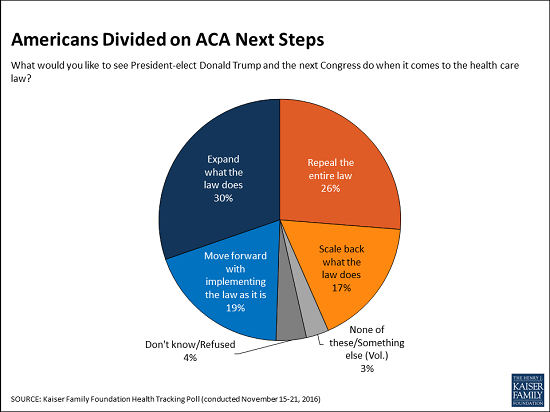
The first Kaiser Health Tracking Poll since the 2016 election finds that Americans are largely divided on the future of the Affordable Care Act even though many of the law’s major provisions remain quite popular across party lines.

The new survey finds that one fourth (26%) of Americans want to see President-elect Donald Trump and the next Congress repeal the entire law, and an additional 17 percent want them to scale back what the law does. This compares to 30 percent of the public who want to see the law expanded and 19 percent who want to see lawmakers move forward with implementing the law as it is.

The poll captures a slight uptick in the share of Americans who want lawmakers to scale back the law as well as a decrease in the share who want lawmakers to repeal the entire law.  This is largely driven by Republicans: About half (52%) of Republicans now say they want to see the Affordable Care Act repealed, down from 69 percent in October. At the same time, a quarter (24%) of Republicans now want to see the law scaled back, up from 11 percent in October.

Among the quarter (26%) of Americans that want to see the Affordable Care Act repealed, 31 percent want to see the health care law just repealed and not replaced. About two-thirds wants lawmakers to repeal the health care law and replace it with a Republican-sponsored alternative, with 42 percent wanting lawmakers to wait to repeal it until the details of a replacement plan have been figured out and 21 percent wanting lawmakers to repeal it immediately and figure out a replacement plan later.

Among those who want the law repealed, 38 percent (or 10% of the public overall) change their opinion after hearing the argument that repealing the ACA would mean that insurance companies could deny coverage to people with pre-existing conditions. A slightly smaller share change their opinion after hearing that more than 20 million Americans could lose their coverage.

Presidential candidates in fantasy land over health care

https://www.publicintegrity.org/2015/09/28/18071/presidential-candidates-fantasy-land-over-health-care

Image result for pharmaceutical industry lobby

The drug companies always win, which is why Americans pay far more than citizens of any other country for prescription medications. We pay exactly 100 percent more per capita for pharmaceuticals than the average paid by citizens of the 33 other developed countries that comprise the Organization for Economic Cooperation and Development (OECD).

Obama also once supported drug re-importation, as did Sen. John McCain, the Arizona Republican who lost to Obama in the 2008 presidential election. In 2012, two years after the passage of the Affordable Care Act, McCain teamed up with Sen. Sherrod Brown, (D-Ohio) in another attempt to get Congress to pass a drug re-importation bill.

When it became clear that his bill would not pass, McCain took to the floor to denounce the ability of well-financed special interests to control the federal government.

“What you’re about to see is the reason for the cynicism that the American people have about the way we do business in Washington. (The pharmaceutical industry)… will exert its influence again at the expense of low-income Americans who will again have to choose between medication and eating.”

Don’t expect that to change anytime soon. As long as interest groups can spend unlimited amounts of money to influence elections and can hire hundreds of lobbyists to do their bidding, millions of Americans will have to decide between health care and eating, while executives and shareholders get richer and richer.