Donald Trump’s Health Care Reform Proposals: Anticipated Effects on Insurance Coverage, Out-of-Pocket Costs, and the Federal Deficit

http://www.commonwealthfund.org/Publications/Issue-Briefs/2016/Sep/Trump-Presidential-Health-Care-Proposal

Image result for Donald Trump's Health Care Reform Proposals: Anticipated Effects on Insurance Coverage, Out-of-Pocket Costs, and the Federal Deficit

Issue: Republican presidential candidate Donald Trump has proposed to repeal the Affordable Care Act (ACA) and replace it with a proposal titled “Healthcare Reform to Make America Great Again.” Proposed reforms include allowing individuals to deduct the full amount of premiums for individual health plans from their federal tax returns, providing block grants to finance state Medicaid programs, and allowing insurers to sell insurance across state lines.

Goal: To assess how each of these reforms, when implemented individually, would affect insurance coverage, consumer out-of-pocket spending on health care, and the federal deficit in 2018.

Methods: RAND’s COMPARE microsimulation model.

Key findings and conclusions: The policies would increase the number of uninsured individuals by 16 million to 25 million relative to the ACA. Coverage losses disproportionately affect low-income individuals and those in poor health. Enrollees with individual market insurance would face higher out-of-pocket spending than under current law. Because the proposed reforms do not replace the ACA’s financing mechanisms, they would increase the federal deficit by $0.5 billion to $41 billion.

The Health Care Reform Proposals of Hillary Clinton and Donald Trump

http://www.commonwealthfund.org/publications/blog/2016/trump-clinton-presidential-health-care-proposals?utm_medium=Facebook&utm_campaign=Health+Coverage&utm_source=Candidates+Blog

Image result for The Health Care Reform Proposals of Hillary Clinton and Donald Trump

As president, Hillary Clinton and Donald Trump would take the nation down distinctly different paths on health care. In this post, we summarize the health reform proposals of each candidate, and—drawing on new estimates by Christine Eibner and colleagues at RAND Health—compare the proposals’ implications for the total number of people with insurance coverage, people’s out-of-pocket health care costs, and the federal budget.

RAND’s analysis is based on publicly available health care proposals on the candidates’ websites. Where these proposals lacked sufficient clarity for modeling, RAND sought additional information from the campaigns. When answers were not forthcoming, or did not fully resolve questions, RAND made reasonable assumptions that were reviewed and critiqued by independent experts. RAND modeled only those proposals for which it had adequate detail and technical capacity.

The Starting Point

As a starting point, Clinton and Trump propose dramatically different approaches to the Affordable Care Act (ACA): Clinton would maintain the ACA and Trump would repeal it. In estimating the impact of Trump’s proposal, RAND assumes a full repeal of the law including insurance subsidies, expanded eligibility for Medicaid, and individual market reforms such as bans against preexisting condition exclusions. RAND also assumes that repeal would eliminate the ACA’s financing mechanisms such as its Medicare payment reforms and taxes on health plans and medical devices. Consequently, RAND estimates that compared to maintaining the ACA as is, repeal would cause nearly 20 million people to lose their insurance in 2018, increase average premium and out-of-pocket costs for people who buy insurance on their own, and increase the federal deficit. Trump’s repeal of the ACA would increase the federal deficit because the loss of savings from the law’s Medicare reforms and revenues from fees and taxes would be greater than savings from the elimination of insurance subsidies and the Medicaid expansion.

On Medicare But At Risk: A State-Level Analysis of Beneficiaries Who Are Underinsured or Facing High Total Cost Burdens

http://www.commonwealthfund.org/publications/issue-briefs/2016/may/on-medicare-but-at-risk

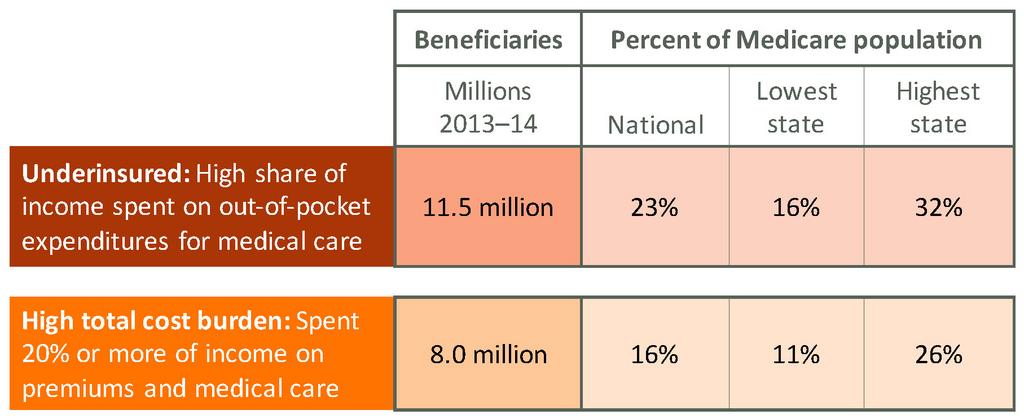
Medicare provides essential health coverage for older and disabled adults, yet it does not limit out-of-pocket costs for covered benefits and excludes dental, hearing, and longer-term care. The resulting out-of-pocket costs can add up to a substantial share of income. Based on U.S. Census surveys, nearly a quarter of Medicare beneficiaries (11.5 million) were underinsured in 2013–14, meaning they spent a high share of their income on health care. Adding premiums to medical care expenses, we find that 16 percent of beneficiaries (8 million) spent 20 percent or more of their income on insurance plus care. At the state level, the proportion of beneficiaries underinsured ranged from 16 percent to 32 percent, while the proportion with a high total cost burden ranged from 11 percent to 26 percent. Low-income beneficiaries were most at risk. The findings underscore the need to assess beneficiary impacts of any proposal to redesign Medicare.

High-Need, High-Cost Patients: Who Are They and How Do They Use Health Care?

http://www.commonwealthfund.org/publications/issue-briefs/2016/aug/high-need-high-cost-patients-meps1

Image result for High-Need, High-Cost Patients: Who Are They and How Do They Use Health Care?

Issue: Finding ways to improve outcomes and reduce spending for patients with complex and costly care needs requires an understanding of their unique needs and characteristics.

Goal: Examine demographics and health care spending and use of services among adults with high needs, defined as people who have three or more chronic diseases and a functional limitation in their ability to care for themselves or perform routine daily tasks.

Methods:Analysis of data from the 2009–2011 Medical Expenditure Panel Survey.

Key findings: High-need adults differed notably from adults with multiple chronic diseases but no functional limitations. They had annual health care expenditures that were nearly three times higher—and which were more likely to remain high over two years of observation—and out-of-pocket expenses that were more than a third higher, despite their lower incomes. On average, rates of hospital use for high-need adults were more than twice those for adults with multiple chronic conditions only; high-need adults also visited the doctor more frequently and used more home health care.

Conclusion: Wide variation in costs and use of services within the high-need group suggests that interventions should be targeted and tailored to those individuals most likely to benefit.

21 statistics on high-deductible health plans

http://www.beckershospitalreview.com/finance/21-statistics-on-high-deductible-health-plans.html

Image result for high deductible health plan


Survey: Hospitals saw 10% increase in self-pay dollars in past 5 years

http://www.beckershospitalreview.com/finance/survey-hospitals-saw-10-increase-in-self-pay-dollars-during-past-5-years.html

Image result for raising self pay patients

With the rising popularity of high-deductible health plans, hospital and health system executives know they must find effective ways of communicating with patients about their financial responsibility and develop strategies to ensure proper payment. Many executives have made strides in these areas, but there is still room for improvement, according to a Healthcare Financial Management Association survey sponsored by Parallon.

HFMA researchers surveyed 117 senior finance executives and revenue cycle leaders to examine their organizations’ self-pay processes and patient financial engagement efforts.

Here are six survey findings:

Would You Like Some Insurance With Your Insurance?

http://khn.org/news/would-you-like-some-insurance-with-your-insurance/?utm_campaign=KHN%3A+Daily+Health+Policy+Report&utm_source=hs_email&utm_medium=email&utm_content=34662261&_hsenc=p2ANqtz-8_T7tLMkCX6Y6LfTReNo75vKpK1maHvHwggi_b0HJdFjSYivQggGeQ_9T7c_uhl0BRZml0KAXMIdJg7jjXJNAXcqcdiA&_hsmi=34662261

A screenshot from a video touting a gap plan called "Premium Saver." (Courtesy of Crema Design Studio)

Gap plans, used to cover out-of-pocket expenses like high deductibles, are becoming increasingly popular among consumers and businesses.

The rising price of insurance is driving the trend, explained insurance broker Ryan Hillenbrand, president of the Missouri Association of Health Underwriters.

“People see the prices of individual insurance and they say, ‘Boy, a $6,000 deductible seems really high. I don’t want something that gives me that much risk,’ ” Hillenbrand said. “That’s why [the gap insurance] market is heating up a little bit more.”

Gap insurance is in a category of insurance known as “limited benefit.” No matter how bad a person’s situation, the plan will pay out only a certain amount of money. “Mini-med” policies, now illegal under the Affordable Care Act, are another example of a limited benefit plan

Now, there’s renewed interest in gap plans. With monthly premiums on health insurance going up, more people are choosing cheaper, high-deductible options. In 2016, more than90 percent of people buying insurance under the ACA chose plans with an average deductible of $3,000 or higher.

Next year, the cost of one of the most popular plans available under the Affordable Care Act could increase by 10 percent on average across the country. That comes on top of a 5 percent jump the year before.

When consumers see those prices, Hillenbrand said, “they get sticker shock.”

“If you don’t qualify for a subsidy, you’re bearing the brunt of all that cost,” Hillenbrand said. “And here come the gap plans.”

AMA: Insurance megamergers ‘threaten healthcare access, quality and affordability’

http://www.healthcaredive.com/news/ama-insurance-megamergers-threaten-healthcare-access-quality-and-afforda/426745/

  • The merger of health insurance giants “would significantly compromise market competition in the health insurance industry and threaten health care access, quality and affordability,” the president of the AMA said as the group released new analyses of the mergers.
  • In the analysis, the AMA claims the Anthem-Cigna merger would diminish competition in 121 metro areas across 14 states, and that the Aetna-Humana merger would diminish it in 51 metro areas across 15 states.
  • The studies also note an “unprecedented lack of competition” that already exists in many states, the AMA says.

http://www.ama-assn.org/ama/pub/news/news/2016/2016-09-21-ama-analyses-support-blocking-mergers.page


34% of patients would delay care in lieu of loan program, survey finds

http://www.beckershospitalreview.com/finance/34-of-patients-would-delay-care-in-lieu-of-loan-program-survey-finds.html

Image result for clearbalance

As employees shoulder a greater portion of medical costs, finance has become an important factor in patients’ healthcare decisions.

ClearBalance’s healthcare consumerism survey is designed to measure patients’ awareness and perception of healthcare finances. More than 2,700 ClearBalance customers completed the survey in August.

ClearBalance partners with hospitals and healthcare providers to offer interest free financing programs to patients who are unable to afford their medical treatment upfront.

Below are four survey findings.

Skyrocketing Obamacare premiums still lower than employer-sponsored insurance

https://www.washingtonpost.com/news/wonk/wp/2016/09/19/skyrocketing-obamacare-premiums-still-lower-than-employer-sponsored-insurance/?_hsenc=p2ANqtz–t7xbLX4NaGtlM9xRr6pZktotgAcCHkdRbjKw0L0a6JJqo2b34g_rHwLhWytv8gR0hasqRy3JGk6Ds4u5Qqqd01XazJQ&_hsmi=34585816&utm_campaign=CHL%3A%20Daily%20Edition&utm_content=34585816&utm_medium=email&utm_source=hs_email

Image result for health insurance

People who warn that President Obama’s health-care law is in dire straits often point to rising health insurance premiums as proof. Sen. John McCain (R-Ariz.) has called premium increases on Affordable Care Act exchanges “astronomically high.” Sen. Ron Johnson (R-Wis.) says premiums have “skyrocketed.”

But are these growing premiums actually high?

A new analysis from the Urban Institute found that the average unsubsidized premiums in the Affordable Care Act exchanges, commonly known as Obamacare, are actually 10 percent lowerthan the full premiums in the average employer plan nationally in 2016.

Nationally, the average employer-sponsored premium was $516 a month, while the unsubsidized marketplace premium was $464. To make an apples-to-apples comparison, the researchers adjusted marketplace premiums to account for the age of enrollees and the different value of the health coverage provided by the marketplace plans.

The exchanges offer health coverage to people who aren’t insured through their jobs, with subsidies based on income. About 11 million people are insured through the marketplaces, compared with about 155 million Americans who receive insurance coverage through employer-provided plans.

Recent news of large insurance carriers pulling out of some states’ marketplaces and hiking premiums in others has raised concerns that offering health insurance through exchanges isn’t sustainable and the health care offered isn’t affordable.