

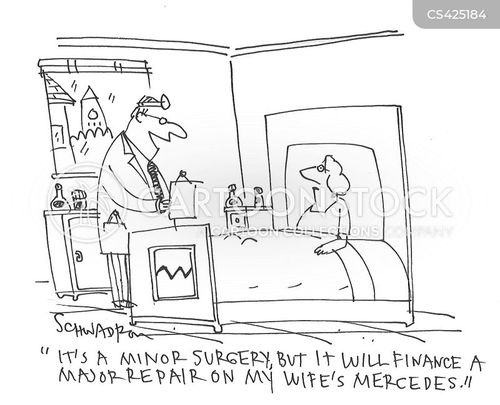
Cartoon – Minor Surgery
Diagnosing why innovation hasn’t stopped healthcare productivity declines

Autonomous vehicles. Augmented reality. Artificial Intelligence.
The world is undergoing radical transformation via technological innovation. Healthcare is not immune to this trend and has lately unleashed its own wonders from CRISPR to 3D-printed prosthesis to sensor-enabled pills. We can truly transform lives in ways unimaginable even just 10 years ago.
In other ways, however, healthcare lags.
In transportation, Google’s first “driverless” Street View cars were on the road a scant few years after the DARPA Grand Challenges of the mid-2000s that paved the way for them, and Uber become a verb in the same amount of time it takes to implement a current EHR system. Furthermore, Amazon’s chatty Alexa now interacts with you in your home, having arrived just a short time after Siri became the personal assistant in your pocket.
Healthcare innovation has been incapable of gaining similar traction even with profound technological advances.
There is an unmentionable dark side of healthcare innovation.
Advances in productivity via utilization of new tools and technologies has been anemic. Healthcare is struggling to keep pace with other industries. In fact, in a recent McKinsey study, healthcare is one of only two industries (construction is the other) that has shown a productivity decline. Read that again: Despite IT spending growth increasing by over 5 percent per year over the last 10 years, we’ve actually seen the healthcare labor pool and service environment become less efficient!

http://khn.org/news/victims-seek-payments-as-dr-death-declares-innocence/

Victims of “Dr. Death” had until this week to submit receipts for unnecessary chemotherapy, medical bills for liver damage and funeral expenses for their loved ones. By an initial count on Tuesday, 517 former patients and their families had filed claims against Farid Fata, the Detroit-area cancer doctor convicted of raking in over $17 million by poisoning patients with chemotherapy and other drugs they did not need.
Fata was branded by prosecutors as “the most egregious fraudster” in U.S. history for scamming Medicare and private insurers by giving at least 553 patients, some of whom did not have cancer, thousands of doses of unnecessary and expensive drugs. Now he insists he did nothing wrong. Breaking his silence in a jailhouse interview, Fata said victims claiming he killed loved ones or ruined their lives are misguided and that those who died were “going to die anyhow because of the nature of the diseases.”
Fata, nicknamed “Dr. Death” by his victims, is serving a 45-year sentence in a federal prison in South Carolina after pleading guilty to 13 counts of health care fraud, one count of conspiracy to pay or receive kickbacks and two counts of money laundering. He ran one of Michigan’s largest private cancer practices, with a network of clinics outside of Detroit, from 2005 to 2013.
The 51-year-old prisoner told Kaiser Health News he plans to speak in court at a Jan. 17 restitution hearing and declare his innocence. Fata said his guilty plea in 2014 came under duress, and he is preparing to seek freedom through a habeas corpus petition, by which a judge would determine if his detention is lawful.


Since the introduction of Obamacare, a growing number of physicians are part of what are called Accountable Care Organizations, where physicians, nurses and other providers are responsible for the health of their patients and the costs of that care.
The shifting landscape is rearranging incentives, and leading doctors into corners of their work they’ve rarely visited.
On a late Friday afternoon last month, the Family Health Associates practice in Charleston, West Virginia is empty.
Empty except for Dr. Julie DeTemple and her staff.
“I should be home and I’m here typing away doing my notes, charting,” DeTemple said.
The primary care doctor has had to adjust from examining patients – why she got into the business – to examining data.
Her quality time with spreadsheets has ramped up this year, now that’s she’s co-founded the Aledade West Virginia ACO, made up of 11 physician practices in the state.
The physicians constantly meet, looking for ways to improve care and cut out wasteful spending.

The Medicare Access and CHIP Reauthorization Act final rule is here. As industry experts begin to dig into the 2,400-page document released Friday, a few details are emerging that will be critical for providers who plan to practice fee-for-service medicine in 2017.
Physicians, physician assistants, nurse practitioners, clinical nurse specialists and certified registered nurse anesthetists who bill more than $30,000 a year or provide care for at least 100 patients under traditional, fee-for-service Medicare will be subject to MACRA’s Merit-Based Incentive Payment System beginning Jan. 1.
Becker’s caught up with two experts who have already started reading — Tom Lee, PhD, founder and CEO of SA Ignite, and Dan Golder, DDS, principal at Impact Advisors — to determine a few details providers should heed in preparation for MIPS next year.
Here are seven takeaways based on the initial findings of Drs. Lee and Golder.


 HENRY KOTULA