Last week, the Trump White House released a plan to reduce health care costs that is consistent with its approach to many differing questions. There was a dominant populist impulse, with several provisions targeting corporate interests for supposedly causing most of the problems consumers experience, alongside a more libertarian orientation that emphasizes patient choice and control, although the proposals tied to this theme lacked sufficient detail to be convincing. What the White House did not provide is an actionable legislative plan to lower the cost of health care for most Americans. Instead, the status quo is almost certain to prevail this year and for the foreseeable future.
That might have been the intention, as the White House probably wants to avoid a protracted debate on health care as the midterm election approaches. The administration’s one-page summary of its ideas, called “The Great Healthcare Plan,” seems to have been put together for defensive reasons. The Republican Party has been scrambling for several months to deflect Democratic attacks over the December expiration of enhanced premium credits for Affordable Care Act (ACA) insurance plans that had been approved through 2025 during President Joe Biden’s term. The Trump White House’s plan was developed to provide the Republican Party, or at least key officials in the administration, with something to talk about when opposing a straight extension of the credits.
The administration’s plan contains nine proposals that purport to boost transparency, lower costs, or give consumers more control over their health care choices. The net effect of the plan will be minimal because the causes of high and rapidly rising health costs have deep roots and cannot be addressed with surface changes that leave untouched the basic architecture of the status quo.
GOP leaders cited data from a Trump-aligned think tank to argue the ACA is “unaffordable”. Health economists say the numbers were spun and the full story tells the opposite.
In December, when Capitol Hill was consumed by a debate over whether to extend the subsidies that had held down premiums for individual health insurance under the Affordable Care Act since the COVID-19 crisis, Senate Majority Leader John Thune took to the floor to make his case against any extension.
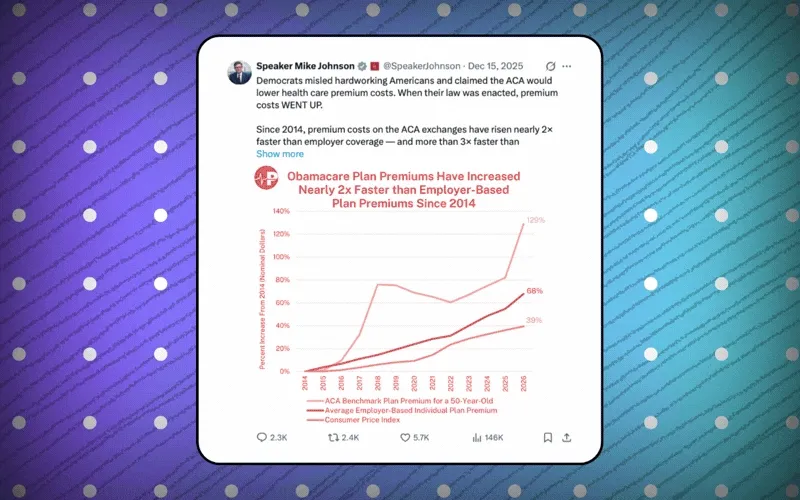
“Obamacare has utterly failed to control health care costs,” argued the South Dakota Republican, who also claimed the government-backed health plan is riddled with what he called “waste, fraud and abuse.” As Thune spoke, he stood before a supersized chart that he said clinched the case for ending the subsidies.
“This graph illustrates that, and it understates the problem,” the GOP leader said, pointing to the chart where a red line symbolizing the costs of ACA insurance jutted skyward. It made a case that since 2014 the premiums for Obamacare coverage have not just outstripped inflation but have increased more than double the rate of employer-based health plans.
In the days that followed, Thune’s GOP caucus held the line and successfully resisted a Democratic push to save the subsidies, even as many of their constituents were getting notices in the mail that their ACA-plan premiums for 2026 would increase sharply – doubling, or more, in some cases.
But some health care experts who looked at the large chart that was so central to Thune’s argument said they could not disagree more with the senator’s claim of an Obamacare affordability crisis. They note that while there was indeed a spike in ACA premium costs in 2017 and 2018 – largely the result of political decisions made by Thune’s fellow Republicans – in the years from 2019 through 2025 the ACA increases were actually lower than in employer-based insurance.
“This is being used as evidence that the individual market is, in some way, particularly inefficient – and I just don’t think there’s any reason for that,” said Matthew Fiedler, senior fellow at the Center for Health Policy at the Brookings Institute. He added: “There has been research that has compared individual-market to employer-market premiums. And what it actually finds is that individual-market premiums” – those offered under ACA – “seem to be a little bit lower than employer-market premiums.”
Thune wasn’t the only top Republican who offered the questionable statistics as a central argument for ending the Obamacare subsidies. House Speaker Mike Johnson tweeted out the same chart on the social-media site X on Dec. 15, lashing out at what he dubbed “the Unaffordable Care Act.”
But where did top Republicans get their arguably misleading information? The answer can be found in the small logo at the top of the controversial chart – that of a small and, until recently, fairly obscure Trump-aligned policy think tank called the Paragon Health Institute. It is led by Brian Blase, who was a member of Trump’s National Economic Council during the president’s first term.
Just a few years old, Paragon under Blase has positioned itself as the leading voice for a Trump-led health care overhaul that has promoted the belief that ACA-supported health insurance is both riddled with fraud and wildly inefficient for taxpayers. And its latest chart on ACA costs isn’t the first time Paragon has been accused of pushing misleading statistics to make its case.
In August, Blase and Paragon claimed that Obamacare is overrun with “phantom enrollees”– insisting that millions of ACA enrollees who’d filed no insurance claims was evidence that unscrupulous brokers had profited by signing up people without their knowledge. But Paragon’s report, which also was cited repeatedly by Republicans seeking to block the extended subsidies, was blasted by groups such as the American Hospital Association.
An AHA vice president, Aaron Wesolowski, wrote in a blog post “that Paragon developed these allegations using inaccurate data, dubious assumptions, and an apparent lack of understanding of how health insurance actually works.” He and other experts explained that while there was a real problem with 200,000 of the more than 25 million people who had signed up for coverage in the ACA marketplace, the vast number of zero-claims patients were not “phantoms” but young people who didn’t see a doctor, people who were only in Obamacare plans for months before getting a new job, or plan-switchers who were double-counted.
The story of Paragon is the health care version of a much bigger story that anyone who’s followed American politics over the last decade will recognize: How misinformation and distortions are amplified in a media and social media ecosystem.
Andrew Sprung, a health care writer who picked apart the Paragon chart on ACA costs in his Substack newsletter, said this type of propaganda “goes straight onto Fox News and into the mouth of Trump allies who deter the Republicans from cutting a deal” that might save the Obamacare subsidies and thus make health coverage more affordable for middle-class families, including their own constituents.
To Sprung and other health watchdogs, the statistical jiu-jitsu that Paragon performed in its analysis of ACA premiums versus employer-based plans is typical of how it helps ultra-conservatives win the PR wars against publicly supported health care in America. The spin helps leaders like Thune and Johnson keep their more moderate members in line.
In fact, Thune, again citing Paragon statistics, noted in his Senate floor speech that if you extend the chart back to 2013, Obamacare premiums appear to have risen some 221% – before he quickly acknowledged that this number is skewed by the difficulties insurers faced in setting rates in the first year of open enrollment.
But health care analysts note that other factors – most of them tied to Republican hostility toward any type of public health care – fundamentally undercut the argument from Paragon and its allies on Capitol Hill that Obamacare is a failure because inflation is baked into the program.
In a post headlined “Lies, damned lies, statistics, and Republican talking points about the ACA,”Sprung notes that the first spike in ACA premiums occurred in 2017 because a three-year, federally funded reinsurance program included in the original 2010 law had expired and insurers recalculated their costs based on a risk pool that was older and sicker than anticipated. As a result, premiums in the benchmark Silver plans under the ACA rose that year by 20%.
But that didn’t end the turmoil for Obamacare, because when Trump took office in 2017 and – with Blase in the White House as a policy adviser – Republicans pushed hard to repeal the ACA. That didn’t happen, of course, but the new administration did make changes like shortening the enrollment period and scaling back recruitment and marketing, as well as reducing cost-sharing payments to insurers.
The chaos the changes caused spooked insurers, who raised premiums a second time in 2018, by an average of 34%. But the failure of the ACA repeal effort in the Senate that same year ushered in a period of stability in which – contrary to Paragon’s argument about the inefficiency of Obamacare – ACA premiums actually outperformed health plans offered by employers. Sprung cited government statistics that premiums for individual plans rose from 2018-23 by 13%, compared to 29% for employer plans.
Brookings’ Fiedler agreed. “You’ll see there’s this period where premiums are actually declining in the individual market,” he said, noting that not only did insurers overshoot with the Obamacare premium hikes of the mid-2010s but that the enhanced subsidies that began under COVID-19 brought in younger, healthier enrollees while encouraging increased competition for new customers.
None of the non-fiction narrative around what has really happened in the marketplace since the passage of Obamacare supports the GOP’s core argument that health care backed by the ACA is riddled with “waste, fraud and abuse.” Instead, Paragon looks to be spinning its own storyline that is to the liking of its donors, like the billionaire libertarians of the Koch family, which supported the think tank in 2021 with a $2 million donation from the aligned organization, Stand Together. Groups aligned with Leonard Leo, the former Federalist Society officer who was the architect of the right-wing takeover of the Supreme Court, have also donated.
The failure by Congress to extend the ACA subsidies ahead of their expiration shows that the right’s deceptive spin-doctoring is working, for now.
That zeitgeist may change once the voodoo economics of a misleading line chart is swamped by the tide of horror stories about soaring out-of-pocket costs for regular folks who can no longer afford the care they need.
Congressional negotiators are working to revive the health care deal that was dropped from a government spending package in late 2024 — but the odds of resurrecting enhanced Obamacare subsidies as part of the effort appear dire.
Why it matters:
Long-stalled bipartisan priorities that are in play include an overhaul of pharmacy benefit manager practices, as well as a measure that would place more controls on Medicare outpatient spending.
They’d likely be combined with a renewal of health programs due to expire Jan. 30, including certain Medicare telehealth flexibilities and funding for community health centers.
Driving the news:
Leadership and health committees in both parties have quietly swapped offers on a package over the past week while attention was primarily focused on the fight over expired Affordable Care Act tax credits.
Democrats included a three-year extension of the ACA subsidies in their latest offer knowing that GOP leadership is likely to reject it, sources said.
That would still leave intact most of the health care deal that was destined to ride on a government funding package before it was scuttled at the last minute by Elon Musk and then President-elect Donald Trump.
What we’re hearing:
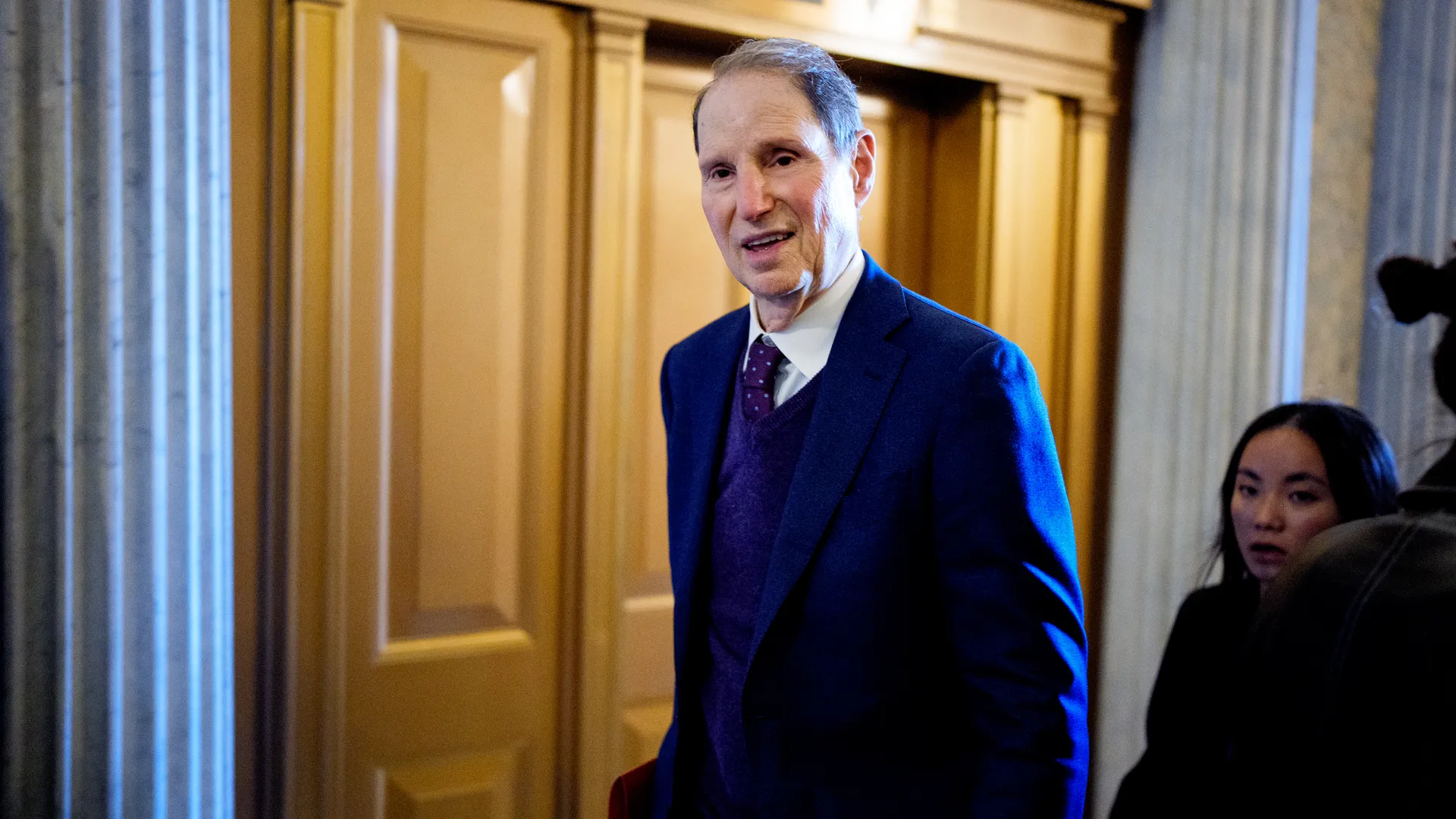
Asked about the likelihood of a health package without the ACA subsidies, Senate Finance Committee Ranking Member Ron Wyden (D-Ore.) pointed to the overwhelming 26-0 vote in his committee for the PBM overhaul in 2023.
“I’m not going to negotiate with myself but the reality is I think a 26-0 vote in the Senate … it’s like unheard of,” Wyden told Axios, adding he is “feeling upbeat” about getting the PBM bill over the finish line.
Senate Finance Chairman Mike Crapo (R-Idaho) also told Axios he is “feeling optimistic” about the PBM bill, saying there is “broad support here and at the White House.”
That measure includes provisions like “delinking” the price of a drug from PBM compensation in Medicare Part D.
The prospective package would also include a measure that would require off-campus hospital outpatient departments to have a unique identifier number.
It’s a cost-saving measure designed to prevent outpatient departments from billing payers at higher amounts associated with full-service hospitals.
But it would stop short of a full-scale, more sweeping change known as site-neutral payments that would more closely align Medicare payments to hospital outpatient departments with freestanding physician offices.
The intrigue:
The outlook for renewing enhanced ACA subsidies, which help millions of Americans afford their premiums, is much bleaker.
While a separate bipartisan group of senators continues to meet in search of a compromise, a key negotiator, Sen. Bernie Moreno (R-Ohio), told reporters on Tuesday that a release of a proposal would be punted until after next week’s Senate recess.
Even if the group can release a proposal — which would include GOP-backed changes like eliminating $0 premium plans — there is deep skepticism in both parties that it can actually pass.
Many Republicans are opposed to any kind of ACA subsidy extension, saying it is wasteful spending that benefits insurance companies.
Top Democrats are pushing for a clean subsidy extension without GOP-backed changes and blasting Republicans for blocking it, in what could be a preview of midterm campaign messaging.
Between the lines:
There still are significant divisions over whether to include new limits on the ACA funding going to plans that cover abortions.
The bipartisan group has discussed a potential compromise that would increase audits and levy penalties on insurance companies that don’t comply with existing rules requiring them to segregate taxpayer money from paying for abortions.
The idea immediately drew fire from the anti-abortion group Susan B. Anthony Pro-Life America, and many Senate Republicans think it does not go far enough.
The bottom line:
There still could be an election-year health deal — just don’t expect it to address ACA subsidies.
Tariff drama and tax cuts! AI spending and AI-spurred job losses! New Federal Reserve leadership! It is on track to be a big year across all the key policy areas of interest to economy-watchers.
The big picture:
Seismic changes have been set in motion by the Trump administration’s sweeping policy agenda and a mega-wave of investment in artificial intelligence — likely to determine the fate of the economy in 2026.
1. The AI economy
The biggest macro questions are whether the alarm bells about AI and the labor market will start to ring true — and whether the productivity effects move from just anecdotes to the economic data.
Last year, much evidence pointed to AI as a marginal part of the labor market slowdown. Some economists (and officials inside the White House) argue that broader adoption of the technology would boost the labor market, at least in the short term.
Of note:
AI spending buoyed economic growth, at least in the first nine months of 2025. It is also lifting the stock market, which might help support spending among wealthier consumers.
Whether this turns out to be a bubble that pops — and the extent such a risk poses to the broader financial system as the Fed rolls back regulations — is the related theme to watch.
That said, any correction in AI investment looks more likely to be a down-the-road story than a 2026 issue.
2. Tax cut boost
The One Big, Beautiful Bill Act, signed into law in July, is set to have its maximum economic punch in the early months of 2026, a likely tailwind for overall economic growth.
But how large, how broad-based and how sustained that boost will turn out to be remains to be seen.
Zoom in:
Fiscal policy is on track to add about 2.3 percentage points to first-quarter GDP growth, per data from the Hutchins Center Fiscal Impact Measure from the Brookings Institution.
On the individual tax side, beneficiaries of policies like a deduction for tip income, Social Security payments and expanded deductibility of state and local tax are on track to generate super-sized tax refunds this spring,
On the corporate side, businesses are enjoying new tax incentives for capital spending, especially on factories.
Federal spending on immigration enforcement, meanwhile, is ramping up due to the legislation.
3. Trade uncertainty (maybe) resolving
Any day now, the Supreme Court will hand down a decision that might scramble the centerpiece of President Trump’s economic agenda: the ability to impose huge tariffs unilaterally.
If the court strikes down the bulk of Trump’s tariffs, fiscal revenues could be put at risk, resulting in a chaotic refund process.
That said, the ruling will help create some guardrails on what kinds of legal authority the president has to impose unilateral tariffs. That, in turn, could lead to a more stable tariff picture (albeit with much higher rates than pre-2025).
While there are other authorities the president can use to enact tariffs besides the sweeping authority under the International Emergency Economic Powers Act he has claimed, they require a more deliberative process than the kind of whipsawing that importers faced last year.
4. Future of the Fed
Fed chair Jerome Powell’s term is up in May, and Trump’s selection of his successor is imminent, with Kevin Hassett and Kevin Warsh the leading job candidates.
Zoom out:
Whoever takes the reins will face immense pressure from Trump to lower interest rates to rock-bottom levels — amid continued high inflation — and how they handle that pressure may determine the future of the central bank’s independence from the White House.
Trump expects the future Fed chair to consult with him on rates, while casting the intention to lower rates as a key qualification for the next leader.
The question is whether the next Fed chair can resist that political pressure and whether financial markets believe that is the case. If bond markets lose confidence that the Fed will raise short-term rates if necessary to combat an inflation surge, it could paradoxically drive up long-term rates.
Another huge question: the makeup of the influential Fed board, with the Supreme Court also set to decide whether Trump can fire governor Lisa Cook and, by extension, other Biden-appointed governors.
5. Affordability and the midterms
With voters going to the polls in November, the cost of living is emerging as a core battleground.
Democrats seeking to take control of Congress are making political hay about the affordability crisis.
Trump has called the term affordability a “con job,” but said recently that he believes “pricing” will be a major election issue.
Flashback:
The Consumer Price Index is up a moderate 2.7% over the last 12 months, but that increase came on top of the Biden-era inflation surge.
The index is up 23.7% since January 2021, even more for some often-purchased subcategories, including groceries (up 24.6%).
Over the holiday break, the administration quietly shelved plans to impose levies on imported pasta and furniture.
It’s a hint that the White House is eager to avoid trade levies that might flow directly to prices consumers pay, as opposed to affecting input costs for businesses.
Millions of ACA enrollees will face steep premium hikes in 2026 as insurer rate increases collide with the expiration of enhanced federal subsidies.
As health insurance premium costs have taken center stage this fall, you may have seen seemingly conflicting reports about how much premiums are increasing, especially for ACA marketplace plans. This isn’t a reporting error. Instead, it reflects a double whammy of increases that more than 20 million ACA enrollees are poised to face in 2026.
To understand what’s happening, it helps to think of ACA premium increases as a one-two punch.
The first hit comes from the overall increase in health insurance premiums for 2026. On average, insurers raised premiums for ACA marketplace plans by roughly 26 percent from 2025 to 2026. This increase reflects a rise in the total cost of coverage, the full premium paid jointly by enrollees and the federal government through subsidies, not just what individuals pay out of pocket.
Premium increases are not new. Insurers raise rates every year. But the 2026 hike is striking: more than three times the 7 percent increase in 2025 and the 6 percent increase in 2024. Insurers have attributed roughly four percentage points of this increase to the anticipated expiration of the enhanced premium tax credits, arguing that enrollment will decline and that sicker, higher-cost enrollees will make up a larger share of the risk pool. Insurers also cite provider consolidation and high pharmaceutical prices as drivers of higher premiums.
These explanations deserve scrutiny. As Wendell Potter recently documented, the seven largest private insurance corporations have collectively taken in more than $10 trillion in revenue since 2014 with revenues steadily increasing each year. Against that backdrop, claims that today’s premium spikes are unavoidable or purely defensive ring hollow.
The second hit falls directly on consumers who currently rely on enhanced premium subsidies (in the form of tax credits) to make coverage affordable. Those enhanced subsidies, first made available during the pandemic, are set to expire at the end of 2025, and Congress appears poised to let them lapse without an extension. If that happens, many enrollees will see the tax credits that lower their monthly premiums shrink dramatically or disappear altogether. Taking this into account, the amount people pay out of pocket for ACA premiums is expected to increase by an estimated 114 percent in 2026. And that is just for the premiums. People enrolled in ACA plans will also have to spend hundreds if not thousands of dollars out of their own pockets in deductibles and copays before their coverage kicks in.
This double whammy will have drastic, and potentially deadly, consequences for millions of Americans. I am already seeing panic from people in my own community and across the country, echoed daily on social media. Yet Congress has taken no action to cushion the blow. The Republicans leading both the House and the Senate are leaving Washington without extending the enhanced tax credits, even as the clock runs out.
This is an abdication of Congress’s responsibility to represent the people it serves, people who have been clear about what they want and need: health insurance they can actually afford. Rather than getting bogged down in partisan gridlock or abstract market ideology, Congress must act now to extend the enhanced premium tax credits. That extension should be treated as an urgent bridge to a real fix to our health care system; one that reduces dependence on Big Insurance, lowers costs for patients, and ensures that no one is forced to go without care.
There’s likely to be one more round of health care votes in the House next week after the Senate votes down two rival Affordable Care Act subsidy proposals Thursday — but they won’t get any closer to extending the enhanced subsidies.
Why it matters:
Those subsidies now appear certain to expire at the end of the year, short of a last-minute breakthrough — and out-of-pocket premium costs will more than double on average for roughly 20 million ACA enrollees.
Driving the news:
The Democratic proposal that will get a Senate vote Thursday would extend the enhanced subsidies for three years, while the Senate GOP proposal would not extend the subsidies but instead provide money for health savings accounts.
Both will fail to get the needed 60 votes.
Senate Majority Leader John Thune (R-S.D.) has left the door open for further bipartisan talks after both votes fail, but there is deep skepticism in both parties that any such deal is possible.
Sen. Tim Kaine (D-Va.) said it’s possible there is “additional discussion” after the failed votes, but said the issue also might end up in a “political solution in November when people pick the side that’s for them.”
The latest:
House GOP leaders outlined a range of possible health care options on Wednesday morning, but they have little to do with the subsidies, which weren’t included in their plans.
GOP leaders will bring “consensus” bills to the floor next weekthat aim to lower health care costs, a source who attended House Republicans’ Wednesday morning conference meeting told Axios.
Those could include expanding health savings accounts and association health plans, which allow employers to band together to purchase coverage.
Overhauling pharmacy benefit managers with the goal of lowering drug costs was also discussed, along with funding ACA payments known as cost-sharing reductions (CSRs).
The intrigue:
On the House side, a bipartisan group of moderates including Reps. Brian Fitzpatrick (R-Pa.) and Jared Golden (D-Maine) filed a discharge petition, a procedural move to force a vote on a compromise extension plan.
But that effort to go around House GOP leadership faces long odds against getting the required majority of the chamber to sign on.
Modifications to the subsidies in that plan designed to win over GOP votes, like a crackdown on zero premium plans that backers say fuel fraud, could lose Democratic support due to concerns about coverage loss.
Democratic leaders havebeen focused on a clean three-year extension, saying that is the clearest way to address the issue with little time remaining to implement changes before the new coverage year starts Jan. 1.
House Democratic Leader Hakeem Jeffries (N.Y.) told reporters Wednesday he has no position on the discharge petition.
The bottom line:
There is also deep resistance to a subsidy extension among many Republicans.
Thune has said he thinks Democratic leadership is more interested in a “political messaging” vote this week than in entertaining reforms to the subsidies that Republicans point to.
Even if members in either chamber are able to make progress on a consensus compromise subsidy plan, which in theory could be attached to a government funding bill needed before Jan. 30, the divisive issue of abortion hangs over all of the discussions.
Many Republicans insist on new limits preventing the subsidies from going to insurance plans that cover abortion. Democrats say that is a dangerous expansion of safeguards that already require taxpayer funds to be segregated and not pay for abortion coverage.
The Senate will vote tomorrow on dueling health care plans: Democrats’ proposal to extend enhanced Affordable Care Act subsidies for three years, and a plan from two Republican chairmen that would instead give enrollees funds in health savings accounts.
Why it matters:
The move gives the GOP an alternative to point to if the ACA subsidies expire at the end of the year and health care costs spike for millions of people.
But neither plan is expected to get the 60 votes to advance.
Driving the news:
The plan from Finance Committee chair Mike Crapo (R-Idaho) and health committee Chair Bill Cassidy (R-La.) wouldn’t extend the tax credits past their year-end expiration, instead providing $1,000 to $1,500 in health savings accounts to help certain marketplace enrollees with out-of-pocket costs.
It’s drawn sharp criticism from some Democrats for leaving working-class Americans saddled with high health costs.
Senate Majority Leader John Thune (S.D.) left open the possibility of talks after both votes fail on Thursday, though there is deep skepticism about the chances of reaching a bipartisan agreement.
“If neither proposal gets 60 then we’ll see where it goes from there,” Thune said.
President Trump, asked later about the Crapo-Cassidy bill and whether Republicans should vote for it, told reporters, “I like the concept. … I love the idea of money going directly to the people.”
Between the lines:
On the House side, GOP leadership, committee chairs and leaders of House GOP factions met yesterday to discuss health proposals, with an eye toward a possible House vote this year.
Members left the meeting tight-lipped, saying discussions are ongoing.
The full House Republican conference is expected to discuss health proposals in its meeting this morning ahead of potential votes next week.
Sen. Bernie Sanders (I-Vt.) is urging Senate Democrats to unite behind an expansive health care proposal in the party’s negotiations with Republicans to extend Affordable Care Act tax credits.
Why it matters:
GOP leaders have promised Democrats a vote on the expiring tax credits next month as part of their deal to end the government shutdown.
Sanders wants the Democratic proposal to extend the ACA tax credits, repeal $1 trillion in GOP health care cuts, expand Medicare and lower prescription drug prices, he said in a letter to colleagues late Monday.
Republicans, however, have signaled that any deal to extend the tax credits must be short term and require reforms.
Premiums will more than double for millions of ACA enrollees next year if Congress does not renew enhanced marketplace subsidies by year’s end, according to a new analysis.
The big picture:
Democratic leaders have argued that the government shutdown has made health care a top political issue.
Sanders, the top Democrat on the Senate Health, Education, Labor and Pensions Committee, said Democrats must make proposals that address “systemic deficiencies.”
“We should not be defending a system which is not only, by far, the most expensive in the world, but one which numerous international studies describe as one of the worst,” Sanders wrote to Democratic senators.
Sanders’ HELP committee is expected to be involved in negotiations with Republicans over a potential bipartisan deal to extend the credits next month.
A spokesperson for Senate Minority Leader Chuck Schumer (D-N.Y.) said: “The bill Democrats bring to the floor will be a caucus product.”
Between the lines:
Sanders acknowledged in his letter that his Medicare For All proposal “does not yet have majority support” in the caucus. But he said his latest proposal included “much-needed reforms.”
Sanders also encouraged Democrats to propose investments to expand primary care services, ban stock buybacks and dividends and substantially reduce CEO compensation in the health care industry.
Republicans are taking a harder line against extending enhanced Affordable Care Act subsidies — and doubling down on an alternative plan that would send the money directly to consumers.
Why it matters:
President Trump’s opposition to an extension makes it increasingly unlikely that Republicans will agree to renew the tax credits, even though it’s not clear how the GOP alternative would work or whether the party can reach a consensus.
Driving the news:
Trump wrote on Truth Social on Tuesday that the “only” plan he will support is “sending the money directly back to the people,” and that Congress should not “waste your time” on anything else, like a subsidy extension.
Trump didn’t elaborate on how his plan would work. The ACA already gives people financial help in buying insurance.
Some GOP proposals envision giving people money for a health savings account on top of existing ACA coverage, mitigating concerns about healthy people leaving the market.
Senate health committee Chair Bill Cassidy (R-La.) outlined a plan on Monday that would redirect the enhanced subsidy money to an HSA to help pay out-of-pocket costs for people who chose bronze-level ACA plans, which tend to have high deductibles.
He argued the move would direct money away from insurance companies and to consumers, and empower them to shop for health services.
Anotherpossible outcome would be allowing people to buy cheaper, skimpier coverage that doesn’t comply with the ACA’s benefit requirements. Some policy experts warn that would destabilize the ACA markets, by prompting an exodus of healthier people.
That would leave a sicker risk pool and prompt insurers to raise premiums, resulting in a “death spiral,” said Larry Levitt, executive vice president for health policy at KFF.
By contrast, “I don’t think there’s any risk of, you know, a collapse or death spiral, from what Senator Cassidy is talking about,” Levitt said, though without the enhanced subsidies there would still be “potentially millions of people who just won’t be able to afford insurance at all.”
Between the lines:
Senate Majority Leader John Thune (R-S.D.) wouldn’t rule out a bipartisan solution when asked about Trump’s comments on Tuesday, saying “we’ll see” how negotiations go and that “there’s an openness” to a deal on the GOP side.
He said the biggest obstacle, though, could be whether Democrats agree to apply the Hyde Amendment to the subsidies and add restrictions on using the funds for abortions.
The intrigue:
Cassidy is framing his plan as the most realistic option, given White House and House GOP leadership resistance to the subsidies.
“The president is not going to sign a straightforward extension of premium tax credits,” Cassidy said. “So if you actually want something which can pass and get a vote on the House floor, then what the president is proposing is actually a better way.”
Yes, but:
Democrats believe mounting public concern about rising health costs gives them the upper hand pushing for a subsidy extension.
“Sending people a few thousand dollars while doing nothing to lower health care costs is a scheme to help the ultra-wealthy at the expense of working people with cancer or pre-existing conditions,” Senate Democratic Leader Chuck Schumer said in response to Trump’s comments.
“Americans want Congress to extend the ACA tax credits to keep health insurance premiums from skyrocketing on January 1,” he added.
The big picture:
The war of words is further diminishing the chances that a group of moderates in both parties can find a bipartisan agreement to extend the subsidies with some modifications favored by Republicans, like an income cap and anti-fraud measures.
House GOP leaders have also been criticizing the subsidies. House Majority Leader Steve Scalise (R-La.) said on Fox News on Sunday that the party would be bringing forward legislation in the coming weeks on other ways to lower costs, like expanding HSAs or cracking down on pharmacy benefit managers.
The Senate Finance Committee will hold a hearing Wednesday morning on health care costs, giving senators a chance to stake out their positions further in public.
The bottom line:
It’s unlikely that Trump’s plan would gain the necessary 60 Senate votes to advance. But it could give Republican senators political cover if they oppose a subsidy extension.
Republicans could still opt to use the reconciliation process to pass a bill with a simple majority. Though the White House floated the idea on Tuesday, it’s not clear if any GOP-only plan has the votes to pass.
The cost of hiring help to care for an elderly or a sick person at home is skyrocketing.
Why it matters:
A labor shortage and surging demand from an aging population was already driving up prices, and nowthe White House’s crackdown on immigration and funding cuts are making things worse.
By the numbers:
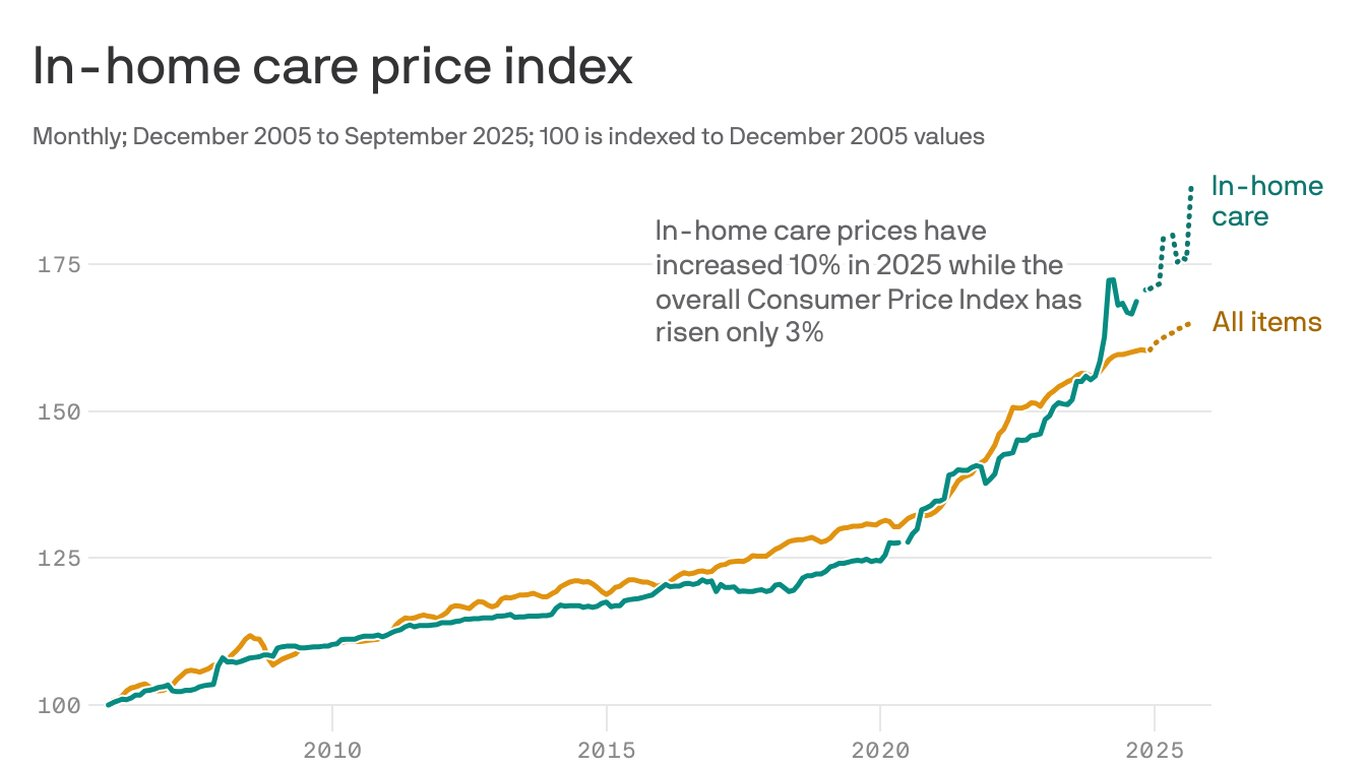
So far this year, the price of in-home care for the elderly, disabled or convalescent at home is up 10%, compared with a rise of 3% for prices overall, according to government data.
From just August to September, prices for home health care spiked a staggering 7%.
Zoom in:
Rising prices and the limited availability of people who do this work are pushing families to make hard choices. Some will put relatives and loved ones into institutions, a more expensive and often less desirable option than staying at home.
Others will drop out of the workforce or cut back their hours to care for parents, relatives or partners.
The supply of workers is not keeping up with demand, Matthew Nestler, senior economist at KPMG, writes in a post. “That hurts workers and their families, employers and the overall U.S. economy.”
Friction point:
Last year, employment was surging in home health care, with an average of 13,500 jobs added each month.
But after the Trump administration immigration crackdown began in January, employment dropped off, falling into negative territory for three consecutive months in the spring, Nestler noted this summer.
This isn’t a matter of demand falling, but a cutoff in supply, he explained.
How it works:
Immigrants make up 1 in 3 workers in home care settings, per data from KFF, a health care research organization.
The severe crackdown this year on undocumented immigrants and the Trump administration’s removal of legal status from workers who are here from Venezuela and other countries are making it hard to find workers, says Mollie Gurian, vice president of policy and government affairs at LeadingAge, an aging-services nonprofit.
“The supply of workers was already so low,” she says. With fewer folks available, the companies that provide these service are raising prices to put pressure on demand. Others are raising prices in anticipation of cuts to Medicaid funding, she says.
The big picture:
At the same time that the supply of people to do this work is falling, the number of Americans who need care is rising, as a silver tsunami of baby boomers ages.
The bottom line:
We are only at the very beginning of a dramatic demographic shift, Nestler says.
Elder care is a “ticking time bomb that no one’s talking about.”






 HENRY KOTULA