Rampaging goats and $10 million mansions: your guide to the weird world of Obamacare rhetoric

Rampaging goats and $10 million mansions: your guide to the weird world of Obamacare rhetoric

The Obamacare repeal effort is just getting underway and already the political wordplay is dizzying. On the GOP side, the rhetoric has gone from “repeal and replace” to “insurance for everybody” to “repair and rebuild.” Meanwhile, Democrats continually warn that the Republicans are trying to “rip apart our health care system.”

To help you keep pace with the debate, we’ve assembled this handy glossary of buzzwords and talking points. Enjoy.

From the Republicans:

Repair and rebuild

This is the GOP’s attempt to describe its legislative strategy for Obamacare, and an evolution of the phrase “repeal and replace.” As Politico reported Thursday, it is the mantra of Oregon Representative Greg Walden, who is leading the offensive against Obamacare in the House. It is meant to soften the GOP’s tone and suggest the replacement effort will be carefully staged and surgical. It also opens the door to delay tactics if things don’t quickly shape up in the GOP’s favor.

From the Democrats:

‘Make America Sick Again’

A play on Donald Trump’s campaign slogan, this phrase emerged in early January as Democrats held rallies to generate support for Obamacare. Judging by the nation’s $3.2 trillion tab for health care costs in 2015, a number expected to jump as high as $3.6 trillion this year, it seems clear a lot of us are pretty sick already. But you get the point.

Get Health Insurance Through Your Employer? ACA Repeal Will Affect You, Too

http://healthaffairs.org/blog/2017/01/11/get-health-insurance-through-your-employer-aca-repeal-will-affect-you-too/

Close-up photograph of an employee group health insurance application form.

Much of the recent attention on the future of the Affordable Care Act (ACA) has focused on the fate of the 22.5 million people likely to lose insurance through a repeal of Medicaid expansion and the loss of protections and subsidies in the individual insurance market. Overlooked in the declarations of who stands to lose under plans to “repeal and replace” the ACA are those enrolled in employer-sponsored health plans — the primary source of coverage for people under 65.

Job-based plans offered to employees and their families cover 150 million people in the United States. If the ACA is repealed, they stand to lose critical consumer protections that many have come to expect of their employer plan.

It’s easy to understand the focus on the individuals who gained access to coverage thanks to the health reform law. ACA drafters targeted most of the law’s insurance reforms at the individual and small-group markets, where consumers and employers had the greatest difficulty finding affordable, adequate coverage prior to health reform. The ACA’s market reforms made coverage available to those individuals with pre-existing conditions who couldn’t obtain coverage in the pre-ACA world, and more affordable for those low- and moderate-income families who couldn’t afford coverage on their own.

Less noticed, but no less important, the ACA also brought critical new protections to people in large employer plans. Although most large employer plans were relatively comprehensive and affordable before the ACA, some plans offered only skimpy coverage or had other barriers to accessing care, leaving individuals—particularly those with costly, chronic health conditions—with big bills and uncovered medical care. For that reason, the ACA extended several meaningful protections to employees of large businesses.

When It Comes to Seeing a Doctor in California, the Uninsured Still Fare Worst

http://www.chcf.org/articles/2017/01/when-seeing-doctor

California Physicians Accepting New Patients by Payer, 2015

With repeal of the Affordable Care Act (ACA) on the horizon, and no replacement plan in sight, millions of Californians are at risk of losing their coverage. Approximately 5 million Californians are currently covered under the ACA. The state’s uninsured rate, which hit a historic low under the ACA, could start to rise again depending on what happens in Washington in the coming weeks and months.

It’s worth remembering the multiple barriers that people without insurance face in our health care system. I am reminded of some key findings from a 2015 survey of California physicians that the University of California, San Francisco, released last fall with support from the California Health Care Foundation.

The survey asked, among other questions, if physicians were accepting new patients who had various types of insurance (private, Medicare, or Medi-Cal) or who were uninsured. The survey also asked physicians if any of their existing patients were uninsured.

As the slides below show, the uninsured face the hardest time getting accepted into a physician’s practice. Only 38% of all California physicians said they accepted new uninsured patients in 2015; only 55% said they had any uninsured patients. The sample of physicians includes emergency department (ED) doctors who are legally required to see all persons who come to an ED, regardless of whether they have insurance.

Repealing Obamacare without replacement would hike premiums 20% and leave 18 million uninsured, report says

http://www.latimes.com/politics/la-na-obamacare-repeal-costs-20170117-story.html

Image result for Repealing Obamacare without replacement would hike premiums 20% and leave 18 million uninsured, report says

Repealing Obamacare without a replacement would result in higher costs for consumers and fewer people with insurance coverage, according to a report Tuesday from the nonpartisan Congressional Budget Office.

In the first year, insurance premiums would jump by 20% to 25% for individual policies purchased directly or through the Obamacare marketplace, according to the report. The number of people who are uninsured would increase by 18 million.

Those numbers would only increase in subsequent years. Premium prices would continue to climb by 50% the next year, with the uninsured swelling to 27 million, as full repeal took effect, the report said.

Americans may be beginning to worry about such costs. For the first time, more Americans view the Affordable Care Act as a “good idea,” rather than a bad one, according to a new Wall Street Journal/NBC News poll also released Tuesday.

Hospital uncompensated care costs fall to lowest level in 26 years: 4 things to know

http://www.beckershospitalreview.com/finance/hospital-uncompensated-care-costs-fall-to-lowest-level-in-26-years-4-things-to-know.html

Image result for uncompensated care

From 1990 through 2015, U.S. hospitals’ uncompensated care costs totaled $704.7 billion, according to a recent American Hospital Association report.

To calculate a hospital’s uncompensated care costs, the AHA combined the hospital’s bad debt and financial assistance costs. The uncompensated care figure does not factor in Medicare or Medicaid underpayments or other contractual allowances.

Using that formula, the AHA has calculated national uncompensated care costs from 1990 through 2015.

Here are four things to know about hospital uncompensated care costs, according to the AHA report.

1. In 1990, total uncompensated care costs were $12.1 billion, representing 6 percent of total hospital expenses.

2. Although total uncompensated care costs steadily increased from 1990 to 2000, the costs consistently represented about 6 percent of total expenses. During that period, uncompensated care costs represented the smallest percent of total expenses in 1992 at 5.9 percent and the largest percent in 1999 at 6.2 percent.

3. From 2000 to 2015, national uncompensated care costs fluctuated, reaching a high of $45.9 billion in 2012, which represented 6.1 percent of total expenses.

4. In 2015, total uncompensated care costs were $35.7 billion, representing 4.2 percent of total expenses — the lowest level in 26 years.

Poll: Public Divided on Repealing Obamacare, But Few Want It Repealed Without Replacement Details

http://connect.kff.org/poll-public-divided-on-repealing-obamacare-but-few-want-it-repealed-without-replacement-details?ecid=ACsprvtG5kIoCbXzcE3WLgrX01kIXFDaDUgXQ0BUzNGGn2gIr2haSAC8OzTQSp0H3e0Qeujg-Q9Y&utm_campaign=KFF-2017-January-Priorities-Tracking-Poll&utm_source=hs_email&utm_medium=email&utm_content=40166809&_hsenc=p2ANqtz-_zwF7NlvPoFINfG9Nd0OPcBebPHjaaSvuWqkCefkoOcmCo9aOPqJHM0W6_uhOAYH4ucOOIuXrEe40HttSNtSg8udNc1A&_hsmi=40166809

1.6.17 - 2017 tracking email alert - image 2.png

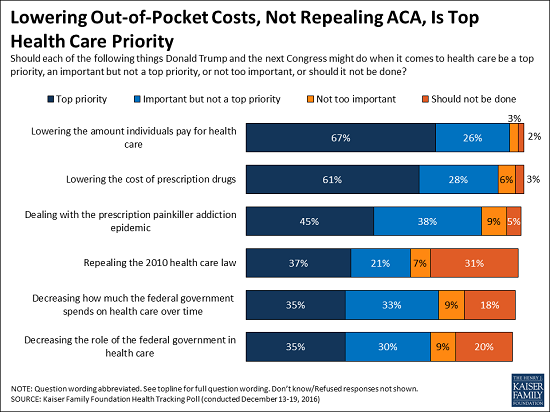
Out-of-Pocket Costs, Not the Affordable Care Act, Top Public’s List of Health Care Priorities for new Administration and Congress

As Congress begins to work on repealing and replacing the Affordable Care Act, the latest Kaiser Health Tracking Poll finds that one in five Americans (20%) support repeal alone, while three quarters either oppose repeal altogether (47%) or want to wait to repeal the law until the replacement plan’s details are known (28%).

Overall, the poll finds that nearly equal shares say that the next Congress should vote to repeal the law (49%) and that it should not vote to repeal it (47%), which mirrors the public’s overall views of the 2010 law (46% view it unfavorably, 43% favorably).

The debate surrounding repeal could influence the public’s views, as the poll finds that some people shift their opinions after hearing counter-arguments.  For example, after hearing pro-repeal arguments about the law’s costs to individuals and the government, the share of the public supporting repeal grows as large as 60 percent, while anti-repeal arguments about people losing coverage and the impact on people with pre-existing conditions decreases support for repeal to as low as 27 percent.

When asked directly about their family’s health care costs, similar shares of the public say repealing the Affordable Care Act would make their situation worse (28%) as say it would make it better (27%). Most say their own ability to get and keep health insurance (55%) and the quality of their own health care (57%) will stay about the same if Congress votes to repeal the law.

GOP won’t promise ObamaCare fix will cover all

GOP won’t promise ObamaCare fix will cover all

Image result for uninsured

Republican leaders are refusing to commit to their ObamaCare replacement plan covering as many people as President Obama’s health law.

Congressional Republicans are quickly moving forward to pass a repeal of ObamaCare and say a replacement plan will come later this year.

But it’s unclear whether that eventual replacement will provide insurance options for at least 20 million people, the number who gained coverage under ObamaCare, amid worries that many could lose their health insurance.


More than 50 million adults with pre-existing conditions would lose coverage in wake of Obamacare repeal, Kaiser study says

http://www.healthcarefinancenews.com/news/more-50-million-adults-pre-existing-conditions-would-lose-coverage-wake-obamacare-repeal-kaiser

Image result for pre-existing conditions

Kaiser Family Foundation poll found the 53 percent of people reported that they or someone in their household has a pre-existing condition.

Crossing the Political Chasm

http://www.commonwealthfund.org/publications/blog/2016/dec/crossing-the-political-chasm

As a new chapter in the saga of U.S. health care reform is written in the coming year, it’s worth remembering that, behind the layers of jargon and obscure political maneuvers, the consequences of success—and of failure—will be shared by individuals and groups across our society…regardless of ideology, demography, or geography.

After the Election, the Public Remains Sharply Divided on Future of the Affordable Care Act

http://connect.kff.org/after-the-election-the-public-remains-sharply-divided-on-future-of-the-affordable-care-act?ecid=ACsprvtkG7thn0KvqmasXGGSnW1I2ovnfcZhoigDXi-aw9Wa_OhWGcyqpjasxqgfF_XFOsbs0N1f&utm_campaign=KFF-2016-November-Tracking-Poll&utm_source=hs_email&utm_medium=email&utm_content=38490459&_hsenc=p2ANqtz–qXSbCJ4pmKneag47QgP5kargBeYht5Al3rljRS8wEAQj-n-71yE8rwo5xn_Bg9Nwp-C89R9o_HVKBqqv5G6aMyddn9g&_hsmi=38490459

november poll1.png

Among Those Who Favor Repeal, Arguments About Loss of Coverage for Those with Pre-Exiting Conditions Can Sway Some Opinions

Many Obamacare Provisions Remain Broadly Popular Across Party Lines, But Not its Mandate

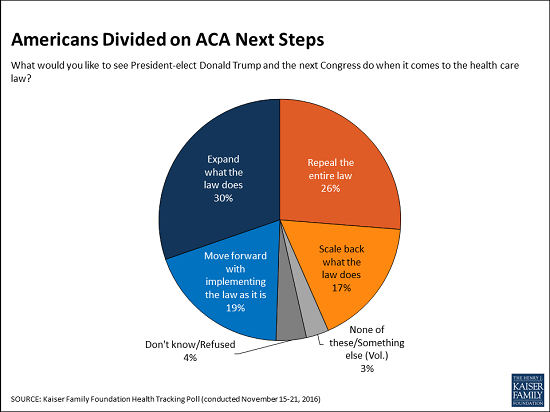
The first Kaiser Health Tracking Poll since the 2016 election finds that Americans are largely divided on the future of the Affordable Care Act even though many of the law’s major provisions remain quite popular across party lines.

The new survey finds that one fourth (26%) of Americans want to see President-elect Donald Trump and the next Congress repeal the entire law, and an additional 17 percent want them to scale back what the law does. This compares to 30 percent of the public who want to see the law expanded and 19 percent who want to see lawmakers move forward with implementing the law as it is.

The poll captures a slight uptick in the share of Americans who want lawmakers to scale back the law as well as a decrease in the share who want lawmakers to repeal the entire law.  This is largely driven by Republicans: About half (52%) of Republicans now say they want to see the Affordable Care Act repealed, down from 69 percent in October. At the same time, a quarter (24%) of Republicans now want to see the law scaled back, up from 11 percent in October.

Among the quarter (26%) of Americans that want to see the Affordable Care Act repealed, 31 percent want to see the health care law just repealed and not replaced. About two-thirds wants lawmakers to repeal the health care law and replace it with a Republican-sponsored alternative, with 42 percent wanting lawmakers to wait to repeal it until the details of a replacement plan have been figured out and 21 percent wanting lawmakers to repeal it immediately and figure out a replacement plan later.

Among those who want the law repealed, 38 percent (or 10% of the public overall) change their opinion after hearing the argument that repealing the ACA would mean that insurance companies could deny coverage to people with pre-existing conditions. A slightly smaller share change their opinion after hearing that more than 20 million Americans could lose their coverage.