Collins’ Obamacare deal faces moment of truth

https://www.politico.com/story/2017/12/08/susan-collins-obamacare-deal-213254

Image result for short changing healthcare

House conservatives thumb their nose at the Maine moderate’s bid to slow the demise of the health law.

Sen. Susan Collins is barreling toward yet another health care showdown with her own party. But this time, she might not have the leverage to get what she wants.

Republicans who watched Collins lead the rebellion over the GOP’s Obamacare repeal effort just three months ago are playing tough on yet another high-stakes bill, wagering they can do without the Maine moderate’s swing vote and still claim a narrow year-end legislative win on tax reform.

Collins went along with the tax bill that repeals Obamacare’s individual mandate after Senate Majority Leader Mitch McConnell pledged to pass a pair of bills propping up Obamacare’s shaky insurance markets, including a bipartisan deal resuming payments on key subsidies that President Donald Trump halted in October.

But Speaker Paul Ryan has made clear he’s not bound by the deal, and there’s little urgency among House Republicans to do much of anything on health care before the end of the year. On Thursday, Republican Study Committee Chairman Mark Walker said conservatives received assurances that talks on a spending package to keep the government open won’t address Obamacare.

“The three things we were told are not gonna happen as part of our agreement: no CSRs, no DACA, no debt limit,” he said, referring to efforts to fund Obamacare’s cost-sharing subsidies.

That could cost Collins’ support after she signaled that her vote on the final bill may hinge on the fate of the health care measures.

She told a Maine CBS affiliate Thursday night that she’d wait to see the final language from the conference committee working on the tax bill before committing her vote.

“I won’t make a final decision until I see what that package is,” Collins told CBS WABI 5.

One bill, known as Alexander-Murray, would temporarily restore subsidies to insurers. The second would fund a two-year reinsurance program helping health plans cover particularly expensive patients.

Senate Republicans can only afford two defections and still pass the tax bill using a fast-track procedure that requires a simple majority, with Vice President Mike Pence ready to cast the tie-breaking vote. The margin would become razor thin if Collins holds out, and Sen. Bob Corker maintains his opposition over concerns about the bill’s impact on the deficit.

Yet House Republicans still chafing over the Senate’s failure to repeal Obamacare insist they won’t bend to Collins’ demands. And while Senate Republicans are trying to keep Collins in the fold, there’s little apparent worry so far that her opposition would sink the tax effort.

“I think you guys have to find something else to be concerned about,” said Sen. Tim Scott, one of the 17 GOP lawmakers assigned to merge the House and Senate versions of the tax plan.

Sen. Lamar Alexander, who coauthored Alexander-Murray and has championed its inclusion in a year-end agreement, also waved off the need to pressure House Republicans on the issue.

“The House knows our position,” he said. “When they see that they can lower premiums 18 percent … reduce the debt, reduce the amount of money going to Obamacare subsidies, I think it’ll be a Christmas present they’ll want to give to their constituents.”

One of the few moderates in a Republican conference that narrowly controls the Senate, Collins has regularly used her voice and vote to extract concessions from GOP leaders and ensure she’s a central figure in negotiations.

During the health care debate, she urged the GOP to protect Medicaid and preserve more subsidies for people to buy insurance. When they stuck with their blueprint, Collins joined fellow Republicans Lisa Murkowski and John McCain in a dramatic vote that killed the months-long repeal bid.

And in the run-up to the Senate’s late-night tax vote, she secured three late changes to the bill, including the expansion of a provision allowing people to deduct hefty medical bills that House Republicans had voted to eliminate entirely.

That was on top of McConnell’s “ironclad commitment” to tackle the two health care bills at year’s end — measures that Collins claims will help offset premium increases stemming from the bill’s repeal of Obamacare’s mandate that most Americans be insured.

Collins said Thursday she considers House passage of those Obamacare bills part of that commitment, even though McConnell has only publicly agreed to “supporting passage” of them and can’t singlehandedly force the House to take up legislation.

Ryan hasn’t officially ruled out the possibility, but declined to commit to rolling either of the bills into upcoming spending agreements. Conservatives have loudly opposed any aid for Obamacare, and even moderates who support stabilizing the health law have shrugged at the exact timing.

“What the vehicle is to get it through the system, in the House and the Senate to the president’s desk, I’ll leave that to our leadership,” said Rep. Tom Reed, who co-chairs the bipartisan Problem Solvers Caucus.

Collins insists she’s taking the long view, claiming progress Thursday on trying to win over House Republicans during rounds of private negotiations.

“I remain confident, despite your skepticism, that we will eventually get that,” she said.

And as the GOP learned during the repeal debate, the whip count could shift suddenly. Sens. Jeff Flake and Ron Johnson remain wild cards, and either could conceivably join Corker and Collins in torpedoing the tax bill if they dislike the final version.

For now though, Republican leaders are signaling once again that Collins may not get everything she wants on health care — and gambling it won’t cost them a second time.

“I think that these are separate issues,” said Sen. David Perdue. “I’m hopeful that that won’t derail this [tax bill]. We’ve got to get it this done and get it on the president’s desk.”

Challenges Abound For 26-Year-Olds Falling Off Parental Insurance Cliff

https://khn.org/news/challenges-abound-for-26-year-olds-falling-off-parental-insurance-cliff/

Marguerite Moniot felt frustrated and flummoxed, despite the many hours she spent in front of the computer this year reading consumer reviews of health insurance plans offered on the individual market in Virginia. Moniot was preparing to buy a policy of her own, knowing she would age out of her parent’s plan when she turned 26 in October.

Marguerite Moniot recently purchased health insurance on the open market with the help of a health navigator. She and her parents began searching for a policy several months ago, but the details of each plan became too complicated for the family. (Courtesy of Marguerite Moniot)

She asked her parents for help and advice. But they, too, ran into trouble trying to decipher which policy would work best for their daughter. The family had relied on her father’s employer-sponsored plan through his work as an architect for years, so no one had spent much time sifting through policies.

“Honestly, my parents were just as confused as I was,” said Moniot, a restaurant server in Roanoke.

In defeat, just before Thanksgiving, she went with her mother to meet a certified health insurance navigator, buying a policy that allowed her to keep her current doctors.

A new crop of young people like Moniot are falling off their parents’ insurance plans when they turn 26 — the age when the Affordable Care Act stipulates that children must leave family policies.

They were then expected to be able to shop relatively easily for their own insurance on Obamacare marketplaces. But with Trump administration revisions to the law and congressional bills injecting uncertainty into state insurance markets, that task of buying insurance for the first time this year is anything but simple.

The shortened sign-up period, which started Nov. 1, runs through Dec. 15. That window is half as long as last year’s, hampering those who wait until the last minute to obtain insurance.

Reminders and help are scarcer than before: The federal government cut marketing and outreach funds by $90 million, and federal funding to groups providing in-person assistance was whacked by 40 percent.

“I think it’s definitely going to be difficult. There’s just additional barriers with [less] in-person help, just fewer resources going around,” said Erin Hemlin, director of training and consumer education for Young Invincibles, an advocacy group for young adults.

Emily Curran, a research fellow at Georgetown University’s Health Policy Institute, said those actions combined with the Trump administration’s vigorous criticism of the health law could further handicap the uphill battle to entice young people to enroll. As of Dec. 2, more than 3.6 million people had enrolled through the federal marketplace, according to the Centers for Medicare & Medicaid Services. The data were not sorted by age.

“There’s already a barrier where young adults are having difficulty understanding what the value of insurance is,” she said. “Coming out … and saying prices are going up, choice is going down and this law is a mess doesn’t really get at the young adult population.”

Trouble Attracting Young Adults 

Before the Affordable Care Act, young adults had the highest uninsured rate of any age group.

The ACA made coverage more affordable and accessible. It allowed states to expand Medicaid to cover single, childless adults. Tax credits to help pay for premiums made plans on the individual market more affordable for people whose incomes fell between 100 and 400 percent of the federal poverty level (between $12,060 and $48,240 for an individual). And young adults were allowed to stay on their parents’ plan until their 26th birthday.

If the Trump administration’s moves dampen enrollment, insurers could face additional challenges in attracting healthy adults to balance those with illnesses, who drive up costs.In all, the uninsured rate dropped to roughly 15 percent among 19- to 34-year-olds in 2016. Still, young adults have not joined the individual market in the numbers as expected. About a quarter of marketplace customers in 2016 were ages 18-34, according to the Department of Health and Human Services. But that age group makes up about 40 percent of the exchanges’ potential market, according to researchers and federal officials.

“When you’re relatively healthy, it’s not something that you’re thinking about,” said Sandy Ahn, associate research professor at Georgetown University’s Health Policy Institute.

But illness does not recognize age. Dominique Ridley, who turned 26 on Dec. 6, knows this all too well.

Ridley has asthma. She always carries an inhaler and sees a doctor when she feels her chest tighten. The student at Radford University in Virginia relies on her mother’s employer-sponsored plan for coverage.

Ridley started peppering her parents with questions about health insurance as soon as she started seeing ads for this year’s open enrollment.

“I don’t want to just go out there and apply for health insurance, and it be all kinds of wrong and I can’t afford it,” she said.

Her parents didn’t have the answers, but her mother linked up Ridley with a friend that runs a marketing company tailored to promoting the Affordable Care Act. Ridley then connected with a broker who signed her up for a silver plan that will cost her less than $4 per month, after receiving a premium subsidy of more than $500 a month.

“If you don’t have health insurance, you don’t have anything,” Ridley said.

A Digital Campaign 

The Obama administration relied in part on partnerships to attract young enrollees to sign up. Last year, it collaborated with national organizations like Planned Parenthood Federation of America and Young Invincibles on a social media campaign called #HealthyAdulting. Emails, according to Joshua Peck, former chief marketing officer for healthcare.gov, were particularly effective for recruitment.

The Centers for Medicare & Medicaid Services, which oversees the marketplaces, said it will focus this year’s resources on “digital media, email and text messages.”

“But obviously we can’t make up for $90 million in advertising” that’s been cut, said Hemlin.Hemlin said the government has not asked Young Invincibles to assist in marketing. Her group will use its own resources to pay for targeted ads on social media to reach the target demographic, she said.

One factor that might compensate is that 20-somethings are facile at shopping online, said Jill Hanken, director of Enroll! Virginia, a statewide navigator program.

“Our job is to make sure they understand to look at provider networks and drug formularies if they have health concerns. But they’re able to do the mechanics of enrollment on their own very often.”

James Rowley, a 26-year-old entrepreneur from Fairfax, Va., is among those who signed up without help. He started his own company two years ago while covered under his father’s health plan. When he turned 26, he signed up for health insurance on his own through a special enrollment period this year. After general enrollment opened this fall, he once again picked a plan.

“I might not 100 percent need it now, but there will come a time where health insurance is important,” said Rowley.


Repealing the Individual Health Insurance Mandate Restricts Freedom

http://www.commonwealthfund.org/publications/blog/2017/dec/repealing-the-individual-health-insurance-mandate-restricts-freedom

Image result for free rider problem


Two short months after they appeared to move past their campaign to dismantle the Affordable Care Act (ACA), Senate Republicans passed a tax reform package that includes a repeal of the law’s individual health insurance mandate. House Republicans have indicated they will follow suit.

The mandate is an easy target. Since before the ACA was passed, it has been portrayed as un-American. President Trump articulated this criticism during his inaugural address to Congress, when he argued that “mandating that every American buy government-approved health care was never the right solution for our country.” It has also been labeled anti–free market, and it has been called an affront to personal freedom.

It is none of these things.

An individual mandate to purchase health insurance was first proposed in the U.S. by the conservative Heritage Foundation, which in 1989 saw it as a way of creating healthy insurance pools, a solution to what they saw as the “free-rider” problem in health care, and as an alternative to a single-payer system. It was first passed into law by Mitt Romney, the Republican governor of Massachusetts, who promoted it as a market-based idea grounded in the principle of individual responsibility.

Does the individual mandate restrict freedom? Yes, but not unreasonably, and it isn’t unique in this regard. The 49 state laws requiring drivers to carry auto insurance also restrict individual freedoms, as do fishing licenses and nearly all taxes. In the case of compulsory auto insurance, every state except New Hampshire has made the calculation that the harm of curtailing freedom is outweighed by associated goods — for compulsory auto insurance this is the sense of security one gets from knowing that if a faulty driver hits you he or she will have the means to pay your medical bills or repair your car. When one turns to health insurance, the associated goods are much more profound.

The benefit of the individual insurance mandate derives from the collective goods we all receive from increased participation in insurance markets — these include lower rates of uncompensated care, healthier insurance markets, and ultimately lower premiums and better access to health care.. It helps makes the ACA marketplaces sustainable, thereby giving millions a source of comprehensive health insurance, and millions more the peace of mind knowing that they have a place to go if they ever need to buy it.  For these last reasons, the individual mandate actually enhances freedom. Having universally available, high-quality health insurance frees us from the fear of being one illness away from financial ruin, from being tethered to a job (or relationship) because it is the only means of coverage, and frees us and our loved ones from the physically or financially disabling effects of an unmanaged illness.

Repealing the individual mandate and the destabilizing of health insurance markets that will follow will harm a lot of Americans. The Congressional Budget Office projects that 13 million people will lose their health insurance because of the repeal.

Nonetheless, Republicans appear poised to move ahead. Crippling the marketplaces hasn’t garnered the ire of key Republican governors who weighed in strongly on the large Medicaid cuts proposed as part of earlier repeal bills. And senators who may have been concerned about the consequences of repeal cared more about passing tax reform — a must-have political victory for Republicans.

The other reason why this newest attack on the ACA may be more successful than earlier ones is that, from the outset, the individual mandate has never had strong public support; it polls lower than other key provisions and has been the target of a disproportionate share of the harsh rhetoric aimed at the law. The Obama administration was never able to sell the public on the connection between a strong mandate and high-quality, affordable health insurance, so for some it has felt like pointless government intrusion.

Regardless of how people feel about the mandate, the facts are clear: millions of Americans have benefited from it and live more freely because of it. Congress should remove the individual mandate repeal from the tax bill to help ensure that 13 million people don’t lose the freedoms it has given them.

With House conservatives’ resistance, ACA stabilization bills’ prospects get dimmer

https://www.fiercehealthcare.com/aca/house-gop-alexander-murray-collins-nelson-bills?mkt_tok=eyJpIjoiT0RnMFkySXdPV0psWldSaCIsInQiOiJQSllQNlpcL2RhTzBDZFwvZXh5M1ZUSDJyUU5JTGw3dnh1QTVac01rZUFcL2pNUUhhMXBaQjBxK29ScHRrOHhsT3d6aE5pcFRJUWd4Sm0rYXA4S0RYVGE2N0czN2hhc2hsXC9EZk9mSGVLR0V1UFlwVDZpQmdkcll0eTBMNDUzTHlIZDIifQ%3D%3D&mrkid=959610&utm_medium=nl&utm_source=internal

Image result for free rider problem

Senate GOP leaders won a key swing vote for their tax bill by pledging to pass bipartisan legislation to shore up the Affordable Care Act. But now it looks like those measures’ chances of becoming law are getting dimmer.

Sen. Susan Collins, R-Maine, wants two bills to pass that she hopes will mitigate the effects of a provision in the tax bill that repeals the individual mandate: the Alexander-Murray bill, which would fund cost-sharing reduction payments for two years, and a bill she co-authored with Democrat Bill Nelson, which provides funding for states to establish invisible high-risk pool or reinsurance programs.

Collins voted for the Senate’s version of the tax bill—a critical win for GOP leaders, as they could only lose two votes and it failed to gain her support for previous ACA repeal bills. But she only did so after Senate Majority Leader Mitch McConnell assured her the two ACA stabilization measures would pass.

Yet while some lawmakers previously said those measures could be tacked on to the short-term spending bill Congress aims to pass this week, congressional aides now say it isn’t likely to be included, according to The Wall Street Journal. Further, while House conservatives have indicated strong support for repealing the individual mandate in the final version of the GOP tax bill, they are far from on board with the two ACA stabilization bills.

For example, Ohio Rep. Warren Davidson said he’s a “hard, hard, very hard no,” on the Alexander-Murray bill, per the WSJ article.

House Speaker Paul Ryan could also be a barrier to passing the two bills. His office told a meeting of congressional leadership offices on Monday that he wasn’t part of any deal between Collins and McConnell, The Hill reported. But his office didn’t say outright that it opposed the bills.

For her part, Collins said it will be “very problematic” if the ACA stabilization bills don’t pass, according to the WSJ. She also won’t commit to voting for the final version of the tax bill until she sees what comes out of a conference committee between the House and Senate.

Even if those measures do pass, there have been questions about whether they would do enough to soften the blow of repealing the individual mandate. The Congressional Budget Office has advised that the Alexander-Murray bill would do little to change its prediction that repealing the mandate would increase the uninsured rate and raise premiums.

A new analysis from Avalere found that Collins’ bill could help stabilize the individual market by increasing enrollment and reducing premiums in 2019, but the consulting firm’s experts cautioned that those effects could be overshadowed by repealing the individual mandate.


Professor Speaks episode, “ACA Individual Mandate”

https://zc1.campaign-view.com/ua/viewinbrowser?od=11287eca81286e&rd=13f3dcd2f1327e7b&sd=13f3dcd2f1324a7b&n=11699e4c13d805f&mrd=13f3dcd2f1324a6d&m=1

http://www.propharmaconsultants.com/speak.html

Professor Speaks

The November 15th, 2017 Professor Speaks episode, “ACA Individual Mandate”, is now available on YouTube and the Pro Pharma Website.

This episode addresses questions like:

  • What is the Individual Mandate?
  • Why do some want to repeal it?
  • What would be the effect of repealing it?

GOP may have no choice but to try health care again after taxes

https://www.axios.com/gop-may-have-no-choice-but-to-try-health-care-again-after-taxes-2513940879.html

Image result for market instability and uncertainty


Republicans have been asking themselves what they’ll turn to next, after their tax overhaul wraps up. If they repeal the Affordable Care Act’s individual mandate, there’s a good chance the answer will be health care — whether they like it or not.

What they’re saying: President Trump has said several times that he wants to take another crack at repeal-and-replace after the tax bill. GOP leaders in the House and Senate have not echoed that plan. But if Republicans do end up repealing the individual mandate, Insurance markets will begin to feel the effects quickly, leading to almost immediate nationwide upheaval that will be impossible to ignore — especially in an election year.

  • This year saw a lot of chaos — insurers pulling out of markets, coming back in, changing their premiums at the last minute — due in large part to changes that would pale in comparison to something on the scale of repealing the individual mandate.
  • “I think next year will be even crazier” if the coverage requirement goes away, the Kaiser Family Foundation’s Larry Levitt says.

The timing: The disruption caused by repealing the individual mandate would start early next year and intensify again just before next year’s midterm elections.

  • The Senate’s tax bill would eliminate the ACA’s penalty for being uninsured, starting on Jan. 1, 2019. That might seem like a long way away, but it’s not.
  • Insurers will start deciding this coming spring whether they want to participate in the exchanges in 2019 — and if so, where. Without the mandate, insurers would likely begin to pull back from state marketplaces early next year, likely leaving many parts of the country with no insurance plans to choose from.
  • Insurers will then have to finalize their 2019 premiums next fall. Those rates would likely be substantially higher (10% higher, on average, according to the Congressional Budget Office) without the mandate in place — and that news would hit just before next year’s midterms.

The bottom line: All this fallout would be impossible to ignore, putting more pressure on Congress to return to health policy whether it wants to or not — and reopening all the same internal divisions that have stymied every other health care bill.

Flashback: “You can make an argument that Obamacare is falling of its own weight — until we repeal the individual mandate,” Sen. Lindsey Graham said two weeks ago. “Then there is absolutely no excuse for us not to replace Obamacare because we changed a fundamental principle of Obamacare. So I hope every Republican knows that when you pass repeal of the individual mandate, it’s no longer their problem, it becomes your problem.”

Healthcare Triage News: Lots of Children Are About to Lose Their Health Coverage

Healthcare Triage News: Lots of Children Are About to Lose Their Health Coverage

Image result for Health Triage: Lots of Children Are About to Lose Their Health Coverage

Budget authorization for the Children’s Health Insurance Program in the US ran out a couple of months ago, and there’s no reauthorization in sight. A LOT of kids are insured through this program.

Stabilization Bill Couldn’t Fix the Damage of Repealing Obamacare’s Mandate

https://www.bloomberg.com/news/articles/2017-11-29/obamacare-stabilization-bill-can-t-fix-harms-of-mandate-repeal

Image result for Healthcare and Tax Cuts


  • CBO has estimated 4 million would lose coverage in 2019
  • Stabilization bill would have no impact on predictions: CBO

Passing a bipartisan Obamacare stabilization bill wouldn’t do much to cushion the blow from repealing the health law’s requirement that all individuals buy health insurance, the Congressional Budget Office said.

 The CBO has estimated that scrapping the mandate would result in 4 million people losing health coverage in 2019 and premiums in the individual market to increase by 10 percent. On Wednesday, the nonpartisan Congressional agency said a stabilization proposal backed by some Republican Senators would have no impact on its calculations.
The CBO’s conclusion could have an impact on the fate of the Senate tax overhaul bill that is expected to get a vote this week. Senate Republicans included the repeal of the Affordable Care Act’s individual mandate in their tax proposal. And several Senators concerned about their states’ health insurance markets, including Susan Collins of Maine and Lisa Murkowski of Alaska, had pushed forward the stabilization bill as a way to mitigate the blow.
President Donald Trump endorsed the proposal, known as the Bipartisan Health Care Stabilization Act, on Tuesday.

“The effects on premiums and the number of people with health insurance coverage would be similar to those referenced above,” the CBO said Wednesday.

The CBO projection comes with caveats. It compares the effect of the stabilization bill to a baseline in which Obamacare’s cost-sharing reduction subsidies are paid. The Trump administration has halted the payments, which lower deductibles and out-of-pocket costs for low-income people, and the funds are the subject of a legal dispute.

“I find it baffling,” Collins said Wednesday. She and Murkowski voted against earlier Republican efforts to repeal the ACA, blocking them.

The CBO report also doesn’t evaluate the effect of giving insurers additional funding, an approach that’s also under discussion. Collins introduced a bill with Senator Bill Nelson of Florida to give states seed money for high-risk pools “which would ensure that people with pre-existing conditions are protected and also to lower premiums,” she said on Tuesday. Alexander specified that Collins’s bill would provide $3 billion to $5 billion to states to set up the high-risk pools. Collins said on Tuesday that Trump also supporters her proposal.

Next U.S. Restructuring Epidemic: Sick Health-Care Companies

https://www.bloomberg.com/news/articles/2017-11-27/next-u-s-restructuring-epidemic-sick-health-care-companies

  • Rural hospitals seen as among hardest hit by regulatory change
  • Technological shifts and urgent care reshaping industry

A growing number of health-care companies may face near-death experiences of their own.

 A wave of hospitals and other medical companies are likely to restructure their debt or file for bankruptcy in the coming year, following the recent spate of failing retailers and energy drillers, according to restructuring professionals. Regulatory changes, technological advances and the rise of urgent-care centers have created a “perfect storm” for health-care companies, said David Neier, a partner in the New York office of law firm Winston & Strawn LLC.
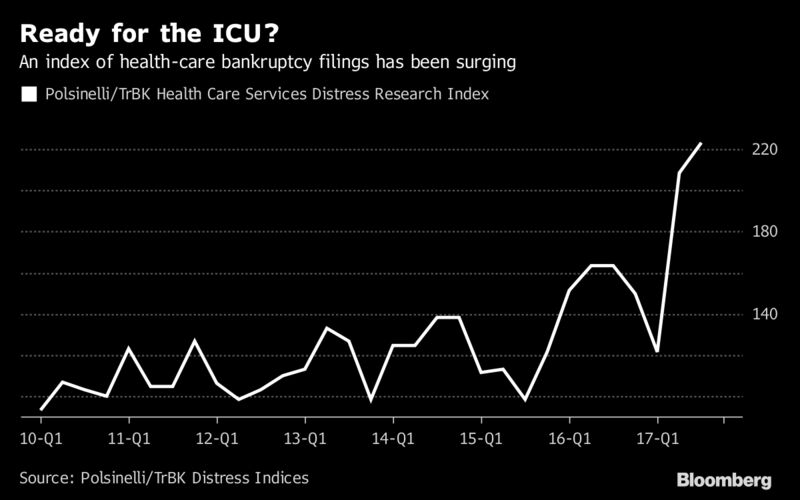
Some signs are already there: Health-care bankruptcy filings have more than tripled this year according to data compiled by Bloomberg, and an index of Chapter 11 filings by companies with more than $1 million of assets has reached record highs in four of the last six quarters, according to law firm Polsinelli PC. Junk bonds from companies in the industry have dropped 1.4 percent this month, a steeper decline than the broader high-yield market, according to Bloomberg Barclays index data.
The pain for the sector comes as bankruptcy filings across the broader economy have plunged since 2010.
Hospitals, including private rural ones, may be among the hardest hit, Winston & Strawn’s Neier said. The Affordable Care Act, known as Obamacare, reduced payments to hospitals that serve a large number of poor and uninsured patients, known as “disproportionate share hospitals,” on the theory that more patients would be insured under the law. Congress delayed those cuts several times, but didn’t do so for the current fiscal year, which may “single-handedly throw hospitals into immediate financial distress — many operate on less than one day’s cash,” he said in an interview.

“Smaller hospitals have already been struggling for years,” said Kristin Going, a partner in the New York office of Drinker, Biddle & Reath LLP. Both lawyers declined to discuss specific companies. Since 2010, a growing number of patients have enrolled in high-deductible health plans that force them to shoulder more of costs when they get treatment, according to the U.S. Centers for Disease Control and Prevention. That has translated into more bad debt from customers for hospitals and other providers.

Some publicly traded hospital companies that were already under pressure from high debt loads have been further buffeted by this year’s hurricanes. Community Health Systems Inc., with $1.9 billion in debt maturing in 2019, has suffered doctor revolts over crumbling, cash-strapped facilities, as well as losses linked to the storms in Texas and Florida earlier this year. A representative for Community Health didn’t return a call seeking comment.

Signs of Distress

Jorian Rose, partner in the New York office of Baker & Hostetler LLP, said many health-care restructurings are already going on under the radar right now. Rose, Going and Neier are members of the Turnaround Management Association, a group for bankruptcy and restructuring professionals.

The Polsinelli Health Care Services Distress Research index, which tracks bankruptcy filings for companies with more than $1 million in assets, shows that activity has surged 123 percent since the fourth quarter of 2010. By comparison, the law firm said, the general index that tracks Chapter 11 filings in the U.S. is down nearly 58 percent from 2010. The Affordable Care Act, which Republican lawmakers have been looking to repeal, replace, defund, or otherwise change, was cited as one of the systemic changes rocking the sector.

Since 1997, health-care cases have made up only 5.25 percent of all U.S. bankruptcy filings, according to Bloomberg data. Year to date, they already comprise 7.25 percent of all filings. Emergency-room operator Adeptus Health, cancer-care provider 21st Century Oncology, and cancer treatment specialist California Proton Treatment are the largest filings. Those statistics exclude pharmaceutical company Concordia, which is restructuring in Canada, and Preferred Care Inc., one of the U.S.’s largest nursing home groups, operating 108 assisted living facilities.

Problems for the sector aren’t limited to U.S. companies. Israeli drugmaker Teva Pharmaceutical Industries Ltd., saddled with debt that’s more than double its market value, is putting together a “detailed restructuring plan” after the company has slashed its profit forecasts, cut its dividend, signaled it may sell new shares, and reduced its goal for paying down debt this year. It announced a management shakeup on Monday.

Distress among health-care companies can spread to other parts of the economy. Quality Care Properties Inc., for example, is a real estate investment trust with a struggling tenant, HCR Manorcare Inc. Moody’s Investors Service said in an October report that if HCR Manorcare files for bankruptcy, Quality Care could also need to amend the terms of its own debt. Representatives for HCR Manorcare and Quality Care didn’t return calls seeking comment.