Here’s What’s Really Driving Healthcare Costs

https://www.medpagetoday.com/publichealthpolicy/healthpolicy/69102?pop=0&ba=1&xid=fb-md-pcp

Image result for Here's What's Really Driving Healthcare Costs


The market economy fails when applied to healthcare.

That healthcare expenditures in the US are high and rising rapidly is nothing new, but this study appearing in the Journal of the American Medical Association identifies the exact components of healthcare that are driving those soaring costs. As F. Perry Wilson, MD points out in this 150 Second Analysis, the data suggest traditional economic forces break down in the US healthcare market.

Transcript:

It’s no secret that healthcare costs in the United States are exceedingly high, and rising.

The US spends the most of any country in the world on healthcare in terms of percent of GDP, sitting around 18% as of the most recent data.

But to address the issue, we need to understand what is driving this increase, and a new study appearing in the Journal of the American Medical Association does the best job yet in decomposing the factors behind the rising costs.

The researchers used data from the US Disease Expenditure Project, which utilizes 183 data sources and 2.9 billion patient records to quantify where each healthcare dollar is being spent in this country.

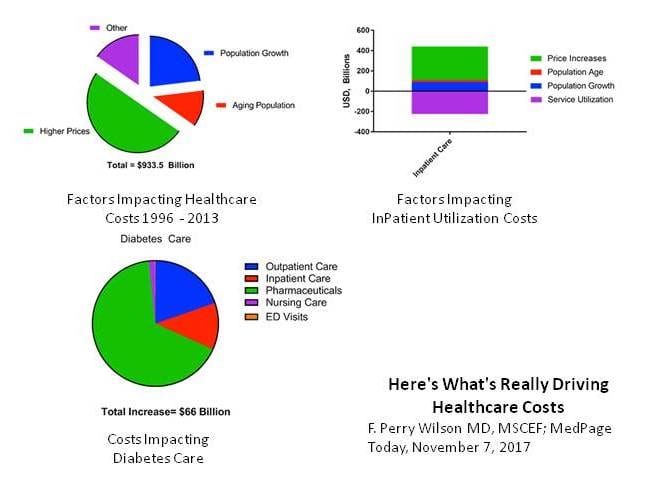
Here’s the top level overview. After accounting for inflation, healthcare expenditures increased by $933.5 billion between 1996 and 2013. To put that into perspective, that’s enough money to create 9 additional interstate highway systems. We could fully fund 3 NASAs every year.

Or we could provide 400 malaria nets to every man, woman, and child in Africa. We could even do something crazy like pay down the debt.

But to save money in the future, we have to know why we keep spending more. Here’s the breakdown.

Some of the increase in spending comes from the aging of the US population and population growth. Not much we can do about that. But 50% of the increase was simply due to higher prices.

This is distinct from healthcare utilization. In fact, healthcare utilization was decreased a bit over this time period. This is shown most dramatically in the data for inpatient care. Take a look at this bar chart.

Use of inpatient care (that’s service utilization – in purple) went down substantially from 1996 – 2013 as we moved to more outpatient treatment. But this may have been a Faustian bargain. The price of the inpatient care that remained went up much more – increasing overall inpatient spending by around 250 billion dollars.

Let’s take a moment to realize how weird this is, economically. Demand for healthcare decreased over time. Prices increased. That is not an efficient market.

Different chronic diseases had different patterns of price increases. The biggest increase was seen in diabetes care, as you can see here, driven largely by rising costs of pharmaceuticals.

Regardless of the disease, though, it is clear that it is the price of what we’re buying – whether a drug, an ED visit, or a hospital stay – not the amount of what we’re buying that is the major driver of cost increases. Efforts to reduce the consumption of healthcare, therefore, may not bend the cost curve as much as efforts to reduce its price. That’s just my 2 cents.

Beyond Showmanship And Spite: Toward A Health Care “Grand Bargain”

https://www.healthaffairs.org/do/10.1377/hblog20171116.24714/full/

Is a deal on health care possible? Conventional wisdom says no. “Repeal and Replace” is dead, and Republicans have moved on. So have many Democrats, toward pursuit of a single-payer plan that’s going nowhere on Capitol Hill but energizes the party’s core. Last month, President Donald Trump said he’ll “dismantle” the Affordable Care Act (ACA) on his own—and backed this up with executive orders that risk the stability of the insurance exchanges.

Democrats are angry that Trump and congressional Republicans want to repeal the ACA and roll back its expansion of health insurance coverage. Republicans are angry that Democrats pushed “Obamacare” through Congress on a party-line basis, and they see the ACA as big government running amok. Both parties are positioning themselves for primaries, and neither shows much interest in the risky work of compromise.

We’re alarmed. One of us is a Cato Institute-friendly “free-market”eer who wrote a book arguing (tongue in cheek) that Medicare is the work of the Devil. The other helped to develop President Barack Obama’s 2008 campaign health plan and believes that failure to ensure everyone’s access to health care is an assault on human decency. But we’ve come together because we believe that failure to resolve the present impasse will have hugely destructive consequences for millions of Americans’ access to health care—and for our national confidence in our political system’s capacity to function.

Designing A Deal

President Trump has cut off cost-sharing reduction subsidies to insurers and issued a directive to allow coverage options less comprehensive than the ACA requires—measures that threaten to unravel the individual and small-group markets by incentivizing younger and healthier people to exit. Meanwhile, the uncertainty that besets federal funding under the ACA for Medicaid expansion poses huge fiscal risks for states, as does Congress’s failure, so far, to renew funding for the Children’s Health Insurance Program (CHIP). And over the longer term, soaring private and public spending on medical services that deliver doubtful value erodes US productivity and well-being.

We think a bipartisan “grand bargain” to stabilize the US health care system is feasible—if key decision makers can move beyond showmanship and spite. To this end, we outline a deal that: honors but balances the competing values at stake, steadies both market and public mechanisms of medical care financing, and puts the nation on a path toward sustainability in health spending.

Our grand bargain builds on federalism. Vastly different values, priorities, and interests stand in the way of nationwide health policy uniformity. Allowing states to sort out controversial matters within broader limits than the ACA now imposes would permit creative policy alternatives to unfold and encourage local buy-in. We needn’t and shouldn’t mandate definitive answers to bitterly contested questions that can be reasonably negotiated at the state or local level. Instead, we should open political and market pathways for the emergence of answers to these questions over time.

Moving to this long game will require all sides to pass on their pursuit of a quick political win. Doing so is the key to moving from cycles of backlash and volatility to a system that builds confidence and delivers high-quality, compassionate health care to all.

The Long Game: Seven Steps Toward a Compromise that Can Work And Endure

With these basic principles in mind, we propose the following seven steps:

Moving Beyond Maximalism—Medicaid Rollback And “Medicare for All”

Republicans should end their campaign to roll back the ACA’s Medicaid expansion, and Democrats should stand down on their quest for single payer. Both pursuits inspire true believers but will go nowhere on Capitol Hill for the imaginable future.

State Flexibility

Give states more flexibility to design their Medicaid programs and to govern their insurance exchanges. One approach would be to simply allow states complete flexibility to design their own coverage rules. Alternatively, we could give states more flexibility but ensure, via federal law, that Medicaid and plans sold on the exchanges provide affordable access to effective preventive, diagnostic, and therapeutic services. States could also be allowed but not required to offer a public option through their exchanges. Instead of an all-or-none answer to the public plan question, the nation would have a framework for market-driven, state-by-state resolution. Similarly, states should be allowed to decide whether to prohibit, permit, or require enrollment of Medicaid beneficiaries in private plans. Finally, when it comes to care that serves culturally contested purposes—including, but not limited to, gender reassignment or confirmation and late termination of pregnancies for nontherapeutic reasons—states should be given autonomy to go their own ways. More federalism will achieve greater stability than would temporary nationwide imposition of one or another approach by whichever party happens to hold the electoral upper hand.

Health Savings Accounts That Appeal To Everyone

An expanded role for tax-protected health savings should have bipartisan appeal. We propose that every lawful US resident be auto-enrolled in a health savings account (HSA), funded through a refundable tax credit, scaled to income and family size. People could opt out but would lose this credit if they did. Few would do so, enabling HSAs to become a means for pursuing both market discipline and social equity.

Repeal The Individual Mandate

Sacrilege, you’re surely thinking, if you’re a Democrat who’s spent seven-plus years defending the mandate, the ACA’s most disliked element. But the mandate isn’t needed to keep healthy people in community-rated risk pools—it’s the intensity of the incentives, whether framed as penalties or subsidies, that matters. Even the mandate’s most outspoken economist-defender, Jonathan Gruber, concedes that high-enough subsidies for the purchase of insurance can substitute for it.

Such subsidies could be supplied in conservative-friendly fashion by allowing all who buy coverage on the exchanges to put HSA funds (including the tax credit we urge) toward their premiums. Sign-up for coverage could also be made more user-friendly through auto-enrollment, subject to opt-out, in “silver” plans (for tax filers who aren’t otherwise covered and aren’t Medicaid eligible). A more robust approach might condition the refundable HSA tax credit on tax filers’ purchasing insurance (or not opting out of auto-enrollment).

Congressional Authorization Of Funding For Both The ACA’s Cost-Sharing Reductions And CHIP

There is bipartisan support for restoring the ACA’s cost-sharing reduction subsidies and extending CHIP. Although annual appropriations are the norm, Congress should guarantee funding for the cost-sharing reductions for a two-year period, with automatic renewal for an additional two years if per capita subsidies rise by no more than the Consumer Price Index (CPI) during the prior two years. By so doing, Congress can reaffirm its authority over appropriations while helping to stabilize markets for individual coverage. Likewise, Congress should renew CHIP’s funding for several years—we urge three as a compromise—to both stabilize state budgets and secure health care for the millions of children who depend on this program.

The “Long Game”—Reining In Medical Spending

A long-term effort to contain spending growth is essential for US fiscal stability and consumer well-being. The ACA created a framework for doing this. The Independent Payment Advisory Board (IPAB) can limit Medicare spending, subject to congressional veto, if growth exceeds target rates. And the 40 percent “Cadillac tax” on high-cost private health plans will cover a rising share of the private market as medical costs increase. Together, these policies have the potential to contain clinical spending by capping demand. But there’s bipartisan opposition to both. The IPAB, which hasn’t yet been established, and the Cadillac tax, now delayed until 2020, are fiercely opposed by stakeholders with lots to lose, and they’re at high risk of repeal.

A grand bargain should follow through on both of these strategies, plus add similar restraints on Medicaid spending and on the amounts spent to subsidize coverage through the exchanges. Most other nations employ global budgeting to control health spending. For reasons of federalism, public philosophy, and market structure, global budgeting isn’t an option for the US. But a coordinated scheme of restraint, based on the best available behavioral and economic modeling, could apply similar braking power to our entire health economy. There’s plenty of room for argument about design details (that is, should per capita growth targets be based on the CPI? The CPI plus 1 percent?) and methods of restraint (that is, the IPAB approach? Spending caps for public programs? The Cadillac tax versus caps on tax deductibility of insurance premiums?). Continued bipartisan evasion will only make the problem worse.

Pursuing Therapeutic Value

Much more must be done to use health care resources wisely as constraints tighten. Tying financial rewards closely to clinical value via paymentpractices, market exclusivity policies, and other incentives will be critical—and will require the clearing of legal and regulatory obstacles. Voluntary action must also play a role: The grand bargain we’ve sketched here creates myriad opportunities for providers, patients, and insurers to gain by insisting on value from a sector of the economy that too often fails to deliver it.

To be sure, politics could foil all efforts to forge compromise. But there is a way forward. Our proposals achieve much that is important to both the ACA’s fiercest critics and staunchest defenders. They work in concert to address the political and market crises that immediately threaten our health care system, while laying the foundation for a long-term approach to control medical spending’s unsustainable growth.

Health Care Price Growth Plummets To Lowest Rate In Almost Two Years

https://altarum.org/about/news-and-events/health-care-price-growth-plummets-to-lowest-rate-in-almost-two-years

Image result for Health Care Price Growth Plummets To Lowest Rate In Almost Two Years

Fueled by health policy uncertainty and structural health sector changes, health care price growth in August rose by only 1.2% compared to a year earlier. This is the lowest health price growth rate recorded in almost 2 years, and just slightly above the all-time low, according to Altarum’s latest Health Sector Economic Indicators Briefs. Contributing to overall slow price growth is a historically low Medical Consumer Price Index growth rate, a possible signal of relief for health care consumers with substantial out-of-pocket expenditures.

Despite an upward revision to recent estimates, health spending growth in August 2017 was only a modest 4.3% higher than a year earlier. Per Charles Roehrig, founding director of Altarum’s Center for Sustainable Health Spending, this moderation in spending growth is in response to a leveling-off in insurance coverage.

Health care job growth also remained modest, with 22,500 new jobs added in September 2017, slightly less than the 2017 average of 25,000. “Slower growth in health care utilization is reflected in slower growth in health jobs, particularly in the hospital sector,” said Roehrig. “This relatively good news should be tempered by a serious look at whether even this moderate growth is sustainable in the longer term.”

Health Care Spending

In August, the health share of gross domestic project (GDP) fell to 18.0%, but spending at an annual rate was 4.3% higher than August 2016, exceeding $3.5 trillion. Spending growth in August 2017 increased in all major categories, led by home health care at 6.5%. Hospital spending continues to grow slowly, at a 2.3% rate.

Health Care Employment

Hospitals added 4,500 jobs and ambulatory care settings added an above-average 24,700 jobs in August, but these gains were offset by the loss of 6,700 jobs in nursing and residential care. Slow hospital job growth in 2017 is a primary force behind the health sector growing at about three-quarters the pace of 2015 and 2016.

Health Care Prices

The 12-month moving average of the Health Care Price Index (HCPI) fell to 1.8% growth after being at 1.9% for 6 straight months, dousing any expectations of a return to a 2.0% growth rate range in the near term. Year-over-year hospital price growth fell to from 1.5% to 1.3%, and physician and clinical services price growth fell one-tenth to 0.5%. Annual drug price growth fell to a 2.7% rate, its lowest reading since growing by 2.4% in December 2015.

Professionalism And Choosing Wisely

http://www.healthaffairs.org/do/10.1377/hblog20171024.907844/full/

The US health care system is plagued by the use of services that provide little clinical benefit. Estimates of expenditures on overuse of medical services range from 10–30 percent of total health care spending. These estimates are typically based on analyses of the geographic variation in patterns of care. For example, researchers at the Dartmouth Institute focused on differences in care use between high-spending and low-spending regions with no corresponding reductions in quality or outcomes. An analysis by the Network for Excellence in Health Innovation (formerly known as the New England Healthcare Institute) identified significant geographic variation in the rates of both surgical and non-surgical services such as coronary artery bypass grafting, back surgery, cholecystectomy, hip replacements, diagnostic testing, and hospital admission.

This variance-based approach to estimating overuse has been very useful at highlighting the problem of inefficiency in the health care system but has done little to direct initiatives designed to reduce unnecessary tests and procedures. The aggregate approach does not help clinicians or managers identify exactly how they should change their practice patterns. As a result, it has been hard to reduce overuse. Identifying the significant overuse of medical services in the health care system is only the first step; now we need to develop evidence-based solutions to reduce unnecessary services and improve efficiency.

The History Of Choosing Wisely

The Choosing Wisely initiative, announced in 2012 by the ABIM Foundation and Consumer Reports, was designed to spark conversations among physicians, patients, payers, and purchasers about the overuse of tests and procedures, and to support physician efforts to help patients make smart and effective care choices. Specialty societies identified specific services that were unnecessary in specific situations. With more than 80 participating specialty societies, Choosing Wisely has identified more than 500 commonly overused tests and procedures and published recommendations for their proper use. For example, the American College of Emergency Physicians recommends avoiding computed tomography (CT) scans in low-risk patients with minor head injury.

The Choosing Wisely campaign began in an environment when efforts to reform health care were polarized by discussions of “rationing” and “death panels.” The initiative focused on quality, safety, and doing no harm to counter suspicions of dual agency and cost reductions motivated by profit; this allowed both the public and clinicians to begin to see reducing unnecessary care as in the best interest of the patient.

Choosing Wisely appealed to the professionalism of physicians and other clinicians as articulated in the Physician Charter on Medical Professionalism, which included a commitment to manage health care resources. The campaign was conducted in a way that respected the autonomy of physicians, relying on and enhancing their professional pride and sense of mastery, instead of functioning as yet another quality initiative imposed from above. Specialty societies took a leadership role in partnership with a wide swath of consumer and patient groups, helping physicians and patients accept the message of “more is not always better.”

Through Choosing Wisely, physicians were socialized toward a new norm in the culture of medicine against low-value care, which was reflected in the medical literature. From 2014 to 2015, the number of articles on overuse nearly doubled. The adage that “culture eats strategy every day” became a guiding light. Manya Gupta, MD, from Rush University Medical Center, summed it up as, “Once culture change starts, improvements become expected.”

The unexpected nature of societies taking the lead on this issue, potentially in conflict with their members’ economic self-interest, helped make the campaign stick. Similarly, the simplicity, concreteness, and credibility of the recommendations allowed them to be deployed in a variety of settings at a variety of levels in the organization.

Implementation has been accelerated through the support of the Robert Wood Johnson Foundation (RWJF), which has provided two grants to support putting the Choosing Wisely recommendations into practice.

Choosing Wisely In Action

The front line empowerment fostered by Choosing Wisely was evident when the University of Vermont Medical Center asked faculty and residents to submit ideas for high-value care projects targeting tests and treatments that could be performed less frequently. Interventions on seven projects were completed. Key reported outcomes included:

  1. a 72 percent reduction in the use of blood urea nitrogen and creatinine lab testing in patients with end-stage renal disease who were on hemodialysis and hospitalized;
  2. a 90 percent reduction in dual-energy x-ray absorptiometry (DEXA) screening on women ages 65 and older without clinical risk factors for osteoporosis; and
  3. a 71 percent reduction in the use of portable chest x-rays in mechanically ventilated patients who were not intubated that day and did not have a procedure performed.

Vanderbilt University Medical Center drove cultural change through a “challenge” to all house staff and residents aimed at reducing unnecessary daily lab orders. After educational sessions, teams were sent weekly emails on tracking use in a friendly monthly competition. This resident-originated focus and intervention resulted in significant reported decreases of daily blood counts and basic metabolic panels.

Crystal Run Healthcare, a multispecialty practice with 350 clinicians, also sponsored a contest designed to advance Choosing Wisely recommendations. Eric Barbanel, MD, a practicing physician at the clinic, was the champion for the winning project, which focused on four recommendations from the American Academy of Family Physicians. The interventions included peer education, clinical decision support, and data feedback. Decreases in annual electrocardiograms (EKGs), magnetic resonance imagings (MRIs) for low back pain, and DEXA screening were reported.

The campaign has also relied on regional health collaboratives to help drive local public awareness of the issue of overuse. Two grantees supported by RWJF, HealthInsight Utah and Maine Quality Counts, have used town hall meetings to engage in conversations with patients and the broader public about Choosing Wisely.

The Choosing Wisely campaign has focused first on adaptive change—on “why” there is concern about overuse by clinicians and patients, and on developing a consensus set of common values and purposes. The campaign has emphasized evidence about benefits and harms and the pursuit of enhancing quality, safety, and doing no harm. The aim has been to win both the hearts and minds of physicians so that they would be more engaged in improvement efforts, something often missing in efforts to change behaviors in clinical practice. The rapid introduction of purely technical solutions (that is, clinical decision support through electronic medical records) often alienates clinicians who don’t know the values and motivation behind the need for such solutions.

Remaining Challenges

Choosing Wisely has had some success in raising awareness of overuse and incorporating recommendations into practice. But results from national studies have been mixed, highlighting the need for further formal evaluation of the initiative’s impact.

More importantly, other strategies needed to complement Choosing Wisely must be jumpstarted. Specifically, more needs to be done to address some of the other underlying drivers of overuse in the health care system, notably perverse payment incentives; eliminating unnecessary services will be challenging as long as providers face financial incentives to provide more care and patients have no incentives to avoid care. Choosing Wisely is an attempt to change attitudes and mindset, but changing attitudes is hard when incentives are misaligned.

Payment reform can play a role in changing physician behavior by minimizing rewards for doing unnecessary tests and procedures. In fact, some evidence suggests population payment has disproportionately reduced use of potentially unnecessary tests and procedures. But it is not always easy to design payment reform such that the incentives are fully experienced at the point of care. Moreover, although evidence suggests these payment models lower spending without sacrificing quality, the effects have generally been modest and surely more could be done. And reinforcement works both ways: Just as payment reform can make the task of changing attitudes through Choosing Wisely easier, winning hearts and minds can amplify the effectiveness of any payment reform strategy.

Benefit design can also help reduce use of potentially unnecessary services by increasing patient out-of-pocket spending for those services. However, higher out-of-pocket spending can be a significant financial burden on patients, and in many cases they are not well suited to make nuanced decisions about care. Most evidence suggests that when faced with higher cost sharing, patients reduce use of appropriate and inappropriate care in similar proportions. Value-based insurance design (VBID)—which aims to increase cost-sharing for less effective treatments and decrease cost sharing for more effective treatments—can help encourage patients to specifically reduce overuse of low-value care. However, VBID is not a panacea and must be implemented in a way that avoids adverse selection and excessive complexity. Engaging clinicians in explaining and implementing benefit design changes will be necessary to help patients better navigate the choices they will confront.

Even if Americans were not grappling with high health care spending, avoiding potentially unnecessary services would be important. But with fiscal pressures driving changes by private and public purchasers that often have deleterious consequences, eliminating potentially unnecessary services—and thus delivering cost savings while increasing quality—is more important than ever. Choosing Wisely exemplifies efforts of the professional societies to engage on the issue; by appealing to the professionalism of physicians and other clinicians, it can provide the foundation for promoting delivery of appropriate care.

Professionalism as a force to improve quality has an opportunity to show its value along with the technical approaches and the environmental changes needed (for example, payment reform). The design of Choosing Wisely, which included few rules, much autonomy for engagement and design, and little central control, produced an activated professionalism. Appealing to the intrinsic motivations of physicians offers an underused path to achieve widely shared policy goals such as reducing the cost of our health care system while enhancing its quality. Professionalism can also appeal to patients and give them confidence in their physicians’ counsel that unnecessary care truly is unnecessary. Given the activity that has been unleashed in health systems and clinical practices throughout the United States, professionalism should not be overlooked as part of our broad health care transformation strategy.

Altarum’s Center For Sustainable Health Spending – Health Sector Economic Indicators (Spending Brief)

Click to access CSHS-Spending-Brief_Sept_2017.pdf

Image result for Altarum’s Center For Sustainable Health Spending - Health Sector Economic Indicators (Spending Brief)

Hospital spending growth is lowest in more than 25 years.

Altarum: Hospital spending growth rate lowest in 28 years

http://www.healthcaredive.com/news/altarum-hospital-spending-growth-rate-lowest-in-28-years/504580/

Dive Brief:

  • Altarum’s Center for Sustainable Health Spending’s latest Health Sector Economic Indicators reported overall national health spending growth decreased in the second quarter. Spending increased by 4% in the quarter, which was less than the 4.6% that Altarum predicted for the quarter.
  • A major reason for the slower spending growth was connected to hospital second-quarter spending growth, which was only 1.3% rather than the expected 4% growth rate.
  • Overall, year-over-year hospital spending increased by 1.1% in July. Hospital spending increased in June by 0.8%, which was the slowest growth rate year-over-year since January 1989.

Dive Insight:

A growth in the number of insured individuals and less hospital utilization are slowing hospital spending growth, according to Altarum. Overall, the researchers found health spending growth between May and July was slower than GDP growth; health spending accounted for 18% of the GDP.

The news of slowed hospital spending growth will please payers, who for years have created policies and designed plans to nudge members toward lower cost services rather than hospitals. These plans charge less for services at a primary care physician, urgent care center or standalone imaging center rather than a hospital. Plus, services that once required hospitalizations are now being performed as outpatient procedures.

In recent months, health insurance companies have looked to go further to reduce hospital utilization. Anthem, a major Blues insurer in 14 states, has led the way recently in creating policies to push members into getting care at less expensive locations rather than hospitals. Anthem said it will no longer pay for MRIs and CT scans at hospitals in 13 states unless Anthem deems it’s an emergency. Instead, the payer wants members to go less to expensive freestanding imaging centers.

Anthem also recently announced it would no longer cover emergency department (ED) visits that it deems unnecessary in Missouri. Anthem has the same policy in Kentucky and Georgia which it may expand to more states. Anthem said the Kentucky policy has been in place since 2015 and has only denied a small percentage of ED claims.

Also, the CMS is proposing to make costs more site neutral by paying services at off-campus hospital outpatient departments at 25% of regular outpatients rates. The same proposal also includes a small increase (1.75%) for outpatient payments.

All of these changes hope to further reduce hospital spending growth, while forcing hospitals to find ways to improve margins despite less utilization. Altarum’s report shows payers’ efforts are working as hospital spending growth was the slowest major healthcare category over the past year.

Despite seeing the smallest spending increase, hospitals still account for the highest percentage of health spending. In July, hospitals made up 32% of health spending, which easily outdistanced physicians and clinical services (20%). Home healthcare, which had the biggest rate increase (6.6%), still only accounted for 3% of overall health spending.

Analysis: Is healthcare spending growth past the ACA bump?

http://www.healthcaredive.com/news/analysis-is-healthcare-spending-growth-past-the-aca-bump/507073/

Image result for us healthcare spending


Healthcare spending, price growth slows in 2017 but job growth spikes

http://www.healthcarefinancenews.com/news/healthcare-spending-price-growth-slows-2017-job-growth-spikes?mkt_tok=eyJpIjoiT0RCalpUWTNNbU16TmpJeiIsInQiOiJyUTBEc0s5clMzSUUyRVV4UGJEam9ZOTBVVW5uWmVzQnpMa1hTSjY0clYyK3FGcmtPOFNQelVtd2hRQmZ3aFwvZndPUDNoZk8zOXBBcHNGQzh6U0ErRnhFSmc3RlVzelhoMXp4SjQ5bU02NDQ4K3Badyt4dFhUMzB3ajZ3U0hhNWIifQ%3D%3D

Altarum report finds spending grew by only 4.6 percent in 2016.

Healthcare spending growth slowed in 2016, and the trend appears to be continuing, according to the August 2017 Altarum Institute Center Health Sector Trend report.

According to the report, spending grew by only 4.6 percent in 2016 and estimates based on new data have the downward trend continuing with growth for the first half of 2017 at 4.4 percent. Altarum said the estimates illustrate the impact of expanded coverage, and its subsequent leveling off, on healthcare utilization. Coverage expansion was concentrated in 2014 and 2015, leading to a jump in health services utilization. That peaked at at 5.1 percent in 2015.

“Coverage leveled off in 2016 and, in response, the growth in health services utilization has been trending back toward pre-expanded coverage rates,” Altarum said.

Healthcare price growth has also dropped in 2017, from 2 percent in the first quarter to 1.6 percent in the second quarter.

Though much higher than healthcare services, prescription drug price growth slowed to 3.6 percent in the second quarter 2017. However it is important to note that the impact of rebates are not reflected in these data, and that drug pricing controversies like the one surrounding Mylan’s EpiPen were recently resolved and some generic alternatives have been made available at lower prices.

Finally, health employment grew an average of 21,000 jobs per month during the first 5 months of 2017 then unexpectedly rebounded to 38,000 in June and July. The jump in June and July was a surprise, and was focused mainly in ambulatory settings.

“Growth averaged 32,000 during 2015 and 2016, and the decline in monthly growth during the first 5 months of 2017 was expected due to slower growth in health care utilization driven by the leveling off in expanded coverage,” Altarum said.

The American Hospital Association’s February 2017 Cost of Caring report also illustrated the increased utilization in 2014 and 2015, due to expanded healthcare coverage and more intense utilization of services like chronic disease management.

However, the report mentioned that statistics also suggested that hospitals are trying to hold costs down. For instance, hospital price growth in 2015, as measured by the Hospital Producer Price Index, was .9 percent, a 13-year low and a notable drop from the rate of 4.4 percent in 2006, the report said.

Growth in Medicare spending for all hospital services, both inpatient and outpatient, is at a 17-year low, and inpatient spending dropped 1.9 percent in 2015.

So it is possible that along with a leveling off of coverage and utilization, successful hospital attempts at stabilizing or reducing cost of care could be responsible for the lower spending. The slowing in hospital price growth in the Altarum report is also illustrative of these theories.

However, the hospital industry faces serious challenges that can slow efforts to reduce costs, including drug prices and regulatory compliance, the AHA report said.

Electronic health records have also proven to be big resource absorbers for providers. AHA estimates show that from 2010 to 2014 hospitals spent over $47 billion annually on IT. Increasing regulatory requirements are also fueling increases in administrative expenses and compliance staffing demands, the AHA report said.

Click to access Altarum%20RWJF%20Trend%20Report%20Aug%202017_1.pdf


Physician Workforce Trends And Their Implications For Spending Growth

http://healthaffairs.org/blog/2017/07/28/physician-workforce-trends-and-their-implications-for-spending-growth/


Controlling the growth rate of health care spending is central to the success of the Affordable Care Act or any subsequent reform. Because labor represents more than 50 percent of health care costs and the clinical workforce drives use and prices, the size and composition of the health care workforce has important ramifications for spending growth. We set out to understand the trends underlying the growth in the clinical workforce and their potential implications for health care spending, health policy, and health system design.

A large literature establishes a link between primary care–oriented health systems and lower spending. Areas with a higher concentration of primary care physicians have much lower spending per beneficiary, higher-quality care, better patient satisfaction, and lower mortality rates. Given this, many existing payment reform strategies prioritize primary care, and the success of these reforms will require a vibrant—and likely growing—primary care workforce.

How The Physician Workforce Has Changed

To observe the evolution of the clinical workforce, we used the Bureau of Labor Statistics’ Occupational Employment Statistics files between 2005 and 2015. This data set is released in May of each year and records the number of jobs (not the number of full-time–equivalent employees) by industry, occupational type, and geography. Using the North American Industry Classification System (NAICS), we limited our analysis to NAICS 621 (ambulatory health care services), 622 (hospitals), and 623 (nursing and residential care facilities). We defined “primary care physicians” as family and general practitioners, general internists, obstetricians and gynecologists, and general pediatricians, and categorized all other physician categories as “specialists” (Note 1).

Overall, there was a net increase of 2.6 million jobs in the health care sector between 2005 and 2015, accounting for 35 percent of total job growth in the United States during that period. Six percent of these jobs were for physicians. The number of primary care physician jobs grew by approximately 8 percent, while the number of jobs for specialists grew about six times faster (see Exhibit 1). In an era when we might have expected (and hoped for) rapid primary care physician growth, the share of the physician workforce devoted to primary care actually decreased from 44 percent to 37 percent, and the number of primary care physicians per capita has remained roughly flat.


What The Workforce Trends Mean

Given the aging of the population and expanded coverage, these findings raise concerns about access to care. Many have suggested expanding the role of non-physician primary care providers to fill the gap between the need for primary care and the supply of primary care physicians. When we broadened our definition of primary care to include the physician assistants and nurse practitioners working in primary care, the total primary care workforce grew considerably faster (17 percent between 2005 and 2015), although still much slower than specialists (Note 2). It seems we are addressing our increasing primary care needs with non-physician labor, but more research is needed to understand the clinical and economic ramifications of that trend.

Under the right conditions, the rapid growth in specialists would not necessarily be negative for health care spending. If health care markets were competitive, one might expect a greater supply of specialists to lead to lower prices for specialist care and greater competition for referrals. With the right incentives in place, this increased competition could lead to lower spending and better outcomes.

Yet, there are reasons to be skeptical of this competitive model. Fees from public payers are set administratively and unlikely to be responsive to competitive pressures. Integration between hospitals and physicians, strong patient preferences for particular specialty groups or affiliated hospitals, and the numerous information problems in health care may dampen the ability of competition to drive down specialist prices.

Moreover, it is likely that the greater number of specialists working within health systems that charge facilities fees on top of expensive specialty care will lead to more expensive care. Furthermore, specialists are paid a larger salary; a recent salary survey found the four highest-paying occupations in the United States were physician specialists. These factors will work in opposition to efforts to control health care spending growth.

Possible Policy Responses

The data raise concerns in light of the belief that we need to increase the share of primary care providers (both physicians and non-physicians) to reduce the rate of growth in health care spending. They also add urgency to recommendations made by the Medicare Payment Advisory Commission (MedPAC), the Health Resources and Service Administration (HRSA), and the Association of American Medical Colleges (AAMC) to support the growth of primary care.

MedPAC suggested in both its 2016 and 2017 reports that the disparities in physician payment resulting from the Medicare fee schedule undervalue primary care and over-compensate certain specialists, and that the fee schedule ought to be amended to reflect the value generated by primary care physicians. In 2013, the HRSA recommended that graduate medical education funding be directed more toward students who will work in family medicine, geriatrics, general internal medicine, general surgery, pediatrics, and psychiatry. In 2012, the AAMC recommended that half of newly created residency positions should be for primary care and generalist disciplines.

While these recommendations are consistent with the goal of reorienting the health care system toward primary care, efforts to expand the primary care workforce are not new. As our data suggest, past initiatives such as low interest loan programs, training grants, or service programs such as the National Health Service Corps, which provides students with loan forgiveness in exchange for a commitment to practice primary care in underserved areas, have met limited success. The workforce continues to shift toward specialists. If we are to bend the cost curve, we likely need to move more aggressively on fee schedule changes, payment reform, and workforce policies.

Note 1

This included anesthesiologists, psychiatrists, surgeons, and the Bureau of Labor Statistics (BLS) group physicians, all other. This final group accounts for “all physicians not listed separately.” Ophthalmologists, dermatologists, gastroenterologists, and cardiologists are given by the BLS as representative occupations. The Occupational Information Network includes a few more detailed occupations under this heading: allergists and immunologists, dermatologists, neurologists, nuclear medicine physicians, ophthalmologists, pathologists, radiologists, preventative medicine physicians, sports medicine physicians, urologists, and preventive medicine physicians.

Note 2

The Bureau of Labor Statistics did not track nurse practitioners separately before 2012. We constructed this statistic using published numbers from the American Association of Nurse Practitioners, the Government Accountability Office, and the Agency for Healthcare Research and Quality.

GOP promises lower health premiums but ignores all that’s driving them

http://www.politico.com/story/2017/07/06/health-care-premiums-republicans-obamacare-240242

Image result for underinsured

Republicans promise to bring down the cost of health insurance for millions of Americans by repealing Obamacare.

But in the race to make insurance premiums cheaper, they ignore a more ominous number — the $3.2 trillion-plus the U.S. spends annually on health care overall.

Republicans are betting it’s smart politics to zoom in on the pocketbook issues affecting individual consumers and families. But by ignoring the mounting expenses of prescription drugs, doctor visits and hospital stays, they allow the health care system to continue on its dangerous upward trajectory.

That means that even if they fulfill their seven-year vow to repeal Obamacare and rein in premiums for some people,the nation’s mounting costs are almost sure to pop out in other places — includingfresh efforts by insurers and employers to push more expenses onto consumers through bigger out-of-pocket costs and narrower benefits.

As a presidential candidate, Donald Trump didn’t talk much about health care in 2016 — not compared to the border wall, jobs, or Hillary Clinton’s emails. But the final days of the campaign coincided with the start of the Obamacare sign-up season — and Trump leapt to attack what he called “60, 70, 80, 90 percent” premium increases. Big spikes did occur in some places, but they weren’t the rule, and most Obamacare customers got subsidies to defray the cost.

But the skyrocketing premium made a good closing message for Trump — and Republicans have stuck with it.

“The Republicans decoded: What is the single, 10-second thing that says why you are running against the Affordable Care Act?” said Bob Blendon, an expert on health politics at the Harvard T.H. Chan School of Public Health. “Premiums became the face of what’s wrong.”

The GOP approach differs from the tack Democrats took when they pushed for the Affordable Care Act back in 2009-10. That debate was about covering more Americans — and about “bending the curve” of national health care spending, which eats up an unhealthy portion of the economy.

Conservatives like Sen. Ted Cruz of Texas argue that Obamacare failed to achieve its promise to bring down costs.

“The biggest reason that millions of people are unhappy with Obamacare is it’s made premiums skyrocket,” said Cruz, who is leading a small band of conservatives trying to pull the Senate repeal bill to the right as leaders seek to cobble together 50 votes. “We’ve got to fix that problem that was created by the failing policies of Obamacare.”

The answer, he says, is getting government out of the way. Conservatives want to free insurers from many of the coverage requirements and consumer protections in Obamacare. That means they could sell plans that wouldn’t cover as comprehensive a set of benefits — but they’d be cheaper.

Even some prominent critics of the Affordable Care Act think that’s not getting at the heart of the U.S. health care problem, even if it sounds good to voters.

“Too many in the GOP confuse adjustments in how insurance premiums are regulated with bringing competitive pressures to bear on the costs of medical services,” the American Enterprise Institute’s James Capretta wrote in a recent commentary for Real Clear Health. “They say they want lower premiums for consumers, but their supposed solution would simply shift premium payments from one set of consumers to another.”

The Congressional Budget Office has not yet evaluated how the House repeal bill, which narrowly passed, or the Senate companion legislation, which is still being negotiated, would affect overall health spending in coming years. It is already a sixth of the U.S. economy — more than 17 cents out of every dollar — and spending is still growing, partly because of an aging population.

The nonpartisan budget office projected the federal government would spend about $800 billion less on Medicaid over a decade, as the GOP legislation upends how Washington traditionally paid its share. But CBO hasn’t yet reported on how that would affect the health sector overall.

Many Republicans predict that limiting federal payments to states would force Medicaid to be more efficient. Democrats says the GOP bill would basically thrust those costs onto the states and onto Medicaid beneficiaries themselves, who are too poor, by definition, to get their care — often including nursing homes — without government assistance.

The CBO gave a mixed assessment of what would happen to premiums under the GOP proposals. They’d rise before they’d fall — and they wouldn’t fall for everyone. Older and sicker people could well end up paying more, and government subsidies would be smaller, meaning that even if the sticker price of insurance comes down, many people at the lower end of the income scale wouldn’t be able to afford it.

“Despite being eligible for premium tax credits, few low-income people would purchase any plan,” the CBO said.

Shrinking insurance benefits may work out fine for someone who never gets injured or sick. But there are no guarantees of perpetual good health; that’s why insurance exists. If someone needs medical treatment not covered in their slimmed-down health plan, the costs could be astronomical and the treatment unobtainable.

Couple that with skimpier benefits, bigger deductibles, smaller subsidies and weaker patient protections, and “Trumpcare” — or whatever an Obamacare successor ends up being called — could spell voter backlash in the not-too-distant future, particularly as poll after poll shows the legislation is already deeply unpopular.

“Premiums are one of the important ways in which consumers experience cost. But it’s not the only way,” said David Blumenthal, president of the Commonwealth Fund, a liberal-leaning think tank, and a former Obama administration official. But deductibles running into the thousands of dollars and steep out-of-pocket costs, he added, “are a source of discontent for Trump and non-Trump voters alike.”

Even the 2009 health debate early in the Obama presidency, which looked at staggering national health spending and what it meant for the U.S. economy, didn’t translate into a bottom line for many American families, said Drew Altman, president and CEO of the Kaiser Family Foundation, which has extensively polled public attitudes on health care.

And the bottom line — the cost of care — is what ordinary people focus on, Kaiser has found. Not just on premiums, but on what it costs to see a doctor, to fill a prescription, or to get treated for a serious disease.

“That’s what all of our polling shows,” Altman said. “The big concern is health care costs.”

Democrats have a long list of things they detest about the Republican repeal-and-replace legislation — and the lack of attention to overall health spending for the country and for individuals and families is right up there.

Sen. Ron Wyden (D-Ore.), the top Democrat on the Finance Committee, would like a bill that tackles cost — starting with rising drug prices. But this bill, he said, does nothing about health care costs.

“This really isn’t a health bill. This is a tax-cut bill,” he said. The repeal bills would kill hundreds of billions of dollars of taxes — many on the health care industry or wealthy people — that were included in Obamacare to finance coverage expansion, though the Senate is now considering keeping some of them to provide more generous subsidies.

Conservative policy experts acknowledge that premiums aren’t the whole story.

The overall cost and spending trajectory “is something we have to get to,” said Stanford University’s Lanhee Chen, who has advised Mitt Romney and other top Republicans. But for now, he said, premiums are a good first step.