


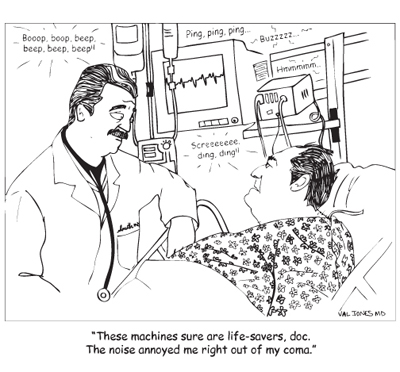
Cartoon – Discussing Your Treatment Options


Turning 65 soon? Your mailbox probably is stuffed with ads from health care companies eager to sign you up for Medicare coverage.
Be aware, though: buried in there may be a notice that you are about to be automatically enrolled in an HMO-style, private Medicare Advantage plan by your current insurance company. If you never see that letter, or if you ignore it, you could find yourself locked into coverage that doesn’t cover your doctors or costs you more.
Some insurance companies serving South Florida seniors are considering, or have started, a little-known policy called seamless conversion. Insurers granted approval by the federal Centers for Medicare and Medicaid Services can automatically shift existing members into their Advantage plans when those members become eligible for Medicare.
While CMS requires that beneficiaries be notified in writing at least 60 days in advance, insurers do not need confirmation that the member wants the new coverage before making the switch. Medicare advocates say that blocks seniors from making informed choices.
Seamless conversion was created by Congress almost 20 years ago, as part of the Social Security Act of 1997, but rarely used over the years, said Stacy Sanders, federal policy director for the Medicare Rights Center in New York City. That changed in the 2016 plan year, she said, when CMS sent Medicare Advantage providers letters suggesting conversion was a good option for transitioning low-income seniors and nursing home residents into new state Medicaid managed care programs once their members were eligible for Medicare.
Sanders is concerned that seniors usually will receive seamless conversion notices when they’re most likely to be flooded with Medicare Advantage pitches: during annual open enrollment in October and right before their 65th birthdays.

Despite the singular nature of this year’s presidential campaign, there is plenty of continuity with past elections when it comes to health care, argue David Blumenthal, M.D., and James A. Morone in their New England Journal of Medicine “Perspective.”
In “Past as Prologue—Presidential Politics and Health Policy,” Blumenthal, The Commonwealth Fund’s president, and Morone, director of Brown University’s Taubman Center for American Politics and Policy, discuss the “deep underlying political forces and historical experiences with health care politics and policy” that are reflected in the platforms of Hillary Clinton and Donald Trump.
The authors previously collaborated on the book The Heart of Power: Health and Politics in the Oval Office (University of California Press, 2009).
http://altarum.org/health-policy-blog/a-quiet-revolution-in-health-care-in-a-digital-era

The whole American political spectrum shares two goals: lower health care spending and better health care delivery. Unfortunately, most political groupings believe success will emerge from a top-down reconfiguration of insurance. Almost certainly, though, better, cheaper care will come not from a relentless focus on insurance, but from fragmentary, bottom-up innovation already underway.
The Left seeks nationalization and centralization — a single-payer system where a wise federal government funds and allocates care. The Affordable Care Act (ACA) approximates this ideal by subsidizing and enlarging the pre-existing menagerie of public, private, individual and group plans. The Right’s hope is federalism and privatization — shifting power from Washington to states and private entities. Each vision has dozens of variations.
While Americans squabble over insurance, a digital revolution quietly disrupts fundamental notions of health care itself. Imagine a world where schoolchildren produce low-cost prosthetic hands; heart patients use smartphones to perform electrocardiograms on themselves; patients shop the globe for surgical hospitals; cloud computing helps patients manage mental health issues; individual doctors manage thousands of prescriptions a day; and streaming video liberates doctors from computers.
This world already exists, barely perceived by the political community — or the medical community. The key to nurturing it is to remove the obstacles that lie in its path.

Today, Medicaid provides coverage to nearly 73 million people — kids, low-income working adults, seniors, and people with disabilities — making it the nation’s largest insurer.


 HENRY KOTULA