Why Apple’s Move On Medical Records Marks A Tectonic Shift

http://www.wbur.org/commonhealth/2018/01/26/apple-health-care-data
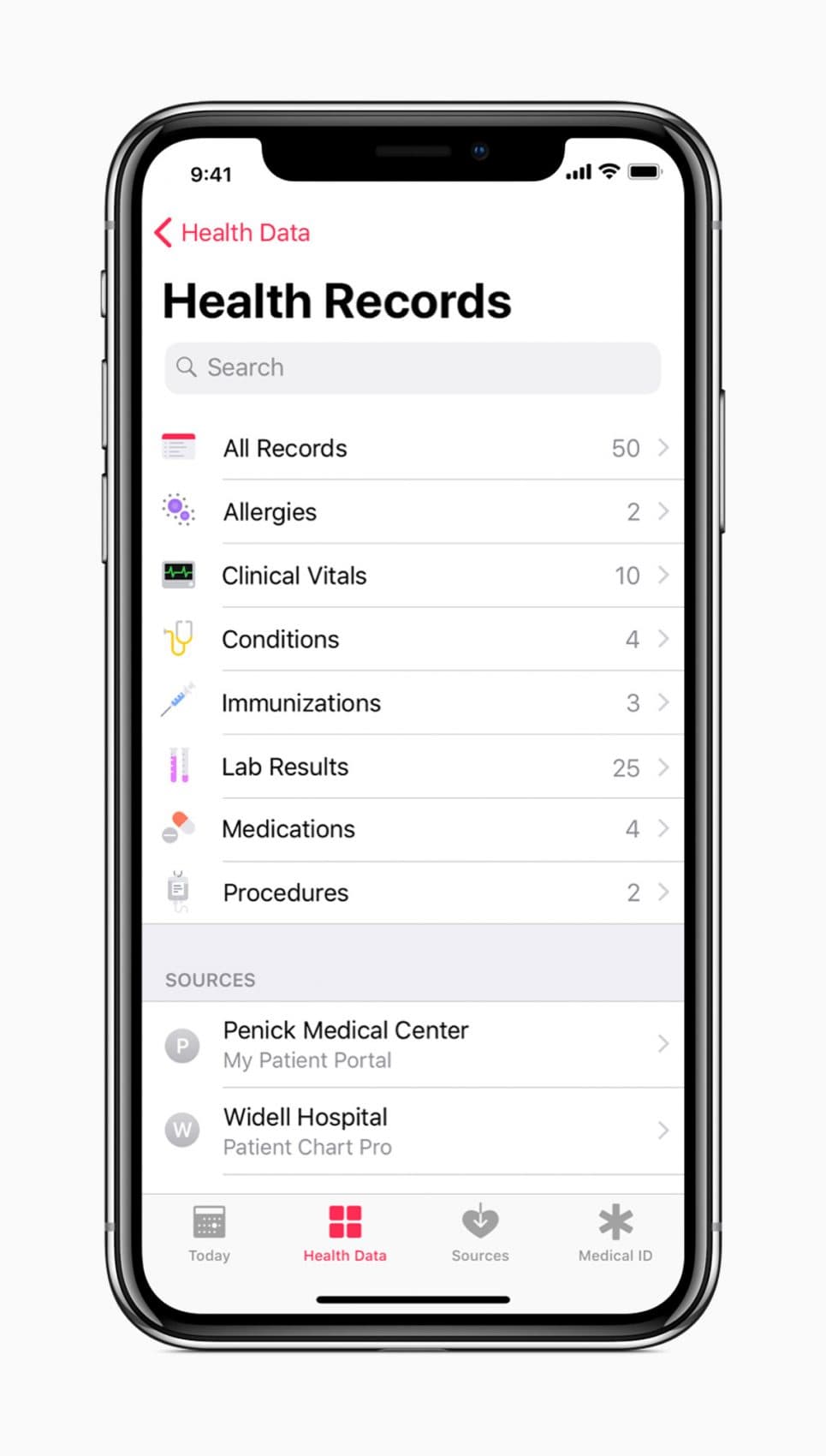
(Courtesy of Apple)


Apple has just announced a major upgrade that will allow customers with iPhones and iPads access to their own health records.

This announcement actually amounts to far less than meets the eye, but it could well also mark a tectonic shift in the health care landscape.

It is less than meets the eye because the data enabled is a mere trickle compared to the torrent of health care data that we all generate during our medical visits.

It’s also only a uni-directional data flow from the health care institutions — the hospitals, the medical practices — to your personal health record. Data will not flow in the other direction. You cannot update an incorrect observation in your health record, nor can you add missing facts or missing medications to your “official” health record. At least, not yet.

It’s also not a magic switch that will allow everyone access to their health care records. It requires that hospitals agree to work with Apple to provide this data at a reasonably timely interval or on demand. Currently, only a small number of hospitals have agreed to do so.

So why might this announcement be earth-shaking? Because it represents the first time a mass consumer platform that is in the hands of tens of millions of consumers daily and for hours on end — the iOS operating system — will get officially sanctioned health care observations from the formal institutional health care system.

This immediately enables a number of productive, cost-saving, pain-saving and even life-saving scenarios.

• First, when you show up at a health care system other than the one you normally visit and see an unfamiliar doctor or nurse, this data will let you speed up and make much more accurate the getting-to-know-you phase of the visit. It will help you avoid repeated, unnecessary, expensive and painful testing.

• Now that our data is on this accessible platform, we’ve opened the gates to a world of innovators — some commercial, some nonprofit — to provide decision support, advice and recommendations based on these accurately and authoritatively transmitted health care data.

For example, genetic tests are mostly reported these days without the genetics company knowing your health care details or sometimes even your age. Now, with the clinical information that you can make available, you can give permission to these third-party applications or apps on your iPhone to access these crucial health data.

These companies will now be able to deliver interpretation of your results that are not generic but truly customized to your particular circumstance, just as has been promised to us under the rubric of precision medicine.

• Third-party telemedicine services such as Teladoc or AmericanWell currently allow you to speak to a licensed doctor, including a video connection, within minutes using your smartphone to get a clinical opinion. Now, they will not have to rely only upon the patients’ recounting of their signs and symptoms, or their recollection of laboratory tests or scraps of their record that they have available.

These will be able to be presented in an integrated fashion as part of the telemedicine encounter, which will thereby enable essentially the practice of medicine across state barriers in a way that has previously been artisanal at best.

The fundamental shift that is enabling this transition is the selected health care systems that have voluntarily agreed to transfer data in a well-formatted, accurate messaging that can be represented faithfully on the digital consumer platform.

This represents a major crack in the previously implicit understanding between electronic health record providers and health care systems that data about their patients would only travel in ways that would not increase the ability of patients to get health care elsewhere.

Companies have attempted multiple workarounds to attain this goal, but this represents a major step forward: Now, it’s the electronic health record systems themselves and the providers that are enabling this to happen. Of course, this was functionality that was mandated multiple times by U.S. legislation, but there always were apparently small details that limited the actual implementation.

So has the new era arrived yet? This announcement is the clarion call, but it may not be the new age yet.

It remains fragile in that health care systems can choose to participate or not to participate. The health care record vendors can choose to be more helpful or less helpful to this effort. New regulatory obstacles may be placed to limit the use and reuse of this data.

But the mere fact of this small beginning shows that it is technically and organizationally possible.

In this era when we expect access to information that is important to us in all parts of our lives — from the news, to our financial information, to our personalized weather — the shift to similarly fluid access to our medical data and the creation of a far larger ecosystem of interpretation and health care decision making will gain increasing support.

It will undoubtedly generate business plans and enterprises seeking to birth their unicorns into this $3 trillion sector of the economy representing one-sixth of our gross domestic product.

Furthermore, because the data-messaging standards that are used in this system were developed not by Apple but by a community of informaticians and data scientists working with various research entities such as the National Institutes of Health, these standards are open, so other consumer health platforms such as Google’s Android should have no particular problem in immediately following suit.

Full disclosure: I have a dog in this fight. I worked with colleagues at Harvard and Boston Children’s Hospital to develop automated consumer access to health-record data with funding from the NIH and the Office of the National Coordinator for National Projects such as the huge study All Of Us.

But I am also a doctor and a patient, and I can tell you what I’m planning to do with this new Apple capability: Develop an app to tell any patient with enough data on their iPhone what questions they should ask their doctor about their diagnosis.

How Trump may end up expanding Medicaid, whether he means to or not

https://www.washingtonpost.com/business/economy/how-trump-may-end-up-expanding-medicaid-whether-he-means-to-or-not/2018/01/28/df2ee6e8-01e1-11e8-8acf-ad2991367d9d_story.html?utm_term=.3e8f27612e2e

Republican lawmakers in a half-dozen states are launching fresh efforts to expand Medicaid, the nation’s health insurance program for the poor, as party holdouts who had blocked the expansion say they’re now open to it because of Trump administration guidelines allowing states to impose new requirements that program recipients work to get benefits.

In Utah, a Republican legislator working with the GOP governor says he hopes to pass a Medicaid expansion plan with work requirements within the year. In Idaho, a conservative lawmaker who steadfastly opposed Medicaid expansion in the past says the new requirements make him more open to the idea. And in Wyoming, a Republican senator who previously opposed expansion — a key part of President Barack Obama’s health-care law — says he’s ready to take another look at fellow Republicans’ expansion efforts in his state.

Moderate Republicans in North Carolina, Virginia and Kansas are similarly renewing calls to take up Medicaid expansion, though it’s unclear if there will be quite enough conservative support or whether Democrats would consider voting in favor of work requirements.

If successful, though, the efforts could make hundreds of thousands of Americans newly eligible for health coverage, while also opening the door to Medicaid changes that could kick some current beneficiaries out of the program and reduce its benefits to recipients — broadening the program’s reach into red states but with a decidedly conservative bent.

The arguments for and against Medicaid work requirements

The Trump administration is calling Medicaid work requirements a positive “incentive” for beneficiaries, but critics say they’re a harmful double standard.

“All of a sudden, we’re seeing some flexibility that allows us to do it our way, and that gives it a much better chance,” said Wyoming state Sen. Ogden Driskill, a Republican who helped defeat Medicaid expansion in a close vote in 2015. “Without the heavy hand of the government forcing it down our throats, many of us will take a much deeper look at it.”

The Trump administration earlier this month said states could apply to add work requirements to their state Medicaid programs, a first in the program’s history. Ten states have already filed requests for such waivers, and the Trump administration has approved a Kentucky plan to add work requirements and premiums to its program.

The new Trump administration rules may also shake up the balance of power in state-level struggles over Medicaid expansion. Thirty-two states and the District have expanded Medicaid since the Affordable Care Act was enacted, giving health care to approximately 13 million additional people. (Maine voters approved a Medicaid expansion in a November ballot referendum, but it has not yet taken effect.)

The other 17 states are overwhelmingly GOP-dominated. In many, Democrats and some moderate Republicans repeatedly have attempted expansions, hoping to take advantage of federal funding available to provide health insurance for low-income patients. But they’ve seen their efforts thwarted by conservative lawmakers and governors, who argue that expansion would give health care to “able-bodied” Americans and explode state budgets.

Now, moderate Republicans hope to win over their conservative colleagues by packaging the expansion with work requirements or other limits on who is eligible for the program, under what circumstances and for how long.

Their chances of success vary widely depending on the state. In Utah, a Republican lawmaker who has opposed a more generous Medicaid expansion is working with a supportive governor and leaders in the state’s House and Senate on a version that would include work requirements.

Under the new rules, “we think that there may be a window of opportunity to revisit the idea of Medicaid expansion,” Utah Gov. Gary R. Herbert (R) said in a statement to The Washington Post. Utah has 46,000 residents who could gain insurance under Medicaid expansion, according to the Kaiser Family Foundation, although the plans being discussed would probably cover a lower number.

Utah state Rep. Robert M. Spendlove (R) is spearheading a plan to expand Medicaid that would impose work requirements on some residents. Spendlove has wanted to craft this kind of package for years, but says he was told by Obama administration officials that the federal government would stop an expansion proposal that included work requirements.

To make the changes, states would need a waiver from the Trump administration’s Department of Health and Human Services. For the first time, that option is available.

“I’m not Captain Ahab; I didn’t see the point in pursuing an expansion bill that wasn’t going to get approved,” said Utah’s Spendlove, adding that he is working with leadership in the state House and Senate on his proposal. “The importance of the Trump administration’s willingness to give states flexibility to manage their programs can’t be overstated.”

Kansas in 2017 came within three votes of overriding outgoing GOP Gov. Sam Brownback’s veto of a Medicaid expansion plan. Moderate Republicans are hoping work requirements would be enough to get the proposal over the finish line, but it’s unclear if Brownback’s replacement, Republican Jeff Colyer, would support a deal. “This gives us a great opportunity and something to run with,” said Republican state Sen. Barbara Bollier, who has tried pushing conservatives in her state to accept Medicaid expansion.

The Affordable Care Act sought to extend Medicaid to every American living on less than 133 percent of the federal poverty line, implementing a national standard to replace a system in which each state sets its own eligibility threshold. But the Supreme Court struck down that portion of the law, allowing states to decline the extension.

As a result, millions of residents in holdout states fall in the “Medicaid gap.” Their incomes are too high to qualify for Medicaid, but they make too little to meet the minimum threshold for federal insurance subsidies to help them buy private health insurance policies on Obamacare’s exchanges.

“It was a huge roadblock that we did not have the ability to get a waiver for work requirements,” said Idaho state Sen. Marv Hagedorn (R), who said he will talk with colleagues about potential vehicles for expansion. “I’m very optimistic now that the administration has done a 180 on that. We’ll see if we can make something happen for people we have in the gap population.”

In states where lawmakers have repeatedly battled over Medicaid, the proposals face an uphill climb.

In Virginia, where Democrats picked up more than a dozen seats in elections last fall and Republicans hold only a two-seat advantage in the state House and in the Senate, a moderate Republican is seeking a bipartisan deal to pair expansion with work requirements. But a spokesman for new Virginia Gov. Ralph Northam, a Democrat, said the governor does not support work requirements and that “very initial” conversations about expansion are ongoingwith GOP lawmakers about Medicaid expansion in 2018.

The odds may be even longer in North Carolina, where moderates are pushing to pair expansion with work requirements but even proponents are skeptical the legislature’s conservative bloc can be won over. Roy Cooper, the state’s Democratic governor, is “pleased that there is some movement” on Medicaid expansion, said spokeswoman Sadie Weiner, though she added that Cooper has concerns about work requirements.

Many Democrats share those concerns. While they’ve long sought expansion, the deals being pushed would require them to accept rules they say will cost thousands of poor Americans their insurance. Republican-led states ranging from Arizona to Indiana are asking for a range of changes aimed at reducing the generosity of the program, including new fees for emergency-room use, premium payments for the poor, and the loss of coverage for those who miss payments.

“Expanding does create the opportunity to cover more people, but if it’s done with things like work requirements, premiums and other similar policies we know reduce coverage, the gains won’t be as large,” said MaryBeth Musumeci, a Medicaid expert at Kaiser.

In other states, expanding Medicaid remains a non-starter for conservatives. Georgia Gov. Nathan Deal and South Dakota Gov. Dennis Daugaard, both Republicans, said through spokesmen that Medicaid expansion would not be on the table in their states.

“There will be state legislators who were previously skeptical of Medicaid expansion, but who now think they can get behind it,” said Akash Chougule, director of Americans for Prosperity, a right-leaning political advocacy group affiliated with the Koch brothers. “But for us, the fact remains that expanding eligibility will massively increase spending costs. That might be blunted a little bit by a work requirement, but we will continue to resist those calls to expand.”


Trump Administration Sued Over $1 Billion Obamacare Cut

https://www.bloomberg.com/news/articles/2018-01-26/trump-administration-sued-by-n-y-minnesota-over-health-funds

Image result for federal lawsuit


  • Suit cites U.S. decision to cut funding to New York, Minnesota
  • States say federal funding vital to 800,000 low-income people

The Trump administration’s ongoing effort to undermine Obamacare triggered a lawsuit accusing the government of trying to financially starve two state-run health care programs that serve almost 1 million low-income Americans.

The U.S. Health and Human Service Department waited until a day before Affordable Care Act payments were due to notify New York and Minnesota by email that more than $1 billion in annual funding was being cut off, according to a complaint filed Friday in federal court in Manhattan.

New York Attorney General Eric Schneiderman called the state’s health plan a “lifeline” for 700,000 residents. “The abrupt decision to cut these vital funds is a cruel and reckless assault on New York’s families,” he said in a statement.

The agency’s decision represents a 25 percent cut in funding to the programs, which New York described as “extremely successful” due to their low cost for participants and generous benefits, according to the suit. In New York, about 40 percent of participants are legal immigrants who would otherwise qualify for Medicaid except for their immigration status, state data show.

‘A Disaster’

While President Donald Trump failed to overturn the Affordable Care Act, his administration has sought to undermine it in a variety of other ways, including cutting funding to various programs and ending the individual mandate through the recent tax overhaul. Trump has said Obamacare is “a disaster.”

HHS spokesman Ryan Murphy declined to comment on the lawsuit.

New York and Minnesota allege the agency made its decision without proper justification, offering no legal analysis or reasoning. Instead, the states say, the agency offered an opinion letter from the Justice Department, which in turn relied on a ruling in federal court, even though they only addressed so-called cost-sharing reduction subsidy payments for qualified health plans purchased through private companies — not the Basic Health Program Plans.

According to the states, the cut in funding constitutes “arbitrary and capricious” decision-making that violates the Administrative Procedure Act.

New York and Minnesota have state-based insurance exchanges under the ACA and don’t use the federal government’s healthcare.gov site. They’re the only two states that participate in the Basic Health Program at the center of the dispute, offering plans with very low out-of-pocket costs and monthly premiums from $0 to $80.

The plans, which merged with New York’s and Minnesota’s earlier state-run insurance programs, were created with millions of dollars in state funds with the expectation that they’d be kept afloat almost entirely with federal funds.

The Trump administration had been complying with funding requirements until Dec. 21, when Health and Human Services said it wouldn’t be paying $266 million due to New York and $32 million due to Minnesota for their Basic Health Program expenses in the first quarter of 2018, according to the suit. Over a full year, that would amount to about $1.2 billion.

“HHS’s termination of this critical funding inflicts direct and potentially devastating injury on the States, which passed legislation and collectively invested millions of dollars to create and operate” the state-run plans, according to the complaint.

The case is State of New York v. Department of Health and Human Services, 1:18-cv-00683, U.S. District Court, Southern District of New York (Manhattan).

More Than One-Third of People with Traditional Medicare Spent at Least 20 Percent of Their Total Income on Health Care in 2013

http://connect.kff.org/many-people-with-traditional-medicare-spent-at-least-20-percent-of-their-income-on-health-care-in-2013?ecid=ACsprvsiFmfyaQUfADFrf32n4wh0OUu4gIROk6tAc4VZ2GmtOCvvgdhIWsEh3xLkkK2toktoTqJN&utm_campaign=KFF-2018-January-Medicare-Out-Of-Pocket-Spending&utm_source=hs_email&utm_medium=email&utm_content=60277390&_hsenc=p2ANqtz-8TexIgilMHyZy_2ZHSiNhSiGZ7_j6xP8h5pBC_LYjbUou03aHoJahmhFiI7UBZrjo7aWH-BfGSNqiNYCUmP5Ho5m9bNA&_hsmi=60277390

revisedmedicare.png

Health Costs Are Projected to Consume Half of Average Per Social Security Income by 2030

Health care costs are a substantial and growing burden for many people on Medicare and are projected to consume a larger share of total income over time, according to a new analysis from the Kaiser Family Foundation.

The studyMedicare Beneficiaries’ Out-of-Pocket Health Care Spending as a Share of Income Now and Projections for the Future, finds that more one-third of people with traditional Medicare spent at least 20 percent of their total income on out-of-pocket health care costs in 2013. That included premiums, deductibles and cost sharing for Medicare-covered services, as well as spending on services not covered by Medicare, such as dental and long-term care. The analysis of spending as a share of total income does not include enrollees in Medicare Advantage plans, who account for 19 million of the 59 million people with Medicare. Income is measured on a per person basis, which for married couples is income for the couple divided in half.

While some people with Medicare face relatively low out-of-pocket costs, the financial burden can be especially large for beneficiaries with modest incomes and significant medical needs. For instance, among beneficiaries in traditional Medicare, just over half with incomes below $20,000 and those ages 85 and over spent at least 20 percent of their total income on health expenditures in 2013, along with more than 4 in 10 beneficiaries in fair or poor health status.

Among all Medicare beneficiaries, out-of-pocket costs consumed 41 percent of beneficiaries’ per person Social Security income in 2013, on average. Older women and beneficiaries ages 85 and older tended to have higher average out-of-pocket spending as a share of average Social Security income than others, according to the analysis.

The analysis projects that the health care spending burden among Medicare beneficiaries will rise over time. By 2030, the study projects that under current policies 42 percent of people with traditional Medicare will spend 20 percent of their total income or more on health care costs.  Among all people with Medicare, out-of-pocket costs are projected to consume half of the average per person Social Security benefit by 2030.

With rising health care costs representing a growing challenge to the financial security of older adults, these findings have implications for policies that could shift costs on to beneficiaries as part of a broader effort to reduce federal spending on Medicare, Medicaid or Social Security.