

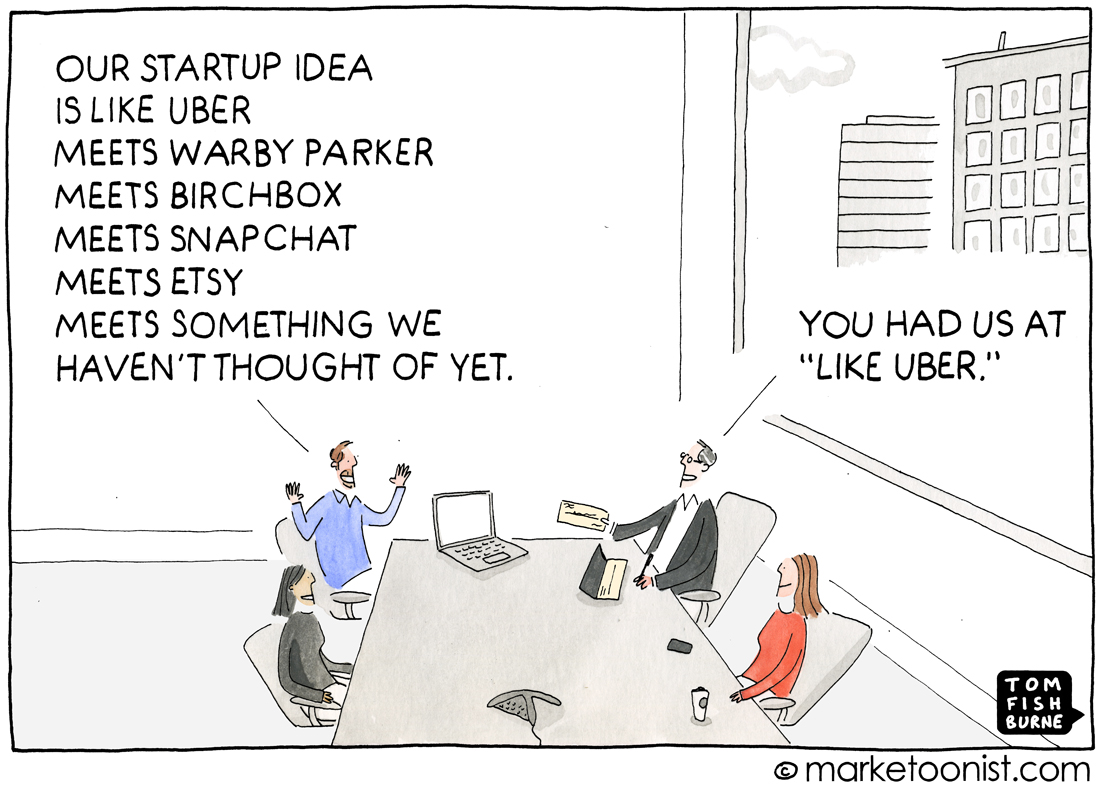
Cartoon – You had us at “Like Uber”



Health care might be one of them. Amazon, Berkshire Hathaway and JPMorgan certainly hope so.
Amazon.com Inc., Berkshire Hathaway Inc. and JPMorgan Chase & Co. are publicly traded, profit-oriented corporations. 1 So it is interesting that when they announced their new joint health-care venture this week they made a point of saying it would be “an independent company that is free from profit-making incentives and constraints.”
Interesting but maybe not all that surprising: Around the world, health, life and property insurance, as well as various other financial services, have long been provided by nonprofit organizations, mostly in the form of customer-owned mutuals. From the 1960s through 2000s, wave after wave of conversions turned many of these entities — especially in the U.S. and U.K. — into shareholder-owned for-profit corporations. But since the global financial crisis, the idea that corporations out to maximize shareholder returns might not always be the best at managing financial and other risks has undergone something of a revival.
Just to be clear: It looks like this new Amazon-Berkshire-JPMorgan entity will be owned by the three companies, not the employees it serves. That is, it won’t technically be a mutual. But the three companies’ apparent belief that the for-profit-insurer-dominated private health-care market in the U.S. isn’t cutting it — and that “profit-making incentives” are at odds with improving health-care delivery and cutting costs — got me thinking about the strengths and weaknesses of mutuals and other nonprofits relative to conventional corporations.
Mutuals that are owned by and distribute excess cash to their customers have been around for centuries, in many cases predating their for-profit counterparts. Some of the first insurance companies were organized in the 1600s and 1700s in the Netherlands and U.K. as customer-owned cooperatives, and the mutual organizational form has remained prominent in life and property insurance ever since. The 1800s saw an explosion of mutual activity, with fraternal organizations, trade associations, labor unions, social reformers and philanthropists starting co-operative lenders, health-care providers, pension funds, groceries, farming enterprises and even factories. This continued into the 20th century, although in Europe these mutual organizations were often co-opted or supplanted by government social insurance programs. 2
In the U.S., mutuals and nonprofits with mutual-like characteristics have continued to play major roles in insurance, money management, health care and other fields — including outdoor gear, which is top of mind at the moment because I recently spent a bunch of money at customer-owned Recreational Equipment Inc. But these mutuals and co-ops have just spent several decades on the defensive, with “demutualizations” in which mutual customers are given shares in newly created for-profit corporations transforming sector after sector.
I think this trend started with mutual funds, sort of. The first mutual fund, Massachusetts Investors Trust, was founded in 1924 as a true-blue customer-owned nonprofit. Most of the funds that followed in its footsteps were controlled by for-profit investment advisers, but for decades after the 1929 stock-market crash, those advisers acted more like cautious trustees than risk-taking profit-maximizers. Things changed during the booming stock market of the 1960s, with fund advisers getting much more aggressive in their investing and marketing, and in some cases acquiring competitors. In 1969, Massachusetts Investors Trust threw in the towel, demutualizing and transforming itself into Massachusetts Financial Services, which is now a subsidiary of Canada’s Sun Life Financial Inc. Mutual funds themselves are all still technically mutual, but the business (with one huge exception that I’ll get to in a moment) really isn’t.
Savings and loans demutualized in a more formal fashion in the 1980s, after the Garn-St. Germain Depository Institutions Act of 1982, in an attempt to attract new capital into the struggling industry, made it much easier for customer-owned S&Ls to convert to shareholder-owned corporations. (Credit unions remain the banking industry’s mutual holdout in the U.S.) Then life insurers began a great demutualization wave in the 1990s, with many of the industry’s biggest names — MetLife Inc., Prudential Financial Inc., John Hancock — switching from customer-owned to publicly traded. The Blue Cross and Blue Shield Association of mutual health insurers began allowing its members to switch to for-profit in 1994. And with Sweden, of all places, leading the way in 1987, stock exchanges began demutualizing as well.
For exchanges, it’s pretty easy to make the case for demutualization. With technological change, deregulation and internationalization transforming their business landscape, single-country, member-owned mutuals were in no position to compete. Publicly traded exchanges could raise capital, merge across national lines and take other steps that wouldn’t have been practical under a mutual structure.
Access to capital and increased flexibility have been offered up as leading reasons for demutualization in other industries as well. Also, in an influential pair of 1983 papers, finance scholars Eugene Fama and Michael Jensen argued that mutuals and other nonprofits lacked some of the control mechanisms — the threats of hostile takeover and shareholder activism, mainly — that kept managers of publicly traded corporations from taking advantage of owners. Empirical research since then has shown demutualized companies to be more efficient and achieve higher returns on capitalthan their mutual peers.
But that’s not the end of the story. It’s not entirely coincidental that the mass demutualization of the savings and loan industry in the 1980s was followed by an industrywide meltdown that cost taxpayers more than $100 billion. And remember Northern Rock, the U.K. institution that suffered a bank run in 2007 that was an early harbinger of the financial crisis? It had demutualized in 1997. On the whole, mutual financial institutions seem to have held up better during the financial crisis than their for-profit competitors. Mutual executives have fewer incentives to take risks, and that can sometimes be a good thing. There’s also evidence that mutual executives do more than just pay lip service to their customer-owned status. Mutual auto insurers in the U.S. — especially those such as Amica Mutual and USAA that pay regular dividends to customers — pay out a higher percentage of their premiums in claims than for-profits, according to one recent study. Mutual insurers perennially top for-profits in customer satisfaction rankings, and credit unions perennially top banks (although the banks have been catching up lately).
All in all, then, it seems that mutuals are, if not necessarily better than investor-owned for-profit corporations, pretty nice to have around. During and after the financial crisis, consumers seemed to take notice of this, with mutuals’ share of the global insurance market jumping from 23.6 percent in 2007 to 27.8 percent in 2013, according to the International Cooperative and Mutual Insurance Federation. That share has since sagged backed to 26.8 percent, though. Mutuals’ advantages may be less apparent when times are good.
Also, while there are multiple forces pushing mutuals to demutualize — not least the possibility of stock-market riches for their executives — there’s very little pushing in the opposite direction. The only major conversion to mutual status that I can think of in the U.S. over the past half century was Vanguard Group Inc., which arose in 1974 out of a power struggle at for-profit mutual fund adviser Wellington Management during which ousted president John C. Bogle talked the board members of Wellington’s mutual funds into seizing effective control of the whole operation. That was a rare case where mutualization seemed to help a top executive’s career prospects (although in the long run it probably resulted in Bogle making a lot less money than if he had simply gotten a job at another mutual fund company).
Starting new mutuals isn’t easy, either: The health-insurance co-ops created by the Affordable Care Act were undeniably a bust, although there’s disagreement over whether inadequate support or design flaws doomed them. And New York’s Freelancers Union, another relatively recent addition to the mutual landscape, got out of the health insurance business in 2014 after ACA rules made it impractical.
Once up and running, though, mutuals can be formidable competitors — as everyone else in the mutual fund industry can attest after decades of rapid growth at low-fee index-fund innovator Vanguard. Health care in the U.S. could sure use some low-fee innovation. Maybe, just maybe, Amazon, Berkshire and JPMorgan will find a nonprofit, mutual-ish way to get there. There are precedents: Nonprofit investment giant TIAA was founded by steel magnate Andrew Carnegie; the mostly nonprofit Kaiser Permanente health-care system was the doing of another industrialist, Henry J. Kaiser. For modern magnates Jeff Bezos, Warren Buffett and Jamie Dimon, creating something like that — or something better — would make for a pretty nice legacy.

Glenview Capital Management, which currently owns 17.8 percent of Dallas-based Tenet Healthcare, has submitted a proposal to Tenet that would amend the for-profit hospital operator’s bylaws to allow all shareholders to take action by written consent without a meeting.
Here are five things to know about Glenview’s proposal, which will be voted on at Tenet’s annual meeting.
1. In a letter to Tenet shareholders, Glenview said Tenet has been a “chronically underperforming company for decades,” and shareholders need the ability to take action by written consent.
“Just as a person in worsening health may need more frequent medical attention than a check-up once every 12-18 months, a chronically unhealthy company is likely to return to health quicker and with more certainty if its owners are allowed more frequent board oversight, and this is effectively accomplished through the ability to take action by written consent,” Glenview wrote in the letter to shareholders.
2. In addition to Tenet’s financial underperformance, Glenview said there are several other factors supporting the proposed change, including the board’s slow response to Tenet’s financial and operational challenges.
3. Although Tenet’s board approved amendments to the company’s bylaws in January that allow majority shareholders to request special meetings, Glenview argued shareholders still need action by written consent.
Glenview said the amendment to allow majority shareholders to call special meetings is “wholly impractical, clearly off-market, and sends a dangerous signal that the board may need additional feedback from shareholders to fully appreciate the cultural renaissance for which we mutually strive.”
4. Tenet said it is reviewing Glenview’s proposal. “We will make a recommendation to shareholders in due course,” Tenet said in a statement.
5. Tenet launched a $250 million cost reduction initiative last year, which involves divesting hospitals in non-core markets and cutting 2,000 jobs, or about 2 percent of the company’s workforce. The for-profit hospital operator ended the third quarter of 2017 with a net loss of $367 million on revenues of $4.59 billion. That’s compared to the same period of 2016, when the company recorded a net loss of $8 million on revenues of $4.85 billion.

President Donald Trump delivered his first State of the Union address Tuesday night, highlighting policy goals while welcoming a “new American moment.”
Over the course of 90 minutes, Trump discussed several healthcare-related legislative achievements, including adjustments to the Affordable Care Act as well as new care accountability measures for the Department of Veterans Affairs (VA).
Below are five key takeaways from the president’s speech to Congress:
1. ‘The individual mandate is now gone.’
Trump touted the repeal of the individual mandate penalty, calling the eliminated provision “an especially cruel tax.”
The measure, which required Americans without health insurance to pay a fine, was removed as part of the tax reform bill passed late last year.
The penalty is $695 or 2.5% of an individual’s income, whichever amount is greater, and remains in effect for 2018. The elimination will take place next year.
Though Trump did not call for a renewed effort to repeal the ACA in its entirety, he said the Republican-controlled Congress successfully repealed “the core of disastrous Obamacare.”
2. No mention of upcoming funding deadline or community health centers.
Trump did not acknowledge the recent six-year extension granted to the Children’s Health Insurance Program (CHIP), which was part of the continuing resolution that reopened the government last week after a three-day shutdown.
There was also no mention of the February 8 deadline to pass another continuing resolution or pass an omnibus budget package. Such action would likely have to address the fate of over 10,000 community health center (CHC) sites across the country. Federal funding for CHCs lapsed on October 1, so they have been funded by temporary spending packages since then.
Despite the next deadline coming in little more than a week, Trump did not speak on the issue last night.
3. Will call for unity result in bipartisan solutions?
The president’s speech centered on a call for unity among Americans and members of Congress alike. Such bipartisanship will be important in order to avoid a second government shutdown in as many months and to address lingering healthcare policy concerns.
There are two bills in the Senate with bipartisan cosponsors seeking to stabilize the federal insurance exchange markets: Alexander-Murray and Collins-Nelson. Trump’s call for bipartisanship in the final crafting and debate over these measures will play a role in determining their road to passage.
Newly confirmed Health and Human Services Secretary Alex Azar applauded the speech in a statement released late Tuesday night.
“I commend President Trump for delivering a speech that celebrated the economic boom we have seen under his leadership, which has brought new opportunity and prosperity to the American people,” Azar said. “A healthier economy means a healthier America, and we look forward to more such success in the coming year, including through reforms to make healthcare more affordable and accessible for all Americans.”
4. Reduce price of prescription drugs, endorse “right to try.”
Continuing with a campaign promise to lower prescription drug costs, Trump said the FDA is following his administration’s lead to approve more generic drugs and medical devices.
“One of my greatest priorities is to reduce the price of prescription drugs,” Trump said. “In many other countries, these drugs cost far less than what we pay in the United States. That is why I have directed my Administration to make fixing the injustice of high drug prices one of our top priorities. Prices will come down.”
Trump also urged Congress to take up the issue of the “right to try,” a policy allowing terminally ill patients to access experimental treatments without having to leave the U.S.
“President Trump says reducing price of prescription drugs is one of his highest priorities,” tweeted Bob Doherty, senior vice president for government affairs and public policy at the American College of Physicians. “Doctors and patients certainly hope so and will be glad to do their part.”
5. Signed VA healthcare accountability bill into law.
Trump promised to ensure veterans have a choice in their healthcare decisions, after reports of substandard care at VA medical facilities surfaced in recent years.
In June, Trump signed the VA Accountability Act, which eased restrictions on removing employees who were accused of wrongdoing while also protecting whistleblowers.
The president said the VA has already fired more than 1,500 employees who “failed to give our veterans the care they deserve.”
VoteVets, a progressive veterans advocacy group, criticized Trump’s remarks Tuesday night. The organization highlighted the push by Republican lawmakers to cut $1.7 trillion from federal healthcare programs, which 1.75 million veterans rely on for coverage.
http://money.cnn.com/2018/02/01/news/economy/amazon-health-care/index.html

Amazon shook up the health care world on Tuesday, announcing it was partnering with fellow heavy hitters Berkshire Hathaway (BRKA) and JPMorgan Chase (JPM) to address soaring costs.
Amazon (AMZN), which has advanced light years from its origins as an online bookseller, has had a dramatic impact on many of the industries it’s touched. When it moved into cloud services and streaming shows, it left rivals scrambling to catch up. Last year, it bought Whole Foods, shaking up the grocery space.
The company is now one of the most valuable in the U.S. and its founder, Jeff Bezos, one of the richest people in the world.
But Bezos and his peers, Warren Buffett and Jamie Dimon, are taking on one of the nation’s thorniest challenges. Making health care more affordable has bested savvy business leaders in many industries. The announcement was met with cautious optimism and lots of skepticism.
Related: Jeff Bezos, Warren Buffett and Jamie Dimon want to fix health care
Not much is known about the threesome’s venture — a yet-to-be-named company that will give the firms’ U.S. employees and their families a better option on health insurance and will not be motivated by profit. Experts, are betting that the firm will eventually expand its services to other companies if the effort proves successful.
Health care costs have soared for both employers and their workers over the past decade. Premiums have jumped nearly 50% for family coverage since 2008 and more than tripled since 1999. Meanwhile, employees are shouldering more of the cost when they actually get medical care because their deductibles and co-pays are going up.
Amazon, however, is a master at wringing out inefficiencies in the supply chain. This could prove particularly useful in the health care arena, which is known for its bloat.
“One thing we know for sure is there’s a lot of overhead costs in health care,” said Frederick Isasi, executive director of FamiliesUSA, a health care advocacy group.
While many employers have tried to tackle health insurance costs in the past, they often didn’t have the bandwidth or resources to devote to the issue, Isasi said. The new venture, however, will be focused on its mission and will have the financial backing of three strong firms.
Some of the ways Amazon could use its know-how to make a dent in prices: Negotiate rates directly with health care providers and drug manufacturers, use technology to ease consumers’ ability to make appointments or consult with doctors outside of the office and improve access to price and quality information about physicians, procedures and prescriptions to allow consumers to shop around, Isasi said.
Amazon could also improve Americans’ interaction with their insurance companies and providers, which all-too-often involves ancient technologies such as faxing, said Bob Kocher, a partner who specializes in health care information technology at Venrock, a venture capital firm. After all, Amazon invented one-click ordering on its retail site. It could develop a similar process for paying medical bills, even grouping invoices for doctors, facilities and labs for care that takes place in a hospital, for instance.
And Amazon could make it easier for patients and providers to access their medical records, which would also reduce costs. The new venture could store all that information in the cloud, said Michael Pachter, managing director for equity research at Wedbush Securities.
That way “everything is all together in one place,” he said.

 HENRY KOTULA