

For people who get their health insurance plans in the Affordable Care Act (ACA) marketplace, coverage became much less affordable in 2026. Insurers increased premiums by more than 20 percent; the average “benchmark” premium before tax credits jumped from $497 per month in 2025 to $625 in 2026.1 These increases were partly the result of actions federal policymakers took — for instance, slashing the tax credit some people received to reduce their health plan premiums and imposing new restrictions on enrollment. Predictably, as premiums rose and financial assistance shrank, consumers’ payments soared and enrollment dropped sharply.
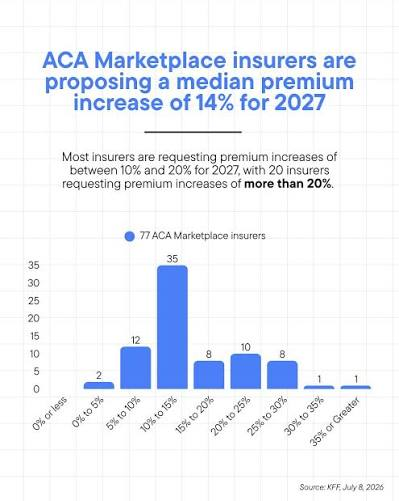
Consumers will get no relief in 2027. Insurers have proposed a median 15 percent rate increase for 2027, with significant variation across insurers and states. These back-to-back double-digit rate increases are the highest we’ve seen in the marketplace since 2018 and follow five years of relatively flat premiums, with average increases of only 2 percent per year for the benchmark plan. Insurer rate filings for 2026 and 2027 reveal that the federal policy changes to the ACA are contributing to these significant rate increases.
What Are Rate Filings and What Information Do They Contain?
Each year insurers adjust their rates so that the premiums they charge will cover projected future health care costs, administrative expenses, and profit. To project future costs, insurers consider a range of factors, including how many people will enroll, how healthy or sick enrollees will be, how much the prices for health care services are likely to rise, and expected changes in how many medical services people will use. Insurers document how these various factors will impact their proposed rates in the annual rate filings. Under the ACA, these filings are subject to independent review from insurance regulators and portions of the filings must be made public.
https://flo.uri.sh/visualisation/30489845/embed?auto=1
Why Are Marketplace Insurers Raising Rates Again for 2027?
Rising health care costs are a key driver of 2027 rate changes. This is an issue for all private health insurance, and indeed, some analysts expect medical costs to grow faster in 2027 than they have in nearly two decades. The marketplace insurer rate filings point to a range of contributing factors, including higher provider prices, higher prescription drug costs, increased use of various services and medications, effects of health care workforce shortages, and general inflation.
But the marketplace rate increases are also the result of recent federal ACA policy changes. Most notable is Congress’ failure to extend ACA premium tax credit enhancements at the end of 2025. Enhanced subsidies were in place from 2021 to 2025, making coverage far more affordable and leading to record enrollment. Their expiration drove up rates in 2026; new rate filings signal ongoing effects.
Marketplace enrollment is expected to decline precipitously this year — by a range of 17 percent to 26 percent. As marketplace plans become less affordable, younger and healthier individuals are more likely to drop coverage. Remaining enrollees will be sicker on average and more costly. Many marketplace rate filings cite the end of premium tax credit enhancements and declining enrollment as further driving up rates in 2027, compounding 2026 increases.
Marketplace consumers will face additional barriers in 2027 that may also impact rates. New paperwork burdens will make it harder to enroll, and many lawfully residing immigrants will lose access to financial assistance that keeps premiums affordable. These changes will further drive down enrollment, leading to a smaller, sicker, and more costly marketplace risk pool.
How Will This Affect Affordability and Access for Consumers?
ACA premium tax credits provide a crucial buffer against insurers’ rate hikes. Policymakers’ decision to end the enhanced version of the credits caused that buffer to shrink for millions of people with modest incomes. For millions more (i.e., Americans with middle incomes), this cost buffer vanished completely. As a result, people with annual incomes of more than $63,840 for an individual or families of four with incomes of $132,000 or more will bear the full brunt of two years of double-digit rate hikes, with no financial help. For example, a 40-year-old individual with income just over this threshold who paid $445 per month after tax credits were applied in 2025 could owe $719 per month in 2027.2
As premiums become less affordable, marketplace consumers may continue to “buy down” to plans with lower premiums but higher deductibles. This would leave more enrollees underinsured, facing greater barriers to care and increased exposure to medical debt.
In addition, at least seven insurers — Baylor Scott & White Health Plan, CareSource, Cigna, Medica, Mending (formerly Taro Health), PacificSource, and Providence Health Plan — have announced they will no longer offer marketplace coverage in 2027. These insurers point to escalating costs, declining enrollment, and shifting regulations. Their exits will force consumers in 20 states to switch to new plans next year. With fewer coverage options, they may have a harder time finding plans that cover their doctors and prescription medicines. Less competition among insurers is also associated with higher premiums.
Looking Forward
Americans struggling to afford health care are concerned about the high cost of their health insurance premiums. They look to the federal government for solutions, yet recent actions by Congress and the Trump administration have made the problem worse. The ACA marketplaces have proven resilient, but the upheaval created by these recent policies could threaten their long-term stability. For now, with open enrollment around the corner, many marketplace consumers will soon face higher prices and fewer choices.

