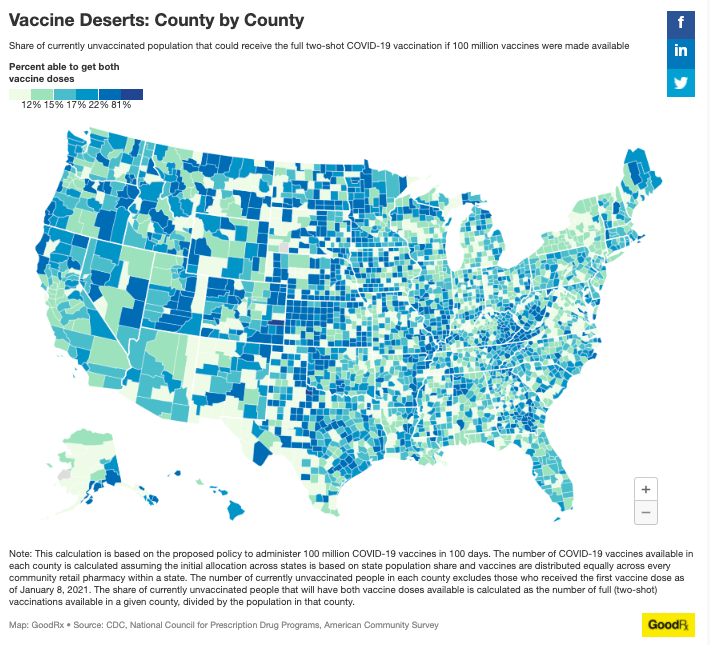
Millions of Americans who live in “pharmacy deserts” could have extra trouble accessing coronavirus vaccines quickly, according to a new analysis by GoodRx.
Why it matters: Places without nearby pharmacies, or with a large population-to-pharmacy ratio, may need to rely on mass vaccination sites or other measures to avoid falling behind.
The big picture: Pharmacies will play a huge role in the vaccine rollout, especially as shots become more available to the general population.
But if people have to drive far to get a shot, or if pharmacies can’t keep up with local demand, that could leave millions of Americans vulnerable to the virus for longer than people in better-served areas.
“Pharmacy deserts in turn create ‘vaccine deserts’ — where the rate of vaccination is slower simply because there aren’t enough vaccination appointments available due to limited pharmacy capacity,” the GoodRx analysis says.
“The rollout of the COVID-19 vaccine may take even longer without additional resources like mass vaccination sites,” it says.
By the numbers:The incoming Biden administration has set a goal of vaccinating 100 million people in 100 days, or about 16% of the unvaccinated U.S. population, per GoodRx.
But “nearly half of all counties would have a slower local vaccination rate, generating further healthcare access inequities in areas that are already more likely to be under-resourced in the fight against COVID-19,” the analysis concludes.
177 counties don’t have any pharmacies at all, leaving 635,000 people forced between foregoing a vaccine or potentially driving long distances to get one.
The United States on Tuesday passed 400,000 deaths from COVID-19, a stunning total that is only climbing as the crisis deepens.
The country is now averaging more than 3,000 coronavirus deaths every day, according to Johns Hopkins University data, more than the number of people killed in the Sept. 11, 2001, terror attacks, and the daily death toll has been rising. The effects of a surge in gatherings and travel over the holidays are now coming into focus.
The grim milestone of 400,000 deaths came on the last full day in office for President Trump, who has long rejected criticism of his handling of the pandemic.
The situation threatens to get even worse as a new, more contagious variant of the virus becomes more prevalent. The Centers for Disease Control and Prevention (CDC) warned last week that one of the new variants, first discovered in the United Kingdom, could be the predominant strain in the U.S. by March.
Vaccines offer hope, but it is crucial for the inoculation campaign to progress as quickly as possible to get as many people protected before the new variant takes greater hold.
The U.S. vaccination campaign has started slowly, though there are signs it is beginning to pick up some speed. President-elect Joe Biden has pledged a more aggressive federal role in the vaccination effort, including using the National Guard and the Federal Emergency Management Agency to set up more vaccination sites.
In the short term, however, the country is in for a bleak period.
“I think we still have some dark weeks ahead,” she said.
The country passed 300,000 deaths in mid-December.
At the end of March, as the crisis was beginning, Trump said that if deaths are limited to between 100,000 and 200,000 “we all, together, have done a very good job.” The country has long ago exceeded those numbers.
The U.S. has by far the most COVID-19 deaths of any country in the world. Brazil follows with around 210,000, and India and Mexico are around 150,000, according to Johns Hopkins University.
More than 124,000 people are in the hospital with coronavirus in the U.S., according to the COVID Tracking Project, though the number is starting to decline somewhat from a peak of over 130,000 about a week ago.
The spread of the more contagious variant, however, threatens to send that number spiking again.
Coroner Elizabeth Napoles, right, of the Los Angeles County Department of Medical Examiner, works with National Guardsmen, helping to store the bodies of covid-19 victims last week.
Health officials stress they haven’t determined whether the variant might be more contagious or resistant to vaccines.
A coronavirus variant first identified in Denmark has ripped through Northern California — including outbreaks at nursing homes, jails and a hospital in the San Jose area — prompting state and local officials to investigate whether it may be more transmissible.
California officials disclosed the rise of the variant Sunday night after genetic monitoring linked it to a fast-growing share of new cases, as well as to the outbreaks in Santa Clara county, which includes San Jose.
This rising variant is distinct from the highly contagious mutation discovered by Britain, which has also been found in California, and which federal health officials projectcould become the dominant strain in the United States by March based on its proven higher transmissibility.
Experts stress that they need to look more closely at the circumstances of the Northern California outbreaks, as well as at the latest variant — this one, known as L452R — before declaring it more contagious or more dangerous than the virus already broadly circulating.
The L452R variant was first detected in northern Europe in March and has since been confirmed in more than a dozen states, including California in May. The discovery did not garner much attention at the time because all viruses change constantly as they replicate. But public health authorities deem some variants to be “of concern” if evidence suggests they might be more contagious, potentially deadlier or resistant to vaccines.
California publicized the latest variant at a late Sunday news conference after researchers identified it in about 25 percent of samples collected between Dec. 14 and Jan. 3, a surge from 3.8 percent of samples collected in the preceding three-week period.
“That is suggestive, and it’s a little worrisome,” Charles Chiu, a virologist at the University of California at San Francisco said at the briefing. But Chiu stressed it was too early to conclude the variant is more infectious because scientists do not know whether their sampling was representative or whether the variant’s increase might be due to random chance, or even a series of superspreader events.
Officials urged people to follow public health guidelines to minimize the risk of contracting the variant as new daily cases in the hard-hit state plateau at more than 38,000, while deaths average more than 515 daily.
“It’s too soon to know if this variant will spread more rapidly than others,” said Erica Pan, California’s state epidemiologist, “but it certainly reinforces the need for all Californians to wear masks and reduce mixing with people outside their immediate households to help slow the spread of the virus.”
Genetic sequencing of viruses is still limited in the United States, preventing health officials from having a real-time picture of all the strains of coronavirus spreading across the country and their prevalence.
California’s preliminary data is based on fewer than 400 samples that overwhelmingly came from the state’s north. Southern California is the heaviest hit part of the state, with deaths in Los Angeles County reaching one every seven minutes and ICU beds and oxygen running out, although hospitalizations have begun to plateau. Environmental regulators on Sunday temporarily lifted limits on cremations because of a backlog in Los Angeles County.
The L452R strain in California raised alarms because it is associated with several large outbreaks in Santa Clara County, including one at a hospital that infected at least 90 people and killed one staff member. Officials at Kaiser Permanente San Jose Medical Center said a staff member wearing an inflatable Christmas tree costume to spread holiday cheer likely spread coronavirus-laden droplets instead.
A Kaiser Permanente employee died and dozens of others contracted the coronavirus after a staffer appeared at the San Jose medical center wearing an inflatable, air-powered holiday costume on Christmas Day.
Sara Cody, Santa Clara’s top public health official, described that episode as a “very unusual outbreak with a lot of illnesses, and it seemed to spread quite fast.” The county is working with state health officials and the CDC to investigate what happened, she said.
Cody cautioned that the outbreak could have been driven by factors unrelated to the variant, such as changes in ventilation or personal protective equipment practices at the hospital.
“The takeaway is not that we need to start worrying about this,” Cody said Sunday. “The takeaway is, this is a variant that’s becoming more prevalent, and we need to lean in and understand more about it.”
County officials on Monday disclosed other places where the variant had been found as a result of aggressive genetic sequencing, “including cases associated with the Kaiser outbreak, skilled nursing facility outbreaks, cases in jails and shelters, and specimens from testing sites in the community,” according to a statement. “This suggests that the variant is now relatively common in our community.”
Chiu, the virologist who conducted the genetic sequencing, said a deeper investigation must be done to determine if the strain is more transmissible like the one found in the United Kingdom.
He also raised concerns that a mutation associated with the variant might make it more resistant to vaccines because it occurs in a critical part of the spike protein that is targeted by the vaccines,but he added that the virus must be grown in a lab and tested more fully before any conclusions can be drawn.
“Mutations happen all the time,” said William Hanage, an epidemiologist at the Harvard T.H. Chan School of Public Health. “Some of them take off and the great majority of them don’t. The main reason why we are paying attention to this is because this mutation has previously been noted as being of particular concern in terms of diminishing the efficacy of the immune response.”
Carlos del Rio, a professor of medicine and global health at Emory University, said the rising prevalence of the variant shows the urgent need for more genetic sequencing in the United States and for greater compliance with public health measures such as wearing masks and avoiding crowds.
“We really need to hunker down because if you are really concerned about mutations, stop transmission,” del Rio said. “The more mutations you see, the more uncontrolled transmission you will see.”
After starting the new year with record-high cases, deaths and hospitalizations, the United States is starting to see signs of slowing spread despite fears of a post-holiday surge that would continue through January. The seven-day average of new infections has slowed since last Tuesday, and hospitalizations have started to plateau, according to Washington Post tracking.
Still, Scott Gottlieb, a former Food and Drug Administration commissioner, warned that the advent of more transmissible variants could reverse that progress.
“As current epidemic surge peaks, we may see 3-4 weeks of declines in new cases but then new variant will take over,” Gottlieb tweeted Sunday, referring to the British variant. “It’ll double in prevalence about every week. It’ll change the game and could mean we have persistent high infection through spring until we vaccinate enough people.”
President Trump on Monday moved to lift restrictions imposed on travelers to the U.S. from much of Europe and Brazil that were implemented last year to slow the spread of the novel coronavirus, though the action is expected to be stopped by the incoming Biden administration.
Trump issued an executive order terminating the travel restrictions on the United Kingdom, Ireland, Brazil and the countries in Europe that compose the Schengen Area effective Jan. 26. The order came two days before Trump leaves office. President-elect Joe Biden’s team immediately signaled they would move to reverse the order.
“With the pandemic worsening, and more contagious variants emerging around the world, this is not the time to be lifting restrictions on international travel,” tweeted incoming White House press secretary Jen Psaki.
“On the advice of our medical team, the Administration does not intend to lift these restrictions on 1/26. In fact, we plan to strengthen public health measures around international travel in order to further mitigate the spread of COVID-19,” Psaki continued.
The order states that Trump’s action came at the recommendation of outgoing Health and Human Services Secretary Alex Azar.The memo cites the new order from the Centers for Disease Control and Prevention (CDC) that requires passengers traveling by air to the U.S. to receive a negative COVID-19 test within three days before their flight departs, saying it will help prevent travelers from spreading the virus.
The Trump administration’s travel restrictions on China and Iran will remain in place, however, because, the order states, the countries “repeatedly have failed to cooperate with the United States public health authorities and to share timely, accurate information about the spread of the virus” and therefore cannot be trusted to implement the CDC’s order.
“Accordingly, the Secretary has advised me to remove the restrictions applicable to the Schengen Area, the United Kingdom, the Republic of Ireland, and the Federative Republic of Brazil, while leaving in place the restrictions applicable to the People’s Republic of China and the Islamic Republic of Iran,” Trump’s order states. “I agree with the Secretary that this action is the best way to continue protecting Americans from COVID-19 while enabling travel to resume safely.”
Though Trump signed the order on Monday, the action does not take effect until six days after he leaves office and Biden is inaugurated.
The order comes as coronavirus cases and deaths continue to hit worrisome, record-high levels on a daily basis. Nearly 400,000 people in the U.S. and more than 2 million people globally have died from COVID-19. While two vaccines have been approved for emergency use in the U.S., the Trump administration has fallen far short of early targets in distributing and administering the vaccine.
The order will be one of the final actions that Trump takes with respect to the pandemic, after being widely criticized for regularly minimizing the threat posed by the virus.
Trump announced in mid-March of last year that he would impose travel restrictions on individuals entering the United States from the 26 countries that compose the Schengen Area, weeks after the first case was reported in the U.S. The move initially attracted scrutiny because it did not include the U.K. or Ireland, and the Trump administration later moved to restrict travel from those countries as well.
Trump later placed travel restrictions on Brazil at the end of May.
The executive order lifting the travel restrictions was one of several released by the White House on Monday as the final hours of Trump’s presidency wind down. Trump is also expected to grant a final slew of pardons before he leaves office on Wednesday.
Yet despite the massive death toll and the changes to daily life caused by the pandemic, the individual deaths are largely invisible.
“Coronavirus victims who die in the hospitaloften spend their final days cut off from family and friends, their only human contact coming from medical personnel hidden behind layers of protective gear. Even those who die at home often decline in quarantine, keeping a lonely vigil over their body’s fight,” my colleagues write.
The numbers are expected to quickly rise. Rochelle Walensky, the incoming director of the Centers for Disease Control and Prevention, told “Face The Nation” on Sunday that she anticipated half a million deaths by mid-February.
“That doesn’t speak to the tens of thousands of people who are living with a yet- uncharacterized syndrome after they’ve recovered. We still yet haven’t yet seen the ramifications from holiday travel, holiday gathering in terms of high rates of hospitalizations,” Walensky added.
NEW: Does incoming @CDCgov dir. @RWalensky agree with current #COVID19 forecasts that the pandemic will get worse in the US in coming months?
Dare we say it: The window for bipartisan work on drug pricing reform may be closed.
Sen. Ron Wyden, top Democrat on the powerful Senate Finance Committee, is focusing on a wish-list item for Democrats but poison pill for the GOP: eliminating a ban on the federal government using its negotiating power to directly force lower drug prices under Medicare.
“I think we’ve got to take bold action on prescription drug prices,” Wyden (Ore.) told reporters yesterday. “We’re going to be looking at all the tools to get this done.”
President Trump made lowering prescription drug prices a major promise during his campaigns. But despite some efforts, there has been major pushback from Capitol Hill and the pharmaceutical industry and not much has actually been accomplished.
Bipartisanship — not to mention mere civility — feels further away than perhaps ever before on Capitol Hill.
Ten House Republicans joined Democrats yesterday to impeach President Trump a second time, amid near-chaos in the chamber and uncertainty about where Trump’s exit leaves the GOP, my colleagues reported.
“Democrats and Republicans exchanged accusations and name-calling throughout the day, while Trump loyalists were livid at fellow Republicans who broke ranks — especially [Rep. Liz] Cheney — leaving the party’s leadership shaken,” Mike DeBonis and Paul Kane write.
None of this bodes well for getting anything bipartisan done in the new session of Congress — including lowering high U.S. drug prices.
Focusing on direct negotiation, as Wyden urged yesterday, would cut Republicans out of the picture.
Back in 2019, Wyden tried very hard to keep Republicans on board such an effort, as he pushed for a limited, bipartisan bill co-written with Sen. Charles E. Grassley (R-Iowa). That measure would have capped out-of-pocket costs for Medicare enrollees and required some rebates from drugmakers. But after passing in committee, the measure languished as Senate Majority Leader Mitch McConnell (R-Ky.) refused to bring it to the floor.
It’s possible to imagine Democrats getting 60 votes to pass such an effort, now that they’ll control the Senate. After all, a half-dozen Finance Committee Republicans voted for it.
But in remarks slamming McConnell, Wyden yesterday said the majority leader proved his ultimate unwillingness to enact any significant drug pricing reforms under heavy pressure from the pharmaceutical industry.
Democrats, Wyden said, should now move aggressively to lower drug prices after years of delays.
“If Mitch McConnell and pharma — two very powerful forces — had been willing to go to the Senate floor, we would have been able to get an enormous vote,” Wyden said. “My bottom line is issues like prescription drugs have been kicked down the road again and again and again.”
Wyden said he now wants to “build on” his legislation with Grassley.
He didn’t rule out using a budget reconciliation measure — which requires just 50 votes — to pass a more aggressive drug pricing bill than Republicans are willing to support. In the normal legislative process, Democrats will have to get at least 10 Republicans on board with legislation because it takes 60 votes to avoid a filibuster.
A starting place could be H.R. 3— the bill the Democratic-led House approved at the end of 2019 allowing the health secretary to directly negotiate with drug companies for lower prices. That provision would lower federal spending by about $456 billion over a decade, but it could also result in 40 fewer new drugs being developed over the next two decades, according to the Congressional Budget Office.
Yet Wyden acknowledged difficulties in pursuing this course of action. For example, there are strict rules around what can go into a budget reconciliation bill. Democrats will be limited to just two such bills — one for this year and one for next. Plus, they have many competing policy priorities.
New research supports the idea that direct negotiations with Medicare can result in lower government payments for prescription drugs.
This effect is one reason the pharmaceutical industry — and thus many Republicans and some Democrats — hate the idea so much. Because of its vast market power, the government can secure far lower prices when it negotiates for drugs directly (the GOP also argues that direct negotiations would dampen new drug development).
A new report by the Government Accountability Office, provided first to The Health 202, found that Veterans Affairs pays 54 percent less for a unit of drugs than Medicare’s prescription drug program. The report, requested by Sen. Bernie Sanders (I-Vt.), compared how much the government pays for drugs provided through the two programs.
The price differences partly stem from how the two programs are structured.
VA can save so much money partly because it directly purchases drugs from manufacturers on behalf of all of its nine million enrollees.
But Medicare Part D has less leverage with drugmakers. Private insurance plans contract with the government to provide pharmacy benefits. Then each plan, on its own, negotiates prices with manufacturers. So while the program covers 42.5 million people — far more than the VA — its negotiating power is dispersed among many different plans.
In its report, the GAO compared the 2017 prices of 399 top drugs in each program. It also found:
Of the 399 drugs in the sample, 233 were at least 50 percent cheaper in VA than in Medicare. One hundred six drugs were at least 75 percent cheaper.
Just 43 drugs were cheaper in Medicare than in VA.
The price differences between the two programs were greater on average for generic drugs.
The VA’s prices were 68 percent lower than Medicare prices for 203 generic drugs and 49 percent lower for the 196 branded drugs.
Market power isn’t the only difference between the VA and Medicare plans.
There are statutory discounts available to VA, which also lower its costs for drugs. VA also has more direct control over the medications it will cover, allowing it to steer patients toward certain lower-priced drug options.
All of this bolsters arguments for allowing direct negotiations in Medicare, Sanders argues.
“There is absolutely no reason, other than greed, for Medicare to pay twice as much for the same exact prescription drugs as the VA,” he said, in a statement provided to The Health 202. “If the VA can negotiate with the pharmaceutical companies to substantially reduce the price of prescription drugs, we must empower Medicare to do so as well.”
By the time President-elect Joe Biden takes the oath of office on Wednesday, more than 400,000 Americans will have died of covid-19 — a dismal milestone in the deadly pandemic.
Yet the crucial task he faces— rapidly distributing coronavirus vaccines to the American public — is one that most experts one year ago didn’t think would even be an option by this point. Few expected multiple vaccines to be approved within a year — a record for vaccine development, by any measure. And although the rollout has been criticized, Israel and Great Britain are the only major nations the United States lags in vaccinations per capita and its daily rate of immunizations has more than doubled in the past two weeks.
“You have my word: We will manage the hell out of this operation,” Biden said in a speech on Friday, announcing his own vaccination plan.
Regardless of whether one views the vaccine effort up to this point as a failure or success, this much is true: Biden and his new administration will face an enormous task, not only in getting the vaccines distributed but also in ramping up testing, convincing Americans to follow public health recommendations and responding to the economic fallout from the pandemic.
Here are six key promises Biden is making about his pandemic response:
1. Administer 100 million doses of coronavirus vaccine during the first 100 days of his administration.
Biden previously cited this as a goal. He reiterated it Friday while rolling out a broader plan for coronavirus vaccinations
The plan would require a rate of 1 million immunizations per day — and the United States isn’t too far away from that goal right now. Nearly 800,000 Americans are getting shots every day on average. That’s a considerable improvement from two weeks ago, when the daily rate was closer to 350,000.
The 100-shot goal is “absolutely a doable thing,” Anthony S. Fauci, direct of the National Institute for Allergy and Infectious Disease, told NBC’s Chuck Todd yesterday.
“The feasibility of his goal is absolutely clear; there’s no doubt about it,” Fauci said. “That can be done.”
But top Biden advisers are also cautioning ramping up immunizations will be gradual and will require lots of coordination.
“The first days of that 100 days may be substantially slower than it will be towards the end,” Michael Osterholm, a member of Biden’s covid-19 task force, told Stat News.“It’s not going to occur quickly … you’re going to see the ramp-up occurring only when the resources really begin to flow.”
2. Set up mass vaccination clinics.
By the end of his first month in office, Biden has promised to open 100 federally managed clinics to administer shots. According to his vaccination plan, these sites would be set up by the Federal Emergency Management Agency. The federal government would reimburse states for sending National Guard members to help run them.
Biden says he also wants to deploy mobile units to rural and underserved areas, along with boosting the role already being played by pharmacies in distributing shots.
This approach would diverge significantly from how things are being done now, with the Trump administration leaving it up to hospitals, doctors, pharmacies and state public health departments to administer the shots. Some cities and states have set up large vaccination sites, but many haven’t.
“Overall, the president-elect’s plan lays out a more muscular federal role than the Trump administration’s approach, which has relied heavily on each state to administer vaccines once the federal government ships them out,” Anne Gearan, Amy Goldstein and Laurie McGinley report.
“Many of the elements — such as seeking to expand the number of vaccination sites and setting up mobile vaccination clinics — were foreshadowed in a radio interview Biden gave last week and in an economic and health ‘relief plan’ he issued Thursday, which contains a $20 billion request of Congress to pay for a stepped-up campaign of mass vaccination,” our colleagues add.
3. Allow federally qualified health centers to directly access vaccines.
These community health centers — which receive higher government reimbursements but are required to accept all patients regardless of their ability to pay — are a core part of the nation’s safety net for low-income Americans.
Biden’s plan proposes a new program “to ensure [federally qualified health centers] can directly access vaccine supply where needed,” although here, too, it’s unclear exactly how that might work.
Under the Trump administration’s plan, these centers have been asked to enroll with state health departments as vaccine providers. States were then supposed to communicate to the federal government how many doses were needed and where they should go.
How well this is actually working is “all over the map,” said Amy Simmons Farber of the National Association of Community Health Centers. She said supplies vary from county to county and many health centers have received their supplies with little notice, making it challenging to prioritize and plan.
Farber declined to comment on the Biden plan, saying she doesn’t have a lot of details about it. But she’s “very encouraged by the recognition of the important role health centers have played in fighting the pandemic and the need to adequately resource them.”
4. Use the Defense Production Act to ensure plenty of vaccine supplies.
Several times over the course of the pandemic, President Trump has invoked the Defense Production Act, which allows the president to require companies to prioritize contracts deemed essential for national security.
Ventilator tubes are attached to a covid-19 patient at Providence Holy Cross Medical Center in Los Angeles.
He has used the DPA to speed the production of coronavirus tests and ventilators, and to keep meatpacking plants open. But he hasn’t invoked the authority to compel faster production of the supplies needed for packaging and administering the vaccine.
Biden says he will invoke DPA to ensure a steady stream of these supplies, which include glass vials, stoppers, syringes, needles and the capacity for companies to rapidly fill vaccine vials and finish packaging them.
5. Sign executive actions to combat the virus.
Biden has promised a raft of executive actions in his first ten days as president, laid out over the weekend in a memo from incoming White House Chief of Staff Ron Klain. They’ll include a number of pandemic-related orders.
On Inauguration Day, Biden intends to issue a mask mandate on federal property and for interstate travel, while encouraging all Americans to wear masks for what he’s calling a “100 Day Masking Challenge.”
The following day, Thursday, he’ll sign executive orders aimed at helping schools and businesses reopen safely, expanding testing, protecting workers and establishing clearer public health standards. And on Friday, Biden will direct his Cabinet secretaries to take immediate action to deliver economic relief to families.
“President-elect Biden will take action — not just to reverse the gravest damages of the Trump administration — but also to start moving our country forward,” Klain wrote.
6. Launch a vaccine education campaign.
The memo says Biden will run a “federally-run, locally-focused public education campaign.”
“The campaign will work to elevate trusted local voices and outline the historic efforts to deliver a safe and effective vaccine as part of a national strategy for beating covid-19,” it says.
But the transition team hasn’t detailed how the education campaign might differ from one launched by the Trump administration last month.
The Department of Health and Human Services said it plans to spend $250 million on efforts to promote vaccine awareness. It kicked off the effort with a $150,000 buy on YouTube for ads that feature Fauci and Food and Drug Administration Commissioner Stephen Hahn.