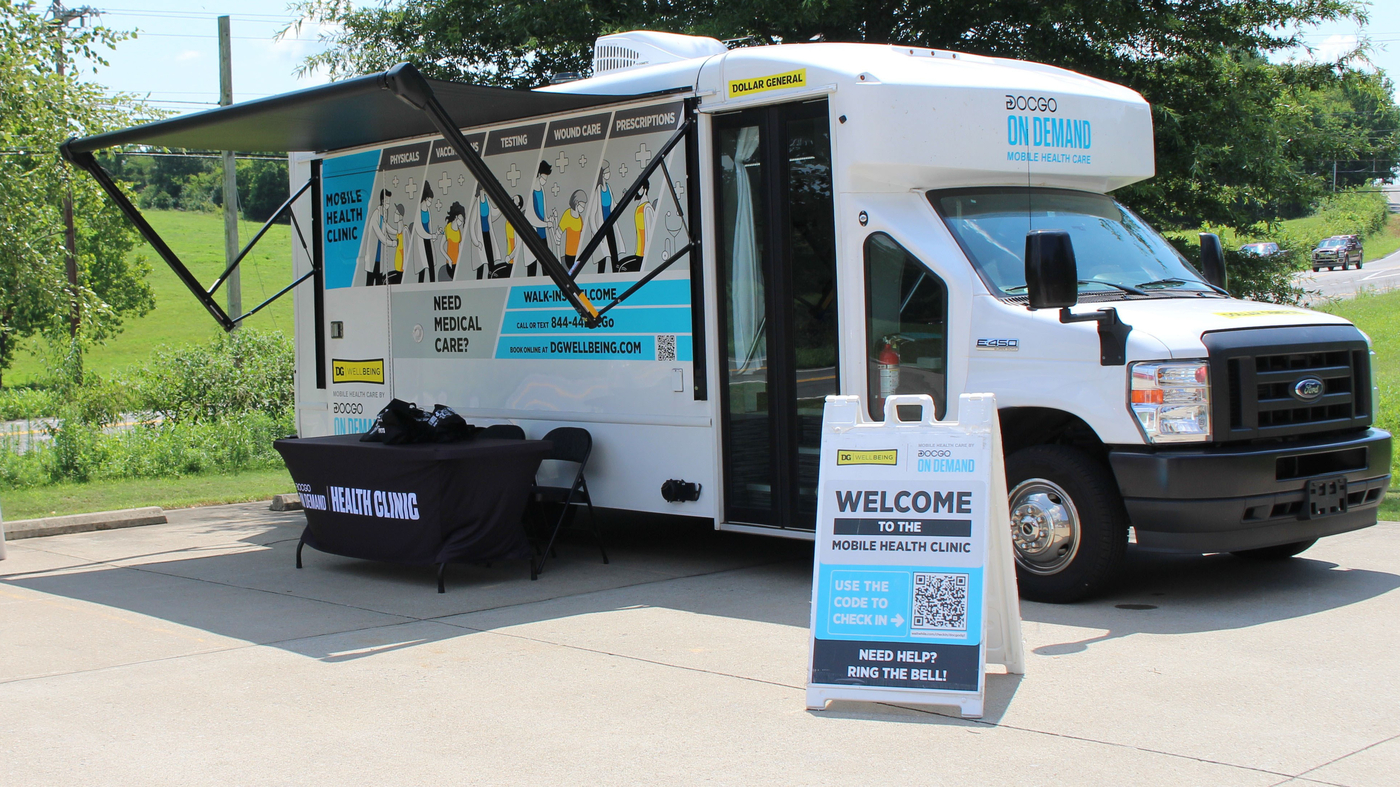
Discount retail giant Dollar General announced late last week that it will end its mobile health clinic pilot program, run in partnership with mobile medical care provider DocGo.
Launched in Jan. 2023, the mobile clinics provided basic healthcare services—including annual physicals, vaccinations, urgent care, and lab testing services—several days per week outside three Dollar General stores near the company’s Goodlettsville, Tennessee headquarters.
A Dollar General spokesperson said that ending the mobile clinics program was a mutual decision between Dollar General and DocGo and did not provide additional details on the decision.
The Gist: Dollar General’s small healthcare delivery pilot received significant attention when it was announced, due to the retailer’s extensive footprint in rural and medically underserved areas.
Although the discount retailer never touted a healthcare strategy on the scale of Walmart or Walgreens, which have each also walked back their healthcare delivery ambitions this year, Dollar General did hire a chief medical officer in 2021, and many thought that this pilot could be the company’s first step toward broader healthcare delivery.
Instead, Dollar General’s role in improving the health of rural Americans for now remains limited to its retail offerings: it continues to expand its DG Fresh initiative, now selling fresh produce at more than a quarter of its 20K locations, and its DG Wellbeing section, which now accepts supplemental health benefits for its selection of more than 300 over-the-counter medicines and supplements.
Late last week, Oregon Health & Science University (OHSU) and Legacy Health, both not-for-profit health systems based in Portland, OR, shared that they had signed a definitive agreement to merge after first announcing their intent to combine last August.
The combined system would be the largest in the Portland region, with 12 hospitals and a total annual revenue of about $6.6B. As part of the deal, OHSU has promised to invest about $1B over ten years to upgrade Legacy’s facilities.
The systems are expected to apply this summer for review by Oregon’s Health Care Market Oversight Program, which was established in 2022 and has the authority to deny or attach conditions to healthcare mergers in the state.
The Gist: If finalized, this merger would connect OHSU’s academic medical center to Legacy’s network of community hospitals and clinics, as well as secure Legacy a needed capital infusion.
Next steps include review by both federal regulatory agencies and Oregon, which is among a growing number of states to implement M&A oversight laws.
The US labor market added more jobs than expected in May defying previous signs of a slowdown in the economy.
Data from the Bureau of Labor Statistics released Friday showed the labor market added 272,000 nonfarm payroll jobs in May, significantly more additions than the 180,000 expected by economists.
Meanwhile, the unemployment rate rose to 4% from 3.9% the month prior. May’s job additions came in significantly higher than the 165,000 jobs added in April.
The print highlights the difficulty the Federal Reserve faces in determining when to lower interest rates and how quickly. The economy and labor market has held up overall, and inflation has remained sticky, building the case for holding rates higher for longer. Yet some cracks have emerged, such as signs of inflation pressuring lower income consumers and rising household debt.
“They’re really walking a tight rope here,” Robert Sockin, Citi senior global economist, told Yahoo Finance of the central bank. He noted the longer the Fed holds rates steady, the more cracks could develop in the economy.
Wages, considered an important metric for inflation pressures, increased 4.1% year over year, reversing a downward trend in year-over-year growth from the month prior. On a monthly basis, wages increased 0.4%, an increase from the previous month’s 0.2% gain.
“To see more confidence that inflation could move lower over time, you’d really like to see the wage numbers look a little lower than we’ve seen them today,” Lauren Goodwin, New York Life Investments economist and chief market strategist, told Yahoo Finance.
Also in Friday’s report, the labor force participation rate slipped to 62.5% from 62.7% the month prior. However, participation among prime-age workers, ages 25-54, rose to 83.6%, its highest level in 22 years.
The largest jobs increases in Friday’s report were seen in healthcare, which added 68,000 jobs in. May. Meanwhile, government employment added 43,000 jobs. Leisure and hospitality added 42,000 jobs.
The report comes as the stock market has hit record highs amid a slew of softer-than-expected economic data, which had increased investor confidence that the Federal Reserve could cut interest rates as of September. After Friday’s labor report, that trend reversed with investors pricing in a 53% chance the Fed cuts rates in September, down from a roughly 69% chance seen just a day prior, per the CME FedWatch Tool.
A group of nurses in East Baltimore is piloting a bold plan to bring basic primary care to everybody no matter their age, income or insurance. Can this idea from abroad take root in the United States?
Raquel Richardson arrived at work in the Johnston Square Apartments in East Baltimore this February expecting to have just another Tuesday. The 31-year-old typically spends her days solving residents’ problems, answering questions at reception and making maintenance rounds.
That day, however, she noticed a team offering free blood pressure checks in the lobby — and decided to sit for one too. Tiffany Riser, a nurse practitioner, was so alarmed by Richardson’s high reading that she checked it twice. The young woman, the nurse confirmed, was at immediate risk for a stroke.
Riser only caught this threat to Richardson’s health because she was offering convenient, preventive care as part of a new program called Neighborhood Nursing. The idea is to meet people where they are and offer them free health checks, whether they realize they need them or not. If Richardson had waited until symptoms arose, Riser says, the results could have been disastrous.
Instead, Richardson quickly got on a new blood pressure medication and received additional information from Riser about how to reduce hidden salt in her diet. Months later, her pressure remains at a healthy level.
Bringing care out of the clinic and into the community
Neighborhood Nursing’s teams of nurses and community health workers have started making weekly visits like these to the lobbies of three apartment buildings in Johnston Square, one of Baltimore’s most marginalized neighborhoods. By next year, the team aims to visit more than 4,000 people in the Baltimore metropolitan area at least once a year.
“We’re trying to turn primary care on its head and deliver it in a completely different way,” says Sarah Szanton, dean of the Johns Hopkins School of Nursing and leader of the project, which is a collaboration with the Coppin State, Morgan State and University of Maryland nursing schools.
“What’s revolutionary,” Szanton says, “is that it’s for everybody” — whether they are sick or healthy, rich or poor, young or old, and no matter if they have private insurance, Medicare, Medicaid, or no insurance at all.
The visits are free to the patient and prioritize each person’s unique goals, from managing chronic back pain to finding safer housing. They can take place in people’s homes, senior centers, libraries or even laundromats.
The idea is modeled after a similar program first tried in Costa Rica about 30 years ago, when that country was grappling with the same core problem that the U.S. is experiencing today: Patients are struggling to access preventive primary care, especially in poor and rural areas. Hospitals are overflowing and basic needs from hunger to high blood pressure are spiraling into bigger, costlier problems.
Szanton believes the U.S. — which lags behind other high-income countries on many measures like infant mortality and obesity — is sorely lacking bold solutions.
Compared to other countries, the U.S. spends far more resources on treating illnesses than on preventing them. America only puts about 5 cents out of every dollar spent on health care toward primary care — and spends less than peer nations on social supports like food and housing.
“It’s like if 10% of our houses were on fire, we would say we don’t have enough firefighters,” Szanton says. “But really what you need to do is prevent fires, which we’ve never done for medical care in this country.”
A primary care approach imported from a land 2,000 miles south
Costa Rica’s national approach to primary care is very different. “It’s pretty much night and day,” says Asaf Bitton, a primary care doctor who has studied Costa Rica’s model and directs Ariadne Labs, a health innovation center at Harvard School of Public Health.
The Central American nation of 5 million people has pioneered a nationwide version of Neighborhood Nursing. Teams of health workers visit residents’ homes at least once a year, whether the patients live in cities, on banana farms or in remote villages reachable only by boat. After three decades of this approach, the results are remarkable.
Deaths from communicable diseases like tuberculosis and hepatitis have fallen by 94%. Disparities in access to health care have improved too — as have outcomes for chronic conditions like diabetes and heart disease. Costa Rica has achieved all this progress while spending less than 10% of what the U.S. spends per person on care.
“There’s both an incredible economic efficiency and effectiveness,” Bitton says of Costa Rica’s system, “and a deep humanity to it — a sense of reciprocal responsibility for every single person in the country.”
Other factors, including national investments in nutrition and sanitation programs, contributed to the country’s gains, but researchers like Bitton say that keeping nearly every single Costa Rican connected to basic primary care has helped drive significant improvements in health. Other countries, including Sri Lanka and Brazil, have borrowed from Costa Rica’s primary care playbook.
Still, it’s unclear whether Costa Rica’s model can take root in the U.S.
“The evidence is great,” says Chris Koller, president of the Milbank Memorial Fund, and coauthor of a landmark national report on how to strengthen primary care in the U.S. “The challenge,” Koller says, “is how do you graft it onto our current method of delivering and financing health care?”
Who should fund preventive care?
Funding is arguably the greatest puzzle facing the Neighborhood Nursing team. The goal is to build something akin to a public utility, serving everyone regardless of the type of health insurance they do — or don’t — have. Health insurers are the most likely to finance a program like this, which is designed to keep costs down by improving members’ health.
But getting insurers to pony up would require Neighborhood Nursing to earn buy-in from a dizzying number of entities. The residents of a single county, for example, are typically covered by as many as 50 different insurers, from Medicaid plans to private Medicare plans to employer plans. “You try to keep it simple,” says Ann Greiner, president of the Primary Care Collaborative, a nonprofit group, “But inevitably when you move toward implementing a model, you come up against this complexity.”
Insurers have collectively funded projects like statewide vaccination programs, so there is precedent for pooling resources to support all consumers, regardless of their coverage. An investment in the type of care that Neighborhood Nursing aims to deliver door to door, however, would represent a significant leap in scope.
Finding a path through an overstretched system
Health policy analysts also believe the program will likely struggle to connect patients to the country’s sprawling health and social services systems. If Neighborhood Nursing effectively opens a new, more welcoming front door to those systems, what awaits patients on the other side?
In many cases, unfortunately, that next step is into a complex maze that’s short on resources and heavy on bureaucracy. For example, Baltimore, ground zero for Neighborhood Nursing’s pilot program, leads all big cities in opioid overdose deaths, yet treatment options there are limited. Challenges to capacity plague Costa Rica’s successful primary care system, too, where patients can wait months to see specialists or get surgeries.
In the U.S., specialty care comes with additional hurdles like the need to secure approvals from a person’s insurance plan for certain procedures or medications. People needing significant social support, such as help with affordable housing, can face years-long wait lists.
“There’s no magic pill to change those structural conditions,” says Lisa Stambolis, a nurse and Neighborhood Nursing’s senior project manager. “But there are still things we can do, and we should do.”
Neighborhood Nursing has included community health workers on their teams to help people navigate these complex systems. The program is also training staff in mental-health first aid and simple techniques of cognitive behavioral therapy to make that type of basic help immediately available.
Team nurses are prepared to go the extra mile, too, to help patients like Raquel Richardson, the East Baltimore worker with high blood pressure that nurse Tiffany Riser encountered in February. Richardson initially resisted seeking care, citing past bad experiences she’d had at a local hospital. Instead of giving up, Riser switched strategies, calling a local clinic, convincing the staff to squeeze Richardson in for an urgent care visit. Nurse Riser even accompanied her patient to the doctor. “Because I had a professional with me, I felt like they took me more seriously,” Richardson says.
Early signs of community buy-in
The Neighborhood Nursing project is still in its pilot phase, building trust and gathering feedback from the community. By 2025, staff members hope to expand their services to four neighborhoods — two within Baltimore, one in the suburbs and one in a more rural area.
So far, the evidence the approach works is only anecdotal, but the team says they are already seeing a difference in the level of trust from community members. And a trusting connection between patient and provider is key. “The first couple weeks we showed up, it was like, ‘Who are they?’” says community health worker Terry Lindsay. “Now people are opening up the doors to their homes, saying, ‘Come on in and sit down.’”
One other sign of progress, said Sarah Szanton, is that the larger neighborhood is taking ownership and helping to shape the project.
Long-time Baltimore resident Regina Hammond and a few of her neighbors told the team they needed safer options for exercise. Together they hatched a plan to start a weekly neighborhood walking group.
“Some people walk other days too, now, as a result of meeting each other at the walking group,” Hammond says. A woman with depression joined the group and soon felt better. Another walker said he liked his neighborhood more after he discovered some new parks and an urban garden he’d never known about, despite living in the area for seven years.
The goal is to improve the health of individuals, says Szanton, and empower communities to create happier, healthier places to live.
“I think of what we’re building as like pipes in a water system,” Szanton says, “Where there’s a resource that’s flowing to every household and that connects them to each other.”
Other senior executives also cashed out as the company faced a $1.6 billion threat that wreaked havoc throughout the health care system.
On February 21, the same day that a ransomware attack began to wreak havoc throughout UnitedHealth Group and the U.S. health care system, five of UnitedHealth’s C-suite executives, including CEO Andrew Witty and the company’s chief legal officer, sold $17.7 million worth of their stock in the company. Witty alone accounted for $5.6 million of those sales.
The company’s stock has not recovered since the ransomware attack and has underperformed the S&P 500 index of major stocks by 8% during that time. In the two weeks following the ransomware attack, the company’s stock slid by 10.4%, wiping out more than $46 billion in market cap and greatly reducing the value of shares held by non-insiders. The slide continued for several weeks. On the day Witty and the other executives sold their shares, the stock price closed at $521.97. By April 12, it had fallen to $439.20.
“He (Witty) sold the shares on the same day that he learned of the ransomware attack,” said Richard Painter, a professor at the University of Minnesota School of Law who is also the vice chair of Citizens for Responsibility and Ethics in Washington. “That’s not good. For the SEC to prove a civil case of insider trading they just have to prove that it’s more probable than not that executives acted on inside information. CEOs have got to be a heck of a lot more careful.
You’re the CEO of a company, you should not be buying or selling the stock right in the middle of a material event like a ransomware attack. You’re asking for trouble. You’re going to end up with an SEC investigation. If that goes badly you could end up with a DOJ investigation.”
How much UnitedHealth’s C-suite executives sold in company stock on February 21, 2024:
Brian Thompson, the CEO of UHG’s insurance arm, sold $1.5 million on the same day. John Rex, then the CFO and now the CFO and president, sold $4.4 million, as did Dirk McMahon, now the former president. Chief Legal Officer Rupert Bondy, who would likely have to have signed off on the sales, sold $750,000.
HEALTH CARE un-covered is the first media outlet to report these disclosures.
The ransomware attack was caused at least in part by negligence on UnitedHealth’s part, Witty admitted at the Finance Committee hearing. He acknowledged that the company had failed to use multi-factor authentication — requiring more than just a password to access information — to secure its data. The cyberattack exposed the personal health information of as much as a third of Americans’ health information.
“This incident and the harm that it caused was, like so many other security breaches, completely preventable and the direct result of corporate negligence,”
Sen. Ron Wyden (D-Ore.) wrote to federal regulators on May 30. “UHG has publicly confirmed that the hackers gained their initial foothold by logging into a remote access server that was not protected with multi-factor authentication (MFA). MFA is an industry-standard cyber defense that protects against hackers who have guessed or stolen a valid username and password for a system.”
UnitedHealth exploited the crisis created by its own negligence to further entrench its position as the largest employer of doctors in the country,acquiring medical practices that were unable to pay their bills due at least in part to the chaos created by the ransomware attack. The American Medical Association is considering legal action against the company for the attack, with a proposal for its House of Delegates conference beginning June 8 stating that “Optum is the largest employer of physicians and has acquired practices when the ransomware disruption made those practices unable to survive without acquisition… Even the practices that survive will have ongoing damages including but not limited to denials related to giving therapy when it was impossible to obtain prior authorization, from using lines of credit and having to pay interest, from having billing departments and others work overtime to submit claims, to losing key employees from inability to make payroll.”
Other well-timed insider stock transactions
In April, Bloomberg reported that in the lead up to the disclosure of an FTC investigation into UnitedHealth’s monopolistic practices, other UnitedHealth insiders, including Chairman Stephen Hemsley, had sold $102 million worth of their shares.
News of that investigation and the stock sales led Sen. Elizabeth Warren (D-Mass.) and other lawmakers to call for an SEC investigation into the trading.
The disclosures revealed here, however, are potentially more incriminating: the executives sold the stock the same day the company became aware of the devastating ransomware attack. When Witty was supposed to be all hands on deck strategizing how to protect health care providers and millions of patients, he spent at least part of his day taking action to preserve his net worth.
EDITOR’S NOTE:
This is not the first time UnitedHealth executives have engaged in questionable or illegal stock transactions. In 2007, former CEO William McGuire agreed to a record $468 million settlement with the SEC after it was learned that for more than a decade he had engaged in a scheme to inflate the value of his holdings in the company and, consequently, his net worth.
An SEC investigation that year found that over a 12-year period, “McGuire repeatedly caused the company to grant undisclosed, in-the-money stock options to himself and other UnitedHealth officers and employees without recording in the company’s books and disclosing to shareholders material amounts of compensation expenses as required by applicable accounting rules.” In other words, he was back-dating his stock options.
As the SEC explained:
[F]rom at least 1994 through 2005, McGuire looked back over a window of time and picked grant dates for UnitedHealth options that coincided with dates of historically low quarterly closing prices for the company’s common stock, resulting in grants of in-the-money options.
According to the complaint, McGuire signed and approved backdated documents falsely indicating that the options had actually been granted on these earlier dates when UnitedHealth’s stock price was at or near these low points.
These inaccurate documents caused the company to understate compensation expenses for stock options, and were routinely provided to the company’s external auditors in connection with their audits and reviews of UnitedHealth’s financial statements.







 HENRY KOTULA