

Author Archives: henrykotula

MedPAC’s report to Congress: 7 takeaways

The Medicare Payment Advisory Commission released its March 2020 report on Medicare payment policy to Congress, which includes a chapter analyzing the effects of hospital and physician consolidation in the healthcare sector.
Here are seven takeaways:
1. Medicare’s Insurance Trust Fund is likely to run out without changes. Trustees from Medicare estimate that the program’s Hospital Insurance Trust Fund, mostly funded through a payroll tax, will be depleted by 2026. To keep the fund solvent for the next 25 years, Medicare trustees advise that the payroll tax immediately be raised from 2.9 percent to 3.7 percent, or Part A spending to be reduced by 18 percent.
2. MedPAC recommends boosting payment rate for three sectors:
- Hospitals. MedPAC recommended a 3.3 percent raise in Medicare payments for hospitals next year. The commission said it wants to give hospitals a 2 percent boost overall and tie the other 1.3 percent to quality metrics to motivate hospitals to reduce mortality and improve patient satisfaction. Currently, CMS has scheduled a 2.8 percent increase in 2021 Medicare payments.
- Outpatient dialysis services. MedPAC recommended that the End Stage Renal Disease Prospective Payment System base payment rate is raised by the amount determined under current law. This is projected to be a boost of 2 percent
- Long-term care hospitals. The commission recommended a 2 percent increase in the payment rates for long-term care hospitals in 2021.
3. MedPAC recommends unchanged payment rates for four sectors:
- Physicians: Under current law, there is no update to the 2021 Medicare fee schedule base payment rate for physicians who treat Medicare patients. MedPAC is recommending that CMS keeps the physician rate the same as it is this year.
- Surgery centers. MedPAC recommended eliminating an expected 2.8 percent payment rate bump for surgery centers next year. It said its decision was due to not having enough cost data from surgery centers.
- Skilled nursing. MedPAC is recommending skilled nursing facilities receive no change to their base rate next year to better align payments with costs while exerting pressure on providers to keep their cost growth low.
- Hospice. MedPAC recommends that the hospice payment rates in 2021 be held at their 2020 levels
4. MedPAC recommends payment rate reductions for two sectors:
- Home health. The commission recommended a 7 percent reduction in home health payment rates for 2021.
- Inpatient rehabilitation hospitals. MedPAC is recommending that CMS reduce the payment rate to inpatient rehabilitation facilities by 5 percent for fiscal year 2021.
5. MedPAC builds on its recommendation to revamp quality programs. MedPAC is furthering its recommendation to replace Medicare’s four current hospital quality programs with a single hospital value incentive program. MedPAC said it believes that this recommendation would provide hospitals higher aggregate payments than they would get under current law.
6. MedPAC’s findings on hospital and physician consolidation. MedPAC said that consolidation gives providers greater market power, which has a statistically significant association with higher profit margins for treating non-Medicare patients. Higher non-Medicare margins also are associated with higher standardized costs per discharge. But the direct association between market power and standardized costs per discharge is statistically insignificant, the commission found.
“The effect of consolidation on hospitals’ costs is not clear in theory or from our current analysis. From a theoretical standpoint, the merger of two hospitals could initially create some efficiencies and bargaining power with suppliers. But over time, higher prices from commercial payers could loosen hospitals’ budget constraints and lead to higher cost growth, thus offsetting any efficiency gains,” MedPAC’s report states.
7. MedPAC’s findings on the 340B Drug Discount Program. MedPAC was asked to analyze whether the availability of 340B drug discounts creates incentives for hospitals to choose more expensive products than they would without the program. MedPAC studied the effect of 340B market share on higher drug spending on cancer treatments between 2009 and 2017. The commission found that for two of the five cancer types studied, 340B participation boosted prices by about $300 per patient per month. However, the boost in spending attributed to 340B was much smaller than the general increase in oncology spending, which includes rising prices and the launch of new products with high drug prices. For example, cancer drug spending grew by more than $2,000 per patient month for patients with breast cancer, lung cancer, and leukemia/lymphoma.
“The MedPAC report released today uses rigorous analysis and finds little evidence 340B participation influences cancer drug spending. Modest differences may be attributable to the types of patients treated in 340B facilities. The safety-net hospitals that participate in the 340B drug-pricing program are essential providers of cancer care in this nation, especially to patients who are living with low incomes, those living with disabilities, and patients requiring more complex oncology care,” said Maureen Testoni, president and CEO of 340B Health, an association that represents more than 1,400 hospitals participating in the 340B program.
Access MedPAC’s full report here.
Health providers seek at least $1B in next coronavirus stimulus bill

Lawmakers should allocate at least another $1 billion in emergency funding for the coronavirus response, according to a letter from health care provider groups to congressional leaders.
The letter from the American Hospital Association, American Medical Association and American Nurses Association urged lawmakers to ensure that the next economic stimulus package includes funding to ensure that hospitals, health systems, physicians and nurses are “directly supported” for preparedness response.
The groups said the additional funding is needed for specific priorities, including ramping up infection controls, increasing the number of patient beds, building or retrofitting separate areas to screen and treat coronavirus patients and obtaining scarce protection supplies like masks and ventilators.
The groups also said hospitals and nurses need financial support because of the impact of canceling elective surgeries and procedures due to shortages of protective equipment, as well as patient fears.
“Such cancellations could have devastating financial implications for hospitals, physicians and nurses already at financial risk and may limit access to care,” the groups wrote.
The House early Saturday passed legislation aimed at mitigating the economic impact of the coronavirus epidemic, including provisions that would ensure that workers can take paid sick or family leave, bolster unemployment insurance and guarantee that all Americans can get free diagnostic testing for the coronavirus.
The Senate is expected to vote on the bill later this week, as the House still needs to pass “technical” corrections.
This Is One Anxiety We Should Eliminate for the Coronavirus Outbreak

A patient can do everything right and still face substantial surprise medical bills.
In his recent Oval Office speech, President Trump pledged that Americans won’t receive surprise bills for their coronavirus testing.
The goal is good; we need people who are lightly symptomatic to be tested without fear of high personal costs. But it was an empty promise. Unless swift action is taken, surprise bills are coming. And they could exacerbate a public health crisis that is already threatening to spiral out of control.
As demand for coronavirus testing surges and beds start to fill with the sick, hospitals and clinics will roll out contingency plans that call on any available resources in their communities. Test samples will be sent to whichever private laboratories have capacity, patients will be transferred from overloaded hospitals to less-crowded locations and physicians and nurses will make greater use of telemedicine.
Emergency rooms will be slammed with visits from the worried well and the dangerously sick alike. College students are already being sent home and will seek treatment far from the universities that offer them health insurance.
All of this will be chaotic.
To their credit, health insurers recognize the need to eliminate out-of-pocket spending that might discourage people from seeking care. At a meeting earlier this week with Vice President Mike Pence, they publicly committed to eliminating deductibles and co-pays for coronavirus testing. The federal government is also taking some needed steps to eliminate or ease cost-sharing.
But insurance companies aren’t the ones sending surprise bills. They’re coming from private labs and emergency-room doctors and other providers of health care services — and they weren’t at Vice President Pence’s meeting.
A patient with insurance through work or the health-insurance exchanges can be surprise-billed when she seeks medical care at a hospital or clinic that’s in her insurance “network” — but then receives medical care from a person or an institution that’s outside the network.
That out-of-network provider will first send a bill to the patient’s insurer. But if the insurer doesn’t pay the full amount, the provider may bill the patient directly for the remaining balance. Because the provider is basically free to name its own price, these surprise bills can be wildly inflated.
In a coronavirus pandemic, a patient can do everything right and still face substantial surprise bills. Take someone who fears that she may have contracted Covid-19. After self-quarantining for a week, she develops severe shortness of breath. Her partner rushes her to the nearest in-network emergency room. But she’s actually seen by an out-of-network doctor — who may soon send her a hefty bill for the visit.
Matters get worse if the in-network hospital is approaching capacity and the patient is healthy enough to be sent to a hospital across town with spare beds. If the second hospital is outside her insurance network, she could potentially receive a second surprise bill. A third could come from the ambulance that transfers her — it too might not be in-network, and no one will think to check during a crisis. She could get a fourth surprise bill if her coronavirus tests are sent to an out-of-network lab. And so on.
Even in normal times, patients with private insurance receive roughly one surprise bill for every 10 inpatient hospital admissions.
These are not normal times.
Federal law currently provides little protection. The Affordable Care Act does cap an individual’s out-of-pocket spending — but the cap only applies to in-network care. For surprise bills, the sky is the limit.
Reputable providers will appreciate that now is not the time for price gouging. But many won’t and will seek to exploit people’s medical needs for financial gain, much as they did before the coronavirus began to spread. They may calculate that can collect enough money charging exorbitant fees for out-of-network services — and still make it to an airport ahead of a mob carrying pitchforks and torches.
We need more than gauzy commitments from the president. We need a law to ban bills incurred from out-of-network providers for medical care associated with the coronavirus outbreak. Unless that commitment is ironclad, people may not believe it. And if they don’t believe it, they won’t get tested.
To date, Congress — cowed by a furious public relations campaign led by private equity and specialty physicians — has been unable to pass a law banning routine surprise billing. Though Congress has moved closer to a watered-down deal in recent months, neither the House nor the Senate has actually passed a bill.
The coronavirus should refocus Congress’s attention. At a minimum, the legislature should quickly pass a temporary measure to limit out-of-network charges for coronavirus testing and treatment.
In the meantime, states can take action. About half have already passed surprise-billing laws, including California and New York, two of the hardest-hit states. But the laws in many states are patchy: Some cover only emergency room care, others don’t contain a legal mechanism for cutting back on excessive bills, and none are tailored for the current outbreak.
Already, reports of people who have received eye-popping bills for coronavirus testing or emergency room visits are circulating. As these stories proliferate, people will become even more reluctant to get tested or treated when they should. That will obscure the spread of the virus, complicate efforts to adopt measures for social distancing, and lead to unnecessary deaths.
It’s a national disgrace that the United States didn’t ban surprise bills in a time of relative prosperity and security. It could become a public health calamity if we do not end them in a world with coronavirus.
Experts agree that Trump’s coronavirus response was poor, but the US was ill-prepared in the first place
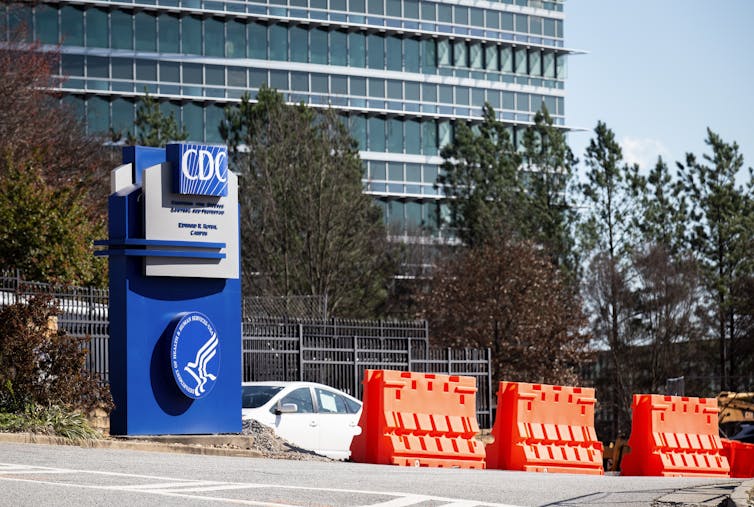
As the coronavirus pandemic exerts a tighter grip on the nation, critics of the Trump administration have repeatedly highlighted the administration’s changes to the nation’s pandemic response team in 2018 as a major contributor to the current crisis. This combines with a hiring freeze at the Centers for Disease Control and Prevention, leaving hundreds of positions unfilled. The administration also has repeatedly sought to reduce CDC funding by billions of dollars. Experts agree that the slow and uncoordinated response has been inadequate and has likely failed to mitigate the coming widespread outbreak in the U.S.
As a health policy expert, I agree with this assessment. However, it is also important to acknowledge that we have underfunded our public health system for decades, perpetuated a poorly working health care system and failed to bring our social safety nets in line with other developed nations. As a result, I expect significant repercussions for the country, much of which will disproportionately fall on those who can least afford it.
Decades of underfunding
Spending on public health has historically proven to be one of humanity’s best investments. Indeed, some of the largest increases in life expectancy have come as the direct result of public health interventions, such as sanitation improvements and vaccinations.
Even today, return on investments for public health spending is substantial and tends to significantly outweigh many medical interventions. For example, one study found that every US$10 per person spent by local health departments reduces infectious disease morbidity by 7.4%.
However, despite their importance to national well-being, public health expenditures have been neglected at all levels. Since 2008, for example, local health departments have lost more than 55,000 staff. By 2016, only about 133,000 full-time equivalent staff remained. State funding for public health was lower in 2016-2017 than in 2008-2009. And the CDC’s prevention and public health budget has been flat and significantly underfunded for years. Overall, of the more than $3.5 trillion the U.S. spends annually on health care, a meager 2.5% goes to public health.
Not surprisingly, the nation has experienced a number of outbreaks of easily preventable diseases. Currently, we are in the middle of significant outbreaks of hepatitis A (more than 31,000 cases), syphilis (more than 35,000 cases), gonorrhea (more than 580,000 cases) and chlamydia (more than 1,750,000 cases). Our failure to contain known diseases bodes ill for our ability to rein in the emerging coronavirus pandemic.
Failures of health care systems
Yet while we have underinvested in public health, we have been spending massive and growing amounts of money on our medical care system. Indeed, we are spending more than any other country for a system that is significantly underperforming.
To make things worse, it is also highly inequitable. Yet, the system is highly profitable for all players involved. And to maximize income, both for- and nonprofits have consistently pushed for greater privatization and the elimination of competitors.
As a result, thousands of public and private hospitals deemed “inefficient” because of unfilled beds have closed. This eliminated a significant cushion in the system to buffer spikes in demand.
At any given time, this decrease in capacity does not pose much of a problem for the nation. Yet in the middle of a global pandemic, communities will face significant challenges without this surge capacity. If the outbreak mirrors anything close to what we have seen in other countries, “there could be almost six seriously ill patients for every existing hospital bed.” A worst-case scenario from the same study puts the number at 17 to 1. To make things worse, there will likely be a particular shortage of unoccupied intensive care beds.
Of course, the lack of overall hospitals beds is not the most pressing issue. Hospitals also lack the levels of staffing and supplies needed to cope with a mass influx of patients. However, the lack of ventilators might prove the most daunting challenge.
Limits of the overall social safety net
While the U.S. spends trillions of dollars each year on medical care, our social safety net has increasingly come under strain. Even after the Affordable Care Act, almost 30 million Americans do not have health insurance coverage. Many others are struggling with high out-of-pocket payments.
To make things worse, spending on social programs, outside of those protecting the elderly, has been shrinking, and is significantly smaller than in other developed nations. Moreover, public assistance is highly uneven and differs significantly from state to state.
And of course, the U.S. heavily relies on private entities, mostly employers, to offer benefits taken for granted in other developed countries, including paid sick leave and child care. This arrangement leaves 1 in 4 American workers without paid sick leave, resulting in highly inequitable coverage. As a result, many low-income families struggle to make ends meet even when times are good.
Can the US adapt?
I believe that the limitations of the U.S. public health response and a potentially overwhelmed medical care system are likely going to be exacerbated by the blatant limitations of the U.S. welfare state. However, after weathering the current storm, I expect us to go back to business as usual relatively quickly. After all, that’s what happened after every previous pandemic, such as H1N1 in 2009 or even the 1918 flu epidemic.
The problems are in the incentive structure for elected officials. I expect that policymakers will remain hesitant to invest in public health, let alone revamp our safety net. While the costs are high, particularly for the latter, there are no buildings to be named, and no quick victories to be had. The few advocates for greater investments lack resources compared to the trillion-dollar interests from the medical sector.
Yet, if altruism is not enough, we should keep reminding policymakers that outbreaks of communicable diseases pose tremendous challenges for local health care systems and communities. They also create remarkable societal costs. The coronavirus serves as a stark reminder.
BIG PHARMA PREPARES TO PROFIT FROM THE CORONAVIRUS

AS THE NEW CORONAVIRUS spreads illness, death, and catastrophe around the world, virtually no economic sector has been spared from harm. Yet amid the mayhem from the global pandemic, one industry is not only surviving, it is profiting handsomely.
“Pharmaceutical companies view Covid-19 as a once-in-a-lifetime business opportunity,” said Gerald Posner, author of “Pharma: Greed, Lies, and the Poisoning of America.” The world needs pharmaceutical products, of course. For the new coronavirus outbreak, in particular, we need treatments and vaccines and, in the U.S., tests. Dozens of companies are now vying to make them.
“They’re all in that race,” said Posner, who described the potential payoffs for winning the race as huge. The global crisis “will potentially be a blockbuster for the industry in terms of sales and profits,” he said, adding that “the worse the pandemic gets, the higher their eventual profit.”
The ability to make money off of pharmaceuticals is already uniquely large in the U.S., which lacks the basic price controls other countries have, giving drug companies more freedom over setting prices for their products than anywhere else in the world. During the current crisis, pharmaceutical makers may have even more leeway than usual because of language industry lobbyists inserted into an $8.3 billion coronavirus spending package, passed last week, to maximize their profits from the pandemic.
Initially, some lawmakers had tried to ensure that the federal government would limit how much pharmaceutical companies could reap from vaccines and treatments for the new coronavirus that they developed with the use of public funding. In February, Rep. Jan Schakowsky, D-Ill., and other House members wrote to Trump pleading that he “ensure that any vaccine or treatment developed with U.S. taxpayer dollars be accessible, available and affordable,” a goal they said couldn’t be met “if pharmaceutical corporations are given authority to set prices and determine distribution, putting profit-making interests ahead of health priorities.”
When the coronavirus funding was being negotiated, Schakowsky tried again, writing to Health and Human Services Secretary Alex Azar on March 2 that it would be “unacceptable if the rights to produce and market that vaccine were subsequently handed over to a pharmaceutical manufacturer through an exclusive license with no conditions on pricing or access, allowing the company to charge whatever it would like and essentially selling the vaccine back to the public who paid for its development.”
But many Republicans opposed adding language to the bill that would restrict the industry’s ability to profit, arguing that it would stifle research and innovation. And although Azar, who served as the top lobbyist and head of U.S. operations for the pharmaceutical giant Eli Lilly before joining the Trump administration, assured Schakowsky that he shared her concerns, the bill went on to enshrine drug companies’ ability to set potentially exorbitant prices for vaccines and drugs they develop with taxpayer dollars.
The final aid package not only omitted language that would have limited drug makers’ intellectual property rights, it specifically prohibited the federal government from taking any action if it has concerns that the treatments or vaccines developed with public funds are priced too high.
“Those lobbyists deserve a medal from their pharma clients because they killed that intellectual property provision,” said Posner, who added that the language prohibiting the government from responding to price gouging was even worse. “To allow them to have this power during a pandemic is outrageous.”
The truth is that profiting off public investment is also business as usual for the pharmaceutical industry. Since the 1930s, the National Institutes of Health has put some $900 billion into research that drug companies then used to patent brand-name medications, according to Posner’s calculations. Every single drug approved by the Food and Drug Administration between 2010 and 2016 involved science funded with tax dollars through the NIH, according to the advocacy group Patients for Affordable Drugs. Taxpayers spent more than $100 billion on that research.
Among the drugs that were developed with some public funding and went on to be huge earners for private companies are the HIV drug AZT and the cancer treatment Kymriah, which Novartis now sells for $475,000.
In his book “Pharma,” Posner points to another example of private companies making exorbitant profits from drugs produced with public funding. The antiviral drug sofosbuvir, which is used to treat hepatitis C, stemmed from key research funded by the National Institutes of Health. That drug is now owned by Gilead Sciences, which charges $1,000 per pill — more than many people with hepatitis C can afford; Gilead earned $44 billion from the drug during its first three years on the market.
“Wouldn’t it be great to have some of the profits from those drugs go back into public research at the NIH?” asked Posner.
Instead, the profits have funded huge bonuses for drug company executives and aggressive marketing of drugs to consumers. They have also been used to further boost the profitability of the pharmaceutical sector. According to calculations by Axios, drug companies make 63 percent of total health care profits in the U.S. That’s in part because of the success of their lobbying efforts. In 2019, the pharmaceutical industry spent $295 million on lobbying, far more than any other sector in the U.S. That’s almost twice as much as the next biggest spender — the electronics, manufacturing, and equipment sector — and well more than double what oil and gas companies spent on lobbying. The industry also spends lavishly on campaign contributions to both Democratic and Republican lawmakers. Throughout the Democratic primary, Joe Biden has led the pack among recipients of contributions from the health care and pharmaceutical industries.
Big Pharma’s spending has positioned the industry well for the current pandemic. While stock markets have plummeted in reaction to the Trump administration’s bungling of the crisis, more than 20 companies working on a vaccine and other products related to the new SARS-CoV-2 virus have largely been spared. Stock prices for the biotech company Moderna, which began recruiting participants for a clinical trial of its new candidate for a coronavirus vaccine two weeks ago, have shot up during that time.
On Thursday, a day of general carnage in the stock markets, Eli Lilly’s stock also enjoyed a boost after the company announced that it, too, is joining the effort to come up with a therapy for the new coronavirus. And Gilead Sciences, which is at work on a potential treatment as well, is also thriving. Gilead’s stock price was already up since news that its antiviral drug remdesivir, which was created to treat Ebola, was being given to Covid-19 patients. Today, after Wall Street Journal reported that the drug had a positive effect on a small number of infected cruise ship passengers, the price went up further.
Several companies, including Johnson & Johnson, DiaSorin Molecular, and QIAGEN have made it clear that they are receiving funding from the Department of Health and Human Services for efforts related to the pandemic, but it is unclear whether Eli Lilly and Gilead Sciences are using government money for their work on the virus. To date, HHS has not issued a list of grant recipients. And according to Reuters, the Trump administration has told top health officials to treat their coronavirus discussions as classified and excluded staffers without security clearances from discussions about the virus.
Former top lobbyists of both Eli Lilly and Gilead now serve on the White House Coronavirus Task Force. Azar served as director of U.S. operations for Eli Lilly and lobbied for the company, while Joe Grogan, now serving as director of the Domestic Policy Council, was the top lobbyist for Gilead Sciences.
Cartoon – This Makes Me Sick
Cartoon – If it ain’t broke, don’t fix it

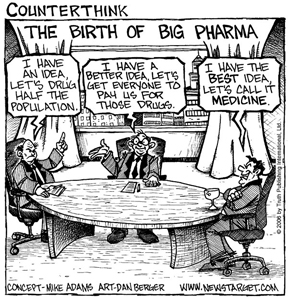
Cartoon – The Birth of Big Pharma
Health Insurers aren’t that worried about coronavirus
https://mail.yahoo.com/d/folders/1/messages/181951?.src=fp

Health insurance companies are not concerned yet that the new coronavirus is going to drive up their medical claims and spending, Axios’ Bob Herman reports.
The big picture: More people will need expensive hospitalizations to treat COVID-19, which has turned into a full-blown public health emergency.
- But insurers view the outbreak as an “extension of the flu season,” according to a Wall Street bank that spoke with insurance executives last week.
What they’re saying: Barclays held its health care conference digitally last week, and several insurance executives reiterated their companies’ profit projections for this year — relatively remarkable statements considering economists believe a recession is imminent.
- “We’re not expecting a material financial impact,” said Matt Manders, a top Cigna executive.
Between the lines: A lot more cases and hospitalizations are coming. But those will be partially offset, from an actuarial perspective, by delays or cancellations of costly elective procedures like joint replacements — something that hospitals are starting to do.
- “There is a net saving” when non-emergency procedures are eliminated, Anthem CFO John Gallina told Barclays analysts.
The bottom line: The coronavirus is throttling almost every business in America. Large insurers think they’re mostly immune, and if medical claims start to rise uncontrollably, they will increase everyone’s premiums next year.
- “We would price for this for 2021 to the extent there’s any meaningful impact,” Humana CFO Brian Kane said. “I would imagine the industry will as well.”


