


Cartoon – Office Visits Today


An analysis of out-of-network claims in large employer health plans

Surprise hospital bills are remarkably common, my colleague Caitlin Owens reports. A new Kaiser Family Foundation brief finds that, among people with employer-based coverage, almost 1 in 5 patients admitted to the hospital end up getting a bill from an out-of-network provider.
Why it matters: Patients have to pay more out of their own pockets for out-of-network care.
Balance billing — the practice of providers billing patients for the difference between their charges and insurance payments — is often responsible for these situations.
By the numbers:

Senate Democrats used their truncated August recess to talk to their constituents about one key issue: Health care.
And though they are returning to Washington tonight, they have no plans to stop talking about it.
That’s a remarkable turnaround for Democrats who have been on the defensive about health care for the better part of a decade. Obamacare played a major role in their loss of control of the House in the first midterm election of President Obama’s presidency in 2010. But now, they’re hoping to take back the House and retain their seats in the Senate largely by running on the merits of the Affordable Care Act.
Over their 10-day mini break, Sen. Joe Donnelly (D-Ind.) held a roundtable discussion with voters about health care, as did Sen. Joe Manchin (D-W.Va.), who held his third roundtable this year focused specifically on pre-existing conditions. And Sen. Claire McCaskill (D-Mo.) also met with voters with pre-existing conditions on Tuesday.
“Cutting people off from insurance and making it harder for people to get insurance, we’re all still gonna pay the bill because in America we’re not going to stop people at the door at the emergency room and I’m sorry you don’t have health insurance, we’re gonna let you die,” she said, according to Missourinet.
In Nevada, Democratic Rep. Jacky Rosen, who is hoping to unseat GOP Sen. Dean Heller, also held a public meeting with voters with pre-existing conditions. Sen. Bob Casey (D-Pa.) met with health care providers and patients to talk pre-existing conditions, and Rep. Kyrsten Sinema (D-Ariz.), who is vying for the open Senate seat there, also met with constituent groups to discuss health care.
“It doesn’t matter which community you are in, health care is the number-one issue that Arizonans are talking about,” Sinema told the Arizona Daily Star. “It is not just Arizonans who don’t have health-care coverage, many of those who are expressing concerns and fear are Arizonans who do have coverage but cannot afford it.”
As campaign cycles go, it’s still early in this one. And the deluge of ads will really heat up come fall. Republicans still see an opening to talk about rising costs of health care and President Trump continues to declare that the ACA is dead. But unlike years past when the GOP could run on an anti-Obamacare message, this year the party is more likely to focus on other issues like tax cuts and job creation.
It’s harder for GOP candidates to make their case that health care policy is failing in the first election where they are in control of both houses in Congress and the White House. And recent scuttlebutt that Republicans would consider another repeal effort if they held Congress may not be helpful this cycle.
And so Democrats, if August activity is the precursor to the fall campaign, are going all in on health care.
Earlier this month, the New York Times’ Margot Sanger-Katz had a great anecdote from an event with McCaskill. The senator, who may be in the toughest fight of her career, asked voters to stand if they have a pre-existing condition. There were reportedly few people left in their seats.
The Democrats and the groups who support them have homed in specifically on the warning that if the ACA is struck down, people with pre-existing conditions would lose protection. Notably, McCaskill and Manchin, two of the Democrats’ most vulnerable members, are running against state attorneys general who joined a lawsuit arguing the ACA should be deemed unconstitutional. If the law were struck down, it would take with it protections for people with past and current health conditions.
Before the Senate left, Minority Leader Chuck Schumer (N.Y.) pledged to keep health care front and center this month in Congress, which is in keeping with Democrats’ election strategy this year. Schumer’s office declined to show its hand, but on the floor he detailed exactly what the Democrats would be pushing for, including votes to protect people with pre-existing conditions and a Medicare buy-in program. They’re unlikely to get those votes, but that’s all part of the game plan to keep the attention on health care.
“The number one thing Americans want is health care, and we Democrats will spend August recess focusing on that issue, and forcing Republicans to cast votes or deny votes on those important issues,” Schumer said. “It’s a great opportunity, not just for Democrats, not just for Republicans, but for America. We are going to do it.”
The first television ad the campaign arm for the Democrats released in 2017 was about health care. It showed a man selling his car and a woman pawning her engagement ring. Then it cuts to them sitting at the hospital bedside of a sick child.
Most of the heavy ad buys are still to come, but an independent analysis of political ads so far this cycle found pro-Democrat ads have been overwhelmingly about health care. According to Kantar Media/CMAG data by the Wesleyan Media Project, “An astounding 63 percent of pro-Democratic ads for U.S. House discuss healthcare, and 16 percent contain an explicit statement about being in favor of the Affordable Care Act. U.S. Senate contests are less likely to feature health care, but it is still the top issue, appearing in over a quarter (28 percent) of all ad airings.”
Take Rosen, the congresswoman running against Heller. She has a television ad that shows her talking to voters about their anxieties over the ACA being repealed. She says in the ad that ACA has “real problems,” but repealing it isn’t the answer.
It’s a strategy divergent from previous years when Democrats were defensive of their support for Obamacare. They’d make macro arguments about the millions of people who would lose coverage without it. But now, with the focus on pre-existing conditions, they’ve found a way to make it personal and accessible for voters.
“What we’re seeing on the trail is that health care remaining the defining issue of the election and voters are aware and concerned that GOP policies will increase their costs and jeopardize their coverage and voters are preparing to hold GOP candidates accountable on this issue,” said David Bergstein, a spokesman for the Democratic Senatorial Campaign Committee.
When asked, most Republicans will say they support keeping protections for pre-existing conditions. For example, when asked, McCaskill’s opponent, Missouri Attorney General Josh Hawley, said he thinks“insurance companies should be forced to cover pre-existing conditions.”
For his part, Hawley’s first television ad of the campaign was about his work as a clerk on the Supreme Court and accused McCaskill of supporting “liberal activist judges.”
In a press release in response to the ad, McCaskill’s campaign said, “Josh Hawley is suing to strip protections for nearly 2.5 million Missourians with pre-existing conditions.”
https://www.beckershospitalreview.com/finance/allina-s-operating-income-sinks-45-in-q2.html
Allina Health’s revenues increased in the second quarter of 2018, but the Minneapolis-based system’s operating income plummeted due to growth in expenses.
Allina reported revenues of $1.07 billion in the second quarter of this year, up from $1.01 billion in the same period of 2017, according to recently released bondholder documents. The boost was attributable to higher net patient service revenue, which climbed 6.4 percent year over year.
The system’s operating expenses totaled $1.06 billion in the second quarter of 2018, up from $990.4 million in the same period a year earlier.
Allina ended the second quarter of this year with operating income of $13.1 million. That’s down 45 percent from the first quarter of 2017, when the system reported operating income of $23.9 million.
Allina reported an investment return of $33.8 million in the second quarter of 2017, but that number dropped to $6.3 million in the second quarter of this year.
After factoring in the drop in investment income, Allina’s net income tumbled 56 percent year over year to $19.1 million in the second quarter of 2018.

Montefiore Health System has landed a $1.2 billion financing deal with the Dormitory Authority of the State of New York that will add roughly $600 million of cash to Montefiore Medical Center’s coffers.
The bonds issued by DASNY were 30-year revenue bonds that were used to pay down $315 million in prior bonds insured by the Federal Housing Administration, including bonds backed by securities guaranteed by the Government National Mortgage Association. The new bonds issued also reimburse Montefiore for $357 million in past capital project spending on its facilities and take advantage of low interest rates in the market, the system said.
The system confirmed that the revenue bonds were secured by a pledge of gross receipts of Montefiore Medical Center and a mortgage on the Moses Division’s primary care facilities and its two parking garages. The new bonds were used to refinance existing bonds and loans as well as reimburse the health system for prior capital expenditures.
“The financing benefits the system by refinancing front-loaded debt to achieve a more level debt service structure and implements a flexible financing structure that can support future initiatives,” a spokesperson said.
According to a recent report from Moody’s Investors Service, the proceeds of the Series 2018 bonds will be used to refinance existing debt including FHA insured bonds, and will add about $600 million of cash to MMC’s balance sheet.
Moody’s assigned an initial Baa2 rating to Montefiore Obligated Group’s $1.2 billion in revenue bonds, which are a hybrid of both taxable and nontaxable bonds. Moody’s also gave a rating outlook of stable.
“Montefiore Obligated Group’s Baa2 rating reflects Moody’s belief that Montefiore Health System will maintain a leading market position in the Bronx, supported by its clinical excellence and its flagship position as the primary teaching hospital for the Albert Einstein College of Medicine (AECOM). Montefiore’s rating also reflects its experience with value based contracting, which will be aided by integration with its large base of faculty practice and primary care physicians,” Moody’s said.
“With this bond rating, Montefiore can continue our leadership in developing risk-based care and delivering care in the most appropriate settings at the right time. In the rating, Montefiore was noted for its clinical excellence, care, and its ability to attract internationally renowned physician scientists, complementing Albert Einstein College of Medicine’s long history of pioneering medical research,” Montefiore said in a statement.
Moody’s also cautioned that the system’s “keen commitment to its community and surrounding counties” could mean uncertainty, as some of MHS’s affiliated hospitals will experience losses despite state funding. The agency also said the med school’s financial issues will require cash support from Montefiore and unusually high levels of Medicaid and a “heavily unionized” workforce will also strain the system’s margins.
Montefiore is a major medical system in the New York metro area that includes three inpatient campuses with 1,558 licensed beds in the Bronx, as well as several other affiliated organizations in Westchester, Rockland and Orange Counties. Its hospitals include the 292-bed White Plains Hospital, 121-bed Montefiore Mount Vernon Hospital, 223-bed lMontefiore New Rochelle Hospital, 375-bed Nyack Hospital, 242-bed St. Luke’s Cornwall Hospital, and 150-bed Burke Rehabilitation Hospital. Montefiore Medicine Academic Health System is the parent above MHS that controls its Albert Einstein College of Medicine.
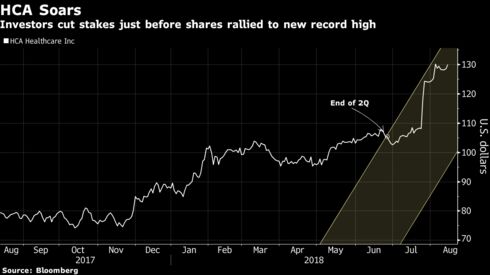
Long-term shareholders were cashing out of HCA Healthcare Inc. in the second quarter, as the stock rallied to record highs in late June — levels since eclipsed by bigger gains this quarter.
Hedge funds Glenview Capital Management, Highfields Capital Management, Wellington Management Group, Magellan Asset Management and Harris Associates cut their stakes in the hospital chain, which saw its shares rise 17 percent in the first half and an additional 27 percent so far this quarter. The investment firms sold a combined 17.3 million shares, according to their latest 13F filings.
After being under pressure for nearly two years, hospitals have staged a comeback in 2018, outperforming most of their health-care peers with a 21 percent gain. The rally was led by Tenet Healthcare Corp., which has more than doubled, and HCA, which saw earnings and patient visits improve. HCA was also among hospitals uniquely benefiting from the U.S. corporate tax overhaul.

 HENRY KOTULA