


Cartoon – Leadership Today

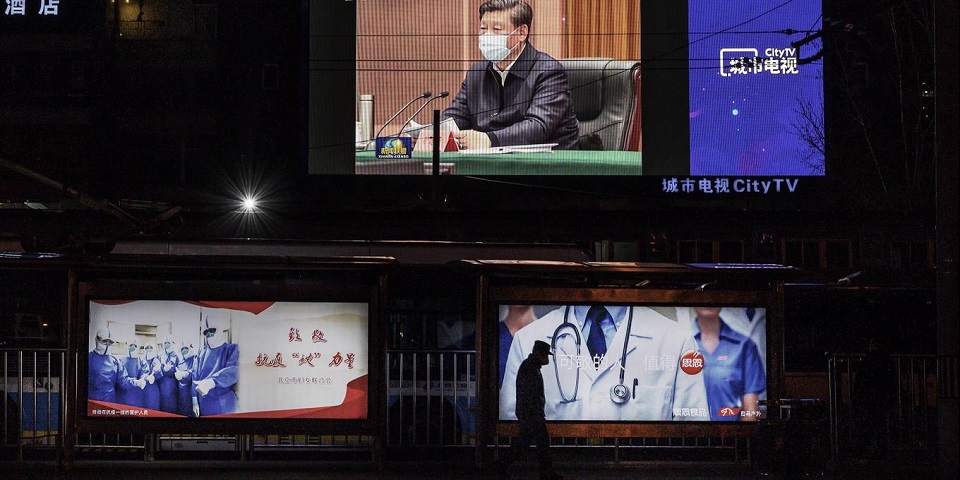
Nobody denies that Chinese officials’ initial effort to cover up the coronavirus outbreak in Wuhan at the turn of the year was an appallingly misguided decision. But anyone who is still focusing on China’s failings instead of working toward a solution is essentially making the same mistake.



https://www.yahoo.com/news/costly-toll-not-shutting-down-161107861.html

You could find Beatriz Diaz at this spring’s Winter Party Festival in Miami Beach, giving out hand sanitizer.
It was early March. She knew the coronavirus was beginning to make its way around the world, but she figured if she kept her hands clean and avoided sweaty people, she would be safe.
“I was thinking, ‘OK, well, hold on, the government did not cancel it, so it should be fine,’” she said.
Within days, reports started popping up on Facebook about a DJ and several partygoers who were suddenly terribly ill. By the end of the month, two people who attended the festival had died.
As of last week, 38 people had reported that they were symptomatic or had tested positive for the coronavirus in the weeks following the event, according to the organizer, the National LGBTQ Task Force. Diaz was among them.
Weeks before Florida ordered people to stay at home, the coronavirus was well into its insidious spread in the state, infecting residents and visitors who days earlier had danced at beach parties and reveled in theme parks. Only now, as people have gotten sick and recovered from — or succumbed to — COVID-19, the disease caused by the coronavirus, has the costly toll of keeping Florida open during the spring break season started to become apparent.
Gov. Ron DeSantis, a Republican, has blamed travelers from New York, Europe and other places for seeding the virus in the state. But the reverse was also true: People got sick in Florida and took the infection back home.
The exact number of people who returned from leisure trips to Florida with the coronavirus may never be known. Cases as far away as California and Massachusetts have been linked to the Winter Party Festival, a beachside dance party and fundraiser for the LGBTQ community held March 4-10. Another California man died after going to Orlando for a conference and then to a packed Disney World. Two people went to Disney and later got relatives sick in Florida and Georgia.
Slow action by Florida’s governor left local leaders scrambling to make their own closure decisions during one of the busiest and most profitable times of the year for a state with an $86 billion tourism economy. The result was that rules were often in conflict, with one city canceling a major event while a neighboring city allowed another event to continue.
The governor, who did not order people to stay home until April 1, has said the state supported local governments that ordered event cancellations and beach closures but that it was not his role to step in first.
“Let’s have tailored approaches, surgical approaches, that are going to work best for those regions,” DeSantis said at a news conference March 24. “These blunt measures — you wouldn’t want to do them on a community where the virus hasn’t spread.”
With little testing available, local officials made decisions blindly. Data that suggested looming trouble, such as rising fever readings from internet-connected thermometers, were ignored, a spokeswoman for Kinsa Health, the company that produces the thermometers, has said.
Only later did the effects become apparent.
Florida has confirmed more than 17,500 coronavirus cases and nearly 400 deaths, with the epidemic still expanding in the state.
A video by data analytics and visualization company Tectonix showed how cellphones that were on one Fort Lauderdale beach at the beginning of March spread across the country — up the Eastern Seaboard and further West — over the next two weeks.
“At the time, there was still this debate: Should we close public beaches? Should we shut down these big public events?” said Mike DiMarco, the company’s chief marketing officer. “When you actually see it visually on a map like that, it brings a ton of awareness to what that really looks like.”
The first festivalgoer to die was Israel Carrera, a 40-year-old Lyft and Uber driver who spent several days in the hospital in Miami Beach before his death March 26. His boyfriend, who also attended, got mildly sick and is now making plans to deliver Carrera’s ashes to his surviving family in Cuba.
Ron Rich, a 65-year-old festival volunteer, died over the weekend of March 28.
The decision to hold the festival five weeks ago came at a different point in the crisis, before a single person had tested positive in Miami-Dade County, said Rea Carey, executive director of the National LGBTQ Task Force. The event ended the day before the World Health Organization declared the virus a pandemic.
“It points to what we didn’t know at the time,” she said. “If we had had the information that is available now, the information that has become available after Winter Party as this pandemic has played out, we would have made a different decision.”
Photos of the festival show hundreds of people crammed in front of a stage under neon lights, dancing, hugging and practicing little social distancing.
Diaz, 42, got a fever March 15. The next day her girlfriend was also sick. By the time Diaz was confirmed positive for COVID-19, she had been grocery shopping, gone to the pharmacy and spent time with her employer’s 80-year-old father and 14-year-old daughter.
“I understand that was my choice to be there; I take full responsibility for that,” Diaz, who lives in Wilton Manors, Florida, said of the Winter Party Festival, which drew about 5,500 people and has been a fixture in the LGBTQ community for more than 25 years.
“I am really upset for the way it was handled,” she said.
Loc Nguyen, a software developer, felt exhausted from the time he returned home to Los Angeles from the festival March 9. He went to work the next day but had to call in sick after that, feeling shortness of breath and such terrible shivers that he wrapped himself in three winter jackets to go to the doctor.
“You’re coughing and gasping for air,” Nguyen said. “You are scared. You can’t breathe.”
His friend who went to the festival with him also tested positive. A third friend got sick but was unable to get a test.
Nguyen knew the risk of attending but said he did not want to lose the money he had spent on tickets. He did not blame organizers for holding the festival and pointed to mixed messages from local officials.
“If one city closes and one city is open, it’s not consistent,” he said. “And therefore you can’t stop this pandemic.”
On March 6, the city of Miami, which is separate from Miami Beach, canceled the Ultra Music Festival, a marquee electronic dance music event that draws tens of thousands of people. Other local leaders criticized the action as too drastic: The Centers for Disease Control and Prevention was not yet recommending mass closures. Florida announced its first confirmed coronavirus case March 1, but it was in the Tampa area.
“We should live our lives normally,” with public health safeguards in place, Mayor Carlos Gimenez of Miami-Dade County said March 5.
By March 12, he had reversed course and canceled the Miami Open tennis tournament and the county youth fair. The fairgrounds now house a field hospital.
“We did what we thought — and I’m sure all cities did what they thought — was the right thing to do at the right time,” Gimenez said last week. “It’s called novel coronavirus for a reason. We don’t really know how it acts.”
Mayor Francis Suarez of Miami, one of the first elected officials in the country to test positive for the coronavirus, said other jurisdictions’ decisions to keep events going proved costly.
“That ended up as a national embarrassment, when you saw what happened with the spring breakers and what happened unfortunately, tragically, with the music festival,” he said, referring to the Winter Party.
Further north, near Orlando, people streamed into the six Disney World theme parks before they closed March 15. Courtney Sheard recalled that the weather was beautiful and that a new ride at Hollywood Studios, Mickey & Minnie’s Runaway Railway, was especially crowded.
After she got back home to Naples, Florida, on March 12, she awoke with a terrible headache and a sore throat. Her 3-year-old daughter, Journey, ran a fever and vomited.
By the time she received a positive test result, Sheard, 30, had been around her sister, her sister’s children, a friend, her parents, beachgoers and diners at a Bonefish Grill.
When Sheard learned that Jeffrey Ghazarian, 34, had died March 19 in California after visiting the theme park, she figured that the coronavirus had been circulating in Disney while he, and then she, were there.
“Think of all the people from around the world, from around the country, that were in Disney and then went home,” she said.
Officials at Walt Disney World did not respond to a request for comment.
Mayor Jerry Demings of Orange County, home to Orlando, said local officials had insufficient guidance to act consistently to slow the spread.
“We were left to our own devices to come up with strategies ourselves because of the lack of direction from the federal government and governor’s office,” he said.
Nicholas Hickman started feeling ill three or four days after returning home to Ringgold, Georgia, on March 11. He had spent five days at Disney with friends who were on spring break. They were also celebrating Hickman’s 20th birthday.
Back home, Hickman came down with a fever, chills and chest pains but struggled to get tested because no one else in his county had received a coronavirus diagnosis.
Hickman has since recovered, but only after getting his mother, and likely his father, sick. He does not blame Disney for his infection.
“If we would have been told not to go to Disney and just avoid going, we would not have gone,” he said. “There’s no way we would have gone.”

 HENRY KOTULA
LONDON – As the COVID-19 crisis roars on, so have debates about China’s role in it. Based on what is known, it is clear that some Chinese officials made a major error in late December and early January, when they tried to prevent disclosures of the coronavirus outbreak in Wuhan, even silencing health-care workers who tried to sound the alarm. China’s leaders will have to live with these mistakes, even if they succeed in resolving the crisis and adopting adequate measures to prevent a future outbreak.
What is less clear is why other countries think it is in their interest to keep referring to China’s initial errors, rather than working toward solutions. For many governments, naming and shaming China appears to be a ploy to divert attention from their own lack of preparedness. Equally concerning is the growing criticism of the World Health Organization, not least by US President Donald Trump, who has attacked the organization for supposedly failing to hold the Chinese government to account. At a time when the top global priority should be to organize a comprehensive coordinated response to the dual health and economic crises unleashed by the coronavirus, this blame game is not just unhelpful but dangerous.
Globally and at the country level, we desperately need to do everything possible to accelerate the development of a safe and effective vaccine, while in the meantime stepping up collective efforts to deploy the diagnostic and therapeutic tools necessary to keep the health crisis under control. Given that there is no other global health organization with the capacity to confront the pandemic, the WHO will remain at the center of the response, whether certain political leaders like it or not.
Having dealt with the WHO to a modest degree during my time as chairman of the UK’s independent Review on Antimicrobial Resistance (AMR), I can say that it is similar to most large, bureaucratic international organizations. Like the International Monetary Fund, the World Bank, and the United Nations, it is not especially dynamic or inclined to think outside the box. But rather than sniping at these organizations from the sidelines, we should be working to improve them. In the current crisis, we should be doing everything we can to help both the WHO and the IMF to play an effective, leading role in the global response.
As I have argued before, the IMF should expand the scope of its annual Article IV assessments to include national public-health systems, given that these are critical determinants in a country’s ability to prevent or at least manage a crisis like the one we are now experiencing. I have even raised this idea with IMF officials themselves, only to be told that such reporting falls outside their remit because they lack the relevant expertise.
That answer was not good enough then, and it definitely isn’t good enough now. If the IMF lacks the expertise to assess public-health systems, it should acquire it. As the COVID-19 crisis makes abundantly clear, there is no useful distinction to be made between health and finance. The two policy domains are deeply interconnected, and should be treated as such.
In thinking about an international response to today’s health and economic emergency, the obvious analogy is to the 2008 global financial crisis. Everyone knows that crisis started with an unsustainable US housing bubble, which had been fed by foreign savings, owing to the lack of domestic savings in the United States. When the bubble finally burst, many other countries sustained more harm than the US did, just as the COVID-19 pandemic has hit some countries much harder than it hit China.
And yet, not many countries around the world sought to single out the US for presiding over a massively destructive housing bubble, even though the scars from that previous crisis are still visible. On the contrary, many welcomed the US economy’s return to sustained growth in recent years, because a strong US economy benefits the rest of the world.2
So, rather than applying a double standard and fixating on China’s undoubtedly large errors, we would do better to consider what China can teach us. Specifically, we should be focused on better understanding the technologies and diagnostic techniques that China used to keep its (apparent) death toll so low compared to other countries, and to restart parts of its economy within weeks of the height of the outbreak.
And, for our own sakes, we also should be considering what policies China could adopt to put itself back on a path toward 6% annual growth, because the Chinese economy inevitably will play a significant role in the global recovery. If China’s post-pandemic growth model makes good on its leaders’ efforts in recent years to boost domestic consumption and imports from the rest of the world, we will all be better off.