A superb jobs report

We really liked what we saw in the December jobs report, which made us more optimistic about the possibility the 2023 economy will hold up reasonably well. More details below.

  • Situational awareness: In less optimistic news, the Institute for Supply Management’s survey of service industry activity plunged in December, to 49.6% — down from 56.5% in November. This is the first time the index has been in negative territory since May 2020.

The U.S. labor market is extraordinarily strong, despite gloom-and-doom economic forecasts and high-profile layoffs.

  • That is the takeaway from December numbers, out this morning, that were outstanding in subtle and not-so-subtle ways.

Why it matters: If America’s economy is going to come in for a soft-landing — inflation dissipating without mass unemployment — you would expect to see numbers that look a lot like last month’s.

  • The economy continues to add a healthy number of new jobs, though the pace is moderating. Wages are rising, but not so quickly as to alarm economic policymakers. And more workers are entering the labor force, which — if sustained — could heal labor shortages.
  • The data has positive developments both for American workers — who continue to have abundant job opportunities — and for Fed officials seeking evidence that their inflation-fighting efforts are starting to cool job creation and wage growth to more sustainable rates.

The headline unemployment rate, at 3.5%, matched its lowest levels in decades. If you extend the calculation out a couple more decimal places, University of Michigan economist Justin Wolfers points out, it was 3.468%, the lowest since 1969!

  • It fell even as the labor force expanded by 439,000 workers, a welcome development on the supply front after months of little progress. More Americans working means fewer of the labor shortages that have contributed to inflation.
  • An additional 717,000 Americans reported being employed, helping resolve what had been a puzzling disconnect between different sources of labor market data — and in a positive direction.
  • A stunningly low jobless rate might raise some alarm bells at the Fed over the possibility the job market is too tight, and that this could fuel inflation. But the labor force growth and benign wage data (more on that below) may take the edge off those fears.

By the numbers: Employers are still hiring at a rapid pace — 223,000 in December — but slowing from early last year’s unsustainable numbers.

  • The economy has added roughly 247,000 jobs per month on average in the last three months, slower than the 366,000 in the prior three-month stretch, and less than half of the 539,000 jobs added each month in Q1 2022.
  • Evidence of tech layoffs did show up somewhat in the report, with the information sector shedding 5,000 jobs. Temporary help services employment fell by 35,000, the clearest sign employers are paring back demand for workers.
  • But most other sectors, including leisure and hospitality, construction and health care, continued to add jobs.

The bottom line: If we keep getting numbers like these, 2023 may not be such a rough year for workers after all.
Inflation cools in November for the second-straight month

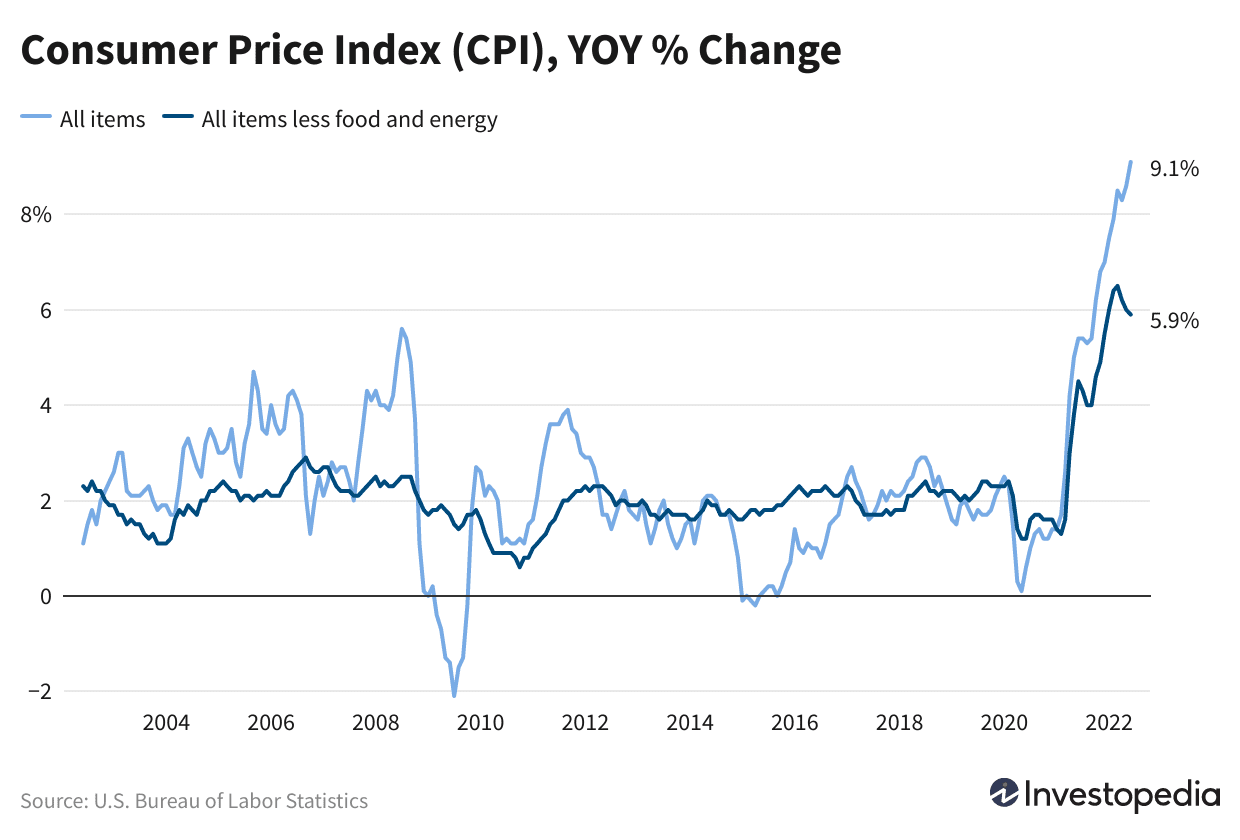
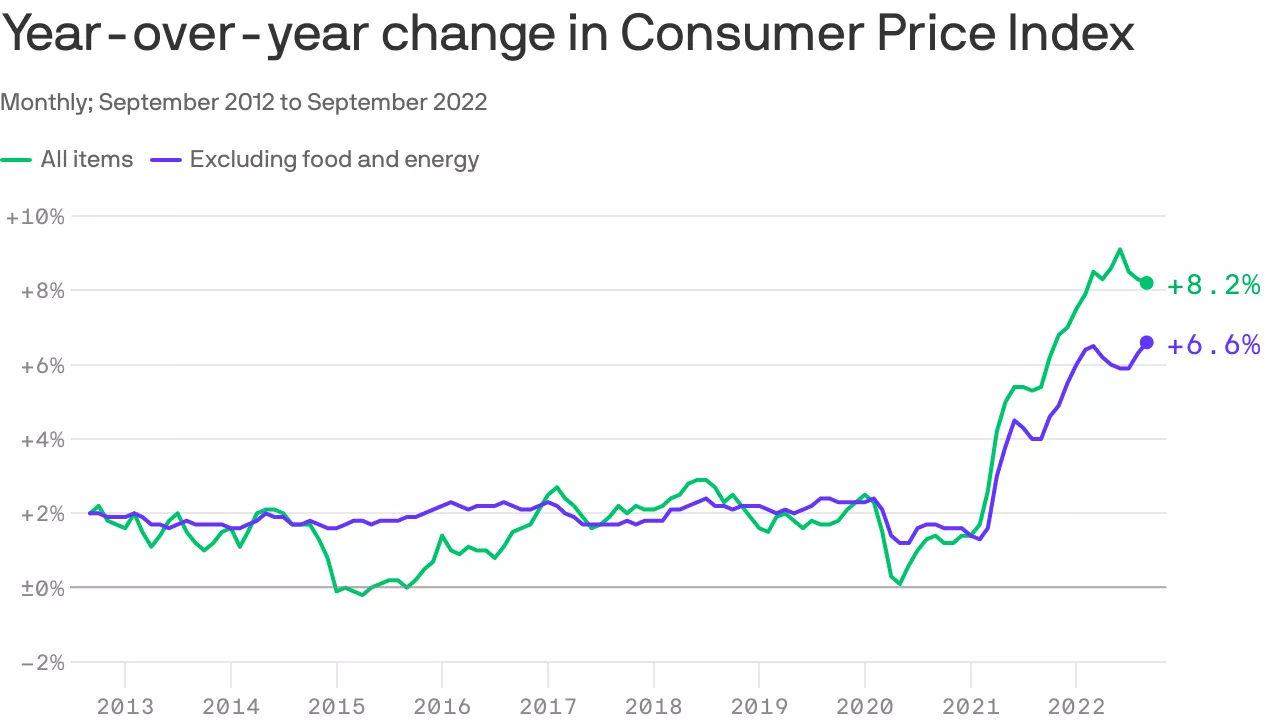
Following a cooler-than-expected inflation reading in October, consumer price gains slowed even further last month: the Consumer Price Index rose 7.1% in the year ending in November, down from 7.7% the prior month, the Labor Department said on Tuesday.

Why it matters: Inflation is still way too high, but the data offers some hope that it can ease alongside a still-healthy economy.

By the numbers: On a monthly basis, CPI rose 0.1%, slower than the 0.4% in October.

  • Core CPI, which strips out volatile food and energy costs, also continued to ease. On a monthly basis, it rose 0.2% — up 6% over the 12 months ending in November.
  • In October, those figures were 0.3% and 6.3%, respectively.

Where it stands: The Federal Reserve has raced to try to get inflation under control, raising interest rates at a historic clip — moves that risk throwing the economy into a recession.

  • Officials will likely raise rates by a smaller (but still historically huge) amount following a two-day policy meeting that concludes on Wednesday.
  • That will come after surprisingly cooler inflation readings, though officials have warned that its war on inflation is far from over.

U.S. economy adds 263,000 jobs in November

The jobs market stayed strong last month: Employers added 263,000 jobs, while the unemployment rate held at 3.7%, near the lowest level in a half-century, the Labor Department said on Friday.

Why it matters: The figures are the latest signal of a roaring labor market that continues to defy fears of a recession.

  • November’s payroll gains are above the addition of 200,000 jobs that economists had expected.

By the numbers: Job growth last month was slightly slower than the 284,000, added in October, which was revised up by 23,000. In September, the economy added 269,000 jobs, 46,000 fewer than initially estimated.

  • Average hourly earnings, a measure of wage growth, rose by 0.6% in November — faster than the prior month, when earnings rose by 0.5%. Over the past year ending in November, average hourly earnings increased by 5.1%.
  • The share of people working or looking for work, known as the labor force participation rate, ticked down to 62.1%, compared to 62.2% in October.

The backdrop: Economists have been bracing for cracks in the labor market that have yet to appear.

  • It has been an ugly stretch for layoffs in a handful of sectors like technology, with large-scale job cuts announced at MetaAmazon and Twitter.

But overall, the booming job market has continued for workers, even in the face of ultra-aggressive efforts by the Federal Reserve to try to cool demand for labor to help put a lid on inflation.

  • Last month, Fed chair Jerome Powell said that employers bidding up wages to attract workers is not “the principal story of why prices are going up.”
  • Still, the labor market may point to clues about how inflation will evolve in certain categories, including industries within the services sector where wages make up the biggest costs for businesses, Powell said on Wednesday.

Inflation cools more than expected in October

The Consumer Price Index cooled more than expected in October: it rose 7.7% from a year earlier, down from 8.2% the prior month, the Labor Department said on Thursday.

Why it matters: Inflation still remains painfully high, but a bigger-than-expected easing in price pressures for items like used cars and apparel helped pull the overall index down.

By the numbers: On a monthly basis, CPI rose 0.4%, the same pace as September.

  • Core CPI, a closely watched gauge that strips out volatile food and energy costs, eased in October. On a monthly basis, it rose 0.3% — up 6.3% from a year ago.
  • In September, those figures were 0.6% and 6.6%, respectively.

Catch up quick: Soaring costs have eroded many Americans’ wage gains, souring their view on the economy that has otherwise held up.

  • Supply chain problems have led to shortages of vehicles and other consumer goods, which pushed up prices. Russia’s invasion of Ukraine has created a volatile backdrop for energy costs.
  • Those supply chain pressures have eased and consumers have dialed back demand for goods, pushing prices down. But costs for services have raced ahead.

Where it stands: The Fed has raced to try to get inflation under control, raising interest rates at a historic clip.

  • In recent months, inflation data has surprised to the upside. That’s kept officials on an aggressive path to slow the economy down, with the hope inflation will follow suit. Those moves have risked throwing the economy into a recession.

U.S. economy adds 261,000 jobs in October as labor market stays solid

https://www.axios.com/2022/11/04/october-job-report-2022-release

The labor market remained solid in October: the U.S. economy added 261,000 jobs, while the unemployment rate rose to 3.7% from 3.5%, the government said on Friday.

Why it matters: The last major economic report before the midterm elections shows that while jobs growth has slowed, employers continue to add workers at a robust pace as the labor market defies fears of a recession.

Driving the news: October’s jobs gains were above the 205,000 payrolls economists expected. It’s a slightly slower pace than the 315,000 jobs added in September, which was revised higher by 52,000.

  • Average hourly earnings, a proxy for wage growth, rose by 0.4% in October — a bit faster than the prior month, when wages grew 0.3%.
  • The share of people working or looking for work, known as the labor force participation rate, was 62.2%, a tick below the 62.3% in September.

The backdrop: The Federal Reserve this year has raised interest rates at historically rapid pace in an effort to slow the economy and, in turn, beat back soaring inflation. Many economists warn that the U.S. will soon enter a recession. Still, the labor market has chugged along.

  • Layoffs are being reported in a handful of sectors, including technology. But a range of job market indicators have suggested that, generally, employers are hungry for workers and trying to hold on to staff.

That is worrisome for the Fed, which fears the too-hot labor market will stoke inflation. But, on the flip side, it’s been great for American workers — though the booming job market has been coupled with decades-high inflation that’s eaten away at wage gains.

  • The economy is a top issue for voters in next week’s midterm elections.

U.S. economy returned to growth in Q3

The U.S. economy expanded at a 2.6% annual rate in the third quarter, ending the streak of back-to-back contractions that raised fears the country had entered a recession.

Why it matters: Gross domestic product got a boost from trade dynamics, but the underlying details — including weaker housing and decelerating consumer spending — point to an economy that’s slowing.

  • The first estimate of GDP, released by the Commerce Department on Thursday, will be revised in the coming months as the government gets more complete data.
  • The report comes on the heels of negative GDP growth during the first half of the year. In the January through March period, the economy contracted at a 1.6% annual rate. In the second quarter, the economy shrank at a 0.6% annualized pace.

Between the lines: The latest GDP report is among the final major economic data releases before the midterm elections, where voters have ranked the economy as a critical issue.

  • The labor market is solid, with the unemployment rate at the lowest level in over 50 years. But soaring inflation has eaten away at Americans’ wage gains.

The backdrop: The Federal Reserve is trying to engineer an economic slowdown in a bid to crush high inflation. It has swiftly raised borrowing costs five times this year, with another big increase likely ahead at its upcoming policy meeting next week.

What they’re saying: “For months, doomsayers have been arguing that the US economy is in a recession and Congressional Republicans have been rooting for a downturn,” President Biden said in a statement. “But today we got further evidence that our economic recovery is continuing to power forward.”

Inflation drops to zero in July due to falling gas prices

Consumer prices were unchanged in July, as plunging prices for gasoline dragged the Consumer Price Index down to zero. Core inflation, which excludes energy and food, rose only 0.3%, below what analysts expected.

Driving the news: The Labor Department reported that overall consumer prices rose 0% last month, and are up 8.5% over the past year. That compares to a 9.1% year-over-year reported in June.

Why it matters: Falling gasoline prices are clearly giving American consumers some inflation relief, and the broader inflation picture was more favorable in July than economists had expected.

By the numbers: Gasoline prices fell 7.7% in July, dragging down headline inflation. Other items with falling prices included used cars and trucks (-0.4%) and airfares (down 7.8%).

  • But rents kept rising, a major factor in stubbornly high underlying inflation. Renters faced a 0.7% rise in costs.

What’s next: The Federal Reserve has indicated it intends to keep raising interest rates until there is clear evidence inflation is waning. After two straight months of extremely hot inflation readings, this report will be welcome news.

U.S. adds whopping 528,000 jobs in July as labor market booms

Employers added a stunning 528,000 jobs in July, while the unemployment rate ticked down to 3.5%, the lowest level in nearly 50 years, the Labor Department said on Friday.

Why it matters: It’s the fastest pace of jobs growth since February as the labor market continues to defy fears that the economy is heading into a recession.

  • Economists expected the economy to add roughly 260,000 jobs in July.
  • Job gains in May and June were a combined 28,000 higher than initially estimated.

The backdrop: The data comes at a delicate time for the U.S. economy. Growth has slowed as the Federal Reserve raises interest rates swiftly in an attempt to contain soaring inflation.

  • Many economists and Fed officials alike are pointing to the ongoing strength of the labor market as a sign the economy has not entered a recession.
  • Policymakers want to see some heat come off the labor market. They are hoping to see more moderate job growth as the economy cools, in order to ease inflation pressures.

Economy adds 431K jobs in March, unemployment down to 3.6 percent

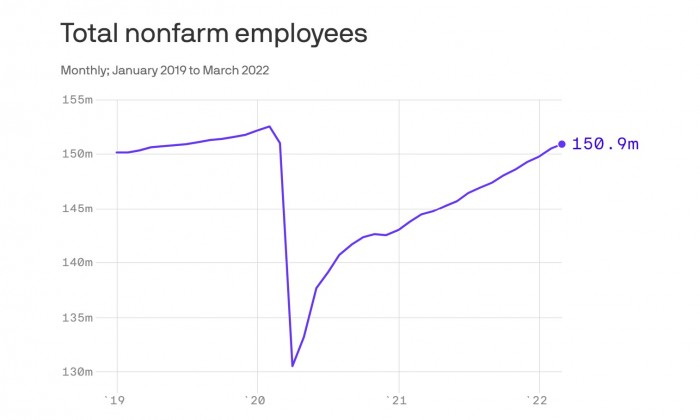
The U.S. added 431,000 jobs and the unemployment rate dropped to 3.6 percent in March, according to data released Friday by the Labor Department.

Job growth fell slightly short of expectations, as consensus estimates from economists projected a gain of roughly 490,000 jobs in March and a decline in the jobless rate to 3.7 percent.

But resilient consumer spending and historically strong demand for workers helped power the U.S. economy to another study job gain.

The Labor Department also revised the January and February job gains up by a combined 95,000, bringing the total of jobs added by the U.S. economy in 2022 up to 1,685,000 million.

More Americans who left the workforce during the pandemic appeared to be returning to the job hunt in March, a promising sign as businesses struggle to fill a record number of openings. The labor force participation rate ticked higher to 62.4 percent and the employment-population ratio—the proportion of working-age adults in the labor force—rose to 60.1 percent.

Wage growth also accelerated in March with average hourly earnings rising 5.6 percent over the past 12 months, up from 5.1 percent in February. 

The wage growth comes as inflation batters the Biden administration and Democrats politically, contributing to the president’s approval ratings being stuck in the low 40s. This has contributed to the anxiety in his party in a midterm election year, as Democrats are worried they could lose both the House and Senate majorities in this fall’s elections.

Gas prices have risen further with the Russian war in Ukraine and the international sanctions on Moscow. President Biden on Thursday announced he would be released 1 million barrels of oil a day from the nation’s strategic reserves to try to offer some help to lower gas prices.

The administration has touted the strength of the job market and the overall economy in the face of attacks from Republicans on inflation. And the March report offered more good news.

Overall, job-seekers continued to enjoy ample opportunities to find work at businesses across the economy even in the face of the highest annual inflation in 40 years. And businesses hit hardest by the pandemic-driven recession were among the top job-gainers in March.

The leisure and hospitality industry added 112,000 jobs in March, with restaurants and bars adding 61,000 jobs and accommodation businesses adding 25,000. Employment in the sector is still down 1.5 million from the onset of the pandemic.

Professional and business services companies gained 102,000 jobs in March and retailers added 49,000 employees, pushing both sectors well above their pre-pandemic employment levels.

The manufacturing, construction, and financial sectors also saw strong jobs gains last month.

The strong March job haul is the latest in a string of stellar employment reports. The U.S. has gained an average of 562,000 jobs each month in 2022—the same rate as in 2021, when the country added a record-breaking 6.8 million jobs

Even so, steady monthly job growth has done little to bolster Biden’s approval ratings and voters’ views about his handling of the economy. While job growth, consumer spending, the stock market and property values rebounded rapidly from the recession, a 7.9 percent annual increase in prices has wiped out the political benefit of a strong economy otherwise.