Why it matters: The breakthrough in talks comes as nurses, front-line technicians and other hospital employees face worker shortages and burnout due to the ongoing COVID-19 pandemic.
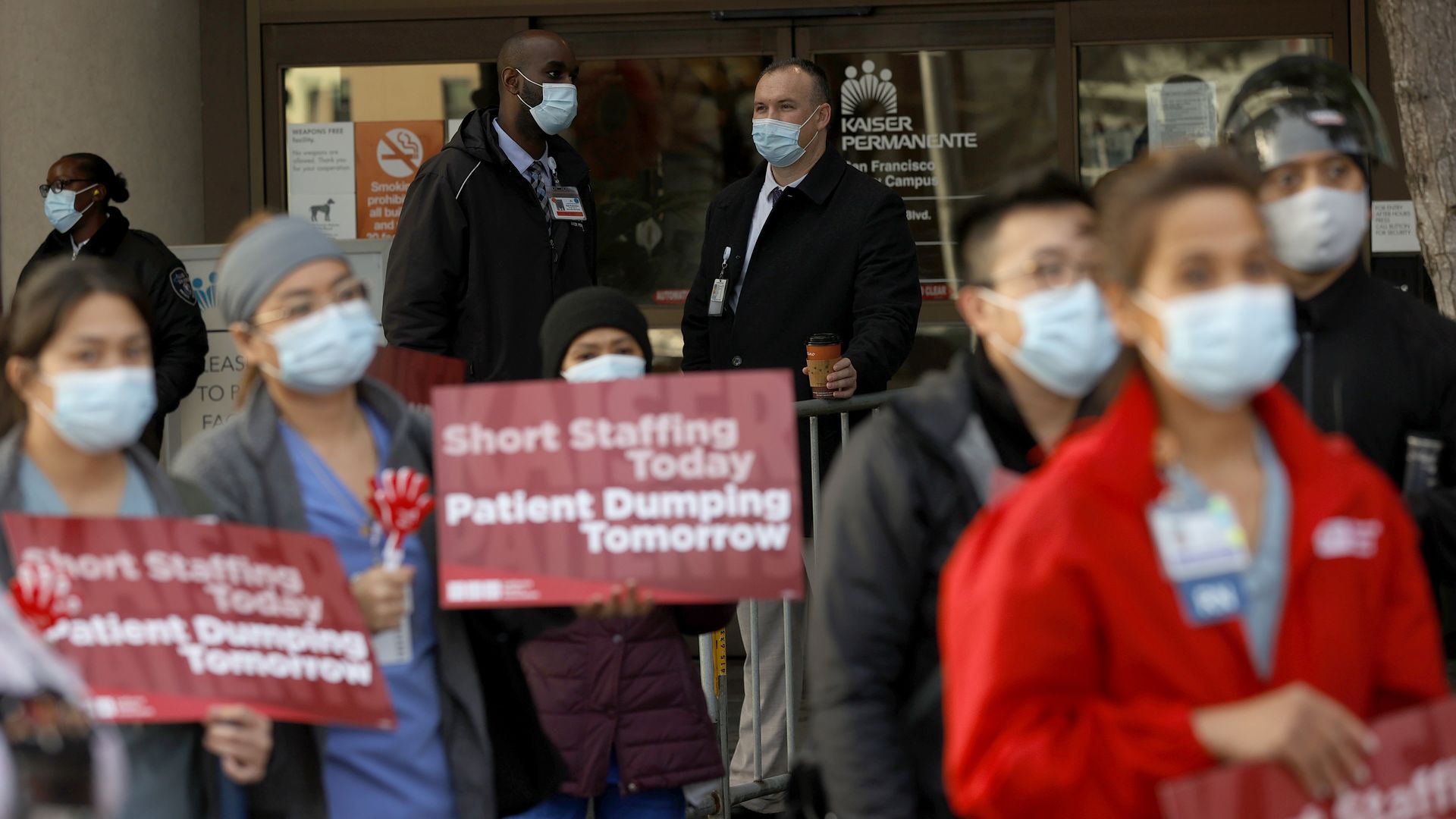
The big picture: More than 30,000 Kaiser Permanente employees in Oregon, Washington, California and other states threatened to walk out on Monday over lower pay for new hires, Reuters reports.
Kaiser and the Alliance of Health Care Unions ended up reaching a tentative four-year deal that includes wage increases, health and retirement benefits and bonus opportunities, per CBS News.
What they’re saying: “This agreement will mean patients will continue to receive the best care, and Alliance members will have the best jobs,” Hal Ruddick, executive director of Alliance, said in the statement.
“This landmark agreement positions Kaiser Permanente for a successful future focused on providing high-quality health care that is affordable and accessible for our more than 12 million members and the communities we serve,” said Christian Meisner, senior vice president and chief human resources officer at Kaiser.
What’s next: The agreement heads to union members for ratification, and, if ratified, it will become retroactive to Oct. 1.
Workers at Pittsburgh-based UPMC plan to strike over wages and benefits, the Post-Gazette reported Nov. 5.
Service Employees International Union Healthcare Pennsylvania, which does not represent the workers but is supporting them, told Becker’s Hospital Review the strike would involve workers at UPMC hospitals in Pittsburgh, including transporters, dietary workers, housekeepers, nurses, patient care techs, medical assistants, pharmacy techs, surgical techs, valets, therapists, health unit coordinators and administrative assistants. Workers plan to strike for one day on Nov. 18.
The workers are demanding a $20 per hour minimum wage, affordable high-quality healthcare, elimination of all medical debt and respect for union rights, according to a union news release.
Their strike notice came after UPMC announced Nov. 2 that the health system is giving 92,000 staff members a bonus of $500 to thank them for their work during the pandemic. UPMC will issue the bonuses on Nov. 26. The health system also announced improvements to employee compensation and benefit programs, including raising the entry level wage to $15.75 in January, according to the Post-Gazette.
“There was no ‘thank you pay’ until we started organizing to strike,” Juilia Centofanti, pharmacy tech at UPMC Children’s Hospital of Pittsburgh, said in a news release.
Ms. Centofanti added that employees are “owed this [$20 per hour wage] and so much more,” and said she “will continue organizing with my co-workers for the pay, safer staffing and union rights we deserve.”
In announcing the bonuses, Leslie Davis, president and CEO of UPMC, told workers, “Over the past 20 months, you have risen in truly exceptional ways to meet challenges we could have never anticipated. With your critical support, UPMC continues to care for so many.”
A UPMC spokesperson declined to comment to Becker’s on Nov. 5.
UPMC is a $23 billion healthcare provider and insurer. SEIU Healthcare Pennsylvania has been trying to organize about 3,500 hourly workers at UPMC Presbyterian and Shadyside hospitals for nearly a decade, but has not yet held a unionization vote, according to the Post-Gazette.
While nurses in Cook County, Illinois, struck a deal in recent days, those on a three-month-plus strike against a Tenet hospital in Massachusetts plan a protest at the chain’s Dallas headquarters.
Thousands of healthcare workers have waged strikes this summer to demand better staffing levels as the pandemic brought greater attention to what happens when a nurse must take care of more patients than they can reasonably handle.
In New York, a report from the attorney general that found nursing homes with low staffing ratings had higher fatality rates during the worst COVID-19 surges last spring helped spur legislators to pass a safe staffing law long-advocated for by the New York State Nurses Association.
While unions elsewhere face a steeper climb to win the success found in New York, through strikes and other actions, they’re attempting to get new staffing rules outlined in their employment contracts.
Most nursing strikes include demands for ratios, or limits on the number of patients a nurse can be required to care for, Rebecca Givan, associate professor in the School of Management and Labor Relations at Rutgers University, said.
“And employers are very anxious about that because it threatens their bottom line, so often when a compromise is found, it’s something that approaches a ratio but maybe has a bit more flexibility,” Givan said.
Some have been successful, like the 1,000 Chicago-area nurses at Stroger Hospital, Provident Hospital and Cook County Jail who waged a one-day strike on June 24 after negotiating with the countyover a new contract for nearly eight months.
They reached a tentative agreement shortly after the strike, stipulating the hiring of 300 nurses, including 125 newly added positions throughout the system within the next 18 months.
The deal also includes wage increases to help retain staff, ranging from 12% to 31% over the contract’s four-year term, according to National Nurses United.
Meanwhile, 700 nurses at Tenet’s St. Vincent Hospital in Worcester, Massachusetts, have been on strike for over 100 days over staffing levels. Nurses represented by the Massachusetts Nurses Association have been trying to get an actual nurse-to-patient ratio outlined for specific units in their next contract.
The two sides haven’t come close to reaching a deal yet, and some nurses will travel to Tenet’s headquarters in Dallas on Wednesday in an attempt to appeal to corporate executives, according to MNA.
At the same time, federal lawmakers wrote to Tenet CEO Ron Rittenmeyer seeking details on the chain’s use of federal coronavirus relief funds amid the strike and alongside record profits it turned last year.
The hospital denied lawmakers’ claims in the letter that Tenet used federal funds to enrich executives and shareholders rather than meet patient and staff needs, saying in a statement it strongly objects to the “mischaracterization of the facts and false allegations of noncompliance with any federal program.”
The strike is currently the longest among nurses nationally in a decade, according to the union.
A number of other major hospital chains have contracts covering their nurses expiring this summer, including for-profit HCA Healthcare and nonprofit Sutter Health.
Unionized nurses at 10 HCA hospitals in Florida have reached a deal on a new collective bargaining agreement, though members still need to ratify it, according to National Nurses United. The details are still unclear.
And after joining NNU just last year, 2,000 nurses at HCA’s Mission Hospital in Asheville, North Carolina, ratified their first contract Saturday, which includes wage increases and the formation of a nurse-led staffing committee.
Newly-formed unions take an average of 409 days to win a first contract, according to an analysis from Bloomberg Law. In the healthcare industry, new unions take an average of 528 days to win a first contract, the longest among all sectors examined.
Across the country at Sutter’s California hospitals, disputes haven’t been so easily resolved. Healthcare workers at eight Sutter hospitals planned protests throughout July “to expose the threat to workers and patients caused by understaffing, long patient wait times and worker safety issues at Sutter facilities,” according to Service Employees International Union United Healthcare Workers West, which represents the workers.
Similar to the ongoing Tenet hospital strike, SEIU is highlighting Sutter’s profits so far this year and the federal relief funds it received.
Workers at three Tenet Healthcare hospitals in Southern California will hold a rally May 6 to highlight their concerns about staffing, wages and benefits during the COVID-19 pandemic, according to the union that represents them.
The rally comes as the National Union of Healthcare Workers is in negotiations with Dallas-based Tenet for more than 600 direct Tenet employees at Fountain Valley Regional, including respiratory therapists, nursing assistants and X-ray technicians. The union is also in negotiations with the Compass Group, a food and support services provider, for about 225 housekeepers and food service workers at Tenet California hospitals in Fountain Valley, Los Alamitos and Lakewood, who are subcontracted by Tenet and employees of Compass.
Union spokesperson Matt Artz told Becker’s workers contend Tenet has remained profitable during the pandemic, but it did not implement appropriate safety measures. He said Tenet also rejected proposals to better staff certain units, and it has rejected the union’s proposal to stop subcontracting out the housekeepers and food service workers who have struggled to afford healthcare.
The union said Tenet, a major for-profit hospital operator, has the financial means to address these issues. The company reported a $97 million profit in the first quarter of 2021. Tenet stock also recently hit a new 52-week high, according to an April 29 report from Zacks Equity Research.
“These profits are not helping workers or patients,” Christina Rodriguez, a respiratory therapist at Fountain Valley (Calif.) Regional Hospital, said in a May 5 news release. “They’re being made at the expense of patient care and the people who have put their health on the line to help patients during this pandemic. At the height of the surge, I would go home crying that we didn’t have enough staff to help patients struggling to survive.”
Tenet contends the issue is not about Tenet but rather about negotiations between Compass and the union. Tenet said it is focused on staff and patients.
“This matter is not about us. It’s about a negotiation strictly between the NUHW and the Compass Group, which is a vendor that provides a range of food, laundry and other support services to hospitals,” Tenet told Becker’s. “At all times, our main concern is the safety of our staff, the integrity of our facilities and the best possible outcomes for our patients, and we remain hopeful that the NUHW and Compass will reach a positive outcome at the conclusion of their respective negotiations.”
But the union said Tenet can decide whether to bring the subcontracted housekeepers and food service workers in-house, which would benefit them in terms of wages and health benefits.
Meanwhile, Compass said it will continue to negotiate in good faith, with union members.
“Our hardworking team members are at the heart of what we do, and their determination to provide best-in-class care and service is inspiring,” a Compass spokesperson told Becker’s.“We take pride in paying competitive wages and providing affordable benefits and continue to uphold our agreement with the NUHW. We have a long history of listening to our employees, working productively with unions, and will continue to meet and negotiate — always in good faith.”
Respiratory therapists, housekeepers, nursing assistants, medical technicians, dietary workers and others represented by the union said they plan to rally from 11 a.m. to noon May 6 outside Fountain Valley Regional.
The rally, scheduled after Tenet’s shareholders meeting, includes workers from Los Alamitos (Calif.) Medical Center and Lakewood (Calif.) Regional Medical Center. Union workers whose jobs are subcontracted to Compass will speak during the rally, the union said.
About 800 nurses at a Tenet hospital are on the third week of a strike that’s shaping up to be one of the longest among healthcare workers in recent years.
At the hospital chain’s St. Vincent Hospital in Worcester, Massachusetts, nurses represented by the Massachusetts Nurses Association have been on strike since March 8 following a breakdown in negotiations over a new contract they’ve been bargaining for since November 2019.
Nurses have been active on the labor organization front in wake of the COVID-19 pandemic, and share a common issue at stake — staffing levels, and more specifically the nurse to patient ratio.
At St. Vincent, unionized nurses say their staffing has been worsened by the pandemic, affecting their ability to adequately care for patients.They point to hundreds of unsafe staffing reports filed by nurses over the past year, and the departure of more than 100 St. Vincent nurses over the past 10 months.
The hospital rejects those claims, and said only two citations have been issued by the Massachusetts Department of Public Health since 2019, according to a release.
The changes MNA is asking for are “excessive,” St. Vincent Hospital CEO Carolyn Jackson contended in an interview with Healthcare Dive, and the hospital cannot agree to the “aggressive” levels the union is proposing.
The two sides haven’t met again since the strike began, and do not have a timeline to get back to the table.
Right now, St. Vincent operates on staffing guidelines brokered after its nurses waged a 49-day strike over their first union contract in 2000. Under those terms, one nurse in its medical surgical units can be assigned to either four or five patients.
The terms proposed by MNA stipulate that one nurse in those units would be assigned to four patients at a maximum. MNA is also asking for a five-nurse critical care float pool, and for the hospital to double its emergency department staff from 71 employees to 157, Jackson said.
California is currently the only state with mandated ratios of one nurse to five patients in medical surgical units.
“It has been our request for them to remove some of those unreasonable, or preferably all of those unreasonable staffing requests, and come back to the table and really work on getting a reasonable deal done,” Jackson said.
During the first week of the strike, the hospital paid over $5 million to hire replacement nurses, according to a release. When asked directly about how much the hospital has spent so far, Jackson declined to answer.
“It is definitely an added expense to the hospital, and that is challenging,” she said.
The strike in 2000 ended when both parties reached a deal brokered by former Sen. Ted Kennedy, D-Mass., that resulted in provisions to limit mandatory overtime and the staffing guidelines currently in place.
But this time it seems “there is no point at which anybody’s going to step in and settle this for the two parties,” Paul Clark, professor and director of Penn State’s school of labor and employment relations said.
The union has garnered support from Massachusetts lawmakers including Sen. Elizabeth Warren, Rep. James McGovern and former Rep. Joe Kennedy, who visited the picket line on March 12, along with state Attorney General Maura Healey, who visited Wednesday.
The Worcester City Council also approved a resolution in support of the striking nurses at St. Vincent on March 16.
But those moves wield little power to break the strike, although the political pressure could hurt the hospital.
“The increased cost is, perhaps, public opinion beginning to coalesce behind the union,” Clark said.
Strikes have costs for both sides, as nurses on the picket line have gone without pay for almost three weeks now.
“Until the cost becomes too great to one or the other sides, they’re going to continue down this road,” Clark said.
In late November, Cliff Willmeng’s wife handed him a sealed envelope at their Minneapolis home “with some trepidation,” he recalled. He looked at the sender printed on the front: “Minnesota Board of Nursing.” Willmeng, a registered nurse, openedtheletter and read that the board was investigating his conduct as a nurse at United Hospital in St. Paul, from which he’d been fired in May. Clearly his license was at stake.
Willmeng was disappointed, but not surprised. He believes the review is due to his standing up for his own safety and that of other nurses, and for filing a lawsuit and union grievance against United’s parent company, Allina Health, after his termination.
He also thinks the investigation, like his firing, has been orchestrated to scare other healthcare workers away from reporting safety violations and concerns as the pandemic rages, and to make an example out of the former union steward.
The investigation is being led by a former Allina executive: “It feels meant to intimidate me,” he said.
Taking a Stand for Safety
Willmeng is a 13-year nursing veteran, husband, and father, who began working at United in October 2019.
When the pandemic hit late last winter, managers instructed nurses to use and reuse their own scrubs rather than hospital-issued scrubs. They were asked to launder their scrubs themselves at home.
Willmeng and others worried about bringing the virus home and pressed for the hospital scrubs. These scrubs were available, he said, and healthcare workers were permitted to wear hospital gear at Abbott Northwestern, another Allina hospital in Minneapolis.
In addition, while United managers told staff their laundering co-op could not keep up with demand for all the scrubs, the co-op denied that assertion, said Brittany Livaccari, RN, an ER nurse and union steward at United.
Willmeng addressed his concerns with management, filed state OSHA complaints, and enlisted the Minnesota Nurses Association (MNA). “He was taking action 100% to protect himself and to protect his patients,” Livaccari said.
But management did not change its policy, which was devised before the pandemic, and pointed to early-pandemic CDC and Minnesota Department of Health (MDH) guidelines — even when Willmeng shared emerging reports suggesting the policy was jeopardizing safety.
“It did feel like a pissing match,” Livaccari said. “We didn’t feel like we were being protected. … We weren’t being valued.”
Managers repeatedly wrote up Willmeng and colleagues who wore the hospital scrubs despite the policy. “It definitely felt like an intimidation tactic — ‘You’re going to do this, you’re going to follow these policies,'” Livaccari said. “A lot of staff chose to stop wearing those scrubs because they needed their job, they have families to pay for, they were afraid.”
Willmeng continued to wear the hospital scrubs. “I had to decide whether that policy was most important, or the safety of my workplace and public health and my family,” he said.
On May 8, the hospital terminated Willmeng. He said its stated cause was violating hospital policies regarding uniform code and a respectful workplace.
Two weeks later, the local nurses’ union held a rally that drew hundreds of supporters for Willmeng and blasted the hospital’s scrub policy.
‘I’m Not a Bad Nurse’
In June, Willmeng sued Allina for whistleblower retaliation and wrongful termination. The case is scheduled to be heard next August.
His union grievance is set to be arbitrated in January. He maintains his firing was not for “just cause” because United’s uniform code policy violated standard nursing practices.
Willmeng has been running the website WeDoTheWork, which describes itself as “worker-run journalism.” It’s an independent but union-affiliated publication that “unflinchingly tells our side of the story, and takes the fight to management.”
He’s been publicizing his case on that website. In his Twitter account he notes, “I believe in the working class, democratically run economy, socialism, and revolution.”
Willmeng is applying for jobs, but despite his experience, a national nursing shortage, and reports of severe understaffing as hospitalizations surge again, Willmeng has not even been interviewed by any of the roughly 20 medical centers he has applied to.
He thinks he is being blackballed. “I’m not a bad nurse,” he said.
The board letter cited these concerns: “On April 16, 2020, you received a written warning for not following the uniform policy,” reads one item, citing a report shared with the board. “On May 5, 2020, you were issued a final written warning for repeatedly violating policy. … On May 8, 2020, you were terminated from employment based on violating hospital policies, behavioral expectations, code of conduct, and not following the directions of your manager.” The letter asks Willmeng to respond to eight questions.
“This looks like it was taken right out of my HR file,” he said. The board will not reveal who reported him, citing confidentiality policies. But he is certain — given the detail in the letter — that it was Allina/United management.
The nursing board cannot comment on Willmeng’s review to protect confidentiality, said executive director Shirley Brekken, MS, RN. The board receives about 1,200 complaints annually and first determines whether a complaint would merit disciplinary action if true. If so, it launches a review.
Allina declined to answer questions via a spokesperson, citing the lawsuit. “We cannot appropriately retain employees who willfully and repeatedly choose to violate hospital policies,” according to an emailed statement. Throughout the pandemic Allina has been following CDC and MDH guidelines, “which do not consider hospital issued scrubs as PPE [personal protective equipment].”
“In the early days of the pandemic, our local and national supply chain was extremely stressed,” the statement continues. “Our practices are aligned with other local and national hospitals … and have enabled us to allocate the appropriate supplies for daily patient care and ongoing care for COVID-19 patients.”
But United healthcare workers still lack hospital scrubs and enough N95 masks, Livaccari said, and the hospital is severely understaffed as the patient load increases. “We hear, ‘It’s a pandemic. You have to do more with less,'” she said. “It’s a really bad situation.”
Retaliation and Intimidation
Some think Willmeng’s review was initiated primarily to retaliate against him, not to protect public health and safety.
“Hospitals, they want a docile workforce, they want a workforce they can control,” said John Kauchick, RN, a retired 37-year nursing veteran who advocates for workplace rights. They do so “by fear and intimidation,” he added. “A nurse’s number one fear is to be turned in to a board of nursing for anything.”
“If you’re a whistleblower and you speak truth to power, that will get you a disciplinary hearing even more so than if there is patient harm.”
The letter was drafted more than six months after Willmeng was fired, and after he filed the lawsuit and union grievance. Just before he received the letter, he was elected to the MNA board. The timing strikes Willmeng and Kauchick as significant.
“If you think there’s been a violation, you are supposed to report that in a much shorter time period,” Kauchick said. Kauchick thinks Allina filed the complaint as leverage, to persuade Willmeng to drop the grievance and lawsuit.
But Livaccari noted the process can take up to six months, and that every firing is supposed to be reported to the board.
Like Kauchick, she takes umbrage with the review’s leader: Stephanie Cook, MSN, RN, a board nursing practice specialist who spent 24 years as a director with Allina. She was a member of multiple Allina committees, including its ethics committee, according to reports. She was with Allina as recently as 2018. Brekken confirmed her employment with Allina, noting that it’s “a very large system.”
Regardless, that’s a conflict of interest, Kauchick and Livaccari said, arguing that Cook should not be part of the review. “It’s just so blatantly obvious. How are you going to look at this with an unbiased lens when you worked for the organization that says Cliff was in the wrong?” Livaccari said. “It’s so inappropriate.”
This is not uncommon, Kauchick said, noting state nursing board reviews are “really just designed to get rid of whistleblowers. It’s like a buddy system. They hire higher-ups from big hospital systems. It’s just incestuous.”
Brekken was aware of Cook’s background before a colleague assigned this review to Cook, she said, noting the board vets staff for personal involvement in cases. Brekken “might consider” removing Cook from the review given her connection to Allina, she said, but added: “Many individuals on our staff may have worked for a particular health system throughout their career.”
The board could throw out the complaint or take action. Such actions typically range from a reprimand to revoking a nurse’s license, Brekken said. A staff member and board member together will review the report and Willmeng’s response, but she said the board itself makes final decisions.
Willmeng is also focused on the grievance, which asks Allina to provide full back pay and reinstate him.
“I would not feel comfortable; I’d feel very anxious” going back, he said. “But I’m an ER nurse. I belong in the ER…. It’s important for a frontline healthcare worker to demonstrate that when they stand up and speak truthfully and assertively about working conditions and patient safety, that they can’t just be triangulated.”
His salary — about twice his current unemployment benefits — is also a draw, he acknowledged.
Meanwhile, he continues applying for other jobs. His life insurance cost doubled and his family switched to his wife’s lesser health insurance plan, he said. A fourth-grade teacher with a local public school system, her salary is the primary support for themselves and their two children.
Willmeng also just hired an attorney at $250 an hour to help him respond to the board letter. “It’s not something I take lightly,” he said. “There’s cause for real concern. That’s my nursing license, that’s everything.“






 HENRY KOTULA