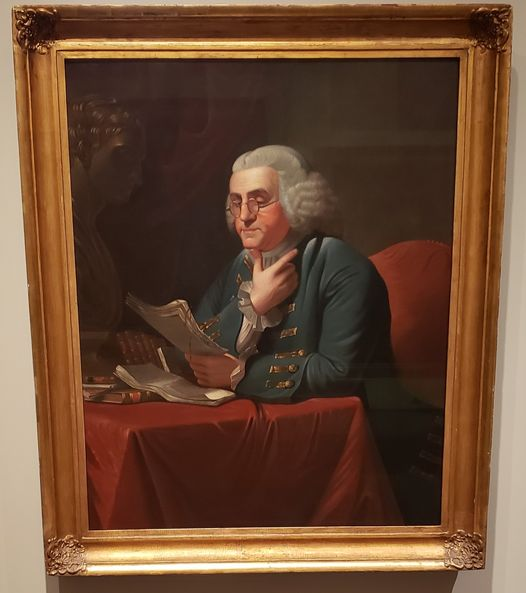
“When a broad table is to be made and the edges of planks do not fit the artist takes a little from both and makes a good joint. In like manner here, both sides must part with some of their demands in order that they may join in some accommodating proposition.”
“We have a collaborative culture; it’s one of our system’s core values. But it takes us far too long to make decisions.” A health system CEO made this comment at a recent meeting, giving voice to a dilemma many system executives are no doubt facing. Of course, leaders want their teams to collaborate—in any important decision, we want to hear different voices, consider diverse points of view, and incorporate various areas of expertise.
On the other hand, collaboration takes time, which we don’t have right now.It also can add complexity, be the enemy of clear direction, and muddy accountability. This CEO went on to make an essential connection: “My concern is that this protracted decision making isn’t just a process problem, but that it’s showing up in our results.
Take performance improvement—we all quickly agreed we need to cut costs, but it’s taking far too long for us to act, and I fear we’ll have trouble holding the new line over time.” She further mused
“I wonder if this problem is, at least in part, due to how we make decisions. We don’t make them quickly enough, they aren’t clear enough, and we don’t have the most effective system of accountability.”
On one hand, traditional hospital culture is rightly grounded in the safety, hierarchy, and tradition of a do-no-harm world. But on the other hand, today’s economic, technological, and competitive environments require an approach to operations, revenue, and growth that has the aggressiveness of a Fortune 50 company. This should not be an either-or situation. Health systems can uphold a culture of safety while also fostering nontraditional values that will drive the organization assertively toward the future – all while committing to change.
Saint Peter’s Healthcare System in New Brunswick, N.J., was six years ahead of the C-suite streamlining curve.
The health system slimmed down its leadership structure in 2017, President and CEO Les Hirsch told Becker’s. A top-heavy executive team grew unsustainable as the system struggled financially, operating at a loss. Saint Peter’s board decided to combine the president and CEO positions — which were previously split in two. Then, as president and CEO, Mr. Hirsch cut five vice presidents’ positions, including the consolidation of the chief information officer and chief medical information officer roles. More than 20 middle-manager positions were also cut or consolidated.
The streamlining of senior leadership positions alone at the time eliminated over $4 million in salaries and benefits, according to Mr. Hirsch. With the old leadership structure, Saint Peter’s spent about 2.4% of its revenue on senior leaders’ compensation. Last year, that percentage sank to 1.34%.
But finances shouldn’t be the only consideration for a health system planning to whittle down its structure.
“The good news is, we’re lean,” Mr. Hirsch said. “The bad news is, we’re lean.”
Since consolidating the president and CEO roles — and not having a chief operating officer — succession planning is more complicated, per Mr. Hirsch.
“There’s no designated No. 2,” he said. “Our senior leadership team structure is very flat.”
A condensed C-suite also means more work for some members of the leadership team — which is taken in stride, Mr. Hirsch said. There’s no specific “planning” department, so executives put their heads together on strategy, growth and development initiatives. There is no government relations officer, but Mr. Hirsch, as CEO, takes primary responsibility for this function and is very active in advocacy.
Anyone who works on a lean team like this also “has to be a generalist,” Mr. Hirsch said. He stays up to date on the literature and sends relevant articles to other executives.
“Considering our size as one of the few remaining single-hospital health systems in New Jersey, we don’t have the luxury of having somebody specifically responsible for artificial intelligence or other niche responsibilities as these are functions that are absorbed within people’s roles,” Mr. Hirsch said. “And we all develop the knowledge needed so that we can understand how new ideas or resources may apply to us. When you’re smaller and don’t have the scale of these mega-organizations, you have to do more yourself. You roll up your sleeves.”
Despite these challenges, a little can go a long way; three departmental administrators now split the job once shared by seven people at Saint Peter’s. There’s been no hit to efficiency; “they’re more effective in their roles as departmental administrators than anybody that I’ve ever seen,” Mr. Hirsch said.
The changes to streamline management were also well-received by the workforce. Often layoffs affect front-line workers more than management or senior leadership — which may have contributed to the lack of outcry, per Mr. Hirsch. But he primarily attributes the positive reception to intentional transparency.
“Most importantly, I’m a very active communicator. So, I communicated about it. It wasn’t that there was some intrigue and mystery in the organization that people were hearing by rumor,” Mr. Hirsch said.
“Rumors — like fear — are two things that equate to being like a cancer in an organization,” he continued. “I always want to do everything I possibly can to set the facts straight and communicate with people. If it’s not confidential and I can communicate it, I will. In fact, I’ll err more on the side of communicating than keeping information close to the vest.”
Regardless of who is affected by layoffs, executives should always handle them with sensitivity, Mr. Hirsch emphasized; the right choice for an organization is not always the easy choice for its people.
“It’s always painful when you’re making these kinds of changes because they affect people, and you always have to go about those changes in a very thoughtful, considerate, and compassionate way,” Mr. Hirsch said. “You’re eliminating roles and impacting people’s lives, their careers and their family. So, I always keep that top of mind.”
In nearly every facet of our lives, all of us are routinely put in the position of trying to settle disputes or disagreements, whether it be with our spouses or significant others, our children, our siblings, co-workers, neighbors, contractors — you name it. It’s part of everyday life. Conflicts arise and we figure out how to resolve them.
Unfortunately, in the politically toxic environment in which we now live, compromise is now perceived as a sign of weakness. Elected leaders are routinely criticized and attacked by fellow party members and their constituents for trying to find middle ground on any issue, particularly those rooted in ideology. The bipartisan agreement reached in Congress last week on gun safety was a rare and welcome exception.
While they hold starkly different positions and come from states that are thousands of miles apart geographically and politically, Senators Chris Murphy, D-Conn., an outspoken proponent of stronger gun safety laws, and John Cornyn, R-Texas, a staunch Second Amendment advocate, found a way to set aside their differences and reach compromise on the so-called Bipartisan Safer Communities Act that was approved by the Senate 65-33 and the House by a margin of 234-193. President Joe Biden signed the legislation into law June 25.
While the new law does not go nearly as far as Senator Murphy and most of his fellow Democrats wanted by, for instance, banning the sale of assault rifles or at least increasing the age to buy them, the willingness to finally get something done after 30 years of Congressional gridlock was a long-overdue victory for common sense.
Bipartisanship has also been evident in Congressional support for military funding for Ukraine and the 2021 Infrastructure Investment and Jobs Act, but little else.
Despite the glimmer of progress in our nation’s legislative branch of government, it appears that polarization now has a firm grip on our nation’s top court. In trying to find middle ground in deliberations on Roe v. Wade, U.S. Supreme Court Chief Justice John Roberts sought this compromise with his five fellow conservatives and three liberals on the bench: support Mississippi’s prohibition against abortion after 15 weeks, but preserve some semblance of reproductive rights for women by not overturning Roe v. Wade or the court’s 1992 ruling in Planned Parenthood v. Casey.
“The Court’s decision to overrule Roe and Casey is a serious jolt to the legal system — regardless of how you view those cases,” Roberts wrote. His incremental approach found no takers among his entrenched colleagues on either the right or the left. Hence, constitutional protections for abortions that had stood for nearly 50 years — and are supported by the vast majority of Americans — were stripped away in a 5-4 vote, leaving the power to individual states.
Unfortunately, bipartisanship can be equally elusive in state capitals around the country, which does not bode well for reproductive rights advocates in 21 states where abortion is now illegal or have “trigger bans” that will take effect within 30 days of the Supreme Court’s June 24 ruling.
Regardless of whether the issue is abortion or other divisive topics such as immigration, gun safety, voting rights, bail reform or LGBTQ rights, governors and state legislators of one controlling party or another routinely dig in and take intractable positions, leaving little or no room for negotiation.
We would all be well served to reintroduce ourselves to the art of compromise, for the good of our family relationships, for the good of our respective professions, for the good of our country and society in general, and even for the good of our own personal health as we consider whether to consume that extra helping of food or another cocktail.
Moderation is key in our lifestyle choices and it could also go a long way in trying to find middle ground with those who have differing opinions. If adversaries are truly motivated to do the right thing, not political gamesmanship, they should always choose their words carefully, listen with an open mind and always be open to making concessions. In short, we should all start by embracing civility.
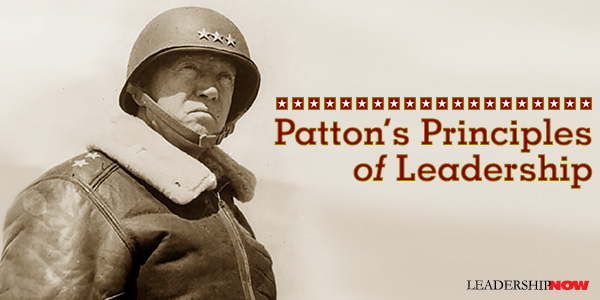
BORN in San Gabriel, California, in 1885, George S. Patton, Jr. was the general deemed most dangerous by the German High Command in World War II. Known for his bombastic style, it was mostly done to show confidence in himself and his troops, says author Owen Connelly.
On December 21, 1945, Patton died in Heidelberg, Germany. The following day the New York Times wrote the following editorial:
History has reached out and embraced General George Patton. His place is secure. He will be ranked in the forefront of America’s great military leaders.
Long before the war ended, Patton was a legend. Spectacular, swaggering, pistol-packing, deeply religious, and violently profane, easily moved to anger because he was first of all a fighting man, easily moved to tears because, underneath all his mannered irascibility, he had a kind heart, he was a strange combination of fire and ice. Hot in battle and ruthless, too. He was icy in his inflexibility of purpose. He was no mere hell-for-leather tank commander but a profound and thoughtful military student.
Everyone is to lead in person.
Commanders and staff members are to visit the front daily to observe, not to meddle. Praise is more valuable than blame. Your primary mission as a leader is to see with your own eyes and be seen by your troops while engaged in personal reconnaissance.
Issuing an order is worth only about 10 percent. The remaining 90 percent consists in assuring proper and vigorous execution of the order.
Plans should be simple and flexible. They should be made by the people who are going to execute them.
Information is like eggs. The fresher the better.
Every means must be used before and after combats to tell the troops what they are going to do and what they have done.
Fatigue makes cowards of us all. Men in condition do not tire.
Courage. Do not take counsel of your fears.
A diffident manner will never inspire confidence. A cold reserve cannot beget enthusiasm. There must be an outward and visible sign of the inward and spiritual grace.
Discipline is based on pride in the profession of arms, on meticulous attention to details, and on mutual respect and confidence. Discipline must be a habit so ingrained that it is stronger than the excitement of battle or the fear of death.
A good solution applied with vigor now is better than a perfect solution ten minutes later.








 Everyone is to lead in person.
 HENRY KOTULA