Medicaid should be a bigger part of the “Medicare for All” debate

https://www.axios.com/medicare-for-all-bernie-sanders-medicaid-states-b3c5eceb-0f3c-4c4b-9317-6a1f9434232b.html?utm_source=newsletter&utm_medium=email&utm_campaign=newsletter_axiosvitals&stream=top

Illustration of a pills capsule opening with state-shaped pills falling out

The fact that “Medicare for All” would eliminate Medicaid hasn’t gotten nearly as much attention as its elimination of private insurance. But it’s a move that would largely eliminate states’ role in the health care system.

Why it matters: State Medicaid programs are leaders in experimenting with delivery and payment reforms, efforts to control drug costs, and addressing social causes of ill health, such as poverty and poor housing. All of those projects would still be important in a single-payer world.

How it works: Sen. Bernie Sanders’ bill would move most Americans into its new single-payer system, including people with private insurance but also virtually all of the 73 million people covered by Medicaid and the Children’s Health Insurance Program.

Winners: States would reap huge savings. Medicaid is the single largest item in most state budgets.

  • The effects on safety-net hospitals and clinics would vary, depending largely on how payment rates under the new plan compare to today’s Medicaid rates.
  • The uninsured in states that have not expanded Medicaid also would be big winners.

Yes, but: The change would all but eliminate states’ role in health care, where they have been leaders not just in providing coverage, but also driving efficiency and testing new models of care.

  • Those reforms — and the idea of states as laboratories of reform — would pretty much disappear, and the balance of federalism in health would fundamentally change.

The bottom line: For advocates of a single national plan, eliminating the patchwork of state Medicaid programs would be progress. For fans of a federal-state balance, it’s a big problem.

  • Either way, Medicaid is a large and generally popular program, and its future at least deserves a bigger role in the debate.


Efforts to save new moms clash with GOP’s Medicaid cuts

https://www.politico.com/story/2019/06/14/new-moms-clash-gop-medicaid-cuts-1364564

Image result for medicaid cuts

The push to address the soaring U.S. maternal morality rate is colliding with a broader, more ideological public health imperative: Republican-led efforts to scale back Medicaid.

The safety net program pays for half of all births in the nation. Democrats and many public health experts see it as a natural vessel for slowing the death toll of pregnant women and new mothers, by extending care in the crucial year following childbirth.

But concern over the potentially staggering cost has already quashed efforts in states such as Texas and left liberals in Congress glum over the prospects for a nationwide legislative fix.

“Medicaid represents the best of America and the administration’s effort to gut it would be a massive step backwards on confronting America’s maternal mortality crisis,” Sen. Elizabeth Warren (D-Mass.) wrote in an email.

The dynamic mirrors the federal response to the opioid epidemic, in which Republicans and the Trump administration support making addiction services more available while simultaneously working to shrink Medicaid, the largest single payer of behavioral and maternal health care.

Research has shown the risk of death after childbirth persists for a full year, from such factors as heart disease, stroke, infections and severe bleeding. Black and Native American women are about three times more likely to die from a pregnancy-related cause as white women, according to the Centers for Disease Control and Prevention.

Warren, along with fellow 2020 Democratic presidential contenders Sens. Bernie Sanders, Cory Booker and Amy Klobuchar, back extending Medicaid’s current requirement to cover new mothers from 60 days to one year after childbirth. Democratic proposals in the Senate from Dick Durbin of Illinois, and in the House, from Reps. Robin Kelly of Illinois and Ayanna Pressley of Massachusetts would do that along with provide states grants to improve hospital deliver practices, among other things.

But the efforts aren’t yielding GOP buy-in across the country, as conservative lawmakers keen on shrinking the program press for narrower fixes, such as increased data collection on deaths and a national standard of best medical practices. Proposals to enhance Medicaid coverage to address maternal mortality haven’t attracted a single Republican co-sponsor in Congress, with both sides at loggerheads on whether to grow or shrink the entitlement program.

“All mothers must have access to adequate care before and after delivery, and we should provide states with the tools and flexibility they need to ensure coverage of their most vulnerable populations,” Sen. John Cornyn (R-Texas) told POLITICO.

A Republican aide said GOP lawmakers are focused on getting a better picture of how many pregnant and postpartum women actually need coverage before exploring how to expand access to care. “That is a laborious process to undertake as we have to talk to both the states, stakeholders, and CMS to discern what coverage gaps exist. And we need to know the role other sources of coverage play as well,” the aide said.

Democrats say the prospect of expanding Medicaid benefits scares Republicans in an era of pitched partisan battles over health policy.

“Following the ACA and repeal Obamacare debates, health care, especially Medicaid experience, has become a hot issue — not quite a third rail but definitely hot and our GOP counterparts are a little squeamish,” a Democratic aide working on the issue said.

President Donald Trump last year signed a maternal care measure that directed millions of dollars in new spending to help states collect data on maternal mortality, but has been mum on extending Medicaid coverage to new mothers. His administration will weigh whether to allow Missouri to use its Medicaid programs to offer extended coverage to mothers struggling with addiction — but not the broader Medicaid population.

Meanwhile, the administration is aggressively pursuing an overhaul of Medicaid, finalizing proposals to allow states to apply for block grants that cap program spending and approving requests to condition benefits on work. The administration’s separate efforts to overturn Obamacare would also jeopardize federal subsidies that low-income mothers use to purchase coverage.

The focus on maternal mortality is driven by rising trend lines showing about 700 women die each year due to pregnancy related conditions a rate that’s more than doubled over the last three decades. About a third of the fatalities occur between one week and one year postpartum, according to a recent CDC report, putting the U.S. behind other developed countries for maternal health. And 60 percent of maternal deaths are preventable, with African American women and other minorities disproportionately affected.

Researchers studying the pattern say that extending Medicaid coverage would provide comprehensive benefits for chronic health conditions like heart disease, which accounts for a quarter of maternal deaths.

The postpartum period is such a period of vulnerability,” said Houston physician Lisa Hollier, immediate past president of American College of Obstetricians and Gynecologists and chair of Texas’s Maternal Mortality and Morbidity task force. “The transition time [from pregnancy to full recovery] is one when we see unmet health needs.”

Obamacare helped boost coverage for new mothers. The uninsured rate for women who reported giving birth in the past year fell to 11.3 percent in 2016 from 19.2 percent in 2013 according to a study in Health Affairs.

The gains in states that expanded their Medicaid programs under Obamacare were especially pronounced, with the uninsured rate among new mothers falling 56 percent compared with 29 percent in non-expansion states.

But the Republican-led push to dial back Medicaid expansion has put a spotlight on controlling spending across the entire program.

Some states are exploring alternatives. Missouri’s Department of Social Services this month intends to ask the Trump administration for a waiver that would allow it to offer Medicaid coverage to postpartum women struggling with substance abuse for one year after they give birth. The move would cover about 1,500 of the 24,000 women in the state whose benefits lapse 60 days after childbirth.

The state’s Republican-controlled legislature endorsed the idea last year after killing a broader expansion of Medicaid benefits to postpartum women.

In Texas, where 382 women died within a year of giving birth between 2012 and 2015, Republican Gov. Greg Abbott this week downplayed the state’s maternal mortality rate on Twitter and said that the state was already doing enough to deal with the issue.

Last month, legislators opted to develop postpartum care services within an existing state program geared towards family planning, which will cost about $56 million over five years, instead of extending Medicaid for 12 months, which carried a five-year price tag of nearly $1 billion in state and federal funds.

Kay Ghahremani, the state’s Medicaid director disputes the cost analysis, saying it would actually save money in the long run by promoting wellness and averting potential emergencies.

“It’s the most important thing we can do for maternal health in this state,” said Ghahremani, now president of the Texas Association of Community Health Plans. “We don’t want to see a single mom die from things that are avoidable.”


Why Are at So Many Children Losing Medicaid/CHIP Coverage?

Why Are So Many Children Losing Medicaid/CHIP Coverage?

Along with the American Academy of Pediatrics, First Focus and Children’s Defense Fund, Georgetown University CCF held a press tele-conference and released a report examining an alarming trend in children’s health coverage. The report shows that more 800,000 fewer children had Medicaid/CHIP coverage at the end of 2018 compared to 2017. This trend comes amid broader efforts to restrict access to health coverage and discourage participation by legal immigrants.

The report found little evidence to support claims that the improving economy was responsible for the 2.2 percent decline in enrollment. Instead data suggest this 2018 could be the second year in a row that the rate of uninsured children increases. The U.S. Census Bureau will release the 2018 child uninsured rate data later in the fall.

Enrollment declines are concentrated in seven states – California, Florida, Illinois, Missouri, Ohio, Tennessee, and Texas – which account for nearly 70 percent of the losses. Nine states – Idaho, Illinois, Maine, Mississippi, Missouri, Ohio, Tennessee, Utah, and Wyoming – had decreases of more than double the national average.

Please listen to the recording of the press call or read the report for more details. Here a few excerpts from Thursday’s press conference:

Joan Alker of CCF moderated the call and explained why this drop in child enrollment is so alarming.

“We are extremely concerned about what we are seeing and what it portends for the uninsured numbers these fall,” she said. “For many years there’s been a national bipartisan commitment to reduce the number of uninsured children and the effort have borne fruit. Unfortunately, today we do not feel confident that this national commitment still exists.”

Tricia Brooks, lead author of the report, explained the many factors have likely led to the decline in child enrollment.

“Knowing that the economy had a minimal impact at best, we must call on state and national policymakers to address the factors contributing to the enrollment decline,” said Brooks. “From systems and renewal issues to enrollment barriers to threats like public charge, we must take a hard look at what these administrative actions and barriers to coverage mean for our kids’ health.”

Dr. Laura Guerra-Cardus, Deputy Director for the Children’s Defense Fund of Texas  said overly cumbersome eligibility checks are causing thousands of eligible children to lose coverage in her state. Nine out of every 10 Texas children being dropped are losing coverage due to red-tape. She said this is causing significant confusion for families and throughout the Texas health care system as many families don’t learn their children are uninsured until they show up for an appointment with their health care provider.

“These income checks are erroneously flagging families – at the very least 30% of the time. Families are not being given enough time to respond,” she said. “They are given only ten days to respond and the timeline starts once flagged by the system which could be before the parents even receive notification.”

Bruce Lesley, President of First Focus, pointed out that bipartisan legislation in the U.S. Congress would address the issues raised by Dr. Guerra by requiring 12 months continuous health coverage for children. He also cited polls that show strong support for children’s health coverage in general.

“The American public is with us on this. Kids are a priority but we’re seeing a failure of policymakers to adhere to what voters want and make children a priority,” Lesley said.

Dr. Lanre Falusi, a pediatrician at the Children’s National Health System and national spokesperson for the American Academy of Pediatrics said pediatricians are very concerned about the decline in Medicaid and CHIP enrollment. In addition to cumbersome enrollment process and administrative burdens discouraging families from enrolling eligible children, she pointed out that immigrant families also encounter the chilling effect the proposed public charge rule.

“The public charge proposal presents immigrant families with an impossible choice: keep your family healthy but risk being separated or forgo vital services like Medicaid so your family can remain together in this country. Although the final rule has yet to be issued, the proposal has already caused immigrant families to avoid or even disenroll from programs they are eligible for out of fear, like Medicaid. I have seen this myself,” Dr. Falusi said.

“We need all children in the United States to reach their full potential if we are to reach ours as a nation. Ensuring children are enrolled in health coverage designed to meet their needs is necessary to making that possible. Our lawmakers must pass policies that keep programs like Medicaid and CHIP strong, not those that jeopardize the critical gains we’ve made in children’s coverage.”


House committee to discuss DSH cut repeal next week

https://www.modernhealthcare.com/government/house-committee-discuss-dsh-cut-repeal-next-week?utm_source=modern-healthcare-daily-dose-thursday&utm_medium=email&utm_campaign=20190530&utm_content=article1-readmore

The House Energy and Commerce Committee next week will consider a full repeal of the Medicaid disproportionate share hospital cuts, a sign that hospitals are getting closer to securing the top lobbying priority for safety net providers and academic medical centers.

The committee will hold a hearing next Tuesday on proposed legislation from Rep. Eliot Engel (D-N.Y.), whose home state gets the single largest so-called Medicaid DSH allotment in the country. In fiscal 2018, New York received $1.8 billion of the roughly $12 billion in annual federal payments.

Engel has pitched a full repeal of the cuts mandated by the Affordable Care Act, which are set to take effect Oct. 1. Should those cuts move forward, they would reduce federal DSH payments to states by $4 billion in fiscal 2020 and $8 billion in fiscal 2021. An aide to Engel said that a full repeal “provides the long-term solution.”

Medicaid DSH is the second-largest federal program to boost hospital Medicaid funding, representing about $12 billion in federal spending annually. It has been the subject of a political fight over proposed reforms to the program.

Last week, 300 of the 435 U.S. House of Representatives lawmakers sent a letter to the chamber’s leadership urging a two-year delay to the DSH cuts, and hinted that some in Congress believe the Medicaid DSH formulas need to be reconfigured, calling for a “sustainable, permanent” solution.

“This delay will ensure that hospitals can continue to care for the most vulnerable in our communities,” the lawmakers wrote, led by Engel and Rep. Pete Olson (R-Texas).

The amount the federal government pays out for DSH varies enormously across states and is mostly arbitrary, reflecting the caps set by Congress in 1992 instead of a relevant benchmark.

Florida, where about 3.3 million people are uninsured, gets the exact same federal DSH allotment as Connecticut, where about 245,000 people are uninsured.

Finance Committee Chair Chuck Grassley (R-Iowa) has said he wants to see a reset. Sen. Marco Rubio (R-Fla.), whose state has a strong vested interest in a formula change, has used the Sept. 30 deadline to push a proposal that would base the federal dollar allotment on a particular state’s share of U.S. citizens living below the poverty level.

But the major trade groups representing DSH hospitals continue to push for a simple delay, since their constituents include hospitals in all the states. Dr. Bruce Siegel, CEO of America’s Essential Hospitals, said at a briefing to House staff earlier this month that he’d be open to a formula change as long as hospitals don’t see cuts to existing funding. That means Congress would have to allocate even more money to the program.

House Speaker Nancy Pelosi (D-Calif.) said she backed another delay when she addressed American Hospital Association’s annual meeting in April. She noted that she wouldn’t back a program overhaul.

“We cannot support efforts that will reward states for not expanding Medicaid or simply take DSH money from some other state and give it to others,” she said. “Who thought that was a good idea?”

The DSH debate doesn’t fall along the lines of which states expanded Medicaid or not. Alabama and Missouri haven’t expanded Medicaid but receive high federal DSH allotments, and would likely lose money if Congress decided to redistribute the existing payments.

Although the policy rationale behind the ACA-mandated cuts was that Medicaid expansion would shrink hospitals’ need for DSH money, high-DSH expansion states such as New York and New Jersey aren’t giving an inch.

Siegel framed the debate over expansion states’ need as being “a little more complicated now” than in the early years of the ACA.

“I think the market has changed in the last eight years or nine years when we started down the road of Medicaid expansion,” he said at the Capitol Hill staff briefing.

He pointed to the slight rise in the uninsured rate recently, as well as the increase of high-deductible plans that put more fiscal burden on enrollees.

“We are frankly concerned about any moves to move us toward skinny health plans,” he added.

Enrollment in more bare-bones commercial plans doesn’t really affect the Medicaid enrollment, but he argued that expansion still brings Medicaid shortfall — which is the difference between Medicaid and Medicare reimbursement.

“If you have 70% Medicaid patients which some of our hospitals do, you are in a terrible disadvantage in terms of payment streams, with the shortfall becoming enormous for you,” he said.

There is another Medicaid program that can help hospitals with shortfall: the “upper payment limit” supplement for Medicaid fee-for-service. States can deploy UPL payments to hospitals in order to increase their reimbursement based on rates Medicare would have paid for the same treatment.

UPL is the largest Medicaid supplemental funding program, with about $13 billion in annual spending according to the Medicaid and CHIP Payment and Access Commission data from fiscal 2017.

The UPL program is also under scrutiny by MACPAC, whose analysts found that 17 states have overspent billions of these payments.


The hospitals staying silent on Medicare for All

https://www.axios.com/hospitals-medicare-for-all-health-care-bernie-sanders-5d28dc00-05cd-411b-98cc-556ddfa12c9b.html

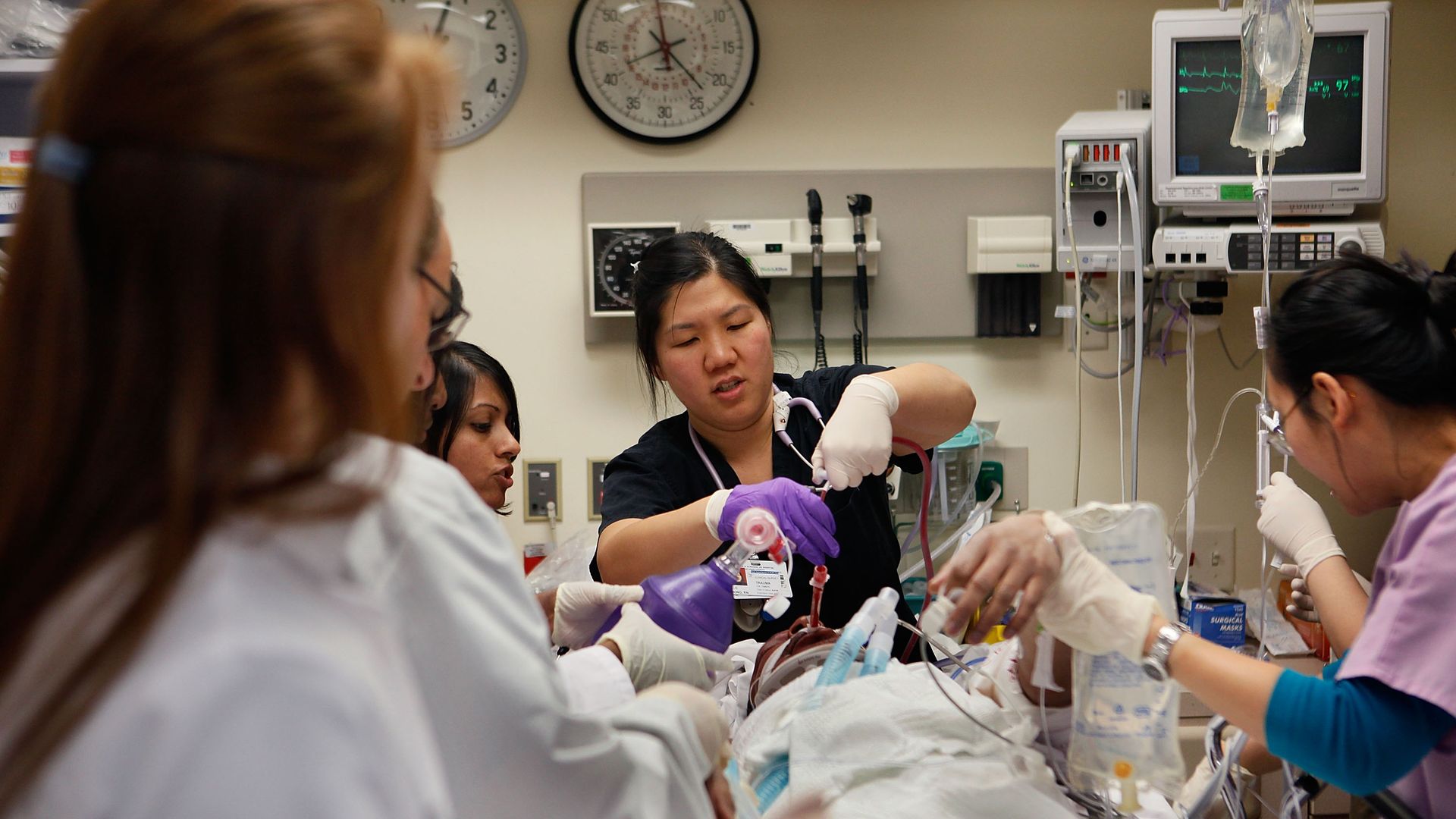
Doctors and nurses treat a patient in a hospital trauma room.

Large hospital systems and trade groups have vociferously criticized Democrats’ “Medicare for All” proposals, but rural facilities and public hospitals that treat mostly low-income patients are sitting on the sidelines of the debate.

Why it matters: Safety nets and many rural hospitals could hypothetically benefit under Medicare for All, but expressing support would put them at odds with their larger brethren.

Between the lines: The Partnership for America’s Health Care Future has become one of the loudest industry-funded voices against Medicare for All.

  • Pharmaceutical companies, health insurers and others are part of PAHCF. But 10 hospital systems and lobbying groups, like Ascension and the American Hospital Association, drive PAHCF.
  • Chip Kahn, the head of the Federation of American Hospitals, said PAHCF was his “brainchild,” according to Modern Healthcare.

Yes, but: Some hospital constituencies aren’t part of the anti-single-payer lobbying.

  • America’s Essential Hospitals, the trade group for safety net hospitals, and the National Rural Health Association, which represents rural hospitals and providers, are not part of PAHCF. They also don’t have official positions on Medicare for All.
  • A spokesperson for AEH said the group recognizes industry peers “have raised reasonable questions” about Medicare for All, but “our focus right now is where our members want it: on stopping the $4 billion cut” to supplemental Medicaid payments.
  • “With specific legislation not moving forward at this time, I don’t see us weighing in anytime soon,” NRHA CEO Alan Morgan said. “I don’t see us at odds. We just haven’t entered the national debate yet.”
  • In an interview, Kahn would not discuss on the record why those two groups were not part of PAHCF.

The big picture: Hospitals that mostly care for poor and uninsured patients could see higher, more stable revenues if everyone had Medicare — a program that often pays higher base rates than Medicaid and infinitely higher rates than nothing at all.

  • Cook County’s public hospital system in Chicago, for instance, gets 79% of its gross patient revenue from the uninsured and Medicaid. That system and multiple other hospitals did not respond to interview requests.
  • Separately, Medicare pays rural “critical access” hospitals 101% of their allowable costs, although those payments have suffered since Congress instituted mandated cuts in 2013.

The intrigue:If you’re trying to solve the problem that we want to get everybody covered and we want to level the playing field between the hospitals that take care of the poor people and hospitals that take care of the rich people, Medicare for All is something we better take a look at,” Eric Dickson, CEO of UMass Memorial Health Care, told Politico.