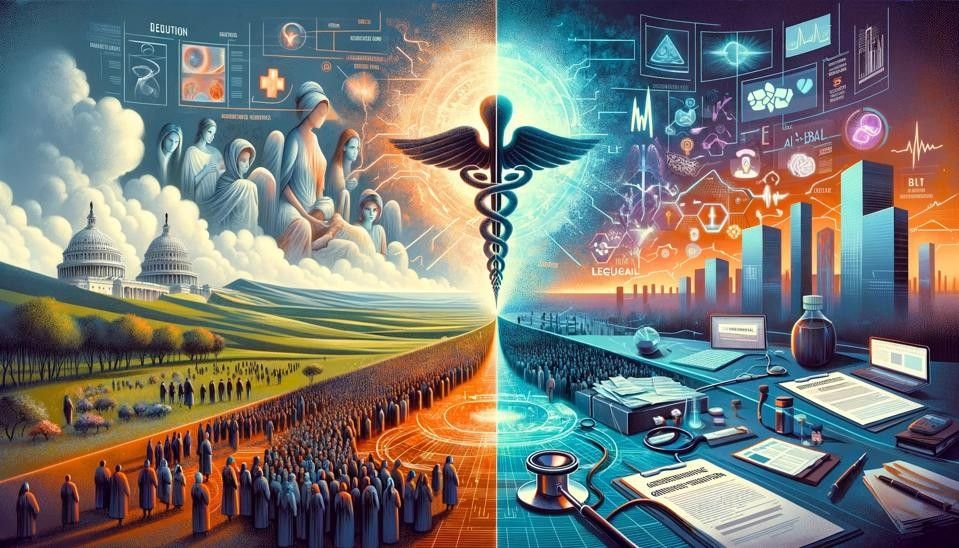
3 huge healthcare battles being fought in 2024

https://www.linkedin.com/pulse/3-huge-healthcare-battles-being-fought-2024-robert-pearl-m-d–aguvc/?trackingId=z4TxTDG7TKq%2BJqfF6Tieug%3D%3D

Three critical healthcare struggles will define the year to come with cutthroat competition and intense disputes being played out in public:

1. A Nation Divided Over Abortion Rights

2. The Generative AI Revolution In Medicine

3. The Tug-Of-War Over Healthcare Pricing American healthcare, much like any battlefield, is fraught with conflict and turmoil. As we navigate 2024, the wars ahead seem destined to intensify before any semblance of peace can be attained. Let me know your thoughts once you read mine.

Modern medicine, for most of its history, has operated within a collegial environment—an industry of civility where physicians, hospitals, pharmaceutical companies and others stayed in their lanes and out of each other’s business.

It used to be that clinicians made patient-centric decisions, drugmakers and hospitals calculated care/treatment costs and added a modest profit, while insurers set rates based on those figures. Businesses and the government, hoping to save a little money, negotiated coverage rates but not at the expense of a favored doctor or hospital. Disputes, if any, were resolved quietly and behind the scenes.

Times have changed as healthcare has taken a 180-degree turn. This year will be characterized by cutthroat competition and intense disputes played out in public. And as the once harmonious world of healthcare braces for battle, three critical struggles take centerstage. Each one promises controversy and profound implications for the future of medicine:

1. A Nation Divided Over Abortion Rights

For nearly 50 years, from the landmark Roe v. Wade decision in 1973 to its overruling by the 2022 Dobbs case, abortion decisions were the province of women and their doctors. This dynamic has changed in nearly half the states.

This spring, the Supreme Court is set to hear another pivotal case, this one on mifepristone, an important drug for medical abortions. The ruling, expected in June, will significantly impact women’s rights and federal regulatory bodies like the FDA.

Traditionally, abortions were surgical procedures. Today, over half of all terminations are medically induced, primarily using a two-drug combination, including mifepristone. Since its approval in 2000, mifepristone has been prescribed to over 5 million women, and it boasts an excellent safety record. But anti-abortion groups, now challenging this method, have proposed stringent legal restrictions: reducing the administration window from 10 to seven weeks post-conception, banning distribution of the drug by mail, and mandating three in-person doctor visits, a burdensome requirement for many. While physicians could still prescribe misoprostol, the second drug in the regimen, its effectiveness alone pales in comparison to the two-drug combo.

Should the Supreme Court overrule and overturn the FDA’s clinical expertise on these matters, abortion activists fear the floodgates will open, inviting new challenges against other established medications like birth control.

In response, several states have fortified abortion rights through ballot initiatives, a trend expected to gain momentum in the November elections. This legislative action underscores a significant public-opinion divide from the Supreme Court’s stance. In fact, a survey published in Nature Human Behavior reveals that 60% of Americans support legal abortion.

Path to resolution: Uncertain. Traditionally, SCOTUS rulings have mirrored public opinion on key social issues, but its deviation on abortion rights has failed to shift public sentiment, setting the stage for an even fiercer clash in years to come. A Supreme Court ruling that renders abortion unconstitutional would contradict the principles outlined in the Dobbs decision, but not all states will enact protective measures. As a result, America’s divide on abortion rights is poised to deepen.

2. The Generative AI Revolution In Medicine

A year after ChatGPT’s release, an arms race in generative AI is reshaping industries from finance to healthcare. Organizations are investing billions to get a technological leg up on the competition, but this budding revolution has sparked widespread concern.

In Hollywood, screenwriters recently emerged victorious from a 150-day strike, partially focused on the threat of AI as a replacement for human workers. In the media realm, prominent organizations like The New York Times, along with a bevy of celebs and influencers, have initiated copyright infringement lawsuits against OpenAI, the developer of ChatGPT.

The healthcare sector faces its own unique battles. Insurers are leveraging AI to speed up and intensify claim denials, prompting providers to counter with AI-assisted appeals.

But beyond corporate skirmishes, the most profound conflict involves the doctor-patient relationship. Physicians, already vexed by patients who self-diagnose with “Dr. Google,” find themselves unsure whether generative AI will be friend or foe. Unlike traditional search engines, GenAI doesn’t just spit out information. It provides nuanced medical insights based on extensive, up-to-date research. Studies suggest that AI can already diagnose and recommend treatments with remarkable accuracy and empathy, surpassing human doctors in ever-more ways.

Path to resolution: Unfolding. While doctors are already taking advantage of AI’s administrative benefits (billing, notetaking and data entry), they’re apprehensive that ChatGPT will lead to errors if used for patient care. In this case, time will heal most concerns and eliminate most fears. Five years from now, with ChatGPT predicted to be 30 times more powerful, generative AI systems will become integral to medical care. Advanced tools, interfacing with wearables and electronic health records, will aid in disease management, diagnosis and chronic-condition monitoring, enhancing clinical outcomes and overall health.

3. The Tug-Of-War Over Healthcare Pricing

From routine doctor visits to complex hospital stays and drug prescriptions, every aspect of U.S. healthcare is getting more expensive. That’s not news to most Americans, half of whom say it is very or somewhat difficult to afford healthcare costs.

But people may be surprised to learn how the pricing wars will play out this year—and how the winners will affect the overall cost of healthcare.

Throughout U.S. healthcare, nurses are striking as doctors are unionizing. After a year of soaring inflation, healthcare supply-chain costs and wage expectations are through the roof. A notable example emerged in California, where a proposed $25 hourly minimum wage for healthcare workers was later retracted by Governor Newsom amid budget constraints.

Financial pressures are increasing. In response, thousands of doctors have sold their medical practices to private equity firms. This trend will continue in 2024 and likely drive up prices, as much as 30% higher for many specialties.

Meanwhile, drug spending will soar in 2024 as weight-loss drugs (costing roughly $12,000 a year) become increasingly available. A groundbreaking sickle cell disease treatment, which uses the controversial CRISPR technology, is projected to cost nearly $3 million upon release.

To help tame runaway prices, the Centers for Medicare & Medicaid Services will reduce out-of-pocket costs for dozens of Part B medications “by $1 to as much as $2,786 per average dose,” according to White House officials. However, the move, one of many price-busting measures under the Inflation Reduction Act, has ignited a series of legal challenges from the pharmaceutical industry.

Big Pharma seeks to delay or overturn legislation that would allow CMS to negotiate prices for 10 of the most expensive outpatient drugs starting in 2026.

Path to resolution: Up to voters. With national healthcare spending expected to leap from $4 trillion to $7 trillion by 2031, the pricing debate will only intensify. The upcoming election will be pivotal in steering the financial strategy for healthcare. A Republican surge could mean tighter controls on Medicare and Medicaid and relaxed insurance regulations, whereas a Democratic sweep could lead to increased taxes, especially on the wealthy. A divided government, however, would stall significant reforms, exacerbating the crisis of unaffordability into 2025.

Is Peace Possible?

American healthcare, much like any battlefield, is fraught with conflict and turmoil. As we navigate 2024, the wars ahead seem destined to intensify before any semblance of peace can be attained.

Yet, amidst the strife, hope glimmers: The rise of ChatGPT and other generative AI technologies holds promise for revolutionizing patient empowerment and systemic efficiency, making healthcare more accessible while mitigating the burden of chronic diseases. The debate over abortion rights, while deeply polarizing, might eventually find resolution in a legislative middle ground that echoes Roe’s protections with some restrictions on how late in pregnancy procedures can be performed.

Unfortunately, some problems need to get worse before they can get better. I predict the affordability of healthcare will be one of them this year. My New Year’s request is not to shoot the messenger.

How generative AI will change the doctor-patient relationship

https://www.linkedin.com/pulse/how-generative-ai-change-doctor-patient-relationship-pearl-m-d-/?trackingId=sNn87WorSt%2BPg3F0SxKUIw%3D%3D

After decades of “doctor knows best,” the traditional physician-patient relationship is on the verge of a monumental shift. Generative AI tools like OpenAI’s ChatGPT, Google’s Bard and Microsoft’s Bing are poised to give people significantly more power and control—not just over their personal lives and professional tasks, but over their own medical health, as well.

As these tools become exponentially smarter, safer and more reliable (an estimated 32 times more powerful in the next five years), everyday Americans will gain access to unparalleled medical expertise—doled out in easily understandable terms, at any time, from any place.

Already, Google’s Med-PaLM 2 has scored an expert-level 86.5% on the U.S. medical license exam while other AI tools have matched the skill and accuracy of average doctors in diagnosing complex medical diseases.

Soon, AI tools will be able to give patients detailed information about their specific medical problems by integrating with health monitors and electronic medical records (such EHR projects are already underway at Oracle/Cerner and Epic). In time, people will be able to self-diagnose and manage their own diseases as accurately and competently as today’s clinicians.

This newfound expertise will shake the very foundation of clinical practice.

Although public health experts have long touted the concept of clinicians and patients working together through shared decision-making, this rarely happens in practice. Generative AI will alter that reality.

Building on part one of this article, which explained why generative AI constitutes a quantum leap ahead of all the tech that came before it, part two provides a blueprint for strengthening the doctor-patient alliance in the era of generative AI.

Patients Today: Sick And Confused

To understand how generative AI will impact the practice of medicine, it’s best to look closer at the current doctor-patient dynamic.

The relationship has undergone significant evolution. In the past century, patients and doctors held close, enduring relationships, built on trust and a deep understanding of the patient’s individual needs. These bonds were characterized by a strong sense of personal connection, as doctors had the time to listen to their patients’ concerns and provided not only medical treatment but also emotional support.

Today, the doctor-patient relationship remains vitally important, but it has undergone several meaningful changes. While medical advancements have greatly expanded the possibilities for diagnosis and treatment, the relationship itself has suffered from less trust and a more transactional focus. The average visit lasts just 15 minutes, barely enough time to address the patient’s current medical concerns. The doctor’s computer and electronic healthcare record systems sit, quite literally, between doctors and patients. The result is that patients feel rushed and find their medical care increasingly impersonal. Modern healthcare is characterized by time constraints, administrative burdens and a focus on efficiency. This can lead to a sense of impersonality and decreased communication between doctors and patients.

But throughout these changes, one thing has remained constant. The doctor-patient relationship, which dates back more than five millennia, has always existed on an uneven playing field, with patients forced to rely almost entirely on doctors to understand their diseases and what to do about them.

Though patients can and do access the internet for a list of possible diagnoses and treatment options, that’s not the same as possessing medical expertise. In fact, sorting through dozens of online sources—often with conflicting, inaccurate, outdated and self-serving information—proves more confusing than clarifying. Nowhere can web-surfers find personalized and credible advice based on their age, medical history, genetic makeup, current medications and laboratory results.

What’s needed now is modern doctor-patient relationship, one that is strong enough to meet the demands of medicine today and restore the vital, personal and emotional connections of the past.    

Patients Tomorrow: Self-Diagnosing And Confident

In the future, generative AI will alter the doctor-patient dynamic by leveling the playing field.

Already, consumer AI tools can equip users with not just knowledge, but expertise. They allow the average person to create artistic masterpieces, produce hit songs and write code with unimagined sophistication. Next generations will offer a similar ability for patients, even those without a background in science or medicine.

Like a digitized second opinion, generative AI will shrink the knowledge gap between doctors and patients in ways that search engines can’t. By accessing millions of medical texts, peer-reviewed journals and scientific articles, ChatGPT will deliver accurate and unbiased medical expertise in layman’s language. And unlike internet sources, generative AI tools don’t have built-in financial incentives or advertising models that might skew responses.

To help patients and doctors navigate the upcoming era of generative AI, here’s a model for the future of medical practice based on proven approaches in education:  

Introducing The ‘Flipped Healthcare’ Model

The “flipped classroom” can be traced back nearly four decades, but it became popularized in the United States in the early 2000s through the Khan Academy in Northern California.

Students begin the learning process by watching videos and engaging with interactive tools online rather than sitting through traditional lectures. This pre-class preparation (or “homework in advance”) allows people to learn at their own pace. Moreover, it enhances classroom discussions, letting teachers and students dive much deeper into topics than they ever could before. Indeed, students spend time in class applying knowledge and collaborating to solve problems—not merely listening and taking notes.  

The introduction of generative AI opens the door to a similar approach in healthcare. Here’s how that might work in practice:

  1. Pre-Consultation Learning: Before visiting a doctor, patients would use generative AI tools to understand their symptoms or medical conditions. This foundational knowledge would accelerate the diagnostic process and enhance patient understanding. Even in the absence of advanced diagnostic testing (X-rays or bloodwork), this pre-consultation phase allows the patient to understand the questions their clinicians will ask and the steps they will take.
  2. In-Depth Human Interactions: With the patient’s knowledge base already established, consultations will dive deep into proactive health strategies and/or long-term chronic-disease management solutions, rather than having to start at square one. This approach maximizes the time patients and clinicians spend together. It also addresses the reality that at least 50% of patients leave the doctor’s office unsure of what they’ve been told.
  3. Home Monitoring: For the 60% of American patients living with chronic diseases, generative AI combined with wearable monitors will provide real-time feedback, thereby optimizing clinical outcomes. These patients, instead of going in for periodic visits (every three to six months), will obtain daily medical analysis and insights. And in cases where generative AI spots trouble (e.g., health data deviates from the doctor’s expectations), the provider will be able to update medications immediately. And when the patient is doing well, physicians can cancel follow-up visits, eliminating wasted time for all.
  4. Hospital At Home: Inpatient (hospital) care accounts for 30% of all healthcare costs. By continuously monitoring patients with medical problems like mild pneumonia and controllable bacterial infections, generative AI (combined with home monitoring devices and telemedicine access) would allow individuals to be treated in the comfort of their home, safely and more affordably than today.
  5. Lifestyle Medicine: Generative AI would support preventive health measures and lifestyle changes, reducing the overall demand for in-person clinical care. Studies confirm that focusing on diet, exercise and recommended screenings can reduce the deadliest complications of chronic disease (heart attack, stroke, cancer) by 30% or more. Decreasing the need for intensive procedures is the best way to make healthcare affordable and address the projected shortage of doctors and nurses in the future.

The Future: Collaborative Care For Superior Outcomes

The U.S. healthcare model often leaves patients feeling frustrated and overwhelmed. Meanwhile, time constraints placed on doctors lead to rushed consultations and misdiagnoses, which cause an estimated 800,000 deaths and disabilities annually.

The “flipped” approach, inspired by the Khan Academy, leverages the patient expertise that generative AI will create. Following this model will free up clinician time to make the most of every visit. Implementing this blueprint will require improvements in AI technology and an evolution of medical culture, but it offers the opportunity to make the doctor-patient relationship more collaborative and create empowered patients who will improve their health.

Talk with educators at the Khan Academy, and they will tell you how their innovative model results in better-educated students. They’ll also tell you how much more satisfied teachers and students are compared to those working in the traditional educational system. The same can be true for American medicine.