


Cartoon – 100% Tax Cut

Consumers frustrated by high costs are bypassing the bureaucracy with patchwork plans.
When their son Sky was born four years ago, Lindsie and Chris Bergevin were hit with a big surprise: $7,000 in bills for the birth that their health plan didn’t cover. Sky was two when the couple jettisoned their medical insurance, which helped them eventually pay off the debt.
Now that they’re ready to have a second child, they’re not going back to their old coverage, with its premiums of more than $350 a month. Instead, they’ve patched together an alternative through a religious group and a primary-care doctor whom they can visit anytime for a monthly fee.
“I was so jaded with the whole health-care insurance situation,” Lindsie, 35, says. “I just didn’t want to deal with it.”
The Bergevins, who rent a snug little house near downtown Boise, Idaho, are joining a small but growing number of Americans rigging their own medical safety nets. They’re frustrated by the high costs, opaque pricing, and maddening bureaucracy of health insurance.
In their quest for a different way, they’re meeting doctors like Julie Gunther who are also fed up. These physicians have opted to reject insurance, instead charging patients directly in return for more personalized care.
“I like to think we can protect people in vulnerable moments where they’re going to get lost like a widget,” Gunther said, “because they’re not a widget for us.”
We Want to Hear Your Insurance Story:
Bloomberg News wants to hear about being uninsured in America in 2018 and what it means to you.
Please click here to tell us your story.
Bloomberg News is following people who are uninsured in a year-long effort to tell the story of Americans struggling to afford the rising costs of health care, and the financial and medical trade-offs they make.
No reliable data exist on how many people are replacing insurance with arrangements like the Bergevins’, but the trend appears to be gaining momentum.
The number of people joining so-called health-care sharing ministries—religion-based cost-sharing plans—rose 74 percent from 2014 to 2016, according to the latest Internal Revenue Service data. An alliance for the groups said that more than 1 million people now participate in such programs. Similarly, primary-care clinics like the one Julie Gunther started in 2014 have grown to almost 900 from just a handful in the early 2000s, according to the Direct Primary Care Coalition, a trade group for the clinics.
The number of people without traditional insurance is expected to increase. The Trump Administration lifted the Affordable Care Act’s penalty for those who go without insurance, while also encouraging the growth of lightly regulated products such as short-term health plans. Proponents of Obamacare fear the administration’s actions will draw healthy people out of the ACA marketplaces, raising costs for those who remain.
Though the ACA expanded coverage to 19 million Americans, some of those gains are reversing. About 28 million remain uninsured. A study by the Kaiser Family Foundation, a health-research nonprofit, determined that most uninsured families simply found health insurance too expensive.
The Bergevins are one of those families.
Lindsie is a freelance graphic designer who focuses on clients in the craft industry. Chris, 34, is a supervisor at the auto shop the Bergevins jointly own with another couple. Though the business is growing, things were tight enough that Chris didn’t draw a salary until last summer. Last year, the couple took home from $40,000 to $50,000, after taxes.
In 2014, when Lindsie was pregnant with Sky, the couple still had coverage through her job at the Idaho Statesman newspaper.
A calculator on her Aetna health plan’s website estimated the Bergevins would need to pay about $3,000 or $4,000 out-of-pocket for Sky’s birth. When the total bill came, the sum for prenatal care, hospital costs, anesthesia, and other care was triple the estimate.
They were still paying off Sky’s birth in 2016 when Lindsie had surgery to remove her tonsils and correct a deviated septum, leaving them with several thousands of dollars more in bills.
She put the sum on a CareCredit medical credit card and is paying $300 each month toward that debt.
As the couple thought more about it, maintaining their coverage made little sense. They were falling deeper into medical debt, despite having insurance which itself cost thousands of dollars a year. In 2016, Lindsie left her newspaper job to devote herself full-time to her thriving freelance design business—and they went uninsured.
“I couldn’t justify it,” she says. The cheapest policy she could find through the Affordable Care Act, she recalls, was $547 a month—more than half the family’s $875 monthly rent at the time. It had a high deductible that could leave them with out-of-pocket costs of more than $10,000.
“If something were to happen to us, we would have been in trouble,” she acknowledges. To hedge, the couple bought an inexpensive accident policy from Aflac that would cover some costs from an injury if, for example, Chris hurt himself working.
A friend told them about a small primary-care clinic called SparkMD less than a mile from their house. The doctors didn’t accept insurance. Instead, they charged a monthly fee of $130 per family. That allowed visits as needed without any limits. When Lindsie went to check it out, a physician began with an in-depth conversation about the family’s health.
“It was amazing. She sat down with me for an hour and talked about everything,” Lindsie says.
Gunther, the Bergevins’ new physician, had long wanted to be a family doctor in her hometown. Working for a large hospital system, though, she was soon chafing under a bureaucracy that seemed to make too many of her clinical decisions for her, down to what tools and equipment she could use. Even worse, Gunther was paid based on her volume of patients and services billed.
She saw patients in 15-minute intervals and says she felt like a factory line worker. She’d later joke that she spent longer waiting in line for her morning coffee than she did with a patient.
“I was saying ‘I’m sorry’ all the time,” Gunther, 42, recalls. “I’m sorry I’m late, I’m sorry this didn’t get called in, I’m sorry this got forgotten, I’m sorry they didn’t give me the message.”
Burned out, she quit her job in 2014 and started her own practice. She borrowed about $200,000 to renovate an old red-brick law office on a leafy corner of downtown Boise, a few blocks from one of the city’s big hospital campuses.
Along with a nurse practitioner and a small office staff, she cares for about 600 patients. A typical primary-care doctor carries at least double or triple that load. More than half of Gunther’s patients have health insurance, often in high-deductible plans. Others are small business owners like the Bergevins. Most are disenchanted with the health-care system.
Last year, Lindsie Bergevin had a bad fever and what she described as “the worst pain I think I ever had in my head.” She called Gunther at 9:30 p.m. on a Saturday. Gunther met her at the clinic 15 minutes later. “She’s like, ‘Girl, you have a double ear infection, and the worst I’ve ever seen.’”
Bergevin walked out with an antibiotic and says that if Gunther hadn’t seen her, she would’ve gone to the emergency room, which could have resulted in a bill for hundreds or thousands of dollars.
Gunther tells her patients that belonging to her practice is not a replacement for having health insurance.
“There’s a whole bunch of things I can’t take care of,” Gunther says. “If you’re not standing upright, or bleeding doesn’t stop, do not call me.”
In April, knowing that they wanted to conceive this year, the Bergevins paid to join a Christian nonprofit called Liberty HealthShare. Organizations like Liberty, sometimes called faith-based plans, help like-minded members share some medical costs. To join, members must pledge to adhere to Christian principles. They are required to make fixed payments each month, and the money is disbursed to cover health-care needs for other families.
Though health-sharing ministries function like insurance in some ways, they aren’t regulated by states, don’t have capital requirements to protect against large losses and don’t have to adhere to rules about minimum benefits. They decline to cover medical expenses that result from behavior they deem immoral. They won’t pay medical costs for a drunk driver in a car crash, for example, or for contraception.
There are other restrictions too: Liberty limits coverage of pre-existing conditions for up to three years, according to its guidelines. Members can also get bounced for “failure to fully disclose known or suspected pre-existing condition information” when they join. Those limits are part of the reason why they’re cheaper—and potentially riskier.
The Bergevins originally expected to pay $450 per month for Liberty. Because Lindsie is overweight, they pay a surcharge of $80 per month—a fee regulated insurers are barred from charging. When they joined, their plan had an “annual unshared amount”—the equivalent of a deductible—of $1,500. Two months later, they learned that amount would increase to $2,250. Lindsie wasn’t thrilled, but she calls it “a ton cheaper than a typical deductible.” And on the plus side, Liberty would reimburse them for some of the cost of membership in SparkMD.
In early June, Lindsie sat at her kitchen table with a stack of medical bills going back four years. Sky ran in from the living room, where Dr. Seuss cartoons played on the TV, looking for dessert before he finished his dinner.
The Bergevins’ improvised plan has pros and cons. They didn’t have to pay premiums for almost two years while they were uninsured, easing their finances significantly while their businesses grew. They love the personalized care they get from Gunther. And their costs for having another child should be capped at a lower level under the Liberty plan.
But between Liberty and SparkMD, the Bergevins pay more than they did for health coverage through Lindsie’s old job, and, she estimates, about as much as Obamacare insurance would cost. The family is still exposed to considerable risk. Liberty caps reimbursements at $1 million—a limit that insurance companies can’t impose. They have two friends who have had cancer, and, Chris says, “a million’s definitely not enough.”
The Bergevins have their fingers crossed that their choices will allow them to expand their family without incurring the kind of debt that Sky’s birth and Lindsie’s surgery left them with. But they know their improvised approach isn’t for everyone.
“It’s not like I’m trying to say, just go without insurance,” Lindsie says. “You have to find something that’s going to work for you.”

We spend many billions of dollars each year on the discovery and development of new drugs, but almost none of it addresses two crucial questions: How do these new therapies compare with already known ones? What are the relative benefits and harms in a particular situation, for a person like you?
Such questions can best be answered by comparative effectiveness research.
To get approval from the Food and Drug Administration, drugs must be proved both effective and safe. The costs of doing this are significant, and they are most often borne by the pharmaceutical industry.
But the F.D.A.’s bar, while meaningful, often isn’t very useful for what physicians and patients really care about every day: how effective and safe drugs are compared with one another.
Consider antibiotics. In my work as a pediatrician, questions about their use come up a lot. Which drug is the best first-line therapy for which common illnesses? We don’t know. How long should we treat for different infections? We don’t know. What are the relative trade-offs between benefits and side effects in different patients in different circumstances? We don’t know.
The questions we need answered are legion. All the guidelines and practices we have are best guesses.
Comparative effectiveness research can take on many forms and involve more than drugs.
Because of a trial published in The American Journal of Preventive Medicine, we know that an intensive lifestyle intervention works better than metformin to promote weight loss.
A study published in JAMA Pediatrics last year showed that adding individual health coaching to enhanced primary care reduced pediatric obesity, but no more than enhanced primary care alone.
A comparison of different levels of insurance published in The New England Journal of Medicine showed that enhanced drug insurance coverage led to increased medication adherence, lower patient spending and lower rates for a first major vascular event (like a heart attack or stroke), with no increased overall health care spending.
We know that high blood pressure is both terribly prevalent and a significant risk factor for cardiovascular disease. We also know that there are a lot of drugs out there, all F.D.A.-approved, that can help reduce this risk by better controlling blood pressure. But which is best?
This question isn’t new. In 2002, the results of the Antihypertensive and Lipid-Lowering Treatment to Prevent Heart Attack Trial — a comparative effectiveness trial — were published in JAMA.
Participants had to be at least 55, have hypertension and have at least one other risk factor for coronary heart disease. They were randomly assigned to take one of four drugs, each with an entirely different mechanism, representing a different class of drugs.
Chlorthalidone is a diuretic, or a drug that increases urine output. Amlodipine, a calcium channel blocker, causes blood vessels to relax and widen, and lowers the heart rate. Doxazosin does the same by blocking the effects of adrenaline on muscles throughout the body. Lisinopril blocks the enzyme angiotensin, which tightens blood vessels, leading to lower blood pressure. All the patients were tracked for four to eight years.

Four years after going out on a limb to get Medicaid expansion enacted in Ohio, outgoing Republican Gov. John Kasich is worried about the future of the program. So he is now defending it — through a study and through the stories of people who have benefited from the coverage expansion.
One of those people is Brenda Jean Searcy, a 55-year-old law student who lives with her 93-year-old father in the Columbus suburb of Westerville. She says she had always been healthy but was felled by Lyme disease and then Graves’ disease; the diagnosis of the latter came after she had signed up for Medicaid through the expansion.
“I am very grateful to have Medicaid. It has made my life much better and made me much healthier,” Searcy says at a press conference.
Searcy is one of the 653,000 Ohioans who gained coverage through the Medicaid expansion, four years after Kasich defied his fellow Republican legislators in pushing Medicaid expansion through.
He claimed it would bring $13 billion in federal funding to help low-income people in Ohio get health care — especially those struggling with mental illness and addiction. Kasich is nearing the end of his second term and will leave office in January. He wants the Medicaid expansion to continue, and his Medicaid department commissioned an independent study on the effects of the expansion to support it.
Ohio Medicaid Director Barbara Sears says the analysis shows Medicaid expansion has cut in half the number of uninsured Ohioans. Ninety-six percent of people in the program with opioid addiction got treatment, and 37 percent of smokers were able to quit. One-third reported improved health, including better access to medical care for high blood pressure and diabetes. ER visits went down 17 percent, and there was a 10 percent increase in the number of people seeing primary care doctors. And most recipients said Medicaid expansion made it easier to find work, earn more money and care for their families.
The state’s budget office, part of the executive branch, estimates Medicaid expansion will cost nearly $5.2 billion in 2021, the first year Ohio will pay its full share of the costs as determined by the Affordable Care Act.
Ohio budget director Tim Keen says the state’s projected share would amount to $354.1 million. However, with drug rebates, assessments on managed care plans, a 1 percent tax on premiums and other offsets, the state’s share drops to $163.1 million. “Medicaid expansion is a significantly better deal for the states and for Ohio than the traditional program, and that’s important as one considers our ability to fund this program,” Keen says.
But Republican lawmakers have long had concerns about the program’s cost.
And so does the Republican candidate to replace Kasich, Attorney General Mike DeWine. After stating for months that he feels the Medicaid expansion is financially unsustainable, DeWine says he’ll keep it but makes changes, such as implementing work requirements and wellness programs. DeWine hasn’t made clear how much those changes would save the program – for instance, 96 percent of Medicaid expansion recipients in Ohio would be exempt from work requirements.
Kasich says he has talked to DeWine’s team about supporting the program. “I worry a little bit about somebody kind of nickeling and diming it away somehow — a little bit here, a little bit there — but I think they’ll be for it,”

John McCain died of brain cancer on August 25, 2018.
Newt Gingrich shared a surprising story about McCain.
Standing with:
Gingrich writes, “One of my most personal encounters with John was in 1986 when I was in a very intense fight with the House Democratic leadership. Two physically large House Democrats came over and said they were sick and tired of what I was doing and I ought to know there would be a payback. One of them said, ‘We are coming for you.’
I had not realized that McCain had calmly come over to stand next to me. When the Democrat sounded threatening, John instinctively stepped closer to me and said, ‘When you come for Newt, come for me too, the name’s McCain.’”
McCain was a first term congressman when this happened.
Theatrics:
You might be tempted to attribute McCain’s behavior to political theatrics. I heard people say that McCain understood and leveraged political theatrics. But when you know that he refused early release in the late 1960’s from the Hanoi Hilton to stand with his fellow POW’s, you realize that McCain knows how to stand with people.
Cost:
It costs a leader to stand with others. It’s so costly that some leaders hang team members out to dry when they screw up.
You probably know what it’s like to drive a stake in the ground beside a team member only to have him casually drive a stake in your back. It might have been ignorance on their part. It may have been malice, but the pain is the same.
Advantage:
There IS advantage to standing with others when it seems there’s only disadvantage. Frankly, that’s the time it matters most.
You earn trust when you stand with others.
How might you stand with others today?
https://www.leadershipnow.com/leadingblog/2018/08/engagement_isnt_built_its_unco.html
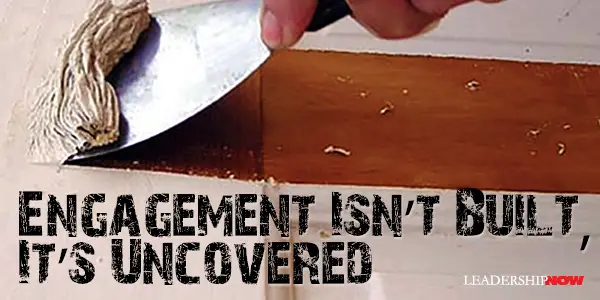
But over the years, depending on our upbringing, our schooling, and our work, our desire to engage gets suppressed. It gets covered up.
Our job as leaders is to uncover and rekindle that child-like desire to engage with others and our environment. We can’t create engagement, but we can uncover it.
I was reading a remarkable little book written for teachers by retired professor Calvin Luther Martin entitled, Successful College Teaching Begins with Throwing Away Your Lecture Notes. We can learn a lot here because teaching, like leading, is about serving others while achieving a result. Indeed, teaching is a function of leading.
We teach much more than our subject matter; we teach trust or distrust, courtesy or discourtesy, warmth or coldness—the lessons between the lines.
The people we lead are not coming to us from our perspective. They have their own that has been years on the making.
Bear in mind that you are teaching young men and women with an educational past that has shaped them.
We bring our whole selves to work. Our hope, our scars, our dreams, our fears, our expectations, and our assumptions. Our childhood sense of wonder has been abused. It’s there, but it is cautious. We are conditioned to want to be right more than we want to be accurate.
Behold the class before you. They are not blank slates, nor are they ignorant. There is plenty written on those slates and your task is to rewrite much of that text—if they will trust you and if your good enough to get that close to them. They sit before you, thoroughly trained (brainwashed might be a better word) in ways of pedagogy that will determine how they hear you, what they hear and cannot hear, and how they will absorb what you say.
We are not leading another version of us. We are leading a human being similar in form but different in substance.
These people come to you with layers of expectations that have been created starting in the first grade. Like an old kitchen countertop, they have been painted over and over. The oak, cherry, or maple cabinet beneath is smothered by an amour of paint. It’s a bland countertop now. The fine wood underneath is unknown; it’s merely a rigid structure useful for covering with paint and, after that, supporting pots and pans.
Thirty countertops, each covered with a dozen coats of paint, file into your room, take a seat, and open their spiral-bound notebooks. They’re ready for yet another coat of paint, Professor Martin. They know the drill; go ahead, start brushing it on.
The sorrow of this parable is that they expect it. They actually expect you to drone on, giving them fact after fact while they fill their notebook and worry about memorizing all this information.
Surprise them; don’t do it.
A leader has to peel off the old paint and get to that desire to engage that has been unwittingly covered over. We have to uncover the desire to engage. The desire to learn. The desire to connect.
The tendency is to be instructing. We do need to instruct but it needs to be part of a larger, coherent story that people can feel a part of.
We are wired to engage. It’s already within us. Our task as leaders is to uncover what is already there.
Martin explains that to teach or to lead “is to give a concert, to perform a beautiful, passionate concerto which everyone in the audience yearns to play, improvise on, and even improve.”
We don’t build engagement, we uncover it.
Uncover engagement in your organization




 HENRY KOTULA