


Cartoon – This Makes Me Sick


Strong balance sheets and capable leadership continue to lead the way for stable success.
M&A activity has bolstered the financial standing and credit ratings of not-for-profit health systems.
Not-for-profit systems are outnumbering stand-alone hospitals through increased M&A activity.
Stand-alone hospitals experienced their second consecutive year of negative outlooks.
Not-for-profit health systems and stand-alone hospitals have maintained generally favorable bond ratings due in large part to strong balance sheets, despite the continual decline in operating margins and cash flows.
S&P Global Ratings released research this week on the financial status of not-for-profit health systems and stand-alone hospitals in 2017.
The sector remained consistent in several year-to-year, such as improving days’ cash-on-hand levels and marginal reduction in debt levels, though the study found that the underlying pressures on not-for-profits are beginning to take their toll. The operating margin for the sector declined from 2.4% in 2016 to 1.8% in 2017.
S&P also noted that not-for-profit health systems continue to outnumber stand-alone hospitals and received stronger overall ratings from the agency.
S&P said a major factor that allowed health systems and hospitals to weather financial challenges last year was the combination of strong balance sheets and leadership.
S&P analysts said that stand-alone hospitals featured stronger medians than systems but found they are weakening. This is due to softer patient volumes, a weakening payor mix combined with increased pressure from commercial payors, and labor expenses.

Franklin, Tenn.-based Community Health Systems has received a civil investigative demand related to the company’s adoption of EHRs and adherence to the meaningful use program, according to CHS’ latest financial filing.
Under the meaningful use program, now called the promoting interoperability program, CMS distributed incentive payments to eligible providers for installing EHR systems and using them to engage patients and families and to improve care coordination.
In its financial filing, CHS said it is responding to a civil investigative demand related to its “adoption of electronic health records technology and the meaningful use program.”
Federal and state authorities issue these types of demands to collect records and information related to ongoing civil investigations, including False Claims Act cases.
CHS declined to comment on the investigative demand beyond what is included in the financial filing.
EHR incentive payments grabbed the attention of federal regulators after HHS’ Office of Inspector General released a report in 2017 that revealed Medicare made approximately $729.4 million in EHR incentive payments to medical providers who did not comply with federal requirements.
http://www.thefiscaltimes.com/2018/08/10/Health-Care-Industry-Gears-Fight-Medicare-All

In anticipation of a “blue wave” election that brings more Democrats to Congress, the insurance and drug industries are gearing up to push back on the idea of a single-payer health care system.
The Hill’s Peter Sullivan reports that health-care industry forces have teamed up to form the Partnership for America’s Health Care Future, “which lobbyists say could run advertisements against single-payer plans and promote studies to undermine the idea.” The health care groups in the partnership, formed in June, include America’s Health Insurance Plans (AHIP), the Pharmaceutical Research and Manufacturers of America (PhRMA), the American Medical Association and the Federation of American Hospitals.
The idea of a single-payer or “Medicare for all” health-care system has gained momentum among Democrats, even as significant questions remain about how such a massive overhaul might be implemented and how to pay for it. “Industry groups are worried that support for single-payer is quickly becoming the default position among Democrats, and they want to push back and strengthen ties to more centrist members of the party to promote alternatives,” Sullivan writes.
The groups’ concern is more about the prospects of a Democratic single-payer platform in 2020, given that a host of the party’s potential presidential candidates have backed Bernie Sanders’ “Medicare for all” bill. “Every one of those organizations that’s in that group will look at Bernie Sanders’s single-payer and see massive losses of money,” John McDonough, a former Democratic Senate staffer who worked on the Affordable Care Act and is now at Harvard’s T.H. Chan School of Public Health, told The Hill.
The industry’s budding campaign could pose a formidable political and public relations challenge to proponents of a single-payer system. “Leaving aside whether single payer is good policy or not,” the Kaiser Family Foundation’s Larry Levitt tweeted, “it seems like the idea is going to eventually need some powerful institutional allies from somewhere to advance.”
https://www.jacobinmag.com/2018/03/west-virginia-teachers-strike-medicare-for-all

West Virginia teachers are engaged in an inspiring illegal strike. They’re also showing why we desperately need Medicare for All.
As the Supreme Court considers the Janus v. AFSCME case this very week — posing an existential threat to public sector unions throughout the country — labor movement activists should be watching the West Virginia teachers’ strike closely. The coincidence of the two events seems almost scripted: as Janus promises to gut the legal framework for public sector worker organizing, West Virginia teachers are militantly flouting the law.
Many in the labor movement contend that this level of rank-and-file engagement is the key to surviving right to work. The question is, how does a militant mood in a workforce like West Virginia’s teachers come into being? Finding the answer in this case requires paying attention the central demand that caused workers to defy union leadership and embark on one of the largest wildcat strikes in recent American history: adequate health care.
Three days prior to the building occupation, the West Virginia governor’s office announced that it had reached a deal with the state teachers’ union leadership. The agreed-upon 5 percent raise for teachers and 3 percent for all public employees was supposed to mark the end of the statewide teachers’ strike. The state had already seen four days of school closures in all fifty-five counties, the result of a work stoppage involving twenty thousand teachers.
But the teachers weren’t satisfied with the deal. At the meeting where it was announced, they began to chant, “Back to the table!” and “We are the union bosses!” According to the agreement, the teachers were supposed to return to work on Thursday, but by Wednesday night all fifty-five counties were again reporting school closures. The strike was still on.
The primary source of striking teachers’ dissatisfaction is the state’s meager offering of a “task force” to fix the Public Employees Insurance Agency (PEIA), West Virginia’s health insurance program for public employees. Tax cuts have resulted in changes to the insurance plan, sending co-pays and out-of-pocket expenses through the roof as teacher pay remains among the lowest in the country. One projection shows premiums under PEIA rising as much as 11 percent per year starting in 2020.
“This has been a huge issue, causing problems for years,” said one striking teacher. “They’ve been cutting our health insurance over and over, making it really expensive to survive.” Throughout the strike teachers held signs that read “Will teach for insurance” and “I’d take a bullet for your child but PEIA won’t cover it.”
According to the strikers, the 5 percent raise offered won’t reverse the damage that rising health care costs have done to West Virginia public employees’ ability to make ends meet. Explaining why she chose to remain on strike, one teacher said, “The number one thing was we needed a permanent fix to PEIA. It wasn’t about the money at all. It was about the insurance fix.”
Health care touches a nerve, one so tender that twenty thousand teachers are willing to defy their union leadership to try to force the state government to fulfill their health care demands (unlawfully, no less). This is one reason many socialists and left-wing labor activists are advocating a movement-wide focus on single-payer health care, or Medicare for All.
It’s no surprise that health care is the crux of the most combative domestic labor upsurge in years. In a poll last summer, Americans said they regarded health care as far and away the biggest challenge facing the nation.
Working-class people are watching their paychecks disappear as they shoulder an increasing share of rising health insurance costs. We live in a country where nearly half of the money raised through crowdfunding websites goes toward medical expenses, where drug costs can increase 5,000 percent overnight, where having premature twins can obliterate the entire savings of a family with insurance, and where medical debt is the number one cause of personal bankruptcy. On top of all that, we have alarmingly deficient care compared to nations with comparable resources.
It’s in this context that single-payer health care, until recently considered anathema in US politics, has garnered the support of the majority of Americans.
Workers are deeply invested in health care — not for abstract reasons, but because rising costs and confusing, extractive, punitive insurance bureaucracies are making their lives harder, with sometimes fatal consequences. The fact that health care is a pressure point for workers is reason enough to take health care seriously as a primary terrain of class conflict to fight on right now.
Labor will need many more West Virginias to climb out of the ditch it’s in, and health care has an important role to play in the task of rebuilding the movement. Socialists see building a sense of class consciousness — a working class that identifies as such, knows it’s exploited by capitalists, and is united in struggle — as a necessary condition for the labor movement’s success. To that end, socialist labor strategists have proposed that unions focus on demands that benefit the entire working class, not just this or that individual union’s members.
The idea is that focusing only on narrow wins for specific groups of workers actually atomizes the class, heightening competition rather than solidarity — and resulting in a cautious, transactional union bureaucracy leading a disengaged, depoliticized membership. It also ensures that victories are temporary; without challenging capitalist power beyond the bargaining table, any gains made will be rolled back in no time.
What socialists want instead is a labor movement that advocates for ambitious policies that build worker power across society, not just for workers in a particular shop or trade. Adolph Reed Jr and Mark Dudzic call this a social-unionist orientation, observing that:
Many unions are beginning to redefine their battles against voracious profiteers and privatizers not as defensive struggles to preserve rights, privileges, benefits and conditions already lost by most of the working class, but as far reaching campaigns for the public good, and they are sinking resources into building the kind of alliances necessary to win.
Some ambitious examples of this type of unionism are offered by Sam Gindin, who calls it by its more common term, social-movement unionism:
Autoworkers could push to rejigger their workplaces so they could make the goods needed to confront the ecological crisis. Steelworkers could fight for the renovation and expansion of public infrastructure. Construction workers could demand public housing and the green retrofitting of existing housing stock.
At this particular moment, health care has an exceptional power to galvanize workers. The issue is urgent and personal; as we’re seeing in West Virginia, it inspires people to fight tooth and nail. Plus its appeal isn’t limited to particular industries — every worker needs health care, and every worker is getting squeezed.
What if unions carried out their own contract campaigns for better health care alongside a collective, movement-wide campaign for federal single-payer health care? This effort would satisfy two conditions at once: tapping into working people’s organic desire to challenge the current capitalist health care regime, and bringing individual union struggles into contact with broader movements to build power for the entire working class.
This idea is already gaining steam. A growing number of locals and internationals have endorsed the Labor Campaign for Single Payer, which maintains that labor must lead the charge in fighting for universal, decommodified health insurance. National Nurses United in particular have stepped to the fore, campaigning for “an improved Medicare-for-All system where everyone — rich or poor, young or old — has access to the same standard of safe medical care.” We need many more unions to follow their lead.
We won’t destroy the private health insurance industry and replace it with a democratically administered, wholly decommodified alternative that generates profit for no one without mobilizing millions of working-class people: nurses and teachers, cashiers and secretaries, anyone who’s ever had a medical debt-collection company breathing down her neck. As it happens, the kinds of mass organizing and diverse coalitions and rhetorical strategies that will be required to win single payer are also the ones required to rebuild a class-conscious workers’ movement.
Committing to an ambitious, universal campaign like Medicare for All is committing to society-wide class struggle, which is exactly what we’ll need to revitalize our imperiled unions — and to effectively challenge capital in arenas besides health care.
Fighting for single-payer health care will do the labor movement good, but so will winning it. Unions currently spend a lot of their time and resources fighting to protect their members from the vagaries of the profit-driven American health care system. In West Virginia, they’re responding to the fact that political elites (including, as Cathy Kunkel explained earlier this week, the state’s Democratic Party) are standing with business elites and passing on the costs of austerity to teachers in the form of rising health insurance costs.
The fact that we don’t have universal public health insurance plays to employers’ advantage: it puts unions on the defensive, constantly negotiating to keep workers from falling into the shark-infested waters of the private health insurance industry. By taxing the rich to pay for health care for everyone, we can empower organized labor to make more radical demands focused on workplace democracy.
Plus right now, individual workers usually have to worry about losing their health insurance when they lose their job. When that threat disappears, they’ll be much more willing to fight the boss. Under the right circumstances, the dire health insurance situation and the high stakes that accompany it can make people brave and ferocious, as we see in West Virginia. But more often they make workers guarded, afraid of rocking the boat, and easier to control. Winning single payer takes a powerful bargaining chip away from employers and deposits it directly into workers’ pockets.
Medicare for All is popular, universal, and social. The task for the Left and labor is to take the West Virginia fight national, to unite the teachers in Appalachia with nurses in California and to connect the demand for single-payer health care to the tactics of working-class militancy.
It’s to place this fight in the broader context of capitalist exploitation and domination, and articulate an alternative: a health care system that works for workers, driven by the needs of the many instead of the profits of the few.
https://www.thenation.com/article/how-medicare-was-won/
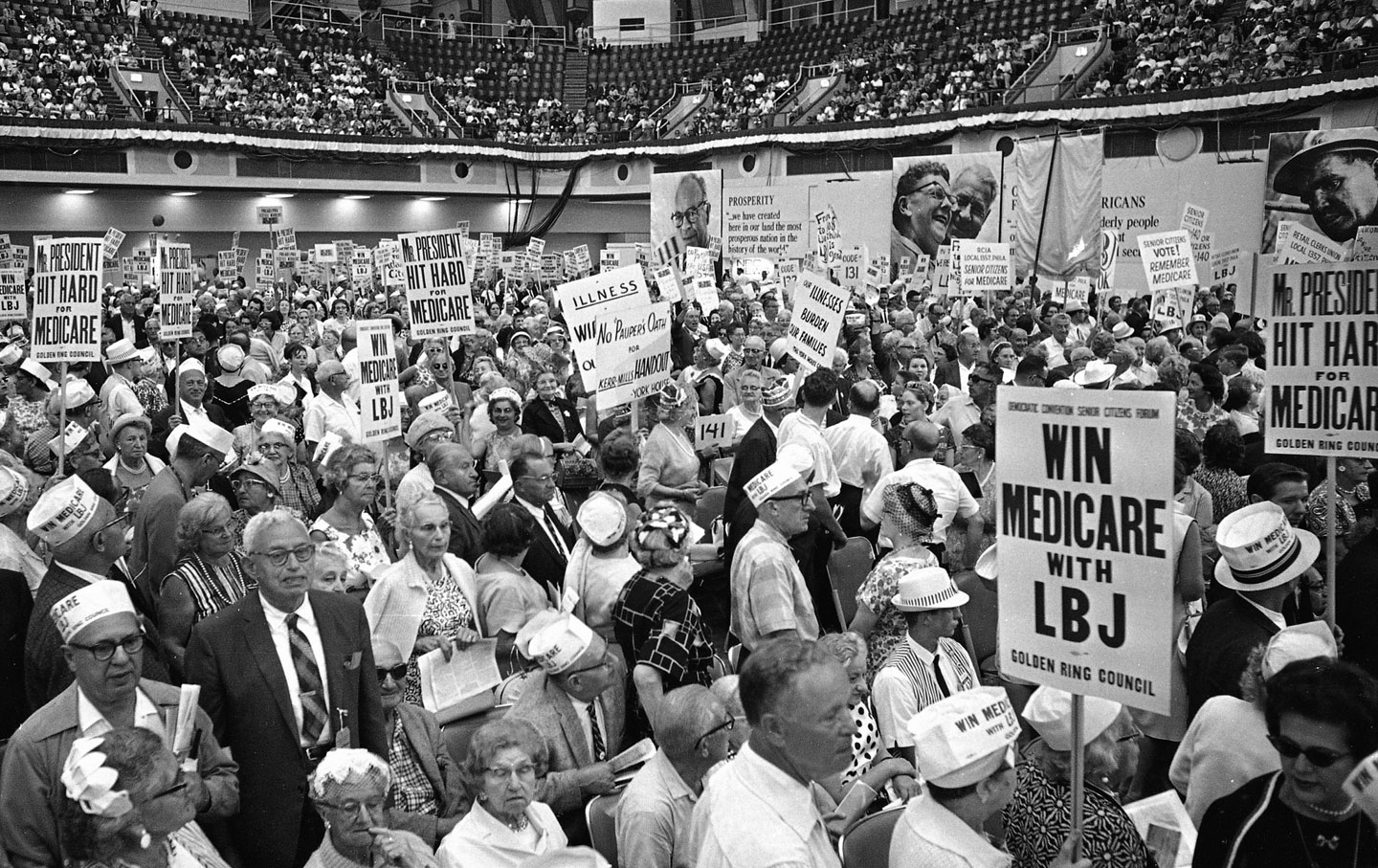
In August of 1964, 14,000 retirees arrived by the busload in Atlantic City. Representing the National Council of Senior Citizens (NCSC), the former railroad workers, dressmakers, and auto assemblers marched 10 blocks up the fabled New Jersey boardwalk to the Democratic National Convention at the Convention Hall. The group, which was organized and bankrolled by the AFL-CIO, moved en masse in floral housecoats and sandwich boards with slogans like “Our Illnesses Burden Our Families” and “Senior Citizens Vote, Remember Medicare.” They intended to push President Johnson to extend public health insurance to millions of Americans.
Astonishingly, less than a year later, they won. Medicare was signed into law in July of 1965 in Independence, Missouri, at a ceremony attended by former president Harry S. Truman, whose push for national health insurance (NHI) had collapsed nearly two decades before. The landmark law created a public-sector insurance pool for Americans 65 and over, which remains today the closest thing to a robust universal entitlement in the US health-care system. Its successful passage (which also passed Medicaid, to insure the very poor) stands in sharp contrast to multiple failed efforts to install a universal single-payer system.
A half-century later, we’re witnessing the early stages of yet another popular thrust toward single payer, increasingly billed as “Medicare for All.” The nomenclature intends to evoke associations with the popular, trusted program, and is perhaps easier for Americans to latch onto than a phraseology that threatens to trigger a tedious lesson in comparative health policy. But if the conceptual jump from Medicare to Medicare for All can serve as a rough model for achieving universal health care in the United States, we should also look to the history of the social movements that achieved something that then, too, seemed impossible.
No one imagines expanding Medicare to all Americans will be easy. Nothing quite like this has ever been accomplished in the United States. Yes, dozens of peer countries have built coherent, humane, universal health-care systems out of entrenched private ones. Yes, mass movements have won major leftist reforms. Yes, advanced private industries of various nations have been nationalized. But human history offers no examples of these things happening in combination, which is what winning Medicare for All will require.
The most viable push toward NHI in American history crumbled in the late 1940s, ruthlessly crushed by not only insurers and pharmaceutical companies but also the American Medical Association. (Physicians, whose already handsome salaries began to rise in the postwar era, feared the blow that NHI could strike to their paychecks, professional prestige, and autonomy, since a government payer would also reduce their control over prices.) As such, the AMA famously shook down its membership for $25 apiece to fund the multimillion-dollar campaign that injected the phrase “socialized medicine” into mainstream American culture.
In this context, it’s perhaps tempting to view Medicare as a capitulation to industry pressure and political challenges, rather than as evidence they can be flouted. After all, Medicare (and, for that matter, Medicaid) targeted the most vulnerable patients. Many single-payer skeptics insist that Medicare managed to pass because it covered the people private insurance left behind. In his book Harry S. Truman Versus the Medical Lobby: The Genesis of Medicare, historian Monte Poen presents Medicare as a sort of compromise between the unfettered free market and the dashed dreams of the 1940s.
While it’s true that the enactment of Medicare didn’t pose nearly the threat to certain health-care-industry stakeholders that the NHI did or that Medicare for All would, it would be a mistake to fully dismiss its applicability to the current political fight. For one thing, the common talking point that Medicare extended insurance to a population who didn’t have it, rather than squashing existing private infrastructure, doesn’t bear out. A full half of elderly Americans did have private insurance plans when Medicare was signed into law. Commercial health insurers initially opposed the program, and began to support it only when it became clear a large administrative role would be preserved for for-profit insurers.
More importantly, while insurance companies certainly fought against health-care-financing reforms, physicians associations and hospitals are typically considered to have been the more significant opponents—they believed Medicare to be a likely conduit for eventual full-scale single payer (and all the government interference they assumed would come with it), and struck back with more or less the same zeal that they mustered decades earlier. As historian Jill Quadagno puts it, the AMA fought Medicare with “every propaganda tactic it had employed during the Truman era.” Such tactics included a widespread media blitz, advertising in doctors’ offices, and visits to congressmen from physicians in their districts. One tactic, called “Operation Coffee Cup,” deputized physicians’ wives to host ladies’ gatherings, at which they’d play their guests an anti-Medicare PSA starring actor Ronald Reagan.
This time, the AMA and its allies failed, but not for lack of trying. So it’s unfair to ascribe Medicare’s triumph to a lack of industry resistance, which was actually quite strong. The more crucial variable distinguishing Medicare from the NHI battles that fizzled before and since was a mass movement of people demanding it, having coalesced at a moment when powerful liberatory struggles against white supremacy and poverty had transformed what could be deemed politically possible.
Organized labor went all-in for Medicare, which took substantial pressure off unions for their retirees’ mounting health-care costs. Their enthusiasm contrasted with their relationship with universal initiatives before and since, despite their largely supporting most on paper. The reasons for labor’s tepid support for single payer have been debated by historians: For one thing, the unions’ success at collectively bargaining for employer-provided health benefits during the Truman-era reform battles perhaps reduced their motivation to prioritize national health-care solutions, the ongoing absence of which almost certainly highlighted the advantage of union membership. Since the 1970s, ever-rising health-care costs strengthened the case that labor’s interests would be served by removing health-care benefits from tense contract negotiations, but declining labor power during America’s rightward political shift tied them to a Democratic Party establishment unwilling to back single payer during the health-care debates of the 1970s and ’90s.
Today, with a slim majority of congressional Democrats vocally warming up to Medicare for All, and the ACA’s so-called “Cadillac Tax” poised to hit hard-won union-bargained health plans, the pro-labor case for single payer has never been more obvious. Indeed, each of the high-profile wildcat teachers’ strikes widely cited health-care benefits as a central demand. While the AFL-CIO has endorsed single payer, the question of whether workers will rally around Medicare for All they way they did for its namesake could well depend on how the movement’s stakeholders deal with those who stand to be displaced by the streamlining effect of large-scale reform.
But beyond institutional heft or the weight of its endorsements, the most impactful contribution organized labor made to the Medicare fight was a committed army of thousands of boots on the ground, many of them seniors who stood to benefit from the legislation or the family members who worried about how they’d care for them. Even the most precursory survey of 20th-century universal-health-care movements makes their most egregious failure stunningly obvious: They were nearly all top-down operations practically devoid of participation of ordinary people intent on changing the status quo.
By the time the NCSC marched in Atlantic City, this movement was already years in the making. It had been building momentum for the idea that would become Medicare in the 1950s, under a Republican president who, in is 1954 State of the Union address, had affirmed he was “flatly opposed to the socialization of medicine.” Rather than standing by waiting for better electoral luck, the Medicare movement fought to make theirs a winning campaign issue that would help to elect Democrats, not the other way around.
For years, the NCSC spearheaded letter-writing campaigns targeting media outlets and elected officials, and did any media outreach it could. It churned out brochures to counter the messaging of the powerful medical lobby, printing and distributing millions of pamphlets and fliers. As Blue Carstenson, then head of the NCSC, recounted later, “We had to make it a cause and we made it a cause…. We charged the atmosphere like a campaign…. We were always jammed in there and there was a hustle and bustle atmosphere. And when reporters came over they were always impressed by telephones ringing and the wild confusion and this little bitty outfit here that was tackling the whole AMA in a little apartment on Capitol Hill…. This was news. It used to make every reporter chuckle or smile.”
So too did the NCSC learn to push the buttons of electoral politics: It organized groups to testify before Congress about insurance premiums, which rose as much as 35 percent some years, like some ACA marketplace plans. And of course, Carstenson’s formidable elderly army turned out to campaign events. When Democrat George Smathers declined to support Medicare before the 1964 election, NCSC members organized town-hall meetings throughout the state—including one in Fort Lauderdale that was allegedly so successful that the organizers had to upgrade to a bigger venue three different times. Their message made appeals to all ages: Relief for seniors’ medical costs, they argued, will also reduce financial pressure on their working-age children, who’d in turn have more room in the budget to raise their own kids.
If the participants in today’s movement for Medicare for All intend to succeed, they must preempt the imminent counterattack of a health-care industry with far more fortunes at stake than the one their counterparts vanquished in 1965. This will require a mass mobilization of people making themselves seen and heard, whose demands for universal public insurance must reach a fever pitch to force candidates and current officials to capitulate. Doing so will demand a broad variety of tactics, including direct action, canvassing, printed materials, and public events, geared toward not only persuading regular voters but also inspiring new ones.
Finally, this vision of justice must extend beyond the realm of health care alone. It is nearly impossible to imagine Medicare passing outside the political context set forth by the civil-rights movement, and the so-called War on Poverty. These years-long mobilizations of oppressed people had forced the political reckoning that fostered large-scale reform. It is no coincidence that the New Deal and the Great Society—however short they may have fallen—came about in large bursts rather than undetectable spurts.
Paradigm-shifting reforms have been delivered by broad coalitions confronting a common enemy. It’s up to advocates to compel people living under the US health-care system to see themselves and one another as part of a single constituency, from the poorest uninsured to those saddled with punishing paperwork, office staff chained to bad jobs for benefits, providers-turned-pawns of corporate conglomerates, and expectant mothers bracing themselves for exorbitant out-of-pocket costs atop weeks of unpaid maternity leave. And it must be done in solidarity with struggles on behalf of all oppressed Americans—people of color, the unhoused, the disabled, and others—whose subjugation benefits the very moneyed interests who’d prefer to keep things as they are.
All the evidence tells us that robust universal programs build solidarity, and create an impassioned base that enthusiastically defends them. Once Medicare for All is in place we can expect the same. Until then, it’s up to advocates to compel as many people as possible to envision the radically different society that stands to inherit it—and to accept nothing less.


 HENRY KOTULA