


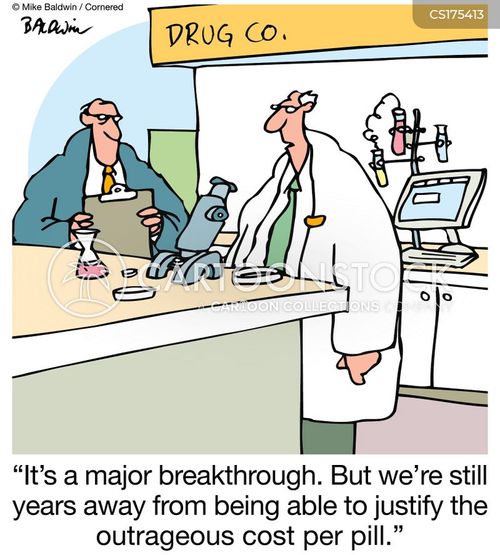
Cartoon – High Cost of Living


https://www.forbes.com/sites/robertpearl/2018/07/16/drug-companies/#72ce13501e41
If you’re a powerful American drug company, then you’ve had a strange couple of months. In that time, you’ve experienced a rainbow of emotions: fear, relief and, now, confusion and anxiety.
The roller-coaster ride, as you recall, began in mid-May when President Trump stood alongside HHS Secretary Alex M. Azar, in the Rose Garden of the White House, in front of a sign reading “Lower Drug Prices for Americans.”
As the president approached the mic, you watched with bated breath, remembering Trump’s campaign promise to drive down prescription drug prices to below a penny on the dollar. You always knew that’d be impossible but, then again, you thought, is anything really impossible?
Things started off poorly that morning. Almost immediately, Trump began denouncing the actions of drug manufacturers who, he said, were contributing to a “broken system.” He then urged all U.S. pharma companies to drop their prices, before deriding pharmacy benefits managers (PBMs) as “middlemen” who are getting “very, very rich” off the same broken system as you.
But when his speech ended, relief washed over you. After all, President Trump made no mention of his previous promise to negotiate lower drug prices for seniors enrolled in Medicare. He didn’t revive his vow to allow the importation of prescription medications, either. He didn’t discuss the popular notion of shortening pharmaceutical patents, nor that idea about requiring drug-companies to justify the price of new medications.
Granted, all these promises would be incredibly difficult to legislate. And, like most drug companies, you know that most of these ideas wouldn’t severely damage your bottom line anyway. But had the president committed to even one of them in his Rose Garden speech, he would have sent a clear message that this is not business as usual.
Instead, you and your colleagues took solace in his words. By late afternoon, the nation’s pharmaceutical, biotech and PBM stocks were up, not down. In the following weeks, drug companies interpreted Trump’s comments the same way drag-racers look at a stop signs—as more of a request than a rule.
Now, in fairness, President Trump and Secretary Azar had no intention of revealing a final, comprehensive set of proposals, rules or regulations on May 11. They set their sights on Tuesday, July 16—the official deadline for interested parties to comment on Secretary Azar’s blueprint Q&A. That’s when the real policy-making is set to begin. And, until early this month, most of the drug industry had been bracing for incremental, not radical, change.
But on July 1, Pfizer learned that it’s not safe to wake a sleeping bear. Thinking they had a clear runway, Pfizer’s corporate executives went ahead and raised list prices on more than 100 prescription drugs.
He followed that Tweet with a phone call and, within 24 hours, Pfizer had rolled back its price increases. Just like that, Trump had the drug industry’s full attention.
It stands as a public relations win for Trump in the lead up to the 2018 midterm elections. With recent polls indicating that 22% to 30% of Americans say healthcare is their top voting issue, Trump and the Republican party are wise to appear tough on rising drug prices (even if Pfizer is merely deferring its price hikes until later in the year).
Uncertainty and confusion, once again, permeate the drug industry. If the polls are even remotely accurate at predicting voter behavior this November, Trump and his cabinet will have good reason to take action.
I personally hope they have the courage to do so.
Unfortunately, the ideas Trump and Azar presented in the Rose Garden won’t be enough. They aren’t going to flatten the rapid rate of drug-price inflation or dramatically impact future price escalation.
So, alongside the administration’s proposed ideas, I offer four alternative policies that could make a real difference:
Leading idea No. 1: Take out the “middlemen”
In his May 11 address, the president went after PBMs, those insurance-company intermediaries between drug manufacturers and patients. At present, consumers know nothing about the prices these intermediaries negotiate or the size of the rebates/kickbacks they keep for themselves. Revenue for PBMs is determined as a percentage of all Rx drugs sold, which means there’s virtually no incentive to drive prices lower or replace the high-margin, brand-name drugs on PBM formularies with new, lower-cost alternatives. Federal legislation could require PBMs to operate transparently and work to lower out-of-pocket costs and drug prices for patients. However, there are way too many “ifs” with this approach to expect major change on the horizon.
A more frightening proposition for drug makers: Imagine if the U.S. government negotiated drug prices for all 55.5 million Medicare patients and made those costs publicly available so that everyone knew what price was fair and reasonable. Nearly all other nations do this. Why not the United States? Besides, Medicare already establishes prices for participating hospitals and doctors. Why not do the same for drug prices?
Leading idea No. 2: Make other nations pay more
Whether it’s NATO spending or wall-building, President Trump expects other nations to pony up for American interests. Most nations have made a habit of saying no. Now, rather than negotiating on behalf of Medicare for lower-cost medications (particularly Part B), the president has encouraged citizens of other countries to pay more for their prescriptions and, thereby, contribute an increased share of funding to drug-company R&D. Health ministers in other nations haven’t made this high priority for their 2019 healthcare agendas. They likely won’t. Even if drug prices were to rise in other countries, would drug manufacturers pass that added revenue on to American patients? Or to their shareholders? History suggests it’s the latter.
A more frightening proposition for drug makers: Require drug companies to document all the R&D dollars they spend in bringing a product to market. Further, force them to quantify and compare their drug’s efficacy to other drugs on the market. If pharmaceutical companies want generous patent protections (for products that often determine whether a patient lives or dies), their pricing can’t be capricious or simply what the market will bear. Prices should relate either to: (a) the cost of the drug’s R&D or (b) the superior clinical effectiveness of the medication.
Leading idea No. 3: Put prices in Rx ads
This is one of the most interesting concepts to come out of Trump and Azar’s blueprint. That’s because such a policy would, at least in theory, make it impossible for drug makers to hide their prices. USDA regulations already require companies to disclose possible side-effects in ads. Imagine if the administration also stipulated that pharmaceutical manufacturers must disclose their prices in ad copy, as well. For now, it’s unclear which costs the drug makers would need to disclose, given that patients and purchasers pay very different amounts for the same medications. Already, drug companies are using coupons and rebates, what critics deem to be clever schemes, to lower the advertised price for patients while simultaneously raising what they charge insurers—who ultimately pass those costs back to purchasers and patients through higher premiums.
A more frightening proposition for drug makers: Limit what U.S. pharmaceutical companies can charge. Period. American drug makers should be required to pay a penalty if they charge Americans more than 120% for the same medication as the 10 wealthiest nations pay on average. It’d be the same thing that happens when baseball teams exceed the salary cap. And when comparable medications exist at lower prices, TV ads would need to disclose that fact to viewers, as well.
Leading idea No. 4: Speed up generic medication approvals
This idea is a step in the right direction. Unfortunately, the president didn’t explain why generics currently undergo such lengthy delays for approval. The biggest hurdle is not government regulations, but drug company tactics. For most patented prescriptions, the generic versions have exactly the same chemical structure, and therefore, the same efficacy. As such, once a generic exists, there’s little or no reason to purchase the more expensive product. Knowing this, makers of the brand-name version use legal maneuvers to extend their patent protections before driving generic competitors out of business with their pricing and marketing leverage.
A more frightening proposition for drug makers: The government needs to change patent laws to protect patients first. Medications fall into two classifications. There are the small-molecule ones that often are available over-the-counter. With these, the generic version’s chemical structure is identical to that of the brand-name version. There also are the biologicals, so named because they are produced by living cells and organisms. Insulin is one example. Increasingly, this latter class of drugs has the highest price. These chemicals are too complex to be copied exactly, which is why the generic equivalents are labeled “biosimilars.” The solution here is to focus on the most expensive, large-molecule biologics first. In so doing, the government should force manufacturers to hand over drug samples to biosimilar companies 18 months before their patents end. This will speed up the development of biosimilars and fast-track the approval of lower-cost (but equally efficacious) medications. For patients with diabetes, this could lower the cost of life-saving insulin by 50% or more. Recent research from Yale shows up to 1 in 4 people with diabetes are injecting less insulin than they should simply because of the cost.
A Realistic Glimpse Into The Future Of Drug Pricing
Today, the pharmaceutical industry enjoys powerful patent protections and, thereby, monopolistic control over pricing. The consequence is that Americans are paying exorbitant prices for patented medications. The simplest solution is to strike a legislative balance that allows (a) drug companies to invent (and invest in) the next generation of breakthrough medication while (b) allowing the American people to afford the medications they need to stay healthy.
For most of the 20th century, the pharmaceutical world stayed within those guardrails. But over the past decade, profits have been way out of line with R&D and investment. The time has come to restore balance and reasonableness, regardless of what the national drug lobby wants.
Later this week, Secretary Azar will receive feedback on the administration’s blueprint and will begin drafting potential cost-cutting regulations. I encourage him and President Trump to use their authority to make drugs more affordable.
I suspect the pharmaceutical industry believes it will be business as usual, despite the campaign rhetoric and another Rose Garden event this coming fall. I hope the Secretary and the president have the courage to prove them wrong. The health of the American people depends on it.

The health insurer Anthem Inc. was sued by doctors in Georgia for declining to pay for some emergency-room care, escalating a long-running battle over how far insurance plans can go to push patients to seek lower-cost treatment.
The American College of Emergency Physicians and the Medical Association of Georgia filed suit on Tuesday in U.S. District Court in Atlanta against Anthem’s Blue Cross and Blue Shield of Georgia unit over the denied payments. The doctors asked the court to require Anthem to halt its policy and cover the claims.
“Providers and patients alike are operating in fear of denial of payment by defendants when patients seek emergency department care,” the groups said in the filing.
It’s the latest legal challenge over a change in policy that Anthem says was designed to cut down on patients going to an emergency room in situations that don’t require it. Emergency-room care usually costs significantly more than treatment at a doctor’s office or an urgent-care clinic. Georgia’s Piedmont Hospital and five related facilities also have sued Anthem over the policy, the Atlanta Journal-Constitution reported in February.
Before putting the policy in place, Anthem sent letters to customers explaining the policy and urging them to use other sites for care. The insurer also held meetings with physicians, according to the suit.
Anthem didn’t immediately respond to a request for comment on the suit.
Anthem’s strategy went beyond what’s legally allowed, the doctors say in their lawsuit. The insurer reviewed the cases of patients who went to an emergency room, and decided whether to pay for their care based on billing information or medical records related to the incident. The suit says Anthem violated legal requirements that insurers cover care in a situation where a “prudent layperson” would believe he or she was experiencing an emergency.
According to the suit, Anthem began reviewing emergency-room visits in Georgia, Kentucky and Missouri, and has also brought the policy to Ohio, New Hampshire and Indiana. Based in Indianapolis, Anthem operates under the Blue Cross and Blue Shield brand in 14 states. The company has almost 40 million health-insurance members.
Lawmakers including U.S. Senator Claire McCaskill of Missouri have criticized Anthem’s policy. McCaskill and a fellow Democrat, Senator Ben Cardin of Maryland, sent a letter in March to the Health and Human Services Department and Labor Department, asking them to investigate the payment denials.
“By denying patient claims based on the patient’s final diagnosis and ignoring the patient’s symptoms present at the time of the emergency, we believe that Anthem likely violated federal law,” the senators wrote.

UnitedHealth Group posted $4.2 billion earnings from operations, an increase of 13% year-over-year, according to its second-quarter earnings report released Tuesday.
The results marked another strong quarter for the insurer, which saw its earnings from operations grow from $3.7 billion during Q2 2017, and even increase from $4.1 billion in Q1 2018. Compared to this time last year, UnitedHealth increased its overall revenues by $6 billion, improving its net margin to 5.2%.
“Today, UnitedHealth Group delivers increasing value to more people, driven by strong execution, consistently high quality, deep relationships and our distinctive combination of clinical, technology and information capabilities. As we look ahead, we will drive our growth on the strength of practical innovations that anticipate and respond to increasing consumer expectations and clear social needs,” UnitedHealth Group CEO David Wichmann said in a statement.
UnitedHealth’s consistent, improved performance comes as insurers brace for the widespread introduction of association health plans and short-term health plans. The health plan juggernaut is so enthused by its first-half financial performance that it raised its outlook for end-of-year adjusted earnings to $12.50 to $12.75 per share. After Q1, UnitedHealth projected a range of adjusted net earnings per share from $12.40 to $12.65. Meanwhile, GAAP diluted earnings ranged between $11.80 to $12.05 per share.
Moody’s Vice President Dean Unger said in a statement Tuesday that UnitedHealth’s leverage remains high and will increase slightly after the company finalizes its acquisition of DaVita Medical Group.
“But the pharmacy benefits manager and analytics business were also solid,” Unger said. “UnitedHealth’s scale, diversity and consistent and disciplined growth continue to support our A3 long-term issuer rating.”
Below are some additional highlights from UnitedHealth’s Q2 earnings report:
UnitedHealth posted cash flows from operations totalling $4 billion.
The insurer’s adjusted net earnings per share also grew 27.6%.
UnitedHealthcare added 2.2 million more consumers year-over-year.
Optum’s earnings from operations grew by 21.5% year-over-year to $1.8 billion.
Additional information is available in UnitedHealth’s filing with the Securities and Exchange Commission.

The appellate judges affirmed the district court’s dismissal for lack of subject-matter jurisdiction.
The AHA failed to fulfill the legal prerequisites to judicial review, according to the ruling.
The plaintiff has seven days to file a petition for the appellate court to rehear the matter en banc.
The American Hospital Association’s attempt to block $1.6 billion in cuts to the 340 Drug Pricing Program suffered a major setback Tuesday, when the D.C. Circuit Court sided with Health and Human Services.
The three-judge panel ruled that the lower court had properly dismissed AHA’s case because the association failed to fulfill the legal prerequisites to judicial review.
More specifically, AHA failed to adequately present the matter to HHS Secretary Alex Azar. This “presentment” threshold is the obstacle that tripped up the AHA challenge at the district court level, a decision Tuesday’s appellate ruling affirmed.
“When the plaintiffs filed this lawsuit, neither the hospital plaintiffs, nor any members of the hospital-association plaintiffs, had challenged the new reimbursement regulation in the context of a specific administrative claim for payment. Nor could they have done so, for the new regulation had not yet even become effective,” the appellate judges wrote. “Therefore, they had neither presented their claim nor obtained any administrative decision at all, much less the ‘final decision’ required under [the relevant law].”
The AHA, along with fellow plaintiffs the Association of American Medical Colleges and America’s Essential Hospitals, had argued that it met the presentment requirement by opposing the policy in writing during the rulemaking process.
Because the decision was based on a lack of subject-matter jurisdiction, it did not address the merits of AHA’s claims.
“We are deeply disappointed that the courts have once again failed to rule on the merits of our case,” the hospital groups said Tuesday in a statement.
The groups emphasized that the decision does not address whether they can obtain judicial review. It simply addresses when and how that review can be obtained.
“We will continue our fight to reverse these unwarranted cuts and protect access for patients, and we expect to refile promptly in district court,” the groups added.

“Medicare for all” is becoming a rallying cry in state elections, with state legislators coming up with their own versions of single-payer healthcare despite, or possibly because of, the stagnation of similar ideas at the federal level.
The push for a single-payer healthcare system is proving successful for some, such as socialist Alexandria Ocasio-Cortez, who rocked New York by beating the 10-term incumbent Joe Crowley in a New York City district. She is a vocal proponent of single-payer healthcare.
The proliferation of state plans and in particular Ocasio-Cortez’s victory in New York could indicate growing support for single-payer healthcare, says Sally C. Pipes, president and CEO of the Pacific Research Institute in San Francisco.
Pipes says the American public may be drawn by the promises of a healthcare plan that eliminates premiums and other disliked features of the current system.
“The horse is out of the barn in terms of single payer. They keep pushing it and pushing it and this has become a major issue that gets the voters’ attention, especially for progressive Democrats,” Pipes says.
She says, “There’s an effort in the states to test the waters as they wait for things to change in Washington. Because Obamacare wasn’t repealed and replaced, Democrats are saying single payer is what they wanted all along, so now they’re going for it.”
Four single payer proposals are on the table nationally, including one from Sen. Bernie Sanders (I-VT) that calls for Medicare to be available to all Americans. State legislators and candidates are taking up the issue ahead of midterm elections, rallying the many voters who are fed up with the current healthcare system and want a solution in the form of a government-sponsored single payer.
The state plans are similarly idealistic, calling for universal coverage of all residents regardless of income and eliminating premiums, copays, and deductibles.
Many states have serious proposals for single-payer systems. In Michigan, Rep. Yousef Rabhi (D-Ann Arbor) is proposing a government-administered single-payer system to provide coverage to everyone in the state.
The MiCare plan would provide state residents with medical, dental, mental health, and prescription drug coverage while eliminating healthcare premiums, copays, and deductibles, Rabhi says.
Healthcare providers would remain independent, and patients would be able to pick among participating providers under the MiCare plan. Michigan would pay for the plan by cutting administrative costs generated by for-profit insurance companies and raising taxes, Rabhi says. He claims the state would save a net $20 billion in the first year.
“Instead of the exorbitant costs, stress and uncertainty of premiums, deductibles, co-insurance and other out-of-pocket payments, working families would pay a small and simple progressive payroll tax designed to save real money on their overall health expenses,” Rabhi explains in his proposal.
He continues, “Large and medium employers would pay a payroll tax set at a level lower than the current average employer expenditures for employee health care, saving many employers money immediately.”
Also, in Michigan, a Democrat running for governor has proposed MichCare. Abdul El-Sayed, MD, says he would pay for his single-payer plan with a new, graduated payroll tax that all working people would pay, coupled with new taxes on the gross earnings of businesses making more than $2 million a year.
The New York state Assembly recently passed a bill calling for a statewide single-payer universal healthcare system, for the fourth year in a row.
The New York Health Act would include comprehensive outpatient and inpatient medical care, primary and preventive care, prescription drugs, lab tests, rehab, dental, vision, hearing, and all benefits required by current state insurance law, by publicly funded medical programs or provided by the state public employee package.
The bill passed easily in the Democrat-led chamber but the state’s Republican-led Senate is not expected to take up the measure this year.
Minnesota State Rep. Erin Murphy (DFL-St. Paul) is running for governor on a platform that includes her Pathway to Single-Payer plan, which will set the state up to “lead the nation by becoming the first state to provide guaranteed, affordable health care to everyone,” as stated in a press release.
Pipes opposes single-payer healthcare, saying Americans would regret the choice only after experiencing the increased taxes and reduced services of such a system. But single payer has become a powerful political tool, she says.
“Before Bernie Sanders proposed single payer in 2016, it wasn’t really taken seriously, but now you have all these states supporting it,” she says. “Political leaders are seeing this as an issue they can run on and get lots of support, draw big crowds, and look like they’re giving people what they want.”
Americans have been on the fence about Medicare-for-all plans for a while, with one survey of 1,850 U.S. adults finding that 51% supported the idea.
That figure could be increasing, Pipes says. If it is, Pipes says she suspects it is largely because politicians can run on the pie-in-the-sky promises of eliminating premiums, copays, and deductibles while giving few details about how to pay for such a plan.
“Both New York and Michigan say theirs would be paid for by progressive income tax increases and a new payroll tax, but they haven’t come out and said just what the cost would be. That’s unlike in California, where the Senate appropriations committee said SB 562 would cost $400 billion a year,” Pipes says. “People are drawn to the promised improvements, but they have to consider the cost at some point.”
Single payer is a polarizing topic, with Democrats and Republicans typically coming down sharply on either side of the issue, but Pipes says Democrats run the risk of dividing their own voters.
“People support single payer when you ask them if they’d like a system that eliminates everything they don’t like about the current system, but when you ask if they want to pay more taxes that support goes down,” Pipes says.
“The Democrats are finding this is a successful way to motivate people in a campaign but when they have to answer questions about raising taxes on everyone, including working class voters, they could find themselves driving a wedge between their constituents,” she says.
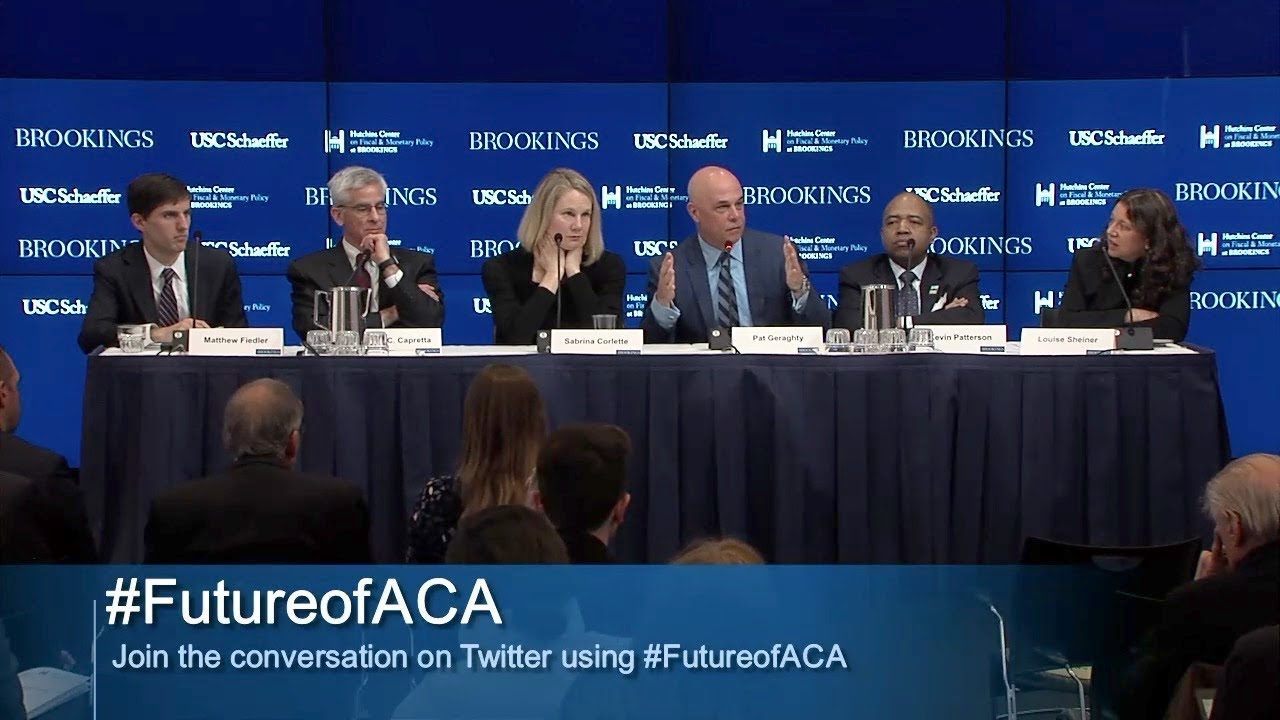
Stability has long been an issue for the individual health insurance market, even before the Affordable Care Act. While reforms adopted under the ACA initially succeeded in addressing some of these market issues, market conditions substantially worsened in 2016.
Insurers exited the individual market, both on and off the subsidized exchanges, leaving many areas with only a single insurer, and threatening to leave some areas (mostly rural) with no insurer on the exchange. Most insurers suffered significant losses in the individual market the first three years under the ACA, leading to very substantial increases in premiums a couple of years in a row.
For a time, it appeared that rate increases in 2016 and 2017 would be sufficient to stabilize the market by returning insurers to profitability, which would bring future increases in line with normal medical cost trends. However, Congress’s decision to repeal the individual mandate and the Trump Administration’s decision to halt “cost-sharing reduction” payments to insurers, along with other measures that were seen as destabilizing, created substantial new uncertainty for market conditions in 2018.
This uncertainty continues into 2019, owing both to lack of clarity on the actual effects of last year’s statutory and regulatory changes, and to pending regulatory changes that would expand the availability of “non-compliant” plans sold outside of the ACA-regulated market. These uncertainties further complicate insurers’ decisions about whether to remain in the individual market and how much to increase premiums.
In “Stabilizing and strengthening the individual health insurance market: A view from ten states” (PDF), Mark Hall examines the causes of instability in the individual market and identifies measures to help improve stability based off of interviews with key stakeholders in 10 states.
In the states studied—Alaska, Arizona, Colorado, Florida, Iowa, Maine, Minnesota, Nevada, Ohio, and Texas—opinions about market stability vary widely across states and stakeholders.
While enrollment has remained remarkably strong in the ACA’s subsidized exchanges, enrollment by people not receiving subsidies has dropped sharply.
States that operate their own exchanges have had somewhat stronger enrollment (both on and off the exchanges), and lower premiums, than states using the federal exchange.
A core of insurers remain committed to the individual market because enrollment remains substantial, and most insurers have been able to increase prices enough to become profitable. Some insurers that previously left or stayed out of markets now appear to be (re)entering.
Premiums have increased sharply over the past two to three years, initially because insurers had underpriced relative to the actual claims costs that ACA enrollees generated. However, political uncertainty in recent years caused some insurers to leave the market and those who stayed raised their rates.
Insurers were able to cope with the Trump administration’s halt to CSR payments by increasing their rates for 2018 while the dominant view in most states is that the adverse effects of the repeal of the individual mandate will be less than originally thought. Even if the mandate is not essential, many subjects viewed it as helpful to market stability. Thus, there is some interest in replacing the federal mandate with alternative measures.
Because most insurers have become profitable in the individual market, future rate increases are likely to be closer to general medical cost trends (which are in the single digits). But this moderation may not hold if additional adverse regulatory or policy changes are made, and some such changes have been recently announced.
Many subjects viewed reinsurance as potentially helpful to market conditions, but only modestly so because funding levels typically proposed produce just a one-time lessening of rate increases in the range of 10-20 percent. Some subjects thought that a better use of additional funding would be to expand the range of people who are eligible for premium subsidies.
Actions to restore stability
Concerns were expressed about coverage options that do not comply with ACA regulations, such as sharing ministries, association health plans, and short-term plans. However, some thought this outweighed harms to the ACA-compliant market; thus, there was some support for allowing separate markets (ACA and non-ACA) to develop, especially in states where unsubsidized prices are already particularly high.
Other federal measures, such as tightening up special enrollment, more flexibility in covered benefits, and lower medical loss ratios, were not seen as having a notable effect on market stability.
Measures that states might consider (in addition to those noted above) include: Medicaid buy-in as a “public option”; assessing non-complying plans to fund expanded ACA subsidies; investing more in marketing and outreach; “auto-enrollment” in “zero premium” Bronze plans; and allowing insurers to make mid-year rate corrections to account for major new regulatory changes.
The ACA’s individual market is in generally the same shape now as it was at the end of 2016. Prices are high and insurer participation is down, but these conditions are not fundamentally worse than they were at the end of the Obama administration. For a variety of reasons, the ACA’s core market has withstood remarkably well the various body blows it absorbed during 2017, including repeal of the individual mandate, and halting payments to insurers for reduced cost sharing by low-income subscribers.
The measures currently available to states are unlikely, however, to improve the individual market to the extent that is needed. Although the ACA market is likely to survive in its basic current form, the future health of the market—especially for unsubsidized people—depends on the willingness and ability of federal lawmakers to muster the political determination to make substantial improvements.

 HENRY KOTULA