

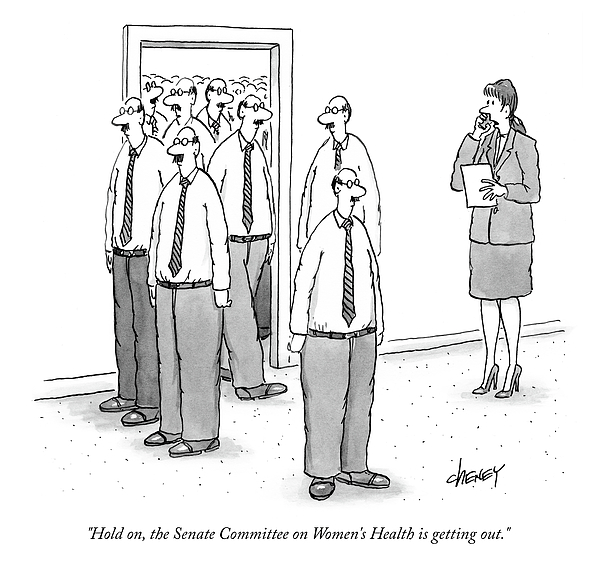
Cartoon – Senate Committee on Women’s Health


WASHINGTON — Federal investigators say they have found huge gaps in the regulation of assisted living facilities, a shortfall that they say has potentially jeopardized the care of hundreds of thousands of people served by the booming industry.
The federal government lacks even basic information about the quality of assisted living services provided to low-income people on Medicaid, the Government Accountability Office, a nonpartisan investigative arm of Congress, says in a report to be issued on Sunday.
Billions of dollars in government spending is flowing to the industry even as it operates under a patchwork of vague standards and limited supervision by federal and state authorities. States reported spending more than $10 billion a year in federal and state funds for assisted living services for more than 330,000 Medicaid beneficiaries, an average of more than $30,000 a person, the Government Accountability Office found in a survey of states.
States are supposed to keep track of cases involving the abuse, neglect, exploitation or unexplained death of Medicaid beneficiaries in assisted living facilities. But, the report said, more than half of the states were unable to provide information on the number or nature of such cases.
Just 22 states were able to provide data on “critical incidents — cases of potential or actual harm.” In one year, those states reported a total of more than 22,900 incidents, including the physical, emotional or sexual abuse of residents.
Many of those people are “particularly vulnerable,” the report said, like older adults and people with physical or intellectual disabilities. More than a third of residents are believed to have Alzheimer’s or other forms of dementia.
The report provides the most detailed look to date at the role of assisted living in Medicaid, one of the nation’s largest health care programs. Titled “Improved Federal Oversight of Beneficiary Health and Welfare Is Needed,” it grew out of a two-year study requested by a bipartisan group of four senators.
Assisted living communities are intended to be a bridge between living at home and living in a nursing home. Residents can live in apartments or houses, with a high degree of independence, but can still receive help managing their medications and performing daily activities like bathing, dressing and eating.
Nothing in the report disputes the fact that some assisted living facilities provide high-quality, compassionate care.
The National Center for Assisted Living, a trade group for providers, said states already had “a robust oversight system” to ensure proper care for residents. In the last two years, it said, several states, including California, Oregon, Rhode Island and Virginia, have adopted laws to enhance licensing requirements and penalties for poor performance.
But the new report casts a harsh light on federal oversight, concluding that the Centers for Medicare and Medicaid Services has provided “unclear guidance” to states and done little to monitor their use of federal money for assisted living.
As a result, it said, the federal health care agency “cannot ensure states are meeting their commitments to protect the health and welfare of Medicaid beneficiaries receiving assisted living services, potentially jeopardizing their care.”
Congress has not established standards for assisted living facilities comparable to those for nursing homes. In 1987, Congress adopted a law that strengthened the protection of nursing home residents’ rights, imposed dozens of new requirements on homes and specified the services they must provide.
But assisted living facilities have largely escaped such scrutiny even though the Government Accountability Office says the demand for their services is likely to increase because of the aging of the population and increased life expectancy.
That potential has attracted investors. “Don’t miss out on the largest market growth in a generation!” says the website of an Arizona company, which adds that “residential assisted living is the explosive investment opportunity for the next 25 years.”
Carolyn Matthews, a spokeswoman for the company, the Residential Assisted Living Academy, said: “Unfortunately, there has been elderly abuse in this business. We are trying to change the industry so the elderly have better quality care and we are not warehousing them.”
The government report was requested by Senator Susan Collins of Maine, a Republican who is the chairwoman of the Special Committee on Aging; Senator Orrin G. Hatch of Utah, a Republican who is the chairman of the Finance Committee; and two Democratic senators, Claire McCaskill of Missouri and Elizabeth Warren of Massachusetts.
The Trump administration agreed with the auditors’ recommendation that federal officials should clarify the requirement for states to report on the abuse or neglect of people in assisted living facilities. The administration said it was studying whether additional reporting requirements might be needed.
“Although the federal government has comprehensive information on nursing homes providing Medicaid services, not much is known about Medicaid beneficiaries in assisted living facilities,” the report said.
Assisted living was not part of the original Medicaid program, but many states now cover it under waivers intended to encourage “home and community-based services” as an alternative to nursing homes and other institutions.
The report said that assisted living could potentially save money for Medicaid because it generally cost less than nursing home care. Under the most common type of waiver, Medicaid covers assisted living only for people who would be eligible for “an institutional level of care,” in a nursing home or hospital.
Alta Bates emergency center will close, but Sutter Health says not as soon as people think

BERKELEY — Hospital services at Alta Bates Medical Center’s Berkeley campus will end, but not as soon as people think, company officials said this week.
In an ongoing debate over the future of emergency services at the campus, legislators, city officials and health care professionals will continue their public campaign against the closure while the hospital’s parent organization Sutter Health insists it will keep the campus open for at least a decade.
Nurses and local leaders will gather for a community forum Saturday on the Ed Roberts campus, calling on Sutter Health to keep Alta Bates open as a full hospital with inpatient and emergency care. Sutter Health, citing a California law that requires hospitals to complete seismic upgrades by 2030, announced in 2016 its plans to move inpatient care and emergency services from the Alta Bates site in Berkeley to an expanded, retrofitted Oakland campus.
This week, Sutter Health released a statement saying the emergency room and inpatient hospital services provided at the Alta Bates campus will remain in Berkeley until they are available in full at the Summit Medical Center campus in Oakland, which could take up to 10 years to build.
The memo was intended to clarify what Sutter Health leaders say is misinformation about the timing of the Alta Bates closure. While many people thought the hospital’s emergency care and inpatient services could close as early as 2019, the organization said this week it will be a decade before that happens.
“The memo is intended to highlight our commitment to community and do this gradually,” said Alta Bates Summit CEO Chuck Prosper by phone on Friday. “The last thing we want to do is create a shock.”
But for many health care workers and community advocates, the memo was not reassuring. They do not want the hospital and emergency room to close at all.
“Even in its own statement, Sutter admitted its plan is not to retain Alta Bates as a full service acute care hospital, and that it fully intends to force patients from Berkeley to Vallejo along the densely populated I-80 corridor to travel even farther to Oakland, further delaying life-saving emergency treatment,” said an email message from organizers from the California Nurses Association and Save Alta Bates Hospital campaign about Saturday’s public forum.
Sutter Health plans to enlarge its Oakland campus with a second building and will build urgent care clinics and outpatient services in Berkeley either at its Alta Bates campus on Ashby Avenue or the Herrick campus on Dwight Way.
Rochelle Pardue-Okimoto, a registered nurse at Alta Bates and El Cerrito’s mayor pro tem, said she’s concerned about the impact on care across hospitals in the area if Alta Bates’ acute care services close. She said her colleagues at hospitals around the East Bay have already seen busier emergency rooms following the closure in 2016 of Doctors Medical Center in San Pablo after years of financial loss. That hospital recorded about 33,000 visits per year, and its closure has left the area between Vallejo and Berkeley with only one hospital — Kaiser Permanente in Richmond.
“If you concentrate all the emergency care in Oakland, it’s just too many people,” Pardue-Okimoto said. “There will be increased wait times.”
According to the most recent data available online from the Office of Statewide Health Planning and Development, the Alta Bates campus had 45,336 emergency room visits in 2016.
When asked on Friday about how Sutter Health plans to ensure that people throughout the area can access emergency care, Prosper said he believes that offering more robust outpatient services could help cut down on the number of emergency room visits.
“We believe today that people come to the emergency room often not needing emergency care,” he said. “Some people come for primary care or other services because they do not have other access to medical care.”
He could not specify what percentage of emergency visits include people seeking non-emergency care, but said Sutter Health is interested in finding more information about that as it plans for the future. He also said that the movement of people who seek care is more “fluid” than people might believe, noting that people already “are routinely leaving Berkeley” to go to hospitals in Oakland or elsewhere.
Sutter Health officials have said they have no choice but to eventually close the acute care services at Alta Bates, as almost all of the Berkeley campus cannot be retrofitted to meet new state seismic standards for inpatient hospital care, and rebuilding would be too expensive.
Berkeley Mayor Jesse Arreguin, who started a task force to discuss the potential impacts of closing Alta Bates said there has been a lack of transparency around the closure of the hospital that makes it difficult to work with Sutter Health on future planning. While Sutter Health executives have said the buildings are not seismically safe, city officials do not know, for example, how much it would cost to retrofit or rebuild them.
“I believe Sutter needs to either save the hospital or sell it,” Arreguin said in an interview Friday. “We cannot make the East Bay a hospital desert.”
He said city officials have met with other hospital operators to discuss options for building another hospital with acute care services. But short of that happening, he hopes Sutter Health will work with the city to develop a plan.
“While it’s reasurring that Sutter said they were not closing next year, they did say they were going to close in 10 years,” Arreguin said. “We are still concerned with Sutter’s plans to close the hospital (at all), which they reaffirmed.”

Nine states are considering laws that would require their residents to purchase health insurance, the The Wall Street Journal reported Saturday.
The proposals come less than two months after Republicans, as part of a sweeping tax code overhaul, voted to repeal the Affordable Care Act’s (ACA) mandate requiring individuals to have health insurance.
Lawmakers in Maryland are considering a law requiring residents to buy health insurance. California, Connecticut, Hawaii, Minnesota, New Jersey, Rhode Island, Vermont and Washington, as well as the District of Columbia, are also considering similar proposals, according to the Journal report.
The ACA’s individual mandate was implemented as a way to keep premiums low by requiring everyone to have insurance. Proponents of the mandate say that, without it, healthy people are less inclined to buy insurance, causing premiums to rise for those who need it the most.
But Republicans have long argued against the idea that people should be forced to purchase health coverage.
The decision to repeal the mandate as part of the GOP tax bill was touted as a victory in Republicans’ effort to repeal the ACA. While the provision did not do away with the entire law, it was a blow.
The proposals to impose health coverage mandates in some states marks a shift of authority over health care from the federal government to the states, possibly leading to significant coverage differences between red states and blue states.
“The federal government has just stalled. They don’t accomplish the basics, and that leaves states with a great opportunity to step up and craft policy,” Connecticut state Rep. Sean Scanlon (D), who sits on a health-care working group, told the Journal.

EVERETT, Wash. — Unable to walk or talk, barely able to see or hear, 5-year-old Maddie Holt waits in her wheelchair for a ride to the hospital.
The 27-pound girl is dressed in polka-dot pants and a flowered shirt for the trip, plus a red headband with a sparkly bow, two wispy blond ponytails poking out on top.
Her parents can’t drive her. They both have disabling vision problems; and, besides, they can’t afford a car. When Maddie was born in 2012 with the rare and usually fatal genetic condition called Zellweger syndrome, Meagan and Brandon Holt, then in their early 20s, were plunged into a world of overwhelming need — and profound poverty.
“We lost everything when Maddie got sick,” said Meagan Holt, now 27.
Multiple times each month, Maddie sees a team of specialists at Seattle Children’s Hospital who treat her for the condition that has left her nearly blind and deaf, with frequent seizures and life-threatening liver problems.
The only way Maddie can make the trip, more than an hour each way, is through a service provided by Medicaid, the nation’s health insurance program started more than 50 years ago as a safety net for the poor.
Called non-emergency medical transportation, or NEMT, the benefit is as old as Medicaid itself. From its inception, in 1966, Medicaid has been required to transport people to and from such medical services as mental health counseling sessions, substance abuse treatment, dialysis, physical therapy, adult day care and, in Maddie’s case, visits to specialists.
“This is so important,” said Holt. “Now that she’s older and more disabled, it’s crucial.”
More than 1 in 5 Americans, about 74 million people, now rely on Medicaid to pay for their health care. In California, one-third of the population — about 13.5 million people — are enrolled in the state’s Medicaid program, called Medi-Cal.
Nationally, the numbers have grown dramatically since the program expanded in California and 31 other states, plus the District of Columbia, to cover prescription drugs, health screening for children, breast and cervical cancer treatment and nursing home care.
With a Republican administration vowing to trim Medicaid, Kaiser Health News is examining how the U.S. has evolved into a “Medicaid Nation,” where millions of Americans rely on the program, directly and indirectly, often unknowingly.Medicaid’s role in transportation is a telling example. Included in the NEMT coverage are nearly 104 million trips each year at a cost of nearly $3 billion, according to a 2013 estimate, the most recent, by Texas researchers.
Citing runaway costs and a focus on patients taking responsibility for their health, Republicans have vowed to roll back the benefits, cut federal funding and give states more power to eliminate services they consider unaffordable.
Already, states have wide leeway in how to provide and pay for the transportation.
In California, Medi-Cal members in managed care get transportation through their health plans, while fee-for-service enrollees can arrange for the service through their counties, said Amber Christ, a Los Angeles-based staff attorney for Justice in Aging, a legal advocacy group.
Medi-Cal transportation is a “lifeline” for the low-income seniors she works with, she said.
“Most of them cannot afford a car, or if they have a car they can’t afford to keep gas in that car, or they can’t use public transportation,” she said. “Medicaid transportation is the only way they are going to their doctor appointments.”
California has not proposed cutting this service, but should the federal government slash Medicaid funding overall, “you could see where states would feel the pressure to make cuts, and this might be one of the first places to do that,” Christ said.
Proponents of limiting NEMT say the strategy will cut escalating costs and more closely mirror private insurance benefits, which typically don’t include transportation.
They also contend that changes will help curb what government investigators in 2016 warned is “a high risk for fraud and abuse” in the program. In recent years, the Centers for Medicare & Medicaid Services (CMS) reported that a Massachusetts NEMT provider was jailed and fined more than $475,000 for billing for rides attributed to dead people.
Last year, a public interest law office in Los Angeles sued a company contracted to provide transportation to Medicaid enrollees in California and other states for allegedly failing to provide “safe, reliable and timely transportation” to fragile patients — some with brain injuries and amputations. That caused them to miss appointments, the suit alleges.
Two ambulance programs in Connecticut paid almost $600,000 to settle claims that they provided transportation for dialysis patients who didn’t have medical needs for ambulance transportation. And the mother of a Medicaid patient who was authorized to transport her child for treatment billed Medicaid for trips that didn’t take place. She was sentenced to 30 days in jail and ordered to pay $21,500.
Last March, Rep. Susan Brooks, an Indiana Republican, introduced a resolutionthat would have revoked the federal requirement to provide NEMT in an effort to provide states with “flexibility.” That effort stalled.
Another Republican proposal in 2017 would have reversed the Affordable Care Act’s Medicaid expansion and reduced federal funding for the NEMT program. It failed, but other efforts by individual states still stand.
Former Health and Human Services Secretary Tom Price and CMS Administrator Seema Verma encouraged the nation’s governors to consider NEMT waivers, among other actions, in a March letter to them.
“We wish to empower all states to advance the next wave of innovative solutions to Medicaid challenges,” they wrote. The Trump administration has used state waivers to bypass or unravel a number of the Obama administration’s more expansive health policies, and has granted some states’ requests.
At least three states, Iowa, Indiana and Kentucky, have received federal waivers — and extensions —allowing them to cut Medicaid transportation services. Massachusetts has a waiver pending.
Critics of the cuts worry the trend will accelerate, leaving poor and sick patients with no way to get to medical appointments.
“I wouldn’t be surprised to see more of these waivers in the pipeline,” said Joan Alker, executive director of the Georgetown University Center for Children and Families.
Because medical transportation isn’t typically covered by the commercial insurance plans most Americans use, it’s unfamiliar to many people and could be seen as unnecessary, said Eliot Fishman, senior director of health policy for Families USA, a nonprofit, nonpartisan consumer health advocacy group.
Formerly a Medicaid official in the federal government, Fishman called the transportation program “vital” not only for children with severe disabilities, but also for non-elderly, low-income adults.
CMS released results of a 2014 survey of Medicaid users, which found that lack of transportation was the third-greatest barrier to care for adults with disabilities, with 12.2 percent of those patients reporting they couldn’t get a ride to a doctor’s office.
“This is not something to be trifled with lightly,” Fishman said. “We’re talking about a lifesaving aspect of the Medicaid program.”
About 3.6 million Americans miss or delay non-emergency medical care each year because of transportation problems, according to a 2005 study published by the National Academy of Sciences.
That same study analyzed costs for providing NEMT to patients facing 12 common medical conditions and found that providing additional transportation is cost-effective. For four of those conditions — prenatal care, asthma, heart disease and diabetes — medical transportation saved money when the total costs for both transportation and health care were tallied.
Medicaid is required to provide NEMT services using the most appropriate and least costly form of transportation, whether that’s taxis, vans or public transit.
Most states rely on NEMT brokers or managed-care organizations to administer the transportation services. Other states run the service directly, paying providers on a per-ride basis, while some use local ride services and pay independent taxi firms to shuttle patients.
Proponents of revamping NEMT note that disabled children like Maddie and other people with serious disabilities are in little danger of losing services. In Iowa and Indiana, Medicaid transportation remains available to several groups of patients, including those classified as “medically frail,” though the definition of who qualifies can vary widely.
In addition, one managed-care provider, Anthem, continues to transport Indiana Medicaid patients, despite the waiver that was first enacted in 2007.
Still, Medicaid clients like Fallon Kunz, 29, of Mishawaka, Ind., are often stuck. Kunz, who has cerebral palsy, migraine headaches and chronic pain, uses a power wheelchair. When she was a child, she qualified for door-to-door service to medical appointments, she said.
Today, she lives with her father, whose home is outside the route of a Medicaid transit van. Getting to and from medical appointments for her chronic condition is a constant struggle, she said. Taxis are too expensive: $35 each way for a wheelchair-enabled cab.
“The only way I can get rides to and from my doctor’s appointment is to ride the 2 miles in my wheelchair, despite all kinds of weather, from my home, across the bridge, to the grocery store,” she said. “Right outside the grocery store is the bus stop. I can catch the regular bus there.”
Sometimes, she’s in too much pain or the Indiana weather — warm and humid in the summer, frigid and windy in the winter — is too much to battle and she skips the appointment.
“Today I didn’t go because it was too cold and my legs hurt too much,” she said on a December Tuesday. “I didn’t feel like getting blown off the sidewalk.”
In Maddie Holt’s case, she was shuttled to Seattle Children’s on a rainy Tuesday morning in a medical van driven by Donavan Dunn, a 47-year-old former big-rig trucker. He works for Northwest Transport, one of several regional brokers that manage NEMT services for Washington state.
Dunn said he received special training to transport patients like Maddie, who is loaded onto a motorized platform, wheelchair and all, into the van and then carefully strapped in.
“I have to drive different,” said Dunn. “I have to watch my corners, watch my starts, watch my stops. It’s always in the back of my mind that I have somebody on board that’s fragile.”
We’re talking about a lifesaving aspect of the Medicaid program.
The transportation service can be used only for medical visits to the specialists who treat Maddie’s condition, which is caused by mutations in any one of at least 12 genes. If Meagan Holt needs to pick up prescriptions or get groceries, she leaves Maddie and a second daughter, Olivia, 3, at home with their dad and takes the bus or walks to her destinations.
Caring for a severely disabled child is not the life she expected, Meagan Holt said, but she cherishes time with Maddie, who has learned to communicate through tactile sign language spelled into her hand.
“She knows about 100 words. She knows the alphabet,” Meagan said. “She likes Disney princesses. She loves ‘Frozen.’”
Maddie is one of hundreds of NEMT-eligible children transported to Seattle Children’s each month. Last September, for instance, more than 1,300 clients made more than 3,600 trips at a cost of more than $203,000, according to the Washington Health Care Authority, which oversees the state’s Medicaid program called Apple Health.
The need is so great, in fact, that the hospital created a transportation will-call desk to help organize the comings and goings.
“When we realized how much transportation is a barrier to getting to your appointment, we decided to do something about it,” said Julie Povick, manager of international exchanges and guest services at Seattle Children’s.
“The majority of our patients are in survival mode,” Povick added. “You need a lot of handholding.”
But Verma, the architect of Indiana’s Medicaid overhaul plan, has suggested that too much handholding might be “counterproductive” for patients — and bad for the country.
In a 2016 Health Affairs essay, Verma noted that early analysis of the effects of curtailing NEMT in Indiana showed that more Medicaid patients with access to the program said transportation was a primary reason for missed appointments than did members without access.
“Moreover, 90 percent of [Healthy Indiana Plan] members report having their own transportation or the ability to rely on family and friends for transportation to health care appointments,” she wrote.
But Marsha Simon, a Washington, D.C., health policy consultant who has tracked NEMT for years, said Medicaid is the option of last resort. People who are able to get rides on their own already do.
“If 90 percent can and 10 percent can’t, what about the 10 percent?” Simon said.
It’s a question that haunts Kunz every day.
“I’m a college student, I have a cat,” said Kunz, who is studying psychology online at Southern New Hampshire University. “I’m just a regular human trying to do things, and the inaccessibility in this area is ridiculous.”
Everyone seems to want lower drug prices. 5 reasons why that hasn’t happened

Everyone seems to want lower drug prices. 5 reasons why that hasn’t happened.
Of all his campaign promises, President Trump’s vow to bring down drug prices was perhaps the most popular.
An assortment of interest groups spoke out loudly and passionately on the need for action, from hospitals to doctors to insurers to generic drug makers to patients themselves.
And in many ways, they seem to have the clout, and resources, to counter drug makers’ slick ad campaigns and lobbying firepower. Last year, the American Medical Association, America’s Health Insurance Plans, and the American Hospital Association together spent more than $45 million lobbying Congress, almost twice what the drug makers’ group, PhRMA, spent in the same time period.
Instead, congressional efforts to lower drug prices are at a total standstill. In interviews with STAT, lobbyists, lawmakers, and congressional staffers, Republicans and Democrats alike, said the most powerful health industry players conspicuously disagree about exactly how to move forward. Every group pushes its own priorities and strategies — a cacophony that makes it unlikely that crushing drug prices will change any time soon.
“They all say, ‘Yes, we should [lower drug prices], and someone else is responsible for it,’” Sen. Patty Murray of Washington, the top Democrat on the Senate Health, Education, Labor, and Pensions Committee, told STAT. “Everybody needs to come to the table and say what can my industry do, what can pharma do. … That will be how we solve this.”
Solving it, however, seems a stretch when just addressing it has gone nowhere. Despite President Trump’s insistence, on the campaign trail and in office, that he will lower drug prices, there has been no major federal effort to do so in the first year of his administration.
The disarray was on full display at a recent congressional hearing, when representatives from nearly every major trade group with any stake in the country’s drug prices — AMA, AHIP, and AHA included — spent almost an hour and a half testifying without more than a cursory discussion of how Congress could fix the problem. When they finally did talk solutions, outside of buzzy phrases like “increase transparency,” almost none of their answers matched.
So why can’t the broader health care industry agree on how to make drugs more affordable? Here are five factors.
When it comes to drug pricing, hospitals, insurers, and PBMs in particular have spent the last year fending off congressional inquiries into their own business practices — leaving little time to go on the offensive.
Meanwhile PhRMA has alternately pointed at hospitals, insurers, and PBMs as the profiteers in the current system.
It’s “lobbying 101, to muddy the waters,” according to Rep. Peter Welch (D-Vt.). And in the complicated world of drug pricing, it’s an effective strategy.
Drug makers’ efforts to vilify PBMs and to demand more transparency about their role in the supply chain are well-documented. The Washington Post earlier this year called pharma’s tactics against those players an effort to “start an industry war.”
They’ve opened a similar front against insurers, ramping up rhetoric and backing new patient groups that decry how higher deductibles and copays mean steeper costs for consumers, even when list prices don’t change much.
And they’ve accused hospitals of marking up the price of drugs and pocketing the difference, both in general and specifically as part of a push to overhaul the hot-button 340B drug discount program.
“That disarray you talk about, it’s not accidental,” Welch said. “The flames of that are fanned by pharma, [which] is doing everything they can to create confusion about what’s the right remedy,” he said.
The problem, according to Walid Gellad, who leads the University of Pittsburgh Center for Pharmaceutical Policy and Prescribing, “is that every part of the industry says things that are correct. It is correct that one of the reasons patients are feeling such high prices is because they have to pay coinsurance and big deductibles,” Gellad said, noting that pharma’s concerns with the PBMs and hospitals had some validity, too. “And it’s true that pharma sets the list prices high. They do do that.”
PhRMA spokesman Robby Zirkelbach also said there was a reason for lawmakers’ interest in so many players: the validity of the concerns. He pointed to data that showed slowing growth of prescription drug prices and increasing copays and deductibles.
“There’s no wonder that people are continuing to dig into this issue, and what they’re realizing is that to really be able to address the drug pricing concerns that people have raised, you’ve got to address some of the misaligned incentives in the system,” he said. “This is a complicated system, and we’ve got to look at how money flows across the system.”
And the tactic has successfully diverted lawmakers’ attention. Republicans in both chambers of Congress have held hearings in the past year looking at the “supply chain” that goes into the cost of drugs — broadening their spotlight from the companies that set the price to the other actors that can impact it. And lawmakers on both sides of the aisle say they want to better examine the vast array of players before they make any sudden policy moves.
“There are some that zero in on just one piece of the cost curve, so what I’m trying to do on the committee is look methodically at every piece,” Rep. Greg Walden, the Oregon Republican who chairs the influential Energy and Commerce Committee, told STAT. “We’re going to look at PBMs, we’re going to look at hospital costs, we’re going to look at what insurance costs. We’re going to look top to bottom.”
Beyond hearings, Congress hasn’t actually shown great appetite to tackle drug pricing. And that lethargy can dampen lobbyists’ enthusiasm to throw their weight and resources behind a given campaign or piece of legislation.
One physician lobbyist called it a “chicken and the egg” problem, wondering whether it would be Congress or the industries to first signal their motivation to act.
Case in point: the so-called CREATES Act. It’s one of the few pieces of drug price legislation that has the support of hospitals, insurers, doctors and a whole host of other groups and companies. But it’s languishing on Congress’s to-do list.
The bill, like its counterpart, the Fast Generics Act, takes aim at what supporters call delay tactics that drug makers use to keep generic competitors off the market. The legislation would give generic manufacturers that are legitimately seeking product samples the right to sue the drug makers if they refuse to hand over those samples.
It’s a small but meaningful change — the Congressional Budget Office has estimated that the legislation could save Medicare, Medicaid, and other federal government health programs more than $3 billion over 10 years.
And industry has been pushing the legislation, albeit without the same urgency that’s animated other priorities. Together, many of the trade associations — along with some three dozen other groups and companies, including Walmart, CVS, and AARP — formed a coalition, the so-called Campaign for Sustainable Rx Pricing, to push the bill. They hired a handful of lobbyists who are largely focused on the issue, too, to the tune of $440,000 over 2017.
But as one supporter put it, “it’s kind of telling that it has to be such an egregious abuse for everyone to coalesce.”
So far, drug makers have blocked attempts to include the measure in the 21st Century Cures Act that passed in 2016 or in last year’s reauthorization of FDA user-fee agreements, a priority for the drug industry. They say the bill will weaken protections for patients and spur “meritless, wasteful litigation.”
Supporters were nonetheless optimistic about the path forward for the bill. Several lobbyists backing the effort, along with staffers in both the House and Senate, told STAT there is momentum on Capitol Hill to include the measure in an upcoming spending package since it could help offset some other spending.
Even when they do agree — as on CREATES, for example — health industry lobbyists don’t always prioritize the same issues. Some may have spent 2017 more focused on the repeal and replace of the Affordable Care Act than drug pricing. Others might have they used their meetings with lawmakers to defend a tax credit. Or perhaps some argue for other, more important drug pricing policies that need to be tackled first.
“When you work with these other groups, they rank [policy proposals] differently. There are certain things they want first. So it’s not only about finding solutions you can agree on, but about which ones you want to do first,” one patient advocate told STAT.
Drug makers, on the other hand? Pricing is their primary concern.
Other groups “have their own fish to fry, their own priorities,” said David Mitchell, the founder of the patient group Patients for Affordable Drugs. For drug companies, “it’s their number one issue: drug pricing. All the rest of them have their own number one issues, and drug prices aren’t it.”
Academics had another easy explanation for the lack of consensus — and the lack of concerted effort — from health care industry groups that profess an interest in lowering drug prices. They all profit from the current system.
Hospitals are paying more for drugs for patients admitted to the hospital, but on the flip side, at least some facilities are profiting from reimbursements for drugs in outpatient settings and in their own specialty pharmacies, according to Peter Bach, the director of Memorial Sloan Kettering’s Center for Health Policy and Outcomes. PBMs also earn bigger rebates if the list prices are higher. And doctors, too, make more money under Medicare rules if they administer a more expensive drug to a given patient.
“People are paying these bills and the pie is getting bigger. Everyone’s arguing about where the knife comes in and cuts the slices of pie,” he said. “Everybody thinks everybody else is getting an unfair share.”
Gellad agreed.
“Everyone is making a lot of money. No one’s gone broke. So they don’t want to change things,” he said. “And that’s why the industry is not going to all agree to do something [on drug prices], because they’d all have to agree to lose money. Why would anyone agree to do that?”
It’s not as if there’s one easy solution, ripe for the picking, if only groups could agree on it, several trade association officials told STAT. The piecemeal approach — getting behind policies like CREATES and then turning to other, smaller issues — may be the best way to approach the issue, they argued.
Similarly, lawmakers said there’s no one fix.
“The reason you haven’t seen all of the groups coalesce around one proposal — it’s not really clear what the solution is at this point because it’s such an opaque process,” Rep. Diana DeGette (D-Colo.) told STAT. “It’s hard to see what one solution there would be.”
Mitchell, along with a spokesman for the Association of Accessible Medicines, which represents generic manufacturers, also pointed to growing consensus behind smaller, targeted policies that would keep branded drug manufacturers from “gaming the system” — policies like CREATES and other changes to the patent system that could garner broader support. They each noted, too, that newly confirmed Health and Human Services Secretary Alex Azar, himself a former drug company executive, had voiced support for those changes during confirmation hearings.
They also preached patience. Bach, a former senior adviser to the Centers for Medicare and Medicaid Services, likened the push to the decades of jockeying between various environmental groups over fossil fuel regulation.
“Environmental regulation is a classic example of this,” Bach said. “You have this broad array of interested parties that would like to see movement, but the flavor of the movement they want, the ranking of their priorities, it’s not ‘one and only,’ even if it’s top [priority] — against a highly concentrated entity that specifically has a single agenda counter to it, with deep influence. That is a very hard row to hoe.”
“We are making progress,” he added. “But we get there in fits and starts.”
http://www.modernhealthcare.com/article/20180130/NEWS/180139995

The CMS saw a sharp decrease in the number of providers opting out of Medicare in 2017, after several years where thousands indicated that they did not want to participate in the program.
Physicians and practitioners who do not wish to enroll in the Medicare program may file an “opt-out” affidavit that will prevent the provider and beneficiaries seeing them from submitting bills to the CMS.
For years, the CMS had few providers opting out of Medicare, with the number first hitting triple digits in 2010, with 130. But those numbers jumped to over 1,600 opt-out requests going into effect in 2013, more than doubling to over 3,500 in 2015, and spiking at 7,400 in 2016. Opt-outs dropped to just 3,732 in 2017, according to data released by the CMS Monday.
The agency did not elaborate on why it may have seen such a change.
One theory is that MACRA ended the need for providers to renew opt-out affidavits every two years; now opt-outs can be indefinite, and providers must ask to rejoin the program.
“Figures from 2015 and 2016 may represent the first wave of physicians opting out and lower 2017 data may reflect the fact that physicians no longer need to file affidavits to renew,” said Anders Gilberg, senior vice president of government affairs for the Medical Group Management Association.
Doctors have shown less and less interest in Medicare participation as the program’s reimbursement has not kept up with the cost of providing care and regulations have increased, according to Donna Kinney, director of research and data analysis at the Texas Medical Association.
“Between price controls and the administrative burden, there is real concern about Medicare,” Kinney said.
Medicare remains a vital part of many doctor practices. But some clinicians, particularly in wealthy metropolitan areas, feel they can opt out of the program because they can fill their practice with patients who have commercial insurance or are willing to pay out-of-pocket for care, according to Dr. Charles Rothberg, president of the Medical Society of the State of New York.
“Patients in these areas are not as price-sensitive as they may be in other places,” Rothberg said.
New York City, for instance, had a 76% acceptance rate for Medicare patients in 2017 compared to a 100% acceptance rate in Fargo, N.D., according to Merritt Hawkins, a physician search firm.
Some groups like the American Medical Association have noted that by and large, doctors are staying in Medicare and accepting patients. The CMS estimates that just over 1.3 million providers now bill Medicare.
However, in a time when overall wait times are growing longer, even a few thousand doctors choosing to opt out of Medicare could mean restricted access to care for some individuals, especially in rural areas, Rothberg said.
Even if doctors chose to not opt out of Medicare, there are increasing reports that some are capping the number of Medicare patients they’re seeing, Kinney said.
The Texas Medical Association found in a 2016 survey that 35% of its members said they would not accept new Medicare patients, up from 22% in 2000.
The drop in opt-outs may also stem from the nation’s aging population. As many as 10,000 Americans become eligible for Medicare every day, thus decreasing the number of patients in other forms of coverage.
“As the percentage of Medicare patients goes up it makes it harder to walk away from that program,” said Dr. Jaan Sidorov, CEO of the Care Centered Collaborative, a consulting firm founded by the Pennsylvania Medical Society to help independent physicians with regulatory matters.
Another reason may be that physicians are increasingly employed versus being in private practice, and their contracts may prohibit them from opting out of Medicare, according to Dr. Jane Orient, an internist and executive director of the Association of American Physicians and Surgeons, a far-right provider group.

