


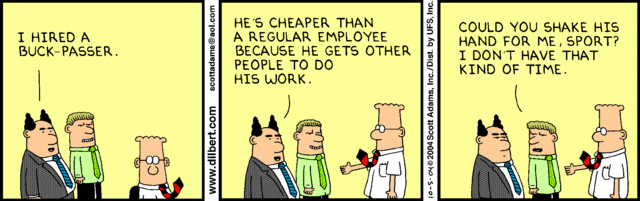
Cartoon – Our Goals vs Their Goals (Totally Different)

https://promarket.org/role-antitrust-free-market-economy/

Opening remarks by Luigi Zingales to the Stigler Center conference: “Is There a Concentration Problem in America?”
What is the role of antitrust in a free-market economy? Historically, economists have been divided on this point. Even Milton Friedman himself admits to having changed his views, turning from a “great supporter of antitrust laws” to “the conclusion that antitrust laws do far more harm than good.” Any economic analysis of the costs and benefits of antitrust enforcement, however, must start from the empirical evidence on the existence of a concentration problem and its potential effects.
Overall, in the last twenty years these questions have received relatively little attention, and the presumption that concentration was not an issue prevailed. Not so in the past year. Starting with a report from the Council of Economic Advisers and an article in The Economist, concerns about an increase in concentration began to surface in the public debate.
Yet, we know that all concentration measures have great shortcomings. Thus, these measures alone cannot be used to infer that there is a concentration problem in America. The more important question is whether this possible increase in concentration has translated into an increase in firms’ market power and whether this increase in market power has caused major welfare distortion.
To try and answer these questions, we decided to bring together world experts on these topics in a conference organized by the Stigler Center. In preparation for this conference, the Stigler Center’s blog ProMarket, has gathered the opinions of many of these world experts. We collect them here for convenience of the conference participants. We hope they can help as stimuli for an ample and lively debate during the conference.
https://promarket.org/antitrust-labor-market-protectionist-pro-competitive/

Redirecting antitrust enforcement to confront monopsony power would be a substantial departure from the way it has been conducted in recent decades, but just because a policy has been in place for a long time does not mean it is a success, and recent evidence implies a significant policy change is necessary and justified.
The very first sentence of the United States submission to the OECD’s “Global Forum on Competition” in 2015 reads “The U.S. Federal Trade Commission and the Antitrust Division of the Department of Justice do not consider employment or other non-competition factors in their antitrust analysis.”
Employment isn’t a “competition factor?” A growing body of evidence, drawn from both micro and macro sources, implies that the labor market has been slack since the Great Recession thanks to an aggregate demand shortfall. The employment-to-population ratio, labor force participation, job-to-job and geographic mobility, and the job ladder as a whole have all stagnated for almost a decade, and even before 2008 these indicators had barely made up ground since the recession of the early 2000s. Wages have been stagnant, and thus the labor share of national income has been in decline.
Over an even longer period, worker compensation has failed to keep pace with productivity gains per capita. The broadening literature on the rise of earnings inequality between firms, controlling for worker characteristics, implies that workers do not receive sufficient job offers to equalize the earnings they receive across firms. All of these phenomena are explained by rising monopsony power in the labor market.
The recent paper by De Loecker and Eeckhout makes this point explicit: the ability of employers to extract rents in the labor market causes a reduction in the market demand for labor, and this in turn motivates all of the manifestations of a slack labor market just described, as well as the rising markups that are the central finding of that paper. Profits have risen, reflecting rising market power in both labor and product markets—a finding that is consistent with the aggregate analysis done by Barkai.
So if monopsony power constrains employment, why not consider it a factor in antitrust analysis? After all, the premise of economic analysis in antitrust is that market power threatens welfare by restricting output and raising prices. Why doesn’t market power threaten welfare by reducing demand for labor and lowering wages?
Existing antitrust policy treats maximizing consumer welfare as the ultimate end goal of antitrust policy, and that policy aim makes sense in a world of little market power, where profits are low and the economy is assumed to be on its production possibility frontier. In that world, maximizing consumer welfare is a suitable summary statistic for overall wellbeing.
Moreover, since the revolution in antitrust policy associated with Robert Bork put such an emphasis on sustaining an “economies” defense—meaning that potentially efficiency-enhancing aspects of corporate mergers and conduct must be weighed against inefficiencies arising from market power—the potential for monopsony power has been considered a plus. After all, enforcers and courts generally assumed that any gains at the expense of workers would be passed to consumers in the form of lower prices, since product markets would be competitive (and if not, the potential for entry would exert a disciplining influence). In that world, caring about employment, wages, or other labor market outcomes looks like protectionism, impeding the competitive pressure that yields the best outcomes for consumers, and favoring certain privileged “insider” workers at the expense of others.
We know now that we don’t live in that world, and that revelation calls for a wholesale re-think of the proper goals of antitrust policy, very much including whether the sole focus on consumer welfare makes sense when powerful corporations squeeze workers and then pocket the gains for themselves and their shareholders.
What would it actually look like to bring antitrust into the labor market?
As with any enforcement regime, antitrust often starts with the lowest-hanging fruit: out-and-out written evidence of anti-competitive practices, such as the Justice Department’s 2010 lawsuit against Silicon Valley employers for colluding not to hire one another’s programmers. This is partly why the recent increase in the use of non-compete clauses has drawn attention in antitrust circles. As a would-be vertical restraint, non-compete clauses aren’t as easy to target under antitrust as horizontal collusion, but they are there, in writing—prohibitions on competition in the labor market, to the benefit of employers. And they should be banned, or at the very least subjected to a high burden of proof requiring a substantive defense on the part of employers who impose them, plus an affirmative finding that they do not act to reduce wages or restrict job offers.
The same dynamic is at play in prohibitions on poaching in franchising agreements, which Alan Krueger and Orley Ashenfelter recently found to be prevalent in franchising contracts and which, to my knowledge, the federal competition regulators have never touched—even though they do regulate other provisions of those contracts. Franchising networks are a hybrid beast, somewhere between horizontal and vertical, but a blanket prohibition on poaching throughout a franchisor’s network certainly starts to look like a horizontal agreement not to compete.
It’s important to understand, though, that these written restraints of trade are symptoms of the broader decline in worker power, and meaningful antitrust enforcement should go after the causes. Reclassification of workers as independent contractors is a broader concern—not only anti-competitive in itself, but as a means to engage in other coercive conduct and corporate structures. Studies show that reclassifications result in immediate wage reductions and no other changes in terms of employment, suggesting that they amount to employer’s exploiting their wage-setting power by changing the legal structure of their business.
And beyond the act itself, classifying workers as independent contractors allows employers to avoid liability for minimum wage, maximum hours, workplace safety, and a host of other entitlements associated with statutory employment. The idea was that employment inherently signifies control, and with control ought to come responsibility—and by extension, if employers do not bear responsibility, then they should not be able to exercise control. What employers have realized now, as enforcement regimes in both labor and antitrust have weakened, is that they can have the control without the responsibility. For example, contracting terms often prevent workers from simultaneously working for others—an exercise of control if ever there was one, and an anti-competitive vertical restraint in the context of an independent contractor.
Employers can have that control without first establishing themselves as a monopoly—in fact, reclassification is increasingly standard operating procedure in many industries, which means that treating it as a violation of Section 2 of the Sherman Act should not require that outright monopolization must first be shown.
This is the fundamental issue behind the litigation over whether Uber’s drivers ought to be considered employees, and if not, whether the business amounts to a price-fixing conspiracy between the company and hundreds of thousands of independent businesses who drive for it. I’ve written before about the antitrust lawsuit against Uber on these grounds. The case was recently dealt a severe blow in the form of an appellate ruling that upheld the company’s mandatory arbitration clause—meaning that if the lower court decides Uber did not itself void the arbitration clause by hastening the case with a move to summary judgment, then the case will likely be thrown out of court.
That brings us to yet another way in which employers exercise monopsony power: mandatory arbitration and class action waivers for employment claims, about which the Supreme Court is set to hear a case this term. The issue there is that expansive readings of the Federal Arbitration Act have essentially said that individual rights protected by both the constitution and federal statute can be voided by bilateral waivers—as though the parties are equally situated and at liberty to reject such provisions in employment agreements and elsewhere. Of course, the whole point of monopsony is that jobs are scarce, and hence employers have leverage with which to extract concessions, be they out-and-out wage reductions or agreements not to litigate disputes. Thus, another aim of antitrust enforcement in labor markets ought to be bans on litigation waivers between parties that are not similarly situated economically as restraints of trade—and the competition authorities ought to make their views known to the Supreme Court on this issue. After all, private action is a pillar of federal antitrust policy, and so arbitration clauses are not just themselves restraints of trade, but they also inhibit enforcement against other restraints, as the fate of the Uber antitrust case shows.
Finally, there’s the elephant in the room when it comes to antitrust: merger review, the bulk of what the agencies do about enforcing the laws they’re entrusted to carry out. Claims that mergers reduce employment are not entertained as arguments against them—in fact, they are likely to be considered arguments in favor, as they show some motivation for the transaction beyond raising prices for consumers. And yet we know anecdotally that recently-consummated mergers have in fact had adverse employment impacts. A systematic study of the labor market impact of past mergers has yet to be conducted, to my knowledge—such an exercise would be a valuable component of assessing the impact and success of the current competition policy regime, including whether these job losses do actually end up benefiting consumers in the form of lower prices, as merging parties invariably claim, versus their shareholders and executives.
In conclusion, the view that the competition authorities expressed to the OECD in 2015 looks increasingly out of touch with the labor market and the broader macroeconomic conditions that currently exist. It is true that redirecting antitrust enforcement to confront monopsony power would be a substantial departure from the way it has been conducted in recent decades, and as such there are both court decisions and agency policies that go against it. But just because a policy has been in place for a long time does not mean it is a success, and recent evidence implies a significant policy change is necessary and justified—much as an intellectual movement in academia once shifted antitrust policy substantially, it’s time for new evidence to change it once again.
https://psmag.com/news/health-insurance-senate-money-connections

On average, senators who don’t support Bernie Sanders’ single-payer plan received more money from insurance companies.
Senator Bernie Sanders introduced a radical bill last week that would overhaul America’s health-insurance system. The Medicare for All Act of 2017 would turn the American government into the country’s only payer—besides individuals—for health care. While the bill has virtually no chance of passing the Republican-controlled Congress, it’s still symbolically important because it shows the Democrats’ shift to the left on health care. Case in point: The last time Sanders (I-Vermont) introduced a similar bill, in 2013, he wasn’t able to garner a single co-sponsor; this time, 16 Democratic senators signed on as co-sponsors.
What’s driving this change of heart? According to University of Southern California political scientist Christian Grose, many of these co-signers are thought to have presidential ambitions and therefore may be “trying to peel off some support from Bernie Sanders voters were they to run in 2020,” he writes in an email. In addition, the number of Americans who say they want to have a single-payer health-care system is growing, although they remain in the minority.
Might other interests be at work as well? MapLight, a non-profit that tracks how campaign donations affect politicians’ voting, ran the numbers to see how much accident- and health-insurance companies have donated to sitting senators in their most recent election campaigns. Pacific Standard re-ran MapLight’s analysis using the organization’s “Find Contributions” tool and came up with similar results: On average, senators who didn’t sign Medicare for All received about $48,000 from these industries between November of 2010 and November of 2016. That’s nearly twice as much as the 17 senators who signed it, who received an average of $27,000. Democratic senators who didn’t sign on received an average of more than twice as much in donations as Sanders and his 16 co-signers: $56,500. You can see our full results below:
Of course, these numbers don’t show the whole picture. It’s very difficult to track all the ways a company can donate to a political candidate. MapLight analysts sought to identify donations from companies, company employees, and relevant political action committees, but they may have missed some major contributions. “The money is more than likely grossly undercounted,” says Paul Jorgensen, a political scientist who studies campaign finance at the University of Texas–Rio Grande Valley and is not involved with MapLight. “What it may not account for are the other committees that those sitting senators will be a part of that receive cash. The committee system in Congress is very complicated and the flow of money is very complicated. Just looking at the primary campaign committee is not sufficient for looking at an aggregate of campaign donations.” Candidates may receive support from super political action committees, or super PACs, run by their party leadership, for example, which wouldn’t show up in the data MapLight uses, which is drawn from the Center for Responsive Politics.
It’s possible that the ratios we found—twice as much money given to Medicare for All’s non-supporters—might be different in a full accounting of donations. Still, nearly all of the political scientists Pacific Standard consulted thought it was reasonable to report these numbers as a rough estimate of industry money involved in the Senate’s votes on health care. They also said the ratios are plausible and, if correct, significant. (Jorgensen was the exception because he thought the undercount might be so severe.)
These numbers don’t prove that industry donations made senators not support Medicare for All. To argue that, analysts would have to rule out other reasons senators may not support the bill, such as their personal ideologies or the desires of their constituents. Plus, the line of reasoning may run the other way. “It’s just as likely that these senators were openly unfriendly to legislation such as the Sanders bill and that that is why the industry donated to them in the first place,” George Mason University political scientist Jennifer Nicoll Victor writes in an email. “The reason for the donation isn’t to ‘corrupt’ the senator or to buy their position on a bill, rather the donation is more like an expression of commonality, friendship, or alliance because they already agree with one another.”
There’s other evidence that shows money influences votes, at least for other bills. Jorgensen himself worked on a white paper for the Roosevelt Institute, a think tank that supports stricter regulation on business, that linked industry donations to congressional votes on the Dodd-Frank Act. MapLight’s analysis isn’t set up to make that same argument for Sanders’ Medicare for All Act. MapLight spokesman Alec Saslow admits as much, but adds, “At a minimum, the outsized influence of money in politics gives the public reasonable cause to question our lawmakers’ motivations.”

On September 13, Senators Graham and Cassidy, together with two other Republican colleagues, introduced legislation that would repeal major portions of the Affordable Care Act (ACA). Press reports indicate that the legislation has gained considerable support among Senate Republicans, and Senate Majority Leader McConnell’s office announced on Wednesday that the Senate would hold a vote on this legislation sometime during the week of September 25.
This legislation has not yet been analyzed by the Congressional Budget Office (CBO), and CBO has indicated that it will not be able to provide a complete analysis of the legislation before the Senate vote. Notably, CBO stated that its analysis would not include “point estimates of [the Graham-Cassidy legislation’s] effects on the deficit, health insurance coverage, or premiums.” To help fill the gap left by the Senate’s decision to hold a vote in the absence of a complete CBO analysis, this analysis draws upon CBO’s estimates for prior legislation to evaluate how the Graham-Cassidy legislation might affect the number of people with health insurance coverage.
Starting in 2020, the Graham-Cassidy proposal would eliminate the ACA’s Medicaid expansion and Marketplace subsidies. Also in that year, the legislation would begin providing block grant funding to states, as well as allowing states to seek waivers from ACA regulations that bar insurers from varying premiums based on health status and require insurers to cover certain health care services.For years prior to 2020, this new legislation broadly tracks prior Republican bills, most importantly by immediately repealing the individual mandate. CBO’s analyses of these prior bills imply that the Graham-Cassidy legislation would reduce insurance coverage by around 15 million in 2018 and 2019. The reduction would be larger if uncertainty about the effects of the more radical changes implemented by the legislation in 2020 caused some insurers to pre-emptively withdraw from the individual market.
To estimate the effects on insurance coverage during these years, we consider the various ways in which states might respond to the options provided by the legislation, using prior CBO analyses to evaluate the likely coverage outcomes for each of four broad categories of states. We then make assumptions about how many states will take each broad policy approach.
Based on this analysis, we estimate that the Graham-Cassidy legislation would reduce the number of people with insurance coverage by around 21 million each year during the 2020 through 2026 period. This estimate likely understates the reductions in insurance coverage that would actually occur under the Graham-Cassidy legislation, particularly toward the beginning and end of the seven-year period, because it does not account for the challenges states will face in setting up new programs on the bill’s proposed timeline, the possibility that uncertainty about the program’s future will cause market turmoil toward the end of the seven-year period, or the bill’s Medicaid per capita cap and other non-expansion-related Medicaid provisions. These estimates are, of course, subject to considerable uncertainty, most importantly because predicting how states would respond to the dramatic changes in the policy environment under the Graham-Cassidy proposal is very challenging. What is clear, however, is that the legislation would result in very large reductions in insurance coverage.
Based on this analysis, we estimate that the Graham-Cassidy legislation would reduce the number of people with insurance coverage by around 21 million each year during the 2020 through 2026 period.
The Graham-Cassidy legislation’s adverse effects on insurance coverage are likely to increase after its block grant funding expires at the end of 2026. After that time, the legislation is similar to the “repeal and delay” proposal that the Senate considered in July, which CBO estimated would reduce the number of people with insurance coverage by 32 million people in the long run. Reductions in insurance coverage would likely be somewhat larger under the Graham-Cassidy proposal because of the legislation’s non-expansion related Medicaid provisions, which would further reduce insurance coverage

We had a whole other video planned for today but we have to talk about the Cassidy-Graham bill, which is getting closer to passing despite our predictions last week.
The only option left to the Senate is to make health care reform someone else’s problem
I wish I had more time to blog. I really do. But I’m consumed with grant submissions, mentoring researchers, and writing columns about health policy because it’s clear that someone’s got to do it.
That said, I’m taking ten minutes out of my day here to rant. Read it or don’t.
If it hasn’t become abundantly clear, the only thing left for Republican Senators to try is to kick the can down the road. Again. They’re going to try and pass a bill which gives less money overall to states, a lot less money to some states, and then tells them to “figure it out”. Later, they can claim that they gave the states all the tools they needed to fix the health care system, so now it’s THEIR fault things don’t work.
This is ridiculous.
There is no magic. There is no innovation. If there was a way to make the health care system broader, cheaper, and better, we would do it right now. We would have done it years ago. No matter what you may think of Democrats in 2009, they didn’t choose the ACA because they wanted to keep states from fixing the health care system. The ACA was the best they could get.
There are no governors, of red or blue states, who have a magic plan for health care innovation. There are no state legislators (who likely work part-time) who have a secret plan to unleash the power of federalism. The Republicans in Congress have had seven years, all the money in the world, the phone numbers of every conservative wonk in the country, the CBO, experts eager to offer their help… If they couldn’t figure this out, do they think that Montana will? Oklahoma? Indiana? In less than two years?
THERE IS NO WAY TO SPEND LESS, COVER MORE, AND MAKE IT BETTER.
Pretty much every health care organization is against this bill. The organization of Medicaid directors is against this bill. Most governors are against this bill. Nearly every wonk I can think of is against this bill.
There are legitimate ways to reform the health care system according to conservative principles. They all involve tradeoffs. The people defending this bill refuse to acknowledge that. Many are – at this point – seemingly just making stuff up and promising the moon. And – I’ll bet all the money in my pocket on this – when they can’t deliver, it’s going to be someone else’s fault.

https://www.yahoo.com/news/trump-lashes-gop-opponents-health-care-bill-110647029–politics.html

“I cannot in good conscience vote for the Graham-Cassidy proposal,” McCain said in a statement, referring to the bill by Sens. Lindsey Graham of South Carolina and Bill Cassidy of Louisiana.
“I believe we could do better working together, Republicans and Democrats, and have not yet really tried,” he said. “Nor could I support it without knowing how much it will cost, how it will affect insurance premiums, and how many people will be helped or hurt by it.”
McCain was the decisive vote against the GOP’s last repeal effort, in July. Once again, the 81-year-old senator, battling brain cancer in the twilight of a remarkable career, emerged as the destroyer of his own party’s signature promise to voters.
President Donald Trump and Senate Majority Leader Mitch McConnell had both been pushing hard for the bill in recent days, and McCain’s best friend in the Senate, Graham, was an author. Trump declared during the presidential campaign that he would quickly demolish Obamacare and “it will be easy.”
McCain’s announcement likely leaves GOP leaders at least one vote short for the bill, which they had hoped to bring to the floor next week. They face a Sept. 30 deadline for action on the legislation, at which point special rules that prevent a Democratic filibuster will expire.
Democrats are unanimously opposed. GOP Sen. Rand Paul of Kentucky has announced his opposition and GOP Sen. Susan Collins of Maine said Friday she, too, was leaning against supporting the bill.
Along with McCain, that would leave Republicans with only 49 votes for the bill; they would need 50, plus Vice President Mike Pence to break a tie, in order to prevail.
The Graham-Cassidy bill would repeal major pillars of former President Barack Obama’s law, replacing them with block grants to states to design their own programs. Major medical groups are opposed, saying millions would lose insurance coverage and protections.

