Rival Senate healthcare group seeks to make waves

Rival Senate healthcare group seeks to make waves

Image result for aca repeal

A rival group of Republican senators is seeking leverage to influence the direction of the Senate’s ObamaCare replacement bill.

The group, led by Sens. Susan Collins (R-Maine) and Bill Cassidy (R-La.), has been meeting “a couple times a week,” according to Sen. Shelly Moore Capitol (R-W.Va.).

Cassidy is a physician and Collins is a former state insurance commissioner. Both have been outspoken opponents of the House-passed American Healthcare Act, and have co-sponsored their own version of an ObamaCare repeal bill called the Patient Freedom Act.

Cassidy told The Hill he and Collins have been meeting with Senate leaders to talk about their legislation. However, he noted the politics of the Senate mean that every member’s voice matters.

“When you only have 52 senators, everybody has significant leverage. That tight vote margin means everyone is essential,” Cassidy said.

The main GOP working group on healthcare includes 13 men backed by Senate leadership who are seeking to bridge the divide between conservatives and centrists.

What ever legislation emerges from that group is likely to be the bill that comes to the Senate floor.

But if all of the Senate’s Democrats oppose the measure, Senate Majority Leader Mitch McConnell (R-Ky.) will only be able to afford two defections.

That gives the other group leverage.

“Let’s look at it practically,” Capito  told The Hill. “You can only lose two votes on any one issue … so I think a bloc of four or five can be very effective.”

Health lobbyists have noted many members of the leadership-led group have been fairly measured in their criticisms of the House bill approved earlier this month.

Collins and Cassidy, in contrast, both seem keen on turning sharply from the House bill.

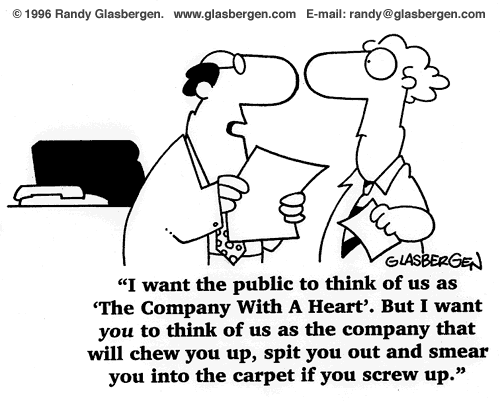
5 WAYS TO SUCCEED WITH AN INFLEXIBLE PIGHEADED BOSS

5 Ways to Succeed with an Inflexible Pigheaded Boss

If you’re flexible, rigid people seem pigheaded, narrow minded, and self-centered. Why can’t everyone be flexible like you?

Rigid people drive the train:

If you have an inflexible boss or team member, they always drive the train.

  1. Fear of offending them controls interactions.
  2. Tough conversations always go one way. Everything is about winning or losing.
  3. Violating the “rules” is a capital offense. Throwing people under the bus may become a means of control.

Change, innovation, and progress slow to a snail’s pace when rigid people drive the train.

Stability:

Stability is the advantage of rigidity.

Organizations need rigid people even if some think they’re evil. You don’t need the dark-side of their strength. But without them, inconsistency escalates into instability.

Sure, they stress themselves and others. They complain about missed commons. But, they’re great at following procedures and delivering consistent results.

Inflexible people love systems that prevent failure.

Navigation tips:

What if your boss is inflexible?

  1. Adapt to them. They won’t adapt to you. No one likes to be changed – especially an inflexible boss. They’ll lash out like caged animals if you pressure them.
  2. Admire their strengths and say so. Say, “Your personal consistency brings stability and consistency to our organization.”
  3. Accept, embrace, and answer their discomforts or fears. Telling them that things will work out drives rigid people crazy.
  4. Prepare them for change.  Don’t surprise them. Discuss problems before solutions.
  5. Establish rituals and routines. Don’t addd stress to their stressful lives.

What suggestions do you have for navigating an inflexible boss or teammate?

Why do CEOs get fired or leave organizations anyway?

https://interimcfo.wordpress.com/2015/01/09/why-do-ceos-get-fired-or-leave-organizations-anyway/

In my previous post, I made reference to comments written by ‘TiredofTheOverpaidFailures’ in response to a Becker Review article.

Among other things, this writer said, “As a healthcare staffer for 35 years from entry-level employee to Director, I’ve literally never seen any CFO or CEO leave our organizations for any reason other than to “spend more time with my family”.  It’s true, because in every case they collected an inflated golden parachute for the next 2-3 years and indeed manage to take off time to spend with their family or most of the time do part-time consulting at some other organization where they have no idea the horrific failure they were in the previous position. For that matter, what shape they left the organization in.  They usually consider them “the expert” because they are from somewhere else.”

Clearly, he or she  was very bitter about what they had observed in the front office of their organization over a long period of time.

It is true that some of the folks occupying C-suite offices are not that stellar but more often than not, when they leave it is rarely because they are an idiot.  The system does a pretty good job of weeding out idiots before they can reach positions of such power and influence although I have seen a number of suspects among the casts of characters I have dealt with in healthcare administration.  So if the CEO is not an idiot, why let him go?  I will discuss a variety of situations that I have seen that I believe explain in part why CEO turnover in healthcare is so high.

I frequently hear complaints about what a Board is and is not doing with respect to the organization and the CEO.  A healthcare organization is not much different from a professional sports team.  The Board is the owner and the CEO is the coach.  In the end, like a sports team, the Board only has one switch or lever to use to guide the organization; hire the coach or fire the coach.  As long as the Board has not decided to fire the coach (CEO), by default they are supporting or at least tolerating him.  He is still their guy until the notice is delivered which can happen on the same date that an incentive award is given.  If you do not like what you see the CEO doing, it is not necessarily his fault.  Look to the Board for responsibility for the actions and results of their CEO.

7 Enemies of Organizational Health

http://www.leadershipdigital.com/edition/daily-leadership-management-2017-05-10?open-article-id=6560474&article-title=leading-with-control-versus-leading-with-influence&blog-domain=ronedmondson.com&blog-title=ron-edmondson

I love organizational leadership. I especially love attempting to lead healthy organizations. I have been in both environments – healthy and non-healthy. I prefer healthy.

If truth be told, I’ve probably been the leader in both extremes. And, there are seasons when every organization is healthier than others.

Over the years of leading I’ve observed a few things which can be the enemy of organizational health. They keep health from happening and – if not dealt with – can eventually destroy an organization – even a local church.

Here are 7 enemies of organizational health:

Shortcuts – There are no shortcuts to creating a healthy organization. I’ve known leaders who think they can read a book, attend a conference, or say something persuasive enough so everything turns out wonderful. Organizational health is much more complicated. Success is not earned through a simple, easy-to-follow formula. It takes hard work, diligence and longevity. Leaders must be committed to the process through good times and bad.

Satisfaction – Resting on past success is a disruption to future growth, which ultimately impacts organizational health. When an organization gets too comfortable – boredom, complacency and indifference are common results. The overall vision must be attainable in short wins, but stretching enough to always have something new to achieve.

Selfishness – Organizational health requires a team environment. There’s no place for selfishness in this equation. When everyone is looking out for themselves instead of the interest of the entire organization – and this starts with the leader – the health is quickly in jeopardy.

Sinfulness – This one is added for those who feel every one of my posts must be spiritual. (Just kidding.) Seriously, healthy organizations are not perfect (and we all sin), but it doesn’t matter if it is gossip or adultery – sin ravages through the integrity of the organization. When moral corruption enters the mix, and is not addressed, the health of an organization will soon suffer. This is why it is so important a leader stays healthy spiritually, relationally and physically.

Sluggishness – Change is an important part of organizational health. In a rapidly changing world, organizations must act quickly to adapt when needed. Some things never change, such as vision and values, but the activities to reach them must be fluid enough to adjust with swiftness and efficiency.

Stubbornness – Let me be clear. There are some things to be stubborn about, again, such as vision and values. When the organization or it’s leaders are stubborn about having things “their way”, however, or resistant to adopt new ways of accomplishing the same vision, the health of the organization will suffer. Most people struggle to follow stubborn leadership, especially when it’s protecting self-interest rather than organizational interests.

Structure – As much as we need structure, and even though we should always be working to add better structure, bad structure can be damaging to organizational health. When people feel they are being controlled by rules, more than empowered by their individuality and passions, progress is minimized and growth stalls. People become frustrated under needless or burdensome structure.

What enemies of organizational health would you add to my list?

Leading with Control Versus Leading with Influence

http://www.leadershipdigital.com/edition/daily-leadership-management-2017-05-10?open-article-id=6560474&article-title=leading-with-control-versus-leading-with-influence&blog-domain=ronedmondson.com&blog-title=ron-edmondson

Let me be honest. I can be a controlling person. It’s part of my character. I know that. I test that way with StrengthsFinders. If no one is taking charge, I’ll take over the room. (And, not because I’m extroverted. I’m not.) If we both come to a four-way stop at the same time – as nice as I try to be and as much as I love others – I won’t stall long for you to decide if you’re going. It’s just how I’m wired. If the leader isn’t in the room, I’ll lead.

I think my team, however – or at least I hope – would tell you I don’t perform as a controlling leader. Some may even wish I controlled more. It’s been a long process to discipline myself not to respond how I am naturally inclined to do.

Leaders, if you want to to have a healthy team environment, you must learn to control less and influence more. The differences are measured in the results of creating a healthy team.

I have learned thought that successful leaders understands the difference in leading with influence and leading with control.

Here’s what I mean by the results of controlling versus influence:

In an organization where control is dominant:

  • The leader’s ideas win over the team’s ideas – every time.
  • The team follows, but only out of necessity (for a paycheck) – not willingly.
  • Change happens through fear and intimidation – not motivation.
  • People are managed closely – rather than led.
  • Team members feel unappreciated and often under-utilized – rather than empowered.
  • The organization is limited to the skills and ability of the controlling leader – not the strength of a team.
  • Passion is weak – burnout is common.

But,

In an organization where influence is dominant:

  • The ultimate goal is what’s best for the organization, not an individual.
  • Team spirit develops as relationships and trust grow.
  • Willing followers, and other leaders, are attracted to the team.
  • Leadership recruitment and development is a continued endeavor.
  • Change is promoted through desire and motivation, not obligation.
  • The organization has the expanded resources of a team of unique individuals.
  • People feel empowered and appreciated.

Leaders, take your pick – control or influence. You can’t have it both ways. One will always be more dominant. Granted, I could write a whole blog post (and, I have) on the messiness of leading by influence. There will often be confusion, lack of clarity, and misunderstandings. It comes when all the rules aren’t clearly defined. This, however, is a tension to be managed not a problem to be solved. (I think Andy Stanley said that first.)

When it comes to creating organizational health – influence will always trump control. Every time.

Have you ever been or worked for a controlling leader?

Have you been in an environment where influence is dominant?

Which did you prefer?