


Cartoon – Privatized Medicare


| Key Takeaways |
This brief describes the role that Medicaid plays for 10 million Medicare beneficiaries to help inform upcoming debates about proposals to restructure Medicaid financing in ways that could reduce federal funding.What is Medicaid’s Role for Medicare Beneficiaries?
Who are the Medicare Beneficiaries Who Receive Medicaid?
How Much Does Medicaid Spend on Medicare Beneficiaries?
|
Because Medicaid spending for Medicare beneficiaries is disproportionate to their enrollment, policy changes that lead states to limit per enrollee Medicaid spending or cut costly services could especially affect these beneficiaries. Medicare beneficiaries who receive Medicaid are poorer than other Medicare beneficiaries, and many have intensive medical and long-term care needs as a result of old age, disability, and chronic illness. Medicare beneficiaries rely on Medicaid to cover expensive but necessary services, especially long-term care in the community and nursing homes, that are generally not available through Medicare or private insurance. They also depend on Medicaid to make Medicare affordable because Medicare’s out-of-pocket costs can be high for those with low incomes. In addition, because the share of state Medicaid budgets devoted to Medicare beneficiaries varies by state, any changes that limit federal Medicaid financing will impact individual states differently. Because changes to Medicaid’s financing structure could have significant consequences for enrollees and states, the potential implications warrant careful consideration for their impact on Medicare beneficiaries.
Pre-ACA Market Practices Provide Lessons for ACA Replacement Approaches

Significant changes to the Affordable Care Act (ACA) are being considered by lawmakers who have been critical of its general approach to providing coverage and to some of its key provisions. An important area where changes will be considered has to do with how people with health problems would be able to gain and keep access to coverage and how much they may have to pay for it. People’s health is dynamic. At any given time, an estimated 27% of non-elderly adults have health conditions that would make them ineligible for coverage under traditional non-group underwriting standards that existed prior to the ACA. Over their lifetimes, everyone is at risk of having these periods, some short and some that last for the rest of their lives.
One of the biggest changes that the ACA made to the non-group insurance market was to eliminate consideration by insurers of a person’s health or health history in enrollment and rating decisions. This assured that people who had or who developed health problems would have the same plan choices and pay the same premiums as others, essentially pooling their expected costs together to determine the premiums that all would pay.
Proposals for replacing the ACA such as Rep. Tom Price’s Empowering Patients First Act and Speaker Paul Ryan’s “A Better Way” policy paper would repeal these insurance market rules, moving back towards pre-ACA standards where insurers generally had more leeway to use individual health in enrollment and rating for non-group coverage.1 Under these proposals, people without pre-existing conditions would generally be able to purchase coverage anytime from private insurers. For people with health problems, several approaches have been proposed: (1) requiring insurers to accept people transitioning from previous coverage without a gap (“continuously covered”); (2) allowing insurers to charge higher premiums (within limits) to people with pre-existing conditions who have had a gap in coverage; and (3) establishing high-risk pools, which are public programs that provide coverage to people declined by private insurers.
The idea of assuring access to coverage for people with health problems is a popular one, but doing so is a challenge within a market framework where insurers have considerable flexibility over enrollment, rating and benefits. People with health conditions have much higher expected health costs than people without them (Table 1 illustrates average costs of individuals with and without “deniable” health conditions). Insurers naturally will decline applicants with health issues and will adjust rates for new and existing enrollees to reflect their health when they can. Assuring access for people with pre-existing conditions with limits on their premiums means that someone has to pay the difference between their premiums and their costs. For people enrolling in high-risk pools, some ACA replacement proposals provide for federal grants to states, though the amounts may not be sufficient. For people gaining access through continuous coverage provisions, these costs would likely be paid by pooling their costs with (i.e., charging more to) other enrollees. Maintaining this pooling is difficult, however, when insurers have significant flexibility over rates and benefits. Experience from the pre-ACA market shows how insurers were able to use a variety of strategies to charge higher premiums to people with health problems, even when those problems began after the person enrolled in their plan. These practices can make getting or keeping coverage unaffordable.
There were many aspects of the pre-ACA non-group market that made it difficult for people with health problems to get and keep non-group coverage. Any proposal for replacing the ACA will have to determine which, if any, of these previous insurance practices will once again be permitted. Medical screening was the most obvious barrier, combined with high premium costs for people who were HIPAA-eligible. Even people who purchased coverage when they were healthy sometimes were unable to keep it because certain rating approaches could cause their premiums to spiral. Returning to a less structured, less regulated non-group market raises questions about how people with health problems will be treated in terms of access to and cost of coverage. Health insurance underwriting and rating is complex, and reviewing how the pre-ACA market operated provides information about the types of issues that people with health problems may confront if the ACA market structure is replaced.
http://kff.org/medicaid/issue-brief/understanding-the-intersection-of-medicaid-and-work/

Medicaid is the nation’s public health insurance program for people with low incomes. Overall, the Medicaid program covers more than 70 million Americans, or 1 in 5, including many with complex and costly needs for care. Historically, nonelderly, non-disabled adults accounted for a small share (27%) of Medicaid enrollees; however, the enactment and implementation of the Affordable Care Act (ACA) has expanded coverage to nonelderly adults with income up to 138% FPL, or $16,394 for an individual in 2016. As of January 2017, 32 states have implemented the ACA Medicaid expansion. By design, the expansion extended coverage to the working poor (both parents and childless adults), most of whom do not otherwise have access to affordable coverage. With the expansion to more “able-bodied” adults, questions have arisen about tying work to eligibility.
President Trump may consider waiver proposals with a work requirement, and the Administration and leaders in Congress are considering proposals to repeal the ACA and to transform Medicaid from an entitlement program with guaranteed federal matching dollars for states to a block grant with no entitlement and capped funding. Such proposals would grant states additional flexibility to design and administer their programs and potentially include an option to allow states to impose a work requirement for Medicaid beneficiaries, which is not allowed under current law. This issue brief examines the work status of non-elderly, non-disabled adults with Medicaid coverage to understand the potential implications of work requirement proposals in Medicaid.
| Key Takeaways |
This brief provides an overview of work status of non-disabled, adult Medicaid enrollees and examines some of the policy proposals around tying Medicaid coverage to work.
|
Compare Key Elements of ACA Repeal and Replace Proposals with New Interactive Tool
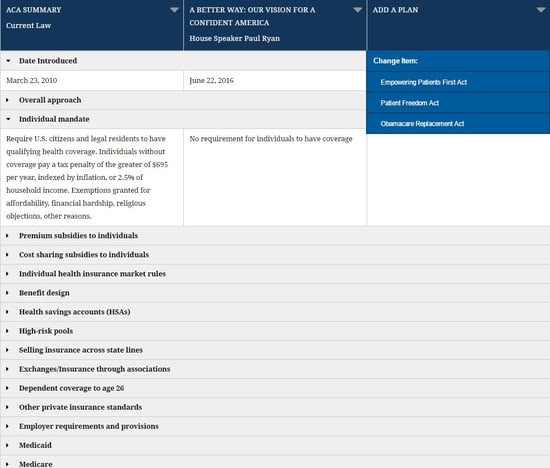
President Trump and Republicans in Congress have committed to repealing and replacing the Affordable Care Act. A new interactive tool from the Kaiser Family Foundation enables users to create side-by-side comparisons of major ACA alternative plans, now including 2017 proposals from Sen. Rand Paul and from Sen. Bill Cassidy.
With the tool, users can compare the plans’ approaches to more than a dozen key areas of health policy, including individual insurance market rules, requirements and provisions for employers, benefit design, Medicaid, and Medicare.
Detailed summaries of the Affordable Care Act and the following proposals are included:
Summaries of major new plans and updates to existing proposals will be added as they’re introduced.


