I’ve been at thisfor so long and have seen so much. And it’s hard to overstate how significant the latest revelations from The Wall Street Journal are. According to its reporting, the U.S. Department of Justice’s criminal health care-fraud unit is questioning former UnitedHealth Group employees about the company’s Medicare billing practices regarding how the company records diagnoses that trigger higher payments from taxpayers.
For years, independent policy experts and *some* regulators have warned that the private Medicare Advantage program has become a breeding ground for upcoding and tax dollar waste. The tactic being scrutinized by the DOJ is called “upcoding.” Essentially, Medicare Advantage companies have an incentive to “find” new illnesses — even among patients who might not need additional treatment because the more serious the diagnoses, the bigger the government payouts to the company.
According to the Journal, prosecutors, FBI agents, and the Health and Human Services Inspector General have been asking ex-employees about special training for doctors, software that flags profitable conditions, and even bonuses for physicians who recode patient files. One former UnitedHealth doctor told the Journal that prosecutors inquired about pressure to use certain diagnosis codes and bonus pay for certain health care decisions that financially favored UnitedHealth.
The Journal’s data shows that UnitedHealth’s members received certain lucrative diagnoses at higher rates than patients in other Medicare Advantage plans — billions of extra dollars that ultimately come from taxpayers. In one example, they reportedly pulled in about $2,700 more taxpayer dollars per patient visit when nurses went into seniors’ homes to hunt for additional conditions.
In a statement, UnitedHealth insists they “remain focused on what matters most: delivering better outcomes, more benefits, and lower costs for the people we serve.”
This latest criminal investigation joins at least two other DOJ probes into UnitedHealth’s billing and potential antitrust violations. And it’s yet another reminder that the Medicare Advantage program — which, much to many advocates alarm, now covers more than half of all Medicare enrollees – is desperately in need of real oversight.
If there’s any silver lining, it’s that courageous former employees are speaking up. They know what I know: This “profit-maximizing” through “upcoding” and “favorable selection” drains billions that could be better spent on actual patient care and pad Wall Street profits.
The House of Representatives’ reconciliation bill, passed by the powerful Energy and Commerce Committee today, cuts just about everything when it comes to health care – except the actual waste, fraud and abuse. Now the bill heads to the floor for a vote of the full House of Representatives before it must also be passed by the Senate to become law.
I know what you’re thinking: not another story about Medicaid. With the flood of articles detailing the devastating Medicaid cuts proposed by House Republicans —cuts that could strip 8.7 million people of their health coverage — there’s an important fact being overlooked: Members of Congress chose to sidestep policies aimed at reining in Big Insurance abuses and, instead, opted to cut Medicaid.
And the real irony of it all is they could have saved a ton of money if they would just address the elephant in the room.
Abuses by Big Insurance companies have been going on for decades but have only recently come under scrutiny. Insurance companies figured out how to take advantage of the structure of the Medicare Advantage program to receive higher payments from the government.
They do this in two ways:
They make their enrollees seem sicker than they are through a strategy called “upcoding” and;
They use care obstacles such as prior authorization and inadequate provider networks that eventually drive sicker people to drop their plans and leave them with healthier enrollees, referred to as “favorable selection.”
According to the Medicare Payment Advisory Commission (MedPAC) these tactics lead the government to overpay insurance corporations running MA plans by $84 billion a year. This number is expected to grow, and estimates show that overpayments will cost the government more than a $1 trillion from 2025-2034. That is $1 trillion dollars in potential savings Republicans could have included in their bill instead of cutting Medicaid spending that provides care for vulnerable communities.
These overpayments do not lead to better care in MA plans; in fact, research has shown that care quality and outcomes are often worse in MA compared to traditional Medicare. Even worse, these overpayments are tax dollars meant for health care that end up in the pockets of shareholders of big insurance corporations, which spend billions of taxpayer dollars on things like stock buybacks and executive bonuses.
One of the most frustrating parts of the lawmaker’s choice to target Medicaid rather than Big Insurance abuses is that there are multiple policies supported by both Republicans and Democrats to stop these abuses. Sen. Bill Cassidy (R-Louisiana), along with Sen. Jeff Merkley (D-Oregon), have introduced the NO UPCODE Act, which would cut down on the practice of upcoding explained above. President Trump’s Administrator of the Centers for Medicare and Medicaid Services, Dr. Mehmet Oz, said during his confirmation hearing that he supports efforts to crack down on practices used by insurers to upcode. And Rep. Mark Green (R-Tennessee) introduced a bipartisan bill to decrease improper prior authorization denials in MA.
In a somewhat cruel twist, the only mention of Medicare fraud in the Republican reconciliation bill proposals is a section claiming to crack down on improper payments in Medicare Parts A and B (which make up traditional Medicare) by using artificial intelligence.
The total improper payments in TM represent just over one-third of the overpayments going to MA plans each year, and many of the payments flagged as improper in TM are flagged due to missing documentation rather than questionable tactics that MA insurers use.
In reflecting on why Republicans in Congress ignored potential savings from Big Insurance reforms and instead pursued cuts to care for people depending on Medicaid, which do not save as much, my biggest question was, why?
Why would lawmakers swerve around a populist policy right in front of them to stop Big Insurance from profiting off of the federal government to instead propose a regressive policy that targets millions of working Americans and leaves health insurance corporations that make billions in profits each year untouched?
Unfortunately, the answer likely lies in money. Although people enrolled in Medicaid and the Children’s Health Insurance Program (CHIP) make up roughly one-third of the U.S. population, they account for just 0.5% of all political campaign contributions — about $60 million annually. This disparity is likely driven by financial constraints: Many of these individuals are rightly focused on covering basic needs such as housing, food, and childcare, especially as wages have not kept pace with the rising cost of living.
In contrast, the health care sector — which includes major players like big insurance, pharmaceutical and hospital companies—contributed $357 million during the 2020 election cycle, including $97 million to outside groups such as Super PACs. These outside spending groups are largely funded by corporations and wealthy individuals, who represent less than 1% of the population but wield significant political influence.
Super PACs spent more than $2 billion during the 2020 election cycle, amplifying the voices of industry-aligned donors. This stark imbalance in political spending may help explain why congressional proposals targeted Medicaid recipients while leaving the powerful health insurance industry largely untouched.
It is not only Republicans who have failed to stop Big Insurance from taking advantage of federal health programs, Democrats declined to take action when negotiating their health care legislation during President Biden’s term. Rather, it seems to be a failure of policymakers of both parties to pass legislation that makes it clear to Big Insurance that our health care is not an investment opportunity for Wall Street, and the dollars we pay in taxes to support Medicare are not pocket change for executives to use for stock buybacks.
The failure to include MA reform represents a missed opportunity to prioritize patient care over corporate profits. However, the growing strength and voices of patients across the nation will ultimately make it impossible for lawmakers to ignore this issue much longer. With continued momentum, the fight to put patients over Big Insurance profits will succeed.
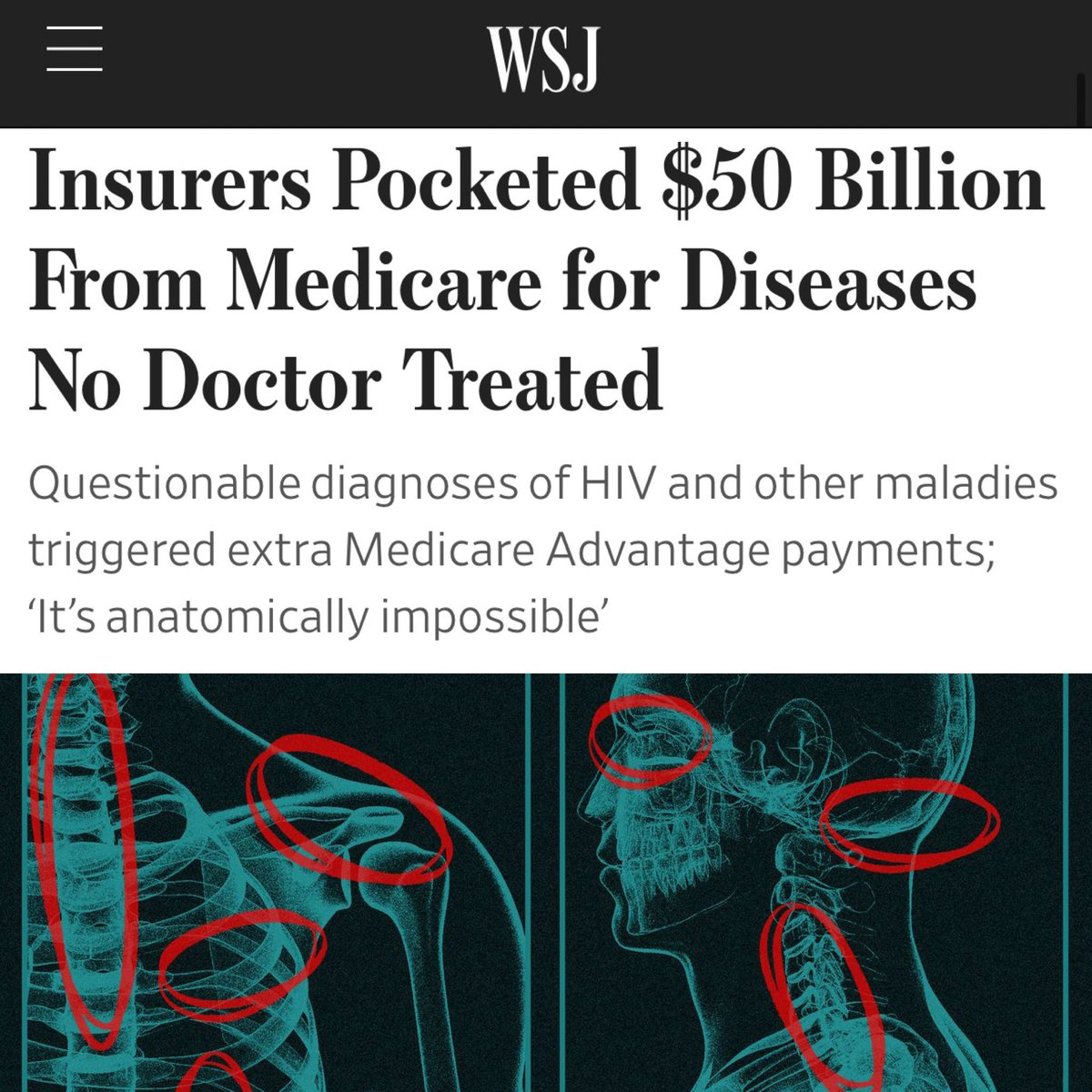
Medicare Advantage plans received $50 billion in payments between 2018 and 2021 for diagnoses insurers added to medical records, a Wall Street Journal investigation published July 8 has found.
The Journal investigated billions of Medicare Advantage records and found that some conditions were diagnosed at a much higher rate among Medicare Advantage beneficiaries than among traditional Medicare beneficiaries. For example, diabetic cataracts were diagnosed much more often among Medicare Advantage beneficiaries than among traditional Medicare beneficiaries, the Journal found.
The federal government pays Medicare Advantage plans a rate per beneficiary based on their diagnoses.
CMS does not reimburse MA plans for beneficiaries with non-diabetic cataracts, a common condition among older adults, according to the Journal. The government does reimburse for diabetic cataracts. CMS paid Medicare Advantage plans more than $700 million for diabetic cataracts diagnoses between 2018 and 2021, the investigation found.
A spokesperson for UnitedHealth, the largest Medicare Advantage insurer, told the Journal its analysis was “inaccurate and biased.” Medicare Advantage plans code diagnoses more completely and ensure diseases are caught earlier, the spokesperson told the outlet.
The Journal’s investigation also found some Medicare Advantage beneficiaries were diagnosed with serious diseases in their medical records, but no evidence of treatment for the disease appeared in these patients’ records. Among beneficiaries who had a diagnosis of HIV added to their record by their insurer, just 17% received treatment for the disease, according to the investigation. Among beneficiaries who were diagnosed with HIV by their physician, 92% received treatment.
The Journal’s investigation is the latest examining upcoding by MA plans. A 2022 report in The New York Times alleged some insurers incentivized employees or physicians to add diagnoses to patients’ reports. Nearly every major payer has been accused of overbilling by a whistleblower, the federal government or an investigation by HHS’ Office of Inspector General.
MedPAC, which advises the government on Medicare issues, estimates the federal government will spend $83 billion more on Medicare Advantage beneficiaries than if they were enrolled in fee-for-service Medicare. Coding intensity in MA will be 20% higher than in fee-for-service in 2024, according to the commission.


 HENRY KOTULA