Cigna posts $1.3B profit in Q1

The Cigna Group beat investor expectations and reported a 10 percent growth in membership year over year, according to the company’s first quarter earnings published May 5.

“Our strong results in the first quarter demonstrate how our company continues to execute well, while also introducing innovative, market-leading solutions that improve clinical outcomes, affordability and transparency for the benefit of those we serve,” Chair and CEO David Cordani said.

Total revenues in the first quarter were $46.5 billion, up 6 percent year over year.

Evernorth revenues rose 8 percent year over year to $36.2 billion. The insurance side of the business, Cigna Healthcare, reported first-quarter revenues of $12.8 billion, up 13 percent from the previous year.

In the first quarter, net income was $1.3 billion, up 6 percent year over year.

The company’s medical loss ratio was 81.3 percent in the first quarter, compared to 81.5 percent during the same period last year.

As of March 31, Cigna had 19.5 million total medical members, up 10 percent year over year. 

For 2023, the company projects revenues of at least $188 billion. Full-year adjusted income from operations is projected to be at least $7.36 billion, or at least $24.70 per share.

The silent killer — toxic ambiguity

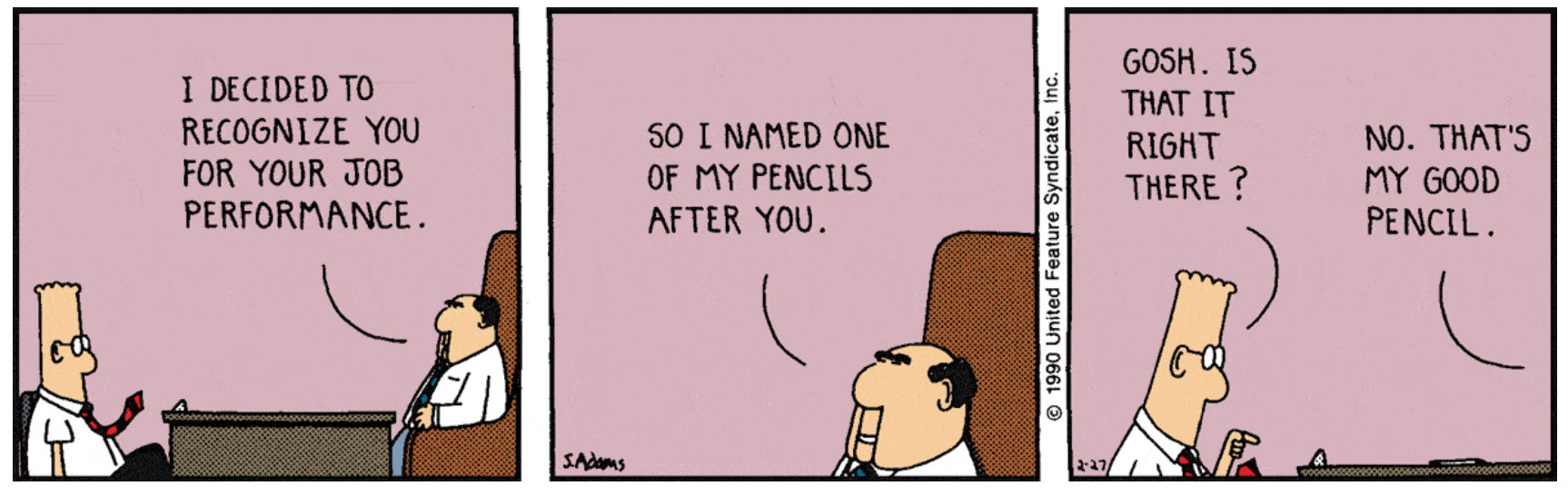
One of the most overlooked, yet lethal forms of organizational rot is toxic ambiguity. Basically, killing people with fog, Jim VandeHei writes.

Why it matters: 

Think of all the time wasted, relationships ruined, budgets missed and moods fouled by leaders or managers offering hazy direction.

  • Ambiguity is a silent killer — like a slow natural-gas leak. You don’t realize until it’s too late that you have a massive, spreading issue.

Gallup developed a workplace survey system for companies to track engagement and performance. We use it at Axios to spot pockets of emerging staff issues.

  • We often score lower than I’d like on the first question — whether “I know what is expected of me at work.” This drives me nuts: How can any person at any level not know what their damn job is?
  • Turns out, this is common. Many people feel foggy, even if leaders feel they’re being crystal clear.

The toxicity comes when the ambiguity is so thick others can exploit the cloudiness, or suffer from it. Here are some common manifestations to watch for:

  1. Fuzzy strategy. In an ideal world, any person under you should be able to jump out of bed at a moment’s notice and recite the three most important things you’re doing as a company or organization. If they can’t, how can they guide others or prioritize? The only remedy for this is constant, clear repetition of what matters most.
  2. Fuzzy thinking. If you’re a leader and you can’t articulate those three things with precision and certainty, you’re screwed. It means you didn’t sharpen your own thinking before trying to sharpen the thinking of others. This is why I constantly write down what matters most so I can stress-test my own clarity.
  3. Fuzzy communications. You might have strong, concrete thoughts — but not explain them clearly. That’s akin to having the perfect, delicious recipe, but not following it — and then wondering why people don’t love your dish. Your ideas might be brilliant. But if you don’t find strong, memorable words to express them, they will be lost.
  4. Fuzzy accountability. This one often trips me up. People don’t know they own something unless explicitly told and empowered. And others don’t know whom to listen to unless you make it clear who’s the decider. Little gets done right without clear accountability, dictated and announced in advance.
  5. Fuzzy feedback. Few things cripple individuals, teams and companies more than foggy feedback. Many managers are afraid to be direct, and hide what they mean by over-talking or over-complimenting. This leaves people confused about their standing and what they need to do better.

💡 What you can do: If you’re unsure what’s expected of you, that’s on you!

  • Ask your boss: “What’s the No. 1 thing I’ll be judged on?” or “What is Job 1 for me — the biggest specific thing I need to do for the team?”
  • If you get a foggy response, push for clarity. It’s tough to crush a performance review if you don’t know what’ll be reviewed.

The big picture: 

Clarity and candor are tough but essential — especially in anxious or uncertain times.

U.S. labor market booms in April, adding 253,000 jobs

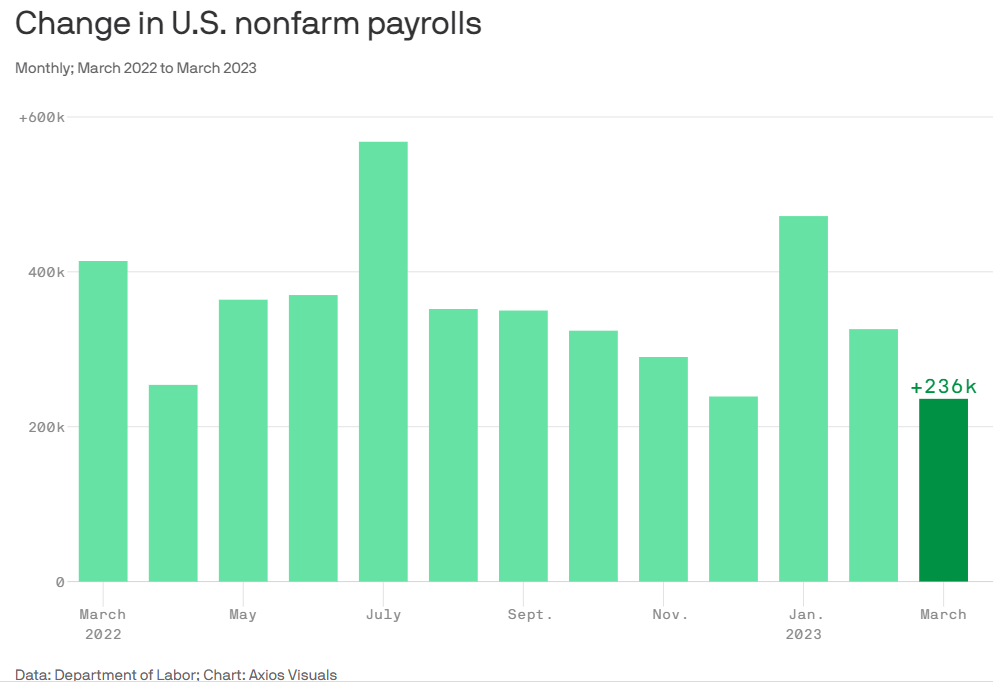
The labor market added 253,000 payrolls in April, while the unemployment rate dipped to 3.4% — a historically low level.

Why it matters:

Job growth continued to boom last month, the latest sign that economy has strong momentum despite recent bank failures.

  • Economists expected a gain of 185,000 jobs last month.

Details:

The April job figures are a pickup from the 165,000 jobs added the previous month, which were revised down by 71,000, the Labor Department said on Friday.

  • The Labor Department said that jobs growth in the previous two months was lower than first estimated: jobs growth was revised down by a combined 149,000 for February and March.

The big picture:

In recent months, more Americans have joined the workforce, helping to ease labor force shortages.

  • The labor force participation rate — or the share of workers employed or looking for work — held at 62.6% in April.
  • Average hourly earnings, a measure of wage growth, rose to 0.5% in March. Wages rose 4.4% from the same time last year.

Where it stands:

The Federal Reserve has been concerned about an out-of-balance labor market that it fears could stoke inflation that’s already running high.

  • But Fed Chair Jerome Powell said this week that there were signs that the workforce was “coming back into better balance,” though it remained “very tight.”

AMA president details ‘Kafkaesque’ prior authorization process

American Medical Association President Jack Resneck Jr., MD, detailed in a post on the medical group’s website the “Kafkaesque” prior authorization process that an unnamed insurance company allegedly put one of his patients through. 

Dr. Resneck, a San Francisco-based dermatologist, was treating a patient with severe head-to-toe eczema, who was unable to sleep because of the condition, according to the post. Dr. Resneck found a medication that allowed the patient to sleep and return to work. 

Several months later, however, the patient was unable to get the prescription refilled at the pharmacy, according to the report. Dr. Resneck completed the paperwork describing how well the patient had responded to the medication, as required by the insurance company, and faxed it over. The prior authorization request for the prescription refill was rejected. 

Dr. Resneck said the insurance company rejected the refill on the grounds that the patient no longer met the severity criteria because not enough of his body was covered and he was not missing enough sleep. 

The insurance company allegedly wanted to take the patient off the medication for several weeks to let his eczema flare up again, according to the post. It took more than 20 additional telephone calls until the patient’s prescription was refilled.