Hospitals prepare for uncompensated care payment change

https://www.healthcaredive.com/news/hospitals-prepare-for-uncompensated-care-payment-change/530719/


Hospitals will soon get paid for uncompensated care differently, and though supporters of the change say it will create a fairer measurement, hospitals are leery about how the move will affect their bottom lines.

Starting Oct. 1, CMS will begin a three-year phase-in for how it pays hospitals for uncompensated care. No longer will they get paid based solely on a Medicaid, dual-eligible and disabled patient headcount. Instead, hospitals will need to provide patient-level detail of the services performed, as well as total uncompensated care totals.

Rita Numerof, co-founder and president of Numerof & Associates, told Healthcare Dive that counting heads is easier for hospitals, but it’s not always accurate. That distortion can result in institutions having an “unfair advantage” in terms of payments under the Disproportionate Share Hospital program. Instead, CMS will now gauge the actual care experience.

Numerof said the move looks to target flaws in the current payment model and improve transparency and accountability. “I think that looking at the services that are provided rather than just looking at the number of people and making an assumption about what their utilization is is a lot more accurate,” she said.

Chuck Alsdurf, director of healthcare finance policy and operational initiatives at Healthcare Financial Management Association, told Healthcare Dive the change “levels the playing field” for hospitals. However, several issues and concerns remain.

Worksheet S-10 and uncompensated care

CMS recently released its hospital inpatient prospective payment system final rule for fiscal year 2019, which included a provision that will require hospitals to use Worksheet S-10 to provide patient-level compensated care information that can be used to make payments to disproportionate share hospitals.

That patient-level data includes forms in which hospitals must attest to a patient’s eligibility, such as whether the person meets the criteria through disability, dual eligibility or Medicaid.

At the same time, CMS will audit Worksheet S-10 data in the fall and says it will continue provider education efforts and look to improve Worksheet S-10 instructions.

CMS made the change to improve the accuracy in the way that DSH payments are made. “Historically, the approach has been a head-count approach, essentially taking a look and totaling up the number of Medicaid patients, dual patients and those that are disabled,” Numerof said.

The new method isn’t as easy as a headcount, but it improves accuracy and is closer to what a hospital is actually owed.

According to the agency, about half of hospitals that receive uncompensated care payments felt the need to modify their S-10 data. Alsdurf said that’s not a large enough number to assume the data is accurate or reliable. “HFMA members view this as half of the hospitals possibly submitted imprecise data based on vague instructions that impact their hospital payments. So, at the current time, we do not feel this model is clear or accurate enough to utilize for such a significant distribution of funds,” he said.

Critics charge that the change might hurt Medicaid expansion states and help hospitals in states that didn’t expand the program. Now, hospitals calculate Medicaid Patient Days and send that information along to CMS. However, supporters of the change say that non-expansion states with fewer Medicaid recipients now lose out on uncompensated care payments compared to expansion states.

In a letter to CMS about the change, Dallas-based Parkland Memorial Hospital CEO Frederick Cerise said his facility is one of the largest providers of uncompensated care in Texas, which has not expanded Medicaid.

He said Parkland supports the change and called using S-10 data a “more exact measure.” The system provided $2.37 billion in uncompensated care in FY 2015. More than three-fourths of the system’s payer mix is unfunded (nearly half) or Medicaid (almost one-third).

The American Hospital Association agrees that Worksheet S-10 has the potential to provide a more accurate measure of uncompensated care costs. However, Erika Rogan, senior associate director of policy at AHA, told Healthcare Dive in a statement the group has concerns about the “accuracy and consistency of the S-10.”

Meanwhile, America’s Essential Hospitals, which represents more than 325 member hospitals with much of the country’s uncompensated care, sent a 44-page letter to CMS in June listing a series of concerns and recommendations to resolve the issues.

“The high cost of providing complex care to struggling Americans leaves our hospitals with limited resources, driving them to find increasingly innovative strategies for high-quality care,” AEH CEO Bruce Siegel said. “But improving care coordination and quality while staying true to a mission of helping those in need can be a delicate balance. This balance is threatened by payment cuts to hospitals.”

What does the change mean for hospitals?

Uncompensated care costs in community hospitals are on the rise after years of decreases following the Affordable Care Act.

Uncompensated care is bad debt charges plus financial assistance charges. This includes caring for uninsured patients unable to pay their bills. Uncompensated care doesn’t include underpayments from Medicare or Medicaid.

The AHA earlier this year said 4,840 community hospitals provided a total of $38.3 billion in uncompensated care in 2016, up from $35.7 billion at 4,862 community hospitals in 2015. And uninsured numbers have increased in the years since 2016, so those numbers are likely higher now.

Hospitals are concerned about any change that might result in them losing out on uncompensated care funding. However, what the change will mean for hospitals depends on multiple factors, including patient mix, location and how much the facility already relies on uncompensated care payments.

The AHA had hoped CMS would put into place protections to shield hospitals hurt by the change. In its comments to CMS, the hospital group requested a stop-loss policy that would kick in if hospitals lost more than 10% of DSH payments in a year after using the S-10 worksheet. AHA estimated that nearly one-fifth of hospitals might face that problem in FY 2019. AEH also requested a stop-loss policy.

Ultimately, CMS didn’t put in that provision. Numerof said she understands the agency’s choice. Hospitals need to understand where the market is headed and build infrastructure and systems to meet those demands accordingly. She added that no other business would request stop-loss protection based on changes like the S-10.

Concerning community relations, Alsdurf doesn’t expect the change will have an impact. “Hospitals will continue to provide care to those who cannot afford it, so I don’t think this change will have any impact on the community, positive or negative,” he said.

How should hospitals prepare?

There are still questions about the S-10, but hospitals can’t wait for CMS to provide all answers and clarifications. The change is here and hospitals need to move forward with the information available to them.

This process means maximizing uncompensated care payments in the new system. One step is for hospitals to make sure their charity care and bad debt policies are updated and that those policies are followed, so they receive the level of payments they’re owed.

Alsdurf said hospitals are already collecting Medicaid days data. Now they’ll have to add another piece. He expects the change will be minor for reporting and data gathering practices.

“Until they receive feedback from CMS on their data, it’s hard to do much other than make sure they feel good about the data … I’d suggest they begin running reports from their billing systems and reconciling the data (if they haven’t already) to the S-10 worksheet for FY 2014 to present,” Alsdurf said.

He added that hospitals should also continue to review their data as CMS provides more explicit instructions about S-10 in the coming months.


CMS eases readmission penalties for safety-net hospitals

https://www.beckershospitalreview.com/finance/cms-eases-readmission-penalties-for-safety-net-hospitals.html?origin=cfoe&utm_source=cfoe

Image result for hospital readmission penalties 2018


Partially because of a push from Congress, CMS is easing its penalties for 30-day readmissions for hundreds of safety-net hospitals, according to NPR.

The penalties were established in 2012 under the ACA in an effort to boost patient care. CMS estimates hospitals will lose $566 million in the latest round of penalties that will be assessed over the next 12 months because patients ended up back in their facilities.

Safety-net hospitals, which serve a large number of low-income patients, have argued for years that these sanctions adversely affect them. They have argued that their patients are more likely to suffer complications and have a readmission through no fault of the institution, but rather because the patients can’t afford necessary medications or don’t have primary care physicians to monitor their recovery.

However, effective Oct. 1, lawmakers mandated that CMS consider the long-standing argument from safety net hospitals: that they shouldn’t be penalized or held to the same standard of readmission as other hospitals. 

In a major change to its evaluation of readmission rates that took effect this year, CMS stopped judging each hospital’s readmission performance against all other hospitals. Rather, the agency assigned hospitals to one of five peer groups with similar percentages of low-income patients. To assess the penalties, Medicare compared each hospital’s readmission rates from July 2014 to June 2017 against the readmission rates of its peers to determine whether a penalty should be assessed and how much the penalty would be.

CMS will assess penalties or dock payments to 2,599 hospitals in fiscal year 2019, which begins Oct. 1.  The penalties resulted from fiscal year 2018 readmissions.

However, the new evaluation method has shifted the burden of those punishments away from safety-net hospitals. Penalties levied against safety-net hospitals in fiscal year 2019 will drop by a fourth on average from fiscal year 2018, according to NPR.

“It’s pretty clear they were really penalizing those institutions more than they needed to,” Atul Grover, MD, executive vice president of the Association of American Medical Colleges, told NPR. “It’s definitely a step in the right direction.”


The State of Emergency: What the data tell us about emergency department use in California

The State of Emergency

hospital emergency department entrance sign

The California Health Care Foundation recently published the latest edition in its wide-ranging Almanac series, California Emergency Departments: Use Grows as Coverage Expands. This timely publication is loaded with data that paint a detailed picture of broad trends in hospital emergency department (ED) care across the state. Recently, I talked about the Almanac’s findings with Kristof Stremikis, who directs CHCF’s Market Analysis and Insight team. Senior program officer Robbin Gaines produced the report as part of the team’s mission to promote greater transparency and accountability in California’s health care system. 

Q: California’s 334 hospital emergency departments provide a vital service to every part of the state. How are they faring?

A: The biggest takeaway from our Almanac is that California EDs are serving significantly more patients than they were just 10 years ago. When we control for population growth, the rate of ED use has grown 33% over the last decade, from 280 to 371 visits per 1,000 residents per year. Visits are up regardless of the type of insurance a patient has. Now, there’s a lot to unpack and understand about these figures, but when we think about the future, it’s important to realize that we are likely to continue to see increased demand for emergency services as the population ages. From a policy standpoint, we need to double down on efforts to ensure patients have access to the care they need in the most appropriate setting, be that an emergency department or somewhere else.

Q: What’s behind the increase in emergency department visits?

A: We don’t exactly know why more people are showing up in California emergency departments, but we do know ED use has been on the rise for at least 30 years. Across the nation, emergency departments have long been a major source of care across all categories of patients. We also know that regardless of source of coverage, California’s public and private payers are covering more visits per enrollee than they were a decade ago.

Sometimes ED use cannot be avoided. A few data points in our most recent Almanac suggest that a significant proportion of the rise in ED visits is due to clinically necessary visits. When we look at the acuity of ED visits, moderate and severe symptoms — including life-threatening ones — constituted all of the increase over the past decade. The number of visits with low or minor acuity fell. That is a big deal. This happened as the number of Californians with Medicare and Medi-Cal increased substantially during this period, and these programs cover a lot of older and sicker Californians who are more likely to need emergency care.

We also know that some of this rise is attributable to visits that could have been avoided. Precisely identifying what portion of visits are avoidable is difficult, and we do not include an estimate in our Almanac. But we know they are there — public and private payers in California have been working hard for years to identify and prevent unnecessary ED use.

Q: How big a problem are avoidable visits? And why would someone go to the ED if they don’t need to?

A: Available research does not point to a precise percentage of ED visits that could be avoided. The most conservative definition classifies as avoidable things like visits for low-acuity mental health and dental issues. Using that methodology, perhaps 3% of ED visits in California did not need to happen. But other estimates are much higher, sometimes exceeding 70% in the commercial market. What is clearer are the reasons why patients go to the ED over other options. Some people can’t take off work when doctors’ offices are normally open. Others have limited or negative perceptions of alternatives. Researchers have found that there is also an increasing number of patients who are referred to the ED by their physician.

Q: The number of ED departments has stayed flat during this period of growth. How are hospitals handling the additional visits?

A: The number of dedicated ED spaces for individual patients, or “treatment stations,” has increased almost 30% over the last decade. In 2016, the average treatment station handled 1,846 patients, or approximately five visits per day, up from 1,656 patient visits in 2006. Despite a 44% increase in total ED visits between 2006 and 2016, the number of visits by patients who left without being seen fell by almost 15%. That is remarkable.

Q: The data show a lot of regional variation in ED use. Are some regions or health plans better than others at addressing ED challenges?

A: ED use does vary widely, from a low of 311 visits per 1,000 residents in Orange County to a high of 516 in the Northern and Sierra region. Patient characteristics (such as age, race, and income), lack of alternatives, and physician referral patterns may all play a role in the relatively high rates of ED use in certain parts of the state. Among the promising strategies that can be deployed regionally are increasing access to primary care services in rural areas through telehealth, providing outreach and case management to frequent users, and addressing the needs of patients with behavioral health and substance use disorders.

Q: The Almanac shows an increase in the percentage of ED visits that are for Medi-Cal beneficiaries, due in large part to the expansion of eligibility for the program. What else would explain why the percentage from Medi-Cal went up?

A: Medi-Cal paid for a larger proportion of California’s ED visits in 2016 than in 2006 because it now covers many more Californians. When we control for the number of beneficiaries covered by various programs, a Medi-Cal member is less likely to end up in an emergency room than someone covered by Medicare, though more likely than someone with private insurance. Regardless of insurance type, the number of visits per enrollee is increasing.

Though we did not include the data in our Almanac, the state closely tracks ED use among Medi-Cal beneficiaries on its monthly managed care performance dashboards. Elderly and seriously disabled beneficiaries remain the most likely to visit the ED, at almost twice the rate of the next highest group, which is the Medi-Cal expansion population. Fortunately, the rate among the expansion population has decreased over the last several years, from about 70 visits per 1,000 member months in January 2014 to around 50 in June 2017. This may reflect managed care plan efforts to connect new patients with primary care “medical homes.”

When we look at the acuity of ED visits, moderate and severe symptoms — including life-threatening ones — constituted all of the increase over the past decade. The number of visits with low or minor acuity fell. That is a big deal.

Q: Critics of the Affordable Care Act (ACA) cite increasing ED visits, especially from people in the expansion population, as evidence that the law isn’t working in California. Is that a fair criticism?

A: Both critics and proponents of the ACA probably agree that the law is complicated — and complicated reforms need to be carefully unpacked and evaluated over long periods of time. One of the law’s major goals was to expand access to insurance coverage, and on this measure the law has made tremendous progress. As of 2016, only 7% of California residents lacked health insurance. Expanding Medi-Cal was the cornerstone of that success.

The relationship between ED use and health insurance coverage is complex, with studies showing both increases and decreases in use when people gain or lose coverage. What is much more clear is that the ACA did not create the problem of ED use — though it has led to decreases in bad debt and charity care reported by our state’s hospitals. What is needed now is further research into just how many of our state’s ED visits are avoidable and how to scale the best approaches to reducing avoidable ED use throughout California’s market.

Q: What’s being done to address avoidable ED use at a local level?

A: On the public side, the ongoing Whole Person Care pilot program in Medi-Cal is one example of where innovation is taking place on this issue — 17 of the 25 counties participating in the program have made it an explicit goal to reduce avoidable ED use. Just last week, 17 health systems, including several in California, announced a major initiative to reduce avoidable ED use among Medicaid beneficiaries. This is likely to include some combination of enhanced access to primary care, behavioral health care, and social services. On the private side, the issue of avoidable ED use has attracted the attention of California payers like Anthem, Blue Shield, and Kaiser Permanente for several years. These groups have also worked to increase access to primary care using medical homes that offer after-hours and weekend care.

Another approach involves targeting those patients who are frequent ED users. In California, one recent study suggested frequent users were less than 10% of the population but accounted for nearly one-third of the visits. Intensive case management, health coaching, and community support for high users are all promising interventions. Finally, specific case management programs for substance use disorder and mental health problems are being considered.

Q: A report like this Almanac is obviously limited by the data that is currently available. What additional data points would you like to have for future issues?

A: I think the most important metric to focus on is potentially avoidable use of the emergency departments rather than the overall number of visits. While the California data we report here certainly do capture the universe that includes avoidable use, it does not allow us to parse out the differences among the subsets. It is always helpful to have additional research to help identify this type of visit, the reasons why a patient decided to go to the ED, and the strategies that would be most effective at helping patients get their care in more appropriate settings.


The Health 202: The rate of people without health insurance is creeping upward

https://www.washingtonpost.com/news/powerpost/paloma/the-health-202/2018/09/13/the-health-202-the-rate-of-people-without-health-insurance-is-creeping-upward/5b99569b1b326b47ec95958c/?utm_term=.ae9e8af79dd2


THE PROGNOSIS

New Census Bureau data on the number of uninsured Americans is either a testament to the resiliency of the Affordable Care Act or a sign that President Trump’s anti-ACA rhetoric and policies are starting to work.

As our colleague Jeff Stein reported Wednesday, there was a slight uptick in the number of Americans without health insurance in 2017 compared to 2016, even though that number essentially remained statistically flat. Still, the fact that uninsured rate went up at all, by about 400,000 people, marks the first time since the ACA’s implementation that the uninsured rate didn’t drop. 

Supporters of the ACA worry the news marks the beginning of a trend, especially when some of Trump administration policies intended to circumvent the ACA go into effect next year.

Ahead of open enrollment last year, the Trump administration dramatically decreased funding for any Obamacare outreach or advertising, limited resources for “navigators” who help people find an insurance plan, and shortened the window for people to sign up for insurance from three months to six weeks in states that use a federally run marketplace.

“Even with all of that, health coverage stayed steady. But at the same time, we’d like to see further progress in the rate of the uninsured,” said Judith Solomon of the Center on Budget and Policy Priorities.

It’s part of a pattern to weaken the 2010 health-care law known as Obamacare. After the GOP Congress failed to repeal and replace the ACA last summer, the Trump administration moved to dilute the law in other ways: including signing off on a plan to eliminate the individual mandate penalty next year; allowing individuals to buy skimpier, short-term health plans without certain coverage requirements under Obamacare; and seeking to allow states to put conditions on Medicaid coverage.

Some of the most prominent health care organizations in the country came together this morning to voice their disapproval of those short-term plans — including the American Cancer Society Cancer Action Network, the American Heart Association, Planned Parenthood Federation of America, the National Women’s Law Center, the , American Academy of Family Physicians, the American Academy of Pediatrics and Families USA.

“The Administration’s decision to expand short-term health plans will leave cancer patients and survivors with higher premiums and fewer insurance options,” said Dr. Gwen Nichols, chief medical officer of the Leukemia & Lymphoma Society.

The groups’ statements, compiled and released by Sen. Tammy Baldwin (D-Wis.), are in support of the senator’s effort to have Congress rescind the White House regulation. Nearly every Democratic senator has signed a resolution of disapproval to overturn it.

The census data reflects trends that started last year, when the administration’s policies had yet to be implemented. Fourteen states saw their uninsured populations rise in 2017. The only three states that didn’t see a spike in that number were New York, California and Louisiana. The first two aren’t surprising given those states’ robust efforts to enroll their own residents, while Louisiana expanded Medicaid in June 2016 so its decrease represents those low-income individuals who now have government coverage.

Medicaid expansion in most of the 33 states and D.C. that have done so under the ACA has predictably decreased the number of people without coverage. The uninsured rate last year in states with an expanded Medicaid program was 6.6 percent compared to 12.2 percent in non-expansion states — a gap that has only continued to grow since 2013.

To be fair, as Larry Levitt, senior vice president at the Kaiser Family Foundation, pointed out on Twitter: the uninsured rate started leveling off before the Trump administration started its work. But Levitt suggested the uninsured rate may really rise in 2019 when elimination of the individual mandate penalty takes effect. Moreover, states are increasingly taking the White House up on its suggestion to add work requirements to their Medicaid programs — in just the first three months of it being implemented in Arkansas, more than 4,000 people were jettisoned from the rolls for failure to comply.

Matthew Fiedler, a health-policy expert at the Brookings Institution, agreed with Levitt’s assessment, noting that the bulk of the people who were uninsured pre-ACA have already been enrolled  in the program. He contended that if policy had remained static, there would likely have been a modest decline instead of similar increase in the uninsured rate — though not a dramatic one. The real effects, he said, of the Trump administration’s efforts to chip away at the ACA are still to come. 

“I don’t think the right takeaway is that none of the policy changes will have a negative effect. I think they will going forward, we just haven’t seen that yet,” he said. “I think if your goal is to evaluate the ACA, I think the right takeaway is that there was a lot of progress, but more policy progress to be made.”

Of course, Democrats and Republicans have disparate views on how to get there. Democrats are now pushing for a public option or a universal health care system in which the government would foot the bill for many health-care costs. A lot of them feel  the ACA “got us roughly 40 percent there and established a framework for lawmakers to make that progress going forward,” Fiedler said. That’s why we’re now seeing so many Democratic candidates and lawmakers embracing some iteration of a “Medicare for all” program.  

Republicans still criticize the ACA as vast government overreach and are vowing they will take another stab at repealing it should they maintain the congressional majorities after the November midterms.

“We made an effort to fully repeal and replace ObamaCare and we’ll continue,” Vice President Pence said while campaigning for Baldwin’s opponent, Leah Vukmir, if the GOP performs well in the midterms.

One additional interesting data point from the census is ages at which there was the greatest increases or decreases in the uninsured rate. As highlighted in the chart above, rates of those without insurance rose at ages 18 and 19 — when children are no longer eligible for the Children’s Health Insurance Program; and for those between ages 25 and 26 — when children no longer qualify for their parents’ insurance. The uninsured rate dropped, however, for those aged 64 and 65 — when adults are eligible for Medicare.

The greatest spike in those without insurance was documented for 26 year olds. That’s likely because young adults are typically healthier and feel less urgency to pay for insurance when they lose coverage under their family’s plan.

As noted by the New York Times’ Margot Sanger Katz on Twitter, these stats show just how crucial government programs and laws have been in providing health coverage to Americans:

Montana health plan strikes victory over cost-sharing reduction payments

https://www.healthcarefinancenews.com/news/montana-health-plan-strikes-victory-over-cost-sharing-reduction-payments?mkt_tok=eyJpIjoiTWpNM05qYzVPR1k0TldKbCIsInQiOiJTd2RzaU9sS1FuKzBOaVF3RXp5RkNqc3plbXp0NFlhdkk1MFlSNGY1NUJKa2NHd3IrXC9OdlJoSW1EQ2FIM3hkVkVzZ2FuaUhkcTNXcUtNczhNQWI2NFd1ckNCOHViSzdFbjRUS2xGMTdrXC90M1BjbCtRcVVnbkxweFwvdlY5VnZGViJ9

Montana Health Co-Op. Credit: Google Street View

The insurer says it is owed $5 million in payments mandated under the Affordable Care Act.

Health insurers in the Affordable Care Act market got a major win Tuesday when the Montana Health Co-op became the first plan to win its case for cost-sharing reduction payments.

Montana Health Co-op said it is owed an estimated $5 million in CSRs for 2017.

United States Court of Federal Claims Judge Elaine Kaplan said it didn’t matter that Congress never appropriated the funds, as argued by the Department of Justice. Kaplan sided with the Montana Health Co-op that said the Affordable Care Act created the mandatory obligation whether Congress approved the funds or not.

Judge Kaplan directed the parties to file a joint status report on or before October 4.

CSRs were set up under the ACA to allow insurers to pay the deductibles and other out-of-pocket costs for lower-income consumers.

The Department of Health and Human Services began making the CSR payments in 2014.

In that same year, Republicans in the House of Representatives sued the Obama Administration over the payments, saying they and others in Congress had never approved the funds. They won and an appeal was brought, but under President Donald Trump, the appeal became moot.

In 2017, Attorney General Jeff Sessions issued an opinion that the funds were never appropriated and the government stopped the payments.

While insurers no longer received the funds, they were still mandated under the ACA to offer to qualifying consumers the benefit of lower out-of-pocket costs.

Several insurers filed lawsuits, including Blue Cross Blue Shield of Vermont, Maine Community Health Options, LA Care Health Plan and Sanford Health Plan, according to Health Affairs. Common Ground Healthcare Cooperative led a class action lawsuit.

Insurers have also filed lawsuits to get payments promised through another ACA program, risk corridors. Under the three-year, budget neutral risk corridors program, the government was to take money from plans that had fewer higher risk beneficiaries and give the  funds to those that suffered losses in insuring higher risk consumers.

In making her decision Tuesday, Judge Kaplan cited a lawsuit brought by Moda Health Plan over risk corridor payments. In that case, the Federal Circuit Court said the government was obligated to make risk corridor payments to insurers.

But that case was overturned in mid-June, when a majority of a three-judge panel of the Court of Appeals for the Federal Circuit said the government did not have to pay health insurers the full amount owed to them in risk corridors payments.


Is Obamacare Constitutional? The Battle Begins Again

http://www.thefiscaltimes.com/2018/09/05/Obamacare-Constitutional-Battle-Begins-Again


The debate over the Affordable Care Act entered a new phase Wednesday as a federal court in Texas began hearing oral arguments in a lawsuit brought by 20 Republican-led states challenging the constitutionality of the 2010 law.

Eighteen Republican state attorneys general and two GOP governors bringing the suit argue that the law’s individual mandate was rendered unconstitutional when Congress lowered the penalty for individuals who don’t buy coverage to zero.

The Supreme Court, in upholding the law in 2012, deemed that penalty a tax and thus a valid and legal exercise of Congress’ power of the purse. The lawsuit claims that the law is no longer constitutional because the zeroed-out penalty can no longer raise revenue. “It’s nothing but a hollow shell because its core has been invalidated,” said Misha Tseytlin, Wisconsin’s solicitor general.

The plaintiffs also claim that this means the entire ACA — and, in particular, its protections for patients with pre-existing conditions looking to buy insurance — must be struck down because the mandate can’t be severed from the rest of the law. The Trump Justice Department decided not to defend the ACA in the case.

What a Kavanaugh Confirmation Might Mean

The case, which legal experts see as a long shot, may still wind up before the Supreme Court — which is why Democrats have brought up Obamacare and its protections for patients with pre-existing conditions in this week’s confirmation hearing for Brett Kavanaugh, President Trump’s nominee to replace Justice Anthony Kennedy.

“Kavanaugh has signaled in private meetings with Senate Democrats that he is skeptical of some of the legal claims being asserted in the latest GOP-led effort to overturn the Affordable Care Act,” the Los Angeles Times’ Jennifer Haberkorn reported last week. Three Democrats in the meetings told the Times that Kavanaugh suggested that if one piece of the law is struck down, the rest of the law doesn’t necessarily have to fall with it.

But that may not be enough to assuage Democratic fears that Kavanaugh could be the deciding Supreme Court vote against Obamacare. “Democrats are more concerned about Kavanaugh’s past writings on expansive presidential powers, which they say could lead to his supporting efforts by the Trump administration to dismantle the health-care law without Congress,” The Washington Post’s Colby Itkowitz notes.

Where Public Opinion Stands

The political debate over Obamacare has shifted as public perception of the law has improved. The latest Kaiser Family Foundation tracking poll, released Wednesday, finds that 50 percent now view the law favorably while 40 percent see it unfavorably, with the divide still falling along partisan lines. Just under 80 percent of Democrats support the law, while a similar percentage of Republicans oppose it.

That may be why Republicans still view repealing the law as a potent issue with their base. Vice President Mike Pence, in Wisconsin last week to campaign for Senate candidate Leah Vukmir, said the GOP push to repeal and replace the health care law was still alive: “We made an effort to fully repeal and replace Obamacare and we’ll continue, with Leah Vukmir in the Senate, we’ll continue to go back to that,” he told reporters. With Sen. Jon Kyl (R-AZ) replacing John McCain, a critical vote against the GOP’s 2017 Obamacare repeal bill, there has been chatter about another potential repeal effort — though Senate Majority Leader Mitch McConnell effectively shot that down on Wednesday.

In the meantime, open enrollment on the ACA exchanges is set to begin on November 1, with the Trump administration once again providing reduced funding for outreach groups that help people enroll. A recent report by the nonpartisan Government Accountability Office criticized the administration’s management of Obamacare signup periods.

Why Protections for Pre-Existing Conditions Are Such a Potent Political Issue

http://www.thefiscaltimes.com/2018/09/05/Why-Protections-Pre-Existing-Conditions-Are-Such-Potent-Political-Issue


The Affordable Care Act provisions preventing insurers from discriminating against patients with pre-existing medical conditions have become a popular — and politically potent — element of the law, and the new Kaiser Family Foundation tracking poll shows why: Six in 10 Americans say that they or someone in their household suffers from a pre-existing condition such as asthma, diabetes or high blood pressure.

It’s no surprise then that the tracking poll also finds that 75 percent of Americans now say that it is “very important” to keep the provision prohibiting insurance companies from denying a person coverage because of his or her medical history. Another 15 percent say it is “somewhat important” this provision stays in place. Similarly, 72 percent say it is “very important” that the provision to keep insurance companies from charging sick people more remains law. Another 19 percent say it is “somewhat important.”

In addition, more than 60 percent of Americans are “very worried” or “somewhat worried” that they will lose insurance coverage if the Supreme Court overturns the Affordable Care Act’s protections for people with pre-existing conditions. And 75 percent are “very worried” or somewhat worried” that they or a family member will have to pay more for coverage.

Democrats have been hammering the administration and Republicans for their willingness to have a court invalidate protections for those with pre-existing conditions.

As part of their effort to push back on that line of attack, 10 Republican senators last month introduced new legislation that they say would prevent insurance companies from denying coverage to people with pre-existing conditions, or charging those people more, no matter what happens in the Texas court case. Critics have said that the GOP bill’s protections don’t go as far as Obamacare’s. Republicans have responded by saying they’d be willing to look at changes to make the legislation more comprehensive.


The ACA is back in court

https://www.axios.com/affordable-care-act-court-challenge-texas-kavanaugh-2dd66378-c046-44e8-9a4a-f660687c17d9.html

Image result for ACA in court

Today is all about the courts, the threats they might pose to the Affordable Care Act, and Democrats’ goal of using those threats to drive turnout in the midterm elections.

Driving the news: A federal district judge in Texas will hear oral arguments this morning on red states’ latest legal challenge to the ACA. At the same time, Brett Kavanaugh will be answering senators’ questions about his nomination to the Supreme Court.

Democrats’ strategy is to tie the two together — to frame the Texas lawsuit as an existential threat to the ACA’s most significant provisions and raise the prospect that a Justice Kavanaugh would cast the decisive vote to strike down the heart of President Obama’s signature achievement.

Reality check: The Texas lawsuit would indeed be devastating to the ACA if it succeeds — Texas wants the courts to invalidate the entire law, while the Justice Department is hoping to ax its protections for pre-existing conditions. But a lot of pieces would have to fall into place to get there.

  • Most of the legal experts I’ve talked to see this case as a long shot on the merits.
  • Even if Kavanaugh were to vote to strike down the ACA — which we can’t know for sure, based on his track recordwith the law — Chief Justice John Roberts would also have to do an about-face and vote to kill the ACA, after upholding it twice before, in order for this suit to ultimately succeed.

The big picture: If there are any tea leaves to read today about the ACA’s future, they’ll come from Judge Reed O’Connor in El Paso, not Judge Brett Kavanaugh in Washington.

  • Don’t expect Kavanaugh to say anything revealing about health care, much less to comment on this specific case.

Situational awareness: The Kavanaugh questioning starts at 9:30 a.m. ET. The district court arguments start an hour later.


Fewer Americans Without Health Plans Since Obamacare Debut

https://www.bloomberg.com/news/articles/2018-08-29/fewer-americans-without-health-insurance-since-obamacare-debut

Image result for Fewer Americans Without Health Plans Since Obamacare Debut

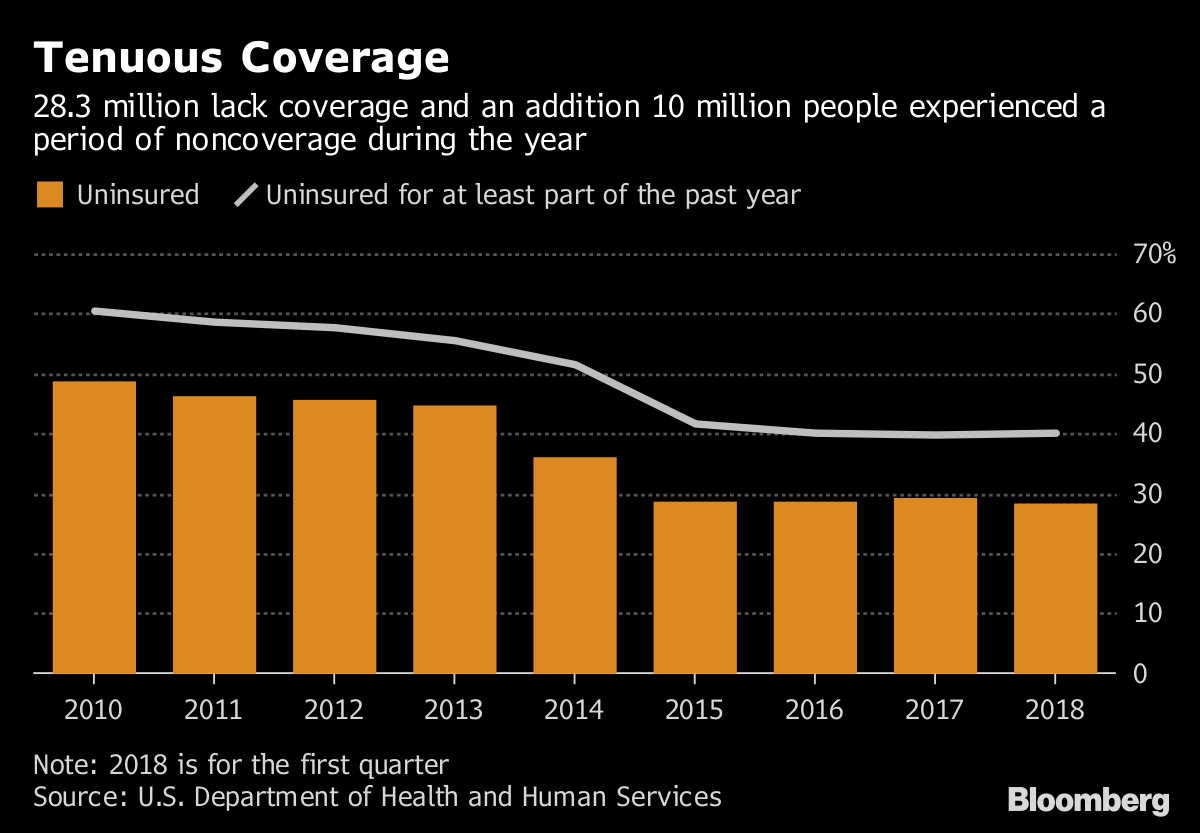
Fewer Americans lack health insurance — but the gap remains wide, especially in some pro-Trump states.

The number of uninsured declined to 28.3 million in the first quarter, down from 29.3 last year — and 48.6 million in 2010, the year the Affordable Care Act was signed into law by then-President Barack Obama, according to data from the federal Centers for Disease Control and Prevention.

The distribution, however, is uneven with data for south central states — Arkansas, Louisiana, Oklahoma and Texas — showing almost a quarter of adults lacking health care coverage. President Donald Trump, who has opposed Obamacare, won those four states in the 2016 presidential election.

The CDC data also show:

  • Even with the reduction, one in eight Americans between 18 to 64 remained uninsured.
  • Of those with insurance, about one in five were covered by public plans and seven in ten were covered by private plans. Children fared better, with more than 95 percent covered by public or private plans.
  • About one in four Hispanics lacked coverage while 14.1 percent of non-Hispanic blacks, 8.9 percent of non-Hispanic whites and 6.1 percent of non-Hispanic Asians lacked coverage.
  • The number of people under age 65 covered under the Health Insurance Marketplace declined by about 1 million to 9.7 million.
  • The number of adults who lacked health insurance for more than one year declined from 32 million in 2010 to 14.9 million in the first quarter of this year.


ACA court case causing jitters in D.C. and beyond

http://www.modernhealthcare.com/article/20180831/NEWS/180839976

Image result for 2018 midterm elections


For months, congressional Republicans have ignored the Texas-led lawsuit seeking to overturn the Affordable Care Act. With the midterm elections looming, talk of the case threatened to reopen wounds from failed attempts to repeal the law. Not to mention that legal experts have been panning the basis of the suit.

But that’s all changing as the ACA faces its day in court … again. The queasy feeling of uncertainty that surrounded the law just one year ago is back. The level of panic setting in for the industry and lawmakers is pinned to oral arguments set for Sept. 5 in Texas vs. Azar. Twenty Republican state attorneys general, led by Ken Paxton of Texas, are seeking a preliminary injunction to halt enforcement of the law effective Jan. 1. Their argument is built around the Supreme Court’s 2012 ruling in which Chief Justice John Roberts said the law is constitutional because it falls under Congress’ taxing authority. The AGs have seized on the congressional GOP’s effective elimination of the individual mandate penalty in the 2017 tax overhaul as grounds to invalidate the law. 

They have the Trump administration on their side, in part. The Justice Department in June filed a brief arguing that the individual mandate as well as such consumer protection provisions as barring insurance companies from denying coverage to people with pre-existing conditions are unconstitutional. But the department stopped short of suggesting that the entire law be vacated.

Conservative U.S. District Judge Reed O’Connor will hear the case in Austin, Texas. O’Connor has already ruled against an ACA provision that prohibited physicians from refusing to perform abortions or gender-assignment surgery based on religious beliefs, and he is considered a wild card.

Even ACA supporters who downplay the legal standing of the case are bracing for the possibility that O’Connor will side with the plaintiffs, who ultimately see a path to the Supreme Court.

Republicans, meanwhile, are trying to head off a potential political storm. A coalition of Senate Republicans led by Sen. Thom Tillis of North Carolina introduced a bill to codify guaranteed issue for people with pre-existing conditions into HIPAA laws. But they left out the key mandate that insurers can’t exclude coverage of treatment for pre-existing conditions. That omission left health insurers scratching their heads and Democrats came out swinging, with Democratic Sen. Claire McCaskill of Missouri dubbing the measure “a cruel hoax.”

The politics around coverage protections will really start to matter for Republicans should O’Connor signal support for the plaintiff states, according to Rodney Whitlock, a Washington healthcare strategist and former GOP Senate staffer. “It ups the pressure considerably,” he said. “There’s no question it complicates things for Republicans if a decision comes down in October.”

Insurers are on the lookout for signs of what could happen next. If O’Connor’s decision comes down before open enrollment starts on Nov. 1, the GOP will feel increasing pressure to do something substantive, according to an industry official who asked not to be identified.

Although a ruling striking down the law wouldn’t necessarily impact the individual market in 2019, it would spark the kind of massive uncertainty that insurers hate and complained of last year during the GOP repeal-and-replace efforts.

America’s Health Insurance Plans filed an amicus brief urging the court to deny the request for a preliminary injunction, citing the massive impact such a move would have on insurers in the individual market, Medicaid managed care and Medicare Advantage plans.

“It creates a lot of impetus for federal or state action,” the insurance official said, noting that insurers would have to rely on HHS to interpret how the law’s regulations would apply going forward. If mounting court decisions start to drastically affect the law’s mandates, it would fall to HHS how to manage complicated questions around how to follow ACA rules.

HHS and Justice Department officials declined to comment. CMS Administrator Seema Verma in August told McCaskill when pressed at a Senate committee hearing that she would support legislation to protect pre-existing conditions, but she declined to specify how the CMS would respond administratively if the suit succeeds.

For now, lawmakers aren’t showing any willingness to take a bipartisan approach. The House GOP plans to introduce a companion bill to the Senate measure, Tillis told Modern Healthcare last week. Meanwhile Democrats have made hay over the fact that the protections in his legislation are incomplete. Tillis said leaving out the prohibition of coverage exclusions was not intentional and GOP senators would look again at the bill if the lawsuit advances.

He added that he envisions the legislation as just one piece that could build into a bigger overhaul effort, and wants to see protections of other popular provisions such as allowing people up to age 26 to stay on their parents’ health insurance.

“It’s similar to what we talked about last year,” Tillis said, referencing the 2017 repeal-and-replace efforts. “Any sort of court challenge that would cause a precipitous voiding of Obamacare would leave a lot of people in the lurch, and one of those areas is pre-existing conditions.”

Sen. Bill Cassidy (R-La.), who spearheaded the last major GOP effort to repeal and replace the ACA last year, also said he would want to look at more comprehensive legislation if the lawsuit advances. “I certainly would,” Cassidy said. “I can’t speak for all, but I do think there would be a drive to.”

How Republicans will move past messaging and into action remains to be seen, Whitlock said.

“If you think of the seminal moments of 2017, you think of pre-existing conditions and the Jimmy Kimmel test,” Whitlock said, referencing the talk show host’s attack on the repeal-and-replace effort following emergency heart surgery for his newborn son. “This was a big deal because people were concerned. It is a very important issue, and it’s also one that Republicans have tried to say in every bill that they’re trying to protect. They have been successful to varying degrees in making that case. But with the Texas lawsuit, there’s no protecting it. It says, throw out the entire ACA root and branch.”

And as nomination hearings for Supreme Court nominee Brett Kavanaugh get underway Sept. 4, Democrats will keep using the GOP’s dilemma as a cudgel. McCaskill, for instance, is leveraging the issue in her neck-and-neck race against Missouri Attorney General Josh Hawley, who is part of the lawsuit.

“How do you have a pre-existing conditions bill that says we’re not going to protect someone with a pre-existing condition?” she told reporters last week. “It’s embarrassing, it’s the Potomac two-step. Do they think nobody’s paying attention? They’re just trying to cover themselves politically, isn’t it obvious?”

And then there’s the other political dilemma for Republicans who want to show they can secure Obamacare’s protections: convincing their base that they still fundamentally oppose Obamacare even if they don’t want to talk about repeal-and-replace anymore.

“You can be sure there are folks out there who really desperately don’t want to see the Texas side laughed out of court,” Whitlock said. “It destroys the whole narrative about the lawsuit. It’s this bizarre dynamic where an obscure lawsuit that has no legal basis whatsoever leaves the opportunity to talk about” repeal.

He added: “There are people who are flat-earthers on ACA, still preaching complete and total repeal.”