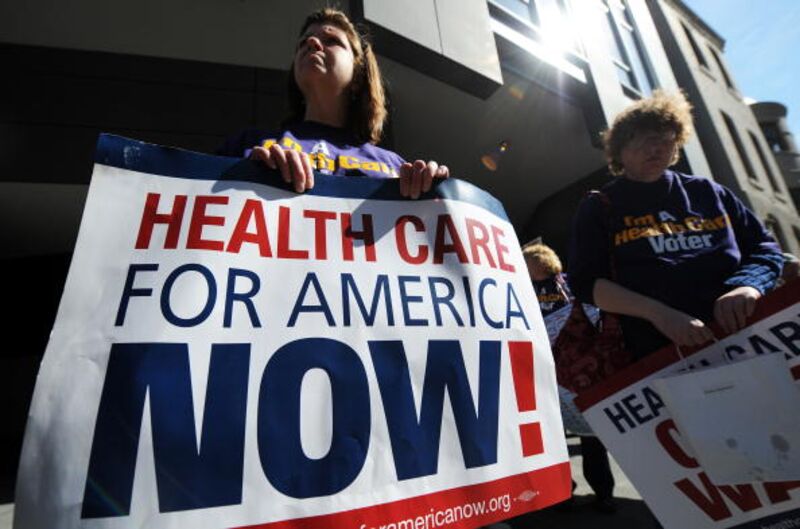
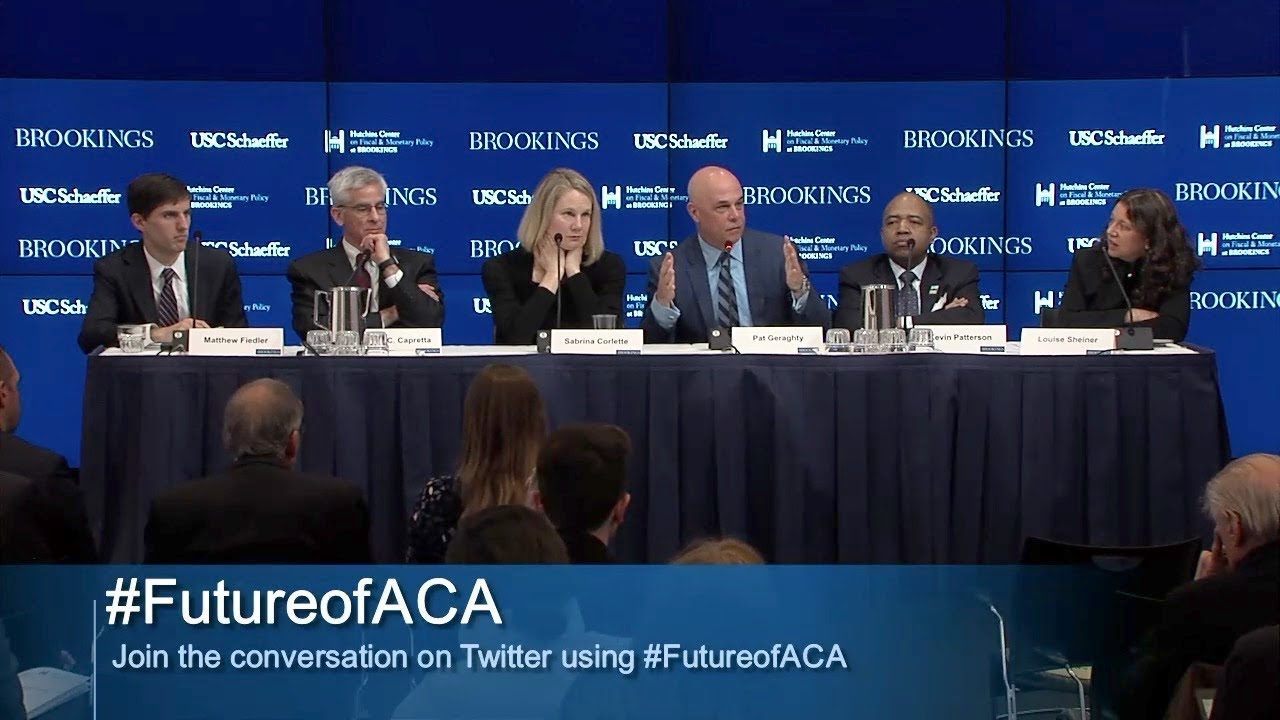
Health Care Industry Gears Up to Fight ‘Medicare for All’

http://www.thefiscaltimes.com/2018/08/10/Health-Care-Industry-Gears-Fight-Medicare-All

In anticipation of a “blue wave” election that brings more Democrats to Congress, the insurance and drug industries are gearing up to push back on the idea of a single-payer health care system.

The Hill’s Peter Sullivan reports that health-care industry forces have teamed up to form the Partnership for America’s Health Care Future, “which lobbyists say could run advertisements against single-payer plans and promote studies to undermine the idea.” The health care groups in the partnership, formed in June, include America’s Health Insurance Plans (AHIP), the Pharmaceutical Research and Manufacturers of America (PhRMA), the American Medical Association and the Federation of American Hospitals.

The idea of a single-payer or “Medicare for all” health-care system has gained momentum among Democrats, even as significant questions remain about how such a massive overhaul might be implemented and how to pay for it. “Industry groups are worried that support for single-payer is quickly becoming the default position among Democrats, and they want to push back and strengthen ties to more centrist members of the party to promote alternatives,” Sullivan writes.

The groups’ concern is more about the prospects of a Democratic single-payer platform in 2020, given that a host of the party’s potential presidential candidates have backed Bernie Sanders’ “Medicare for all” bill. “Every one of those organizations that’s in that group will look at Bernie Sanders’s single-payer and see massive losses of money,” John McDonough, a former Democratic Senate staffer who worked on the Affordable Care Act and is now at Harvard’s T.H. Chan School of Public Health, told The Hill.

The industry’s budding campaign could pose a formidable political and public relations challenge to proponents of a single-payer system. “Leaving aside whether single payer is good policy or not,” the Kaiser Family Foundation’s Larry Levitt tweeted, “it seems like the idea is going to eventually need some powerful institutional allies from somewhere to advance.”


How Medicare Was Won

https://www.thenation.com/article/how-medicare-was-won/
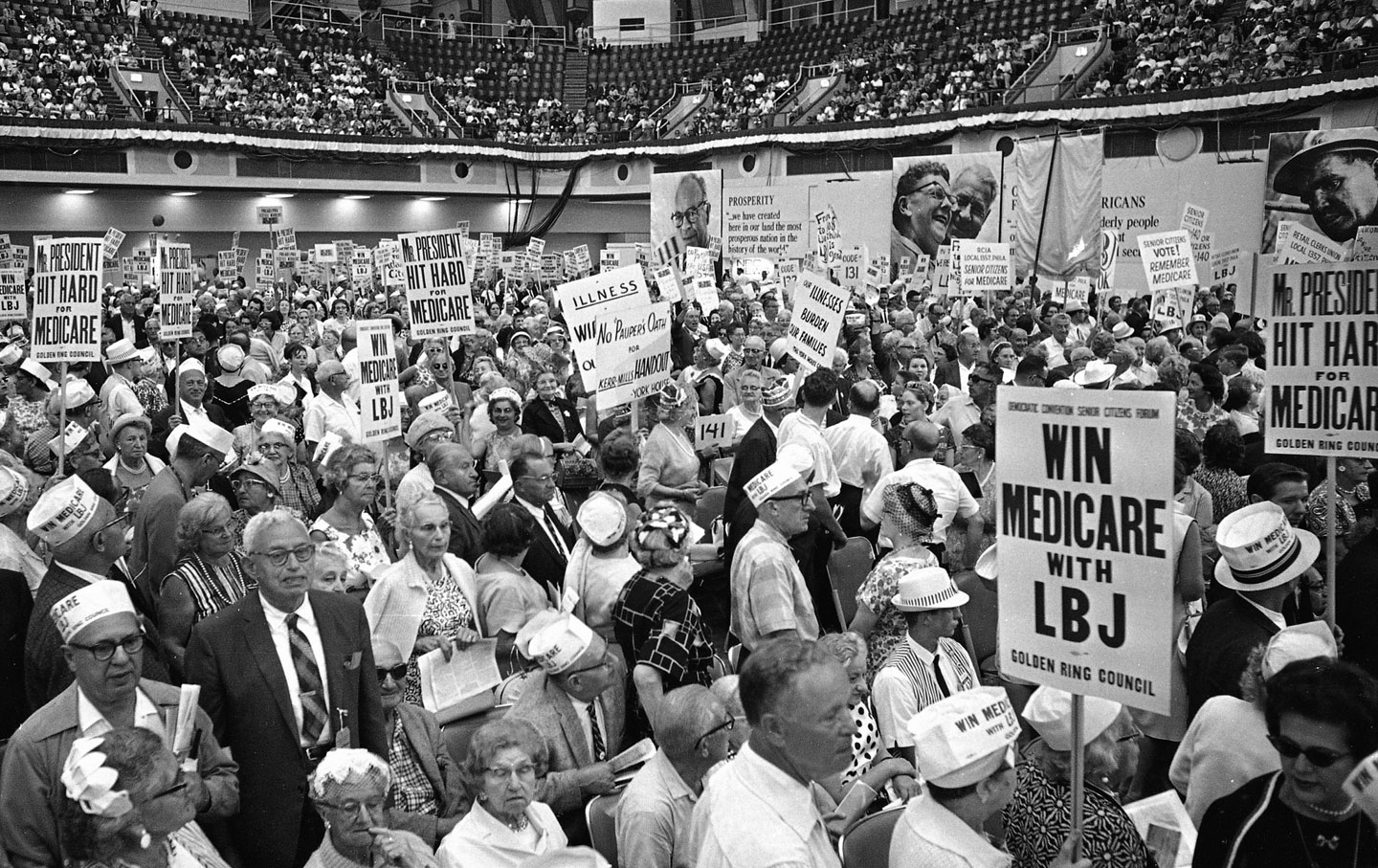
senior citizens supporting Medicare at the 1964 Democratic National Convention


The history of the fight for single-payer health care for the elderly and poor should inform today’s movement to win for Medicare for All.

In August of 1964, 14,000 retirees arrived by the busload in Atlantic City. Representing the National Council of Senior Citizens (NCSC), the former railroad workers, dressmakers, and auto assemblers marched 10 blocks up the fabled New Jersey boardwalk to the Democratic National Convention at the Convention Hall. The group, which was organized and bankrolled by the AFL-CIO, moved en masse in floral housecoats and sandwich boards with slogans like “Our Illnesses Burden Our Families” and “Senior Citizens Vote, Remember Medicare.” They intended to push President Johnson to extend public health insurance to millions of Americans.

Astonishingly, less than a year later, they won. Medicare was signed into law in July of 1965 in Independence, Missouri, at a ceremony attended by former president Harry S. Truman, whose push for national health insurance (NHI) had collapsed nearly two decades before. The landmark law created a public-sector insurance pool for Americans 65 and over, which remains today the closest thing to a robust universal entitlement in the US health-care system. Its successful passage (which also passed Medicaid, to insure the very poor) stands in sharp contrast to multiple failed efforts to install a universal single-payer system.

A half-century later, we’re witnessing the early stages of yet another popular thrust toward single payer, increasingly billed as “Medicare for All.” The nomenclature intends to evoke associations with the popular, trusted program, and is perhaps easier for Americans to latch onto than a phraseology that threatens to trigger a tedious lesson in comparative health policy. But if the conceptual jump from Medicare to Medicare for All can serve as a rough model for achieving universal health care in the United States, we should also look to the history of the social movements that achieved something that then, too, seemed impossible.

No one imagines expanding Medicare to all Americans will be easy. Nothing quite like this has ever been accomplished in the United States. Yes, dozens of peer countries have built coherent, humane, universal health-care systems out of entrenched private ones. Yes, mass movements have won major leftist reforms. Yes, advanced private industries of various nations have been nationalized. But human history offers no examples of these things happening in combination, which is what winning Medicare for All will require.

The most viable push toward NHI in American history crumbled in the late 1940s, ruthlessly crushed by not only insurers and pharmaceutical companies but also the American Medical Association. (Physicians, whose already handsome salaries began to rise in the postwar era, feared the blow that NHI could strike to their paychecks, professional prestige, and autonomy, since a government payer would also reduce their control over prices.) As such, the AMA famously shook down its membership for $25 apiece to fund the multimillion-dollar campaign that injected the phrase “socialized medicine” into mainstream American culture.

In this context, it’s perhaps tempting to view Medicare as a capitulation to industry pressure and political challenges, rather than as evidence they can be flouted. After all, Medicare (and, for that matter, Medicaid) targeted the most vulnerable patients. Many single-payer skeptics insist that Medicare managed to pass because it covered the people private insurance left behind. In his book Harry S. Truman Versus the Medical Lobby: The Genesis of Medicare, historian Monte Poen presents Medicare as a sort of compromise between the unfettered free market and the dashed dreams of the 1940s.

While it’s true that the enactment of Medicare didn’t pose nearly the threat to certain health-care-industry stakeholders that the NHI did or that Medicare for All would, it would be a mistake to fully dismiss its applicability to the current political fight. For one thing, the common talking point that Medicare extended insurance to a population who didn’t have it, rather than squashing existing private infrastructure, doesn’t bear out. A full half of elderly Americans did have private insurance plans when Medicare was signed into law. Commercial health insurers initially opposed the program, and began to support it only when it became clear a large administrative role would be preserved for for-profit insurers.

More importantly, while insurance companies certainly fought against health-care-financing reforms, physicians associations and hospitals are typically considered to have been the more significant opponents—they believed Medicare to be a likely conduit for eventual full-scale single payer (and all the government interference they assumed would come with it), and struck back with more or less the same zeal that they mustered decades earlier. As historian Jill Quadagno puts it, the AMA fought Medicare with “every propaganda tactic it had employed during the Truman era.” Such tactics included a widespread media blitz, advertising in doctors’ offices, and visits to congressmen from physicians in their districts. One tactic, called “Operation Coffee Cup,” deputized physicians’ wives to host ladies’ gatherings, at which they’d play their guests an anti-Medicare PSA starring actor Ronald Reagan.

This time, the AMA and its allies failed, but not for lack of trying. So it’s unfair to ascribe Medicare’s triumph to a lack of industry resistance, which was actually quite strong. The more crucial variable distinguishing Medicare from the NHI battles that fizzled before and since was a mass movement of people demanding it, having coalesced at a moment when powerful liberatory struggles against white supremacy and poverty had transformed what could be deemed politically possible.

Organized labor went all-in for Medicare, which took substantial pressure off unions for their retirees’ mounting health-care costs. Their enthusiasm contrasted with their relationship with universal initiatives before and since, despite their largely supporting most on paper. The reasons for labor’s tepid support for single payer have been debated by historians: For one thing, the unions’ success at collectively bargaining for employer-provided health benefits during the Truman-era reform battles perhaps reduced their motivation to prioritize national health-care solutions, the ongoing absence of which almost certainly highlighted the advantage of union membership. Since the 1970s, ever-rising health-care costs strengthened the case that labor’s interests would be served by removing health-care benefits from tense contract negotiations, but declining labor power during America’s rightward political shift tied them to a Democratic Party establishment unwilling to back single payer during the health-care debates of the 1970s and ’90s.

Today, with a slim majority of congressional Democrats vocally warming up to Medicare for All, and the ACA’s so-called “Cadillac Tax” poised to hit hard-won union-bargained health plans, the pro-labor case for single payer has never been more obvious. Indeed, each of the high-profile wildcat teachers’ strikes widely cited health-care benefits as a central demand. While the AFL-CIO has endorsed single payer, the question of whether workers will rally around Medicare for All they way they did for its namesake could well depend on how the movement’s stakeholders deal with those who stand to be displaced by the streamlining effect of large-scale reform.

But beyond institutional heft or the weight of its endorsements, the most impactful contribution organized labor made to the Medicare fight was a committed army of thousands of boots on the ground, many of them seniors who stood to benefit from the legislation or the family members who worried about how they’d care for them. Even the most precursory survey of 20th-century universal-health-care movements makes their most egregious failure stunningly obvious: They were nearly all top-down operations practically devoid of participation of ordinary people intent on changing the status quo.

By the time the NCSC marched in Atlantic City, this movement was already years in the making. It had been building momentum for the idea that would become Medicare in the 1950s, under a Republican president who, in is 1954 State of the Union address, had affirmed he was “flatly opposed to the socialization of medicine.” Rather than standing by waiting for better electoral luck, the Medicare movement fought to make theirs a winning campaign issue that would help to elect Democrats, not the other way around.

For years, the NCSC spearheaded letter-writing campaigns targeting media outlets and elected officials, and did any media outreach it could. It churned out brochures to counter the messaging of the powerful medical lobby, printing and distributing millions of pamphlets and fliers. As Blue Carstenson, then head of the NCSC, recounted later, “We had to make it a cause and we made it a cause…. We charged the atmosphere like a campaign…. We were always jammed in there and there was a hustle and bustle atmosphere. And when reporters came over they were always impressed by telephones ringing and the wild confusion and this little bitty outfit here that was tackling the whole AMA in a little apartment on Capitol Hill…. This was news. It used to make every reporter chuckle or smile.”

So too did the NCSC learn to push the buttons of electoral politics: It organized groups to testify before Congress about insurance premiums, which rose as much as 35 percent some years, like some ACA marketplace plans. And of course, Carstenson’s formidable elderly army turned out to campaign events. When Democrat George Smathers declined to support Medicare before the 1964 election, NCSC members organized town-hall meetings throughout the state—including one in Fort Lauderdale that was allegedly so successful that the organizers had to upgrade to a bigger venue three different times. Their message made appeals to all ages: Relief for seniors’ medical costs, they argued, will also reduce financial pressure on their working-age children, who’d in turn have more room in the budget to raise their own kids.

If the participants in today’s movement for Medicare for All intend to succeed, they must preempt the imminent counterattack of a health-care industry with far more fortunes at stake than the one their counterparts vanquished in 1965. This will require a mass mobilization of people making themselves seen and heard, whose demands for universal public insurance must reach a fever pitch to force candidates and current officials to capitulate. Doing so will demand a broad variety of tactics, including direct action, canvassing, printed materials, and public events, geared toward not only  persuading regular voters but also inspiring new ones.

Finally, this vision of justice must extend beyond the realm of health care alone. It is nearly impossible to imagine Medicare passing outside the political context set forth by the civil-rights movement, and the so-called War on Poverty. These years-long mobilizations of oppressed people had forced the political reckoning that fostered large-scale reform. It is no coincidence that the New Deal and the Great Society—however short they may have fallen—came about in large bursts rather than undetectable spurts.

Paradigm-shifting reforms have been delivered by broad coalitions confronting a common enemy. It’s up to advocates to compel people living under the US health-care system to see themselves and one another as part of a single constituency, from the poorest uninsured to those saddled with punishing paperwork, office staff chained to bad jobs for benefits, providers-turned-pawns of corporate conglomerates, and expectant mothers bracing themselves for exorbitant out-of-pocket costs atop weeks of unpaid maternity leave. And it must be done in solidarity with struggles on behalf of all oppressed Americans—people of color, the unhoused, the disabled, and others—whose subjugation benefits the very moneyed interests who’d prefer to keep things as they are.

All the evidence tells us that robust universal programs build solidarity, and create an impassioned base that enthusiastically defends them. Once Medicare for All is in place we can expect the same. Until then, it’s up to advocates to compel as many people as possible to envision the radically different society that stands to inherit it—and to accept nothing less.

CMS allows Medicare Advantage plans to negotiate Part B drug prices, implement step therapy

https://www.fiercehealthcare.com/payer/cms-allows-medicare-advantage-plans-to-negotiate-part-b-drug-prices-implement-step-therapy?mkt_tok=eyJpIjoiWlRsak1qTmpPV0poTVRBeCIsInQiOiI4TVwvbjloekN1OGJxWlJVTUw1djE5YXZkNlhONEpUQ3pXVFpmN3hlckFBcFRhSFBVRURkcCtVSmhpbVF0NlZoYkVmNVpHczVKbjBLXC9ZbjkxUlwvQVYrdm9FemhcL0FId3BmWkYzelg0a2tcLytaUEpHZ2VlU0dScldoRGJhWXlwUDlzIn0%3D&mrkid=959610

The Centers for Medicare & Medicaid Services (CMS) is giving Medicare Advantage (MA) plans more power in how they pay for Part B drugs.

The agency will allow MA plans to negotiate Part B drug prices with manufacturers, as well as to implement step therapy for Part B drugs. Plans will be required to pass half of the savings generated through negotiation to patients.

Negotiating Part B drug prices will foster competition and allow MA plans to get a better deal for their enrollees, according to CMS. These negotiations may also lead to price decreases in traditional Medicare.

The move represents perhaps the most significant step in the administration’s push to reduce drug prices, offering a new lever to combat ever-increasing costs.

Step therapy is a form of prior authorization that requires patients to try a “preferred” drug—that is, a less-expensive biosimilar— before the plan will cover a different, more expensive one. CMS says this will reduce costs for plans and beneficiaries alike.

Under the Affordable Care Act, at least 85% of plans’ savings must go toward healthcare services and quality improvement activities.

Further, the new policy requires “more than half of the savings required to be passed on directly to patients,” CMS said in a press release. A memo (PDF) from the agency says the savings may come in the form of “gift cards or other items of value.”

It is “unique that Medicare Advantage has not done this,” said CMS administrator Seema Verma in a press call on Tuesday evening, noting that traditional Medicare and private insurance plans have long been allowed to implement a step therapy policy.

MA plans will not be required to implement step therapy. Those that decide to do so must inform beneficiaries before the next enrollment period in October.

Verma added that patients and doctors can appeal the step therapy requirement through the existing appeals process.

The Pharmaceutical Care Management Association (PCMA), a trade association representing pharmacy benefit managers (PBMs), called the move “an important step toward reducing costs for the program and beneficiaries,” adding that “some of the highest priced drugs are found in Medicare Part B.”

Opponents of step therapy, who sometimes call it “fail first,” say limiting medication options can have negative consequences for consumers.

Step therapy policies “dangerously intrude on patient safety” and “weaken the doctor/patient relationship by negating the healthcare plan that they created together,” according to patient advocacy organization Fail First Hurts.

Part B drugs are either generally administered by a physician, administered via durable medical equipment, or otherwise specified by statute.


Healthcare Triage News: ACA Risk Adjustment is out of Danger. For Now.

Healthcare Triage News: ACA Risk Adjustment is out of Danger. For Now.

Image result for Healthcare Triage News: ACA Risk Adjustment is out of Danger. For Now.

A few weeks ago, we were critical of the Trump administration’s handling of ACA risk adjustment payments. We’re fair-minded types around here, so we though you should know that they’ve taken steps to fix it.


Molina still considering returning to Obamacare in Utah and Wisconsin

https://www.washingtonexaminer.com/policy/healthcare/molina-still-considering-returning-to-obamacare-in-utah-and-wisconsin

Heath Overhaul Texas 080118


Health insurer Molina is considering providing Obamacare plans in Wisconsin and Utah for 2019, after taking a one-year hiatus from these states, company executives said in an earnings call Wednesday.

Molina left these states for 2018 after suffering $230 million in overall losses and undertaking 1,500 planned layoffs. Company executives said in April that they would consider re-entering the market, and on Wednesday they said they were still evaluating how the plans are performing in the states where they still have Obamacare customers.

“I’m inclined to say that we would re-enter, but we have until the end of the summer to decide,” said Joseph Zubretsky, the company’s CEO.

Roughly 409,000 people are still enrolled in Molina’s Obamacare plans, and premiums for these customers increased by an average of 55 percent from 2017 to 2018, though many of them received subsidies from the federal government to cover the cost.

Zubretsky said that the current prices on their plans were “no longer corrective” but were priced about right in order to cover medical claims. Molina has customers on Obamacare plans in California, Florida, New Mexico, Michigan, Ohio, and Texas. It also has plans in Washington state but scaled back its participation by reducing the number of counties in which it offered plans.

“The strategy was to maintain [enrollment] and grow profits,” Zubretsky said of 2018, adding that re-entering Utah or Wisconsin would likely increase growth in enrollment for 2019.

Molina scaled back during a time of uncertainty, when President Trump had not yet announced he would be cutting off payments to insurers known as cost-sharing reduction subsidies, which under Obamacare help insurers offer lower out-of-pocket prices to their low-income customers. Though the payments were ended, many insurers have restructured their plans to make up for the loss by raising premiums, a move that shifts more expenses to the federal government and offers cheaper prices to Obamacare customers who get subsidies.

Early filings show that Obamacare customers will have more options for coverage in 2019, largely because of this strategy employed by insurers.

Molina’s overall performance is improving. Net income for the second quarter of 2018 was $202 million, compared with a net loss of $230 million for the second quarter of 2017. The company’s business focuses on managed care plans in Medicare and Medicaid.

Though Molina is a relatively small insurer, it drew headlines for enthusiastically embracing Obamacare. The company’s former chief executive, J. Mario Molina, was a major industry supporter of Obamacare and he has been a vocal critic of Republican efforts to repeal and replace the law. He and his brother, former Chief Financial Officer John Molina, were fired from their positions in May 2018 after poor first-quarter financial results.


Welcome to the New Health-Care Debate

https://www.bloomberg.com/view/articles/2018-08-03/health-care-debate-helps-republicans-hurts-conservatives

America’s health-care debate is entering a new phase. Liberals, inspired by self-described socialists such as Senator Bernie Sanders and Representative-to-be Alexandria Ocasio-Cortez, are excited about the possibility of “Medicare for All.” Republicans have at the same time largely abandoned efforts to enact major reforms of health care.

This new phase of the debate is full of opportunity for Republicans, and peril for conservatives.

But perhaps it would be better to say that the debate is reverting to an older pattern. For roughly four decades, liberals have highlighted the flaws of the existing health-care system, chiefly high costs and unequal access, and proposed increased governmental involvement as the solution. Conservatives talked up the dangers of bigger government, chiefly even higher costs and the disruption of existing arrangements, and reminded voters of the virtues of the status quo.

Most of the time, health care has been a back-burner issue, and discontent with the system has been a modest source of political strength for liberals. When health care has become a dominant issue, however, public fear of disruption has helped conservatives. From 2009 through 2016, Republicans were able to exploit public unhappiness with the changes that Obamacare first threatened to make and then did make.

There have been two brief exceptions to this pattern. In 1995-96 and 2017-18, Republicans advanced their own sweeping changes to health policy. Led by Newt Gingrich 20 years ago, they tried to reform Medicare and Medicaid. Over the last two years, they tried to replace Obamacare and reform Medicaid. 1

Both times the public’s fear of change was turned against Republican politicians, who did not like the pressure one bit. Most of them are relieved to have dropped their party’s Obamacare and Medicaid proposals. They are eager to settle into the familiar role of criticizing liberal health-care proposals.

There’s plenty to criticize. In polls, most people say they like their existing insurance policies — which may be a way for them to signal to politicians that they fear their meddling with those policies. The single-payer plans that are ascending among Democrats would by definition threaten most existing coverage.

These plans pose much bigger political risks than Obamacare did. Obamacare was carefully designed to insulate Democrats from charges that they were turning people’s coverage upside down.

In selling the legislation, President Barack Obama spent much of his time reassuring people that they could keep their doctors and their insurance plans if they liked them. The law mostly avoided changes to the employer-provided coverage through which most Americans get health care.

Yet Obamacare still provoked a backlash. That backlash was especially intense when, in the fall of 2013, it resulted in a significant number of plan cancellations. But many voters have also resented the narrower networks and higher premiums and deductibles that Obamacare has foisted on them.

As even more sweeping left-wing proposals move to the center of the debate, Republicans can reclaim the advantage of opposing disruption. But they may also again be saddled with the disadvantage of being associated with an unsatisfactory status quo.

They are in charge of Congress and the White House; they have been talking about reworking the health-care system for years; and they have succeeded in making significant changes, albeit much less ambitious ones than they sought. They have, for example, ended the fines on people without health insurance that were a major part of Obamacare. In addition, the Trump administration is in the process of liberalizing the rules for short-term insurance plans that do not have to comply with the regulations Obamacare imposes on most other plans.

The Republicans therefore have some, and growing, political ownership of the health-care system. The more they argue against left-wing proposals to change the system, the more ownership they will have.

For Republican politicians, defending even a flawed status quo is probably preferable to trying to impose disruptive changes to it. But if they adopt that position, it will mean that the only solutions on offer to popular concerns about health care will be left-wing ones.

It will mean, as well, that occasionally liberals will have enough political power to enact some, and maybe a lot, of their preferred changes to the system. We will move, that is, toward a health-care system with a larger and larger degree of governmental control even as Republicans make political gains by resisting that trend.

The new shape of the debate may be good news for Republican politicians, then, but it’s bad news for conservatives who favor limited government and free markets.

  1. Arguably there was a third exception: In 2011 and 2012, Paul Ryan led congressional Republicans to endorse increasing competition within Medicare as part of their budget proposals. They did not, however, attempt to advance legislation that would actually change Medicare.


Stabilizing and strengthening the individual health insurance market

https://www.brookings.edu/research/stabilizing-and-strengthening-the-individual-health-insurance-market/?utm_campaign=Economic%20Studies&utm_source=hs_email&utm_medium=email&utm_content=64960143

Image result for Stabilizing and strengthening the individual health insurance market

Stability has long been an issue for the individual health insurance market, even before the Affordable Care Act. While reforms adopted under the ACA initially succeeded in addressing some of these market issues, market conditions substantially worsened in 2016.

Insurers exited the individual market, both on and off the subsidized exchanges, leaving many areas with only a single insurer, and threatening to leave some areas (mostly rural) with no insurer on the exchange. Most insurers suffered significant losses in the individual market the first three years under the ACA, leading to very substantial increases in premiums a couple of years in a row.

For a time, it appeared that rate increases in 2016 and 2017 would be sufficient to stabilize the market by returning insurers to profitability, which would bring future increases in line with normal medical cost trends. However, Congress’s decision to repeal the individual mandate and the Trump Administration’s decision to halt “cost-sharing reduction” payments to insurers, along with other measures that were seen as destabilizing, created substantial new uncertainty for market conditions in 2018.

This uncertainty continues into 2019, owing both to lack of clarity on the actual effects of last year’s statutory and regulatory changes, and to pending regulatory changes that would expand the availability of “non-compliant” plans sold outside of the ACA-regulated market. These uncertainties further complicate insurers’ decisions about whether to remain in the individual market and how much to increase premiums.

In “Stabilizing and strengthening the individual health insurance market: A view from ten states” (PDF), Mark Hall examines the causes of instability in the individual market and identifies measures to help improve stability based off of interviews with key stakeholders in 10 states.

The condition of the individual market

In the states studied—Alaska, Arizona, Colorado, Florida, Iowa, Maine, Minnesota, Nevada, Ohio, and Texas—opinions about market stability vary widely across states and stakeholders.

While enrollment has remained remarkably strong in the ACA’s subsidized exchanges, enrollment by people not receiving subsidies has dropped sharply.

States that operate their own exchanges have had somewhat stronger enrollment (both on and off the exchanges), and lower premiums, than states using the federal exchange.

A core of insurers remain committed to the individual market because enrollment remains substantial, and most insurers have been able to increase prices enough to become profitable. Some insurers that previously left or stayed out of markets now appear to be (re)entering.

Political uncertainty

Premiums have increased sharply over the past two to three years, initially because insurers had underpriced relative to the actual claims costs that ACA enrollees generated. However, political uncertainty in recent years caused some insurers to leave the market and those who stayed raised their rates.

Insurers were able to cope with the Trump administration’s halt to CSR payments by increasing their rates for 2018 while the dominant view in most states is that the adverse effects of the repeal of the individual mandate will be less than originally thought. Even if the mandate is not essential, many subjects viewed it as helpful to market stability. Thus, there is some interest in replacing the federal mandate with alternative measures.

Because most insurers have become profitable in the individual market, future rate increases are likely to be closer to general medical cost trends (which are in the single digits). But this moderation may not hold if additional adverse regulatory or policy changes are made, and some such changes have been recently announced.

Many subjects viewed reinsurance as potentially helpful to market conditions, but only modestly so because funding levels typically proposed produce just a one-time lessening of rate increases in the range of 10-20 percent. Some subjects thought that a better use of additional funding would be to expand the range of people who are eligible for premium subsidies.Actions to restore stability

Concerns were expressed about coverage options that do not comply with ACA regulations, such as sharing ministries, association health plans, and short-term plans. However, some thought this outweighed harms to the ACA-compliant market; thus, there was some support for allowing separate markets (ACA and non-ACA) to develop, especially in states where unsubsidized prices are already particularly high.

Other federal measures, such as tightening up special enrollment, more flexibility in covered benefits, and lower medical loss ratios, were not seen as having a notable effect on market stability.

Measures that states might consider (in addition to those noted above) include: Medicaid buy-in as a “public option”; assessing non-complying plans to fund expanded ACA subsidies; investing more in marketing and outreach; “auto-enrollment” in “zero premium” Bronze plans; and allowing insurers to make mid-year rate corrections to account for major new regulatory changes.

Conclusion

The ACA’s individual market is in generally the same shape now as it was at the end of 2016. Prices are high and insurer participation is down, but these conditions are not fundamentally worse than they were at the end of the Obama administration. For a variety of reasons, the ACA’s core market has withstood remarkably well the various body blows it absorbed during 2017, including repeal of the individual mandate, and halting payments to insurers for reduced cost sharing by low-income subscribers.

The measures currently available to states are unlikely, however, to improve the individual market to the extent that is needed. Although the ACA market is likely to survive in its basic current form, the future health of the market—especially for unsubsidized people—depends on the willingness and ability of federal lawmakers to muster the political determination to make substantial improvements.

Read the full paper here


Do States Know the Status of Their Short-Term Health Plan Markets?

https://www.commonwealthfund.org/blog/2018/do-states-know-short-term-health-plan-markets?omnicid=EALERT1447487&mid=henrykotula@yahoo.com

Short term plans

The Trump administration this week issued a final rule reversing federal limits on short-term health coverage, allowing such plans to become a long-term alternative to individual market coverage. Starting in October, insurers will be allowed to sell short-term plans for just under 12 months, up from the current federal limit of three months. And in a sharp break from prior regulations, insurers can renew short-term plans for up to 36 months. The rule does strengthen a consumer notice required in application materials, but the notice does not need to inform consumers of all limitations and “fine print.” Importantly, the rule does not preempt state regulation that includes shorter limits on coverage.

Short-term plans are not required to comply with the Affordable Care Act’s (ACA) consumer protections, meaning insurers that sell these policies can deny coverage to individuals with preexisting conditions and are not required to cover essential health benefits. These plans are typically marketed to healthy consumers, for whom coverage with limited benefits and a low premium may appear attractive.

In the past, many state insurance departments have had to warn residents about deceptive marketing practices sometimes undertaken by short-term plan sellers, which can lead consumers to believe they are buying a comprehensive policy when they are not. During the fall open-enrollment seasons for ACA marketplaces, these plans will be competing for consumers’ premium dollars with comprehensive coverage, introducing the possibility of still greater consumer confusion.

We surveyed the Departments of Insurance (DOIs) in the 17 state-based ACA marketplace states to understand how the market for short-term coverage is working on the eve of this policy shift. We found that most states have little information about the status of their current short-term plan markets. Additionally, inconsistencies in how states have collected and reviewed the premium rates and contracts for short-term plans will make it difficult to assess how the market is responding to the new federal rules.

Most States Do Not Have a Complete Picture of the Current Short-Term Market

With the exception of New York, which doesn’t permit short-term plans, 16 states in our survey require insurers to file for approval in order to sell short-term policies. However, once these policies are approved, few states require annual reapproval unless policies undergo significant rate or benefit design changes. Most DOIs acknowledged that insurers with short-term policies that were approved decades ago could potentially market them to consumers this fall without any additional regulatory approval.

As a first step to prepare for the Trump administration’s rulemaking, some states started to identify their approved short-term sellers and which ones are actively marketing. For example, in Maryland, the legislature directed the DOI to contact every approved short-term plan insurer to determine whether they are actively marketing. Similarly, Oregon is now reviewing advertisements for short-term products, and insurers marketing products that are at least five years old have been asked to refile with the state. However, overall, few states are aware of which short-term insurers are actively marketing. A few DOI officials also explained that with the new rule, more short-term plan insurers are likely to market within their state.

Insurers Marketing Short-Term Plans Are Generally Different Than Those Marketing Individual Plans

We compared the list of 2018 marketplace insurers to those who have been approved to sell short-term policies. Four of the 17 states (Massachusetts, New York, Rhode Island, and Vermont) in our survey have no approved short-term sellers because they require such plans to play by some or all of the same rules as traditional coverage. While the data are limited,1 it appears that 11 of the 17 states have more insurers approved to sell short-term plans than individual plans. There tends to be little overlap among the companies, although there are a few approved to sell in both the individual and short-term markets.

This separation poses a risk to individual market stability, as short-term sellers may target healthy marketplace consumers, undercutting ACA-compliant insurers. In return, ACA-compliant insurers may be incentivized to start selling short-term policies in order to shift and maintain their healthy enrollees in those plans. Indeed, the Trump administration expects that as many as 500,000 individual market enrollees will migrate to short-term plans in 2019. Because they will be relatively healthy, their departure will cause premiums in the individual market to increase by a projected 5 percent. This increase will come on top of other projected increases resulting from the repeal of the ACA’s individual mandate penalty and the expansion of association health plans.

Looking Forward

The final rule allowing short-term policies to be sold for longer durations puts enrollees at financial risk, as they unknowingly enroll in the skimpier policies that do not meet their health needs. In turn, the shift of large numbers of healthy consumers to the short-term market will increase prices for those remaining in the individual market. As a new market of long-term short-term plans emerges, states need to understand their short-term market in order to protect consumers and maintain a stable individual market. This can begin with an assessment of which insurers are actively marketing in the state. States also may want to ensure that any short-term plan sellers seeking to offer coverage that mimics the 12-month duration of ACA-compliant coverage submit plan designs, rates, and marketing materials for review and approval, as Vermont has done recently. Doing so will allow states to have a firmer understanding of the insurance products being sold to their residents, and will better position them to reduce consumer confusion and monitor for potential fraud.


The Health 202: ‘Medicare for all’ is the dream. ‘Medicaid for more’ could be the reality.

https://www.washingtonpost.com/news/powerpost/paloma/the-health-202/2018/08/02/the-health-202-medicare-for-all-is-the-dream-medicaid-for-more-could-be-the-reality/5b61d4ed1b326b0207955ea2/?utm_term=.f54d337c2d74

Image result for incremental health reform

“Medicare for all” is the hottest position on the left these days, but there’s a quieter push afoot to create a public option using Medicaid. 

Chanting “Medicaid for more” may not sound as bold for progressives seeking to prove their bona fides before the midterm elections. Yet all the most-hyped 2020 Democratic presidential candidates are on board with the idea, including the Medicare expansion’s biggest champion, Sen. Bernie Sanders (I-Vt.).

The idea in concept is simple: Allow states to open up their Medicaid programs to anyone regardless of income. Those people could buy in to the social safety net and have access to Medicaid’s provider network and benefits. The groundwork for expanding the program for low-income Americans has already been laid to some extent as 34 states have expanded Medicaid under the Affordable Care Act.

Sen. Brian Schatz (D-Hawaii) has introduced the “State Public Option Act” to promote states to expand Medicaid — co-sponsored by some familiar Democratic faces: Sanders, Elizabeth Warren (Mass.), Cory Booker (N.J.), Kamala Harris (Calif.) and Kirsten Gillibrand (N.Y.). But the real efforts are happening at the state level where legislatures all over the country are seriously considering the idea.

Heather Howard, a lecturer at Princeton University who also helps states with their health-care systems, said many plans are in their infancy, but that 14 states across the country have made moves to, at minimum, weigh the benefits and challenges of shifting Medicaid to a publicly available health insurance option.

“There are a lot of policy considerations to think about, but while the federal policy debate is stalled, you have states thinking about what tools do we have. [Medicaid] is the immediate tool you have,” she told me.

That’s because Medicare is operated at the federal level so any major changes to it have to be decided in Washington. Medicaid, on the other hand, is run by the states, so they have more discretion over how the program is set up. 

There are real critiques of Medicaid as it now exists, such as low reimbursement rates for doctors and uniform access to care. To offer it to everyone would require responding to those criticisms as well as new questions such as the cost to states, whether states have to apply for federal waivers to alter the program and whether a public option lives on or off the ACA exchanges.

This week stakeholders across New Mexico met with President Obama’s former Centers for Medicare and Medicaid Services Administrator Andy Slavitt to begin some of those conversations. Earlier this year, New Mexico’s state legislature passed a bill to create a committee to study a Medicaid buy-in program. Medicaid is popular there; one-third of New Mexicans are enrolled. Yet 230,000 people remain uninsured in the state, according to Kaiser Family Foundation data, and proposed premium rates for 2019 for those who don’t qualify for ACA subsidies are increasing anywhere from 9.2 percent to 18.5 percent.

Slavitt is the board chair of a new group, United States of Care, which has an impressive roster of bold-faced names leading it from investor Mark Cuban to former Obama speechwriter Jon Favreau to former congresswoman Gabrielle Giffords (D-Ariz.) and her astronaut husband Mark Kelly. In the absence of Washington leadership, the group is working with states on ways to improve health care.

Allison O’Toole, the group’s director of state affairs, was also on the ground in New Mexico this week and told me there’s a “real hunger” and “momentum” around the idea of allowing states to expand Medicaid.

“Washington is in gridlock and not addressing people’s real concerns around the cost and affordability of health care,” O’Toole said. “This has created a greater sense of urgency and necessity by states to pick up that ball and run with it.”

With the Republicans’ failure to repeal the ACA and the public outcry when they tried, Democrats are feeling emboldened this year to talk ambitiously about their health-care goals. 

Health care is a leading issue heading into November, and polls show at least half of Americans are in favor of a “Medicare for all” program. But even if Democrats win the House majority and make gains in the Senate, President Trump has said Obamacare is unsustainable and his administration has worked persistently to chip away at it.

That’s why Michael Sparer, a public- health professor at Columbia University, believes “Medicaid for more” is not only good policy, but also good politics. It’s the type of proposal, he reasons, that could peel off moderate Republicans in a way that a national Medicare program never could. 

It’s true that Medicaid is a favorite GOP punching bag. The Trump administration is urging states to add work requirements to their programs and the GOP playbook has long included capping how much the federal government pays each state to administer Medicaid.

Yet 34 states, including many with Republican governors, expanded the ACA under Medicaid to include more low-income residents, and several more red states are on the precipice of following them. It’s a program that has endured and grown for 53 years.

“The Medicaid buy-in is more of a compromise program, it’s not viewed as a big national program. People who believe in states’ rights can view it as states having more flexibility,” Sparer said.

Sparer has written extensively on the topic and told me his support for expanding Medicaid is heavily influenced by the political viability of focusing on the program for low-income Americans versus the one covering seniors — meaning states don’t have to wait for a new president to do something meaningful. But that doesn’t mean he thinks national political figures like Sanders should stop talking about “Medicare for all.”

“The advantage is [Medicaid buy-in] is incremental, it adds populations here and there. But incremental isn’t a great political slogan. You put ‘let’s change the system’ on a bumper sticker and I get that,” he said. “But the more there’s momentum for ‘Medicare for all,’ then ‘Medicaid for more’ could be the back up plan.”

“Given the ever-present debate,” he added, “a more incremental path is a better path.”


How Would Individual Market Premiums Change in 2019 in a Stable Policy Environment?

Click to access Individual-Market-Premium-Outlook-20191.pdf

Image result for How Would Individual Market Premiums Change in 2019 in a Stable Policy Environment?

Introduction

In recent weeks, insurers in many areas of the country have unveiled the premiums they propose to
charge for individual market health insurance policies in 2019. In setting premiums for 2019, insurers
are taking account of several policy changes that will be newly in effect for the 2019 plan year, including
repeal of the individual mandate penalty and Trump Administration actions to expand the availability
of plans that are exempt from various Affordable Care Act (ACA) requirements. These policy changes
are generally expected to cause many healthier people to leave the individual market and thereby raise
individual market premiums (e.g., CBO 2018a; Blumberg, Buettgens, and Wang 2018).

This analysis examines how premiums might have changed in 2019 in a stable policy environment. To
do so, I first estimate insurers’ revenues and costs in the ACA-compliant individual market through
2018, drawing primarily on insurers’ reports to state and federal regulators. With these estimates as a
starting point, I then estimate how premiums would have changed in 2019 under various assumptions
about how insurers’ costs and margins would have evolved in 2019 without the major pending policy
changes. This analysis reaches two main conclusions:

 Insurers will earn large profits in the ACA-compliant individual market in 2018:
I project that insurers’ revenues in the ACA-compliant individual market will far exceed their
costs in 2018, generating a positive underwriting margin of 10.5 percent of premium revenue.
This is up from a modest positive margin of 1.2 percent of premium revenue in 2017 and
contrasts sharply with the substantial losses insurers incurred in the ACA-compliant market
in 2014, 2015, and 2016. The estimated 2018 margin also far exceeds insurers’ margins in the
pre-ACA individual market. These estimates for 2018 as a whole are broadly consistent with
estimates for the first quarter of 2018 derived from insurers’ first quarter financial filings by
researchers at the Kaiser Family Foundation (Semanskee, Cox, and Levitt 2018).

The estimated improvement in insurers’ margins for 2018 is driven by the substantial
premium increases insurers implemented for 2018, which will almost certainly be more than
sufficient to offset the loss of cost-sharing reduction (CSR) payments and what appears likely
to be another year of moderate growth in underlying claims spending. Prior analysis of
insurers’ 2018 rate filings suggests that many insurers expected policy changes that are now
scheduled to take effect in 2019, notably repeal of the individual mandate penalty, to take effect
in some form during 2018 (Kamal et al. 2017). This may have led insurers to incorporate those
policy changes into their premiums a year early.

 In a stable policy environment, average premiums for ACA-compliant plans
would likely fall in 2019: In this analysis, I define a stable policy environment as one in
which the federal policies toward the individual market in effect for 2018 remain in effect for
3
2019. Notably, this scenario assumes that the individual mandate remains in effect for 2019,
but also assumes that policies implemented prior to 2018, like the end of CSR payments,
remain in effect as well. Under those circumstances, insurers’ costs would rise only moderately
in 2019, primarily reflecting normal growth in medical costs. Meanwhile, for reasons I discuss
in detail in the main text, it is unlikely that insurers would set 2019 premiums with the goal of
keeping margins at their unusually high 2018 level. Downward pressure on premiums from
falling margins would likely more than offset upward pressure on premiums from underlying
cost pressures, so premiums would fall on net.

Indeed, under my base assumptions, I estimate that the nationwide average per member per
month premium in the individual market would fall by 4.3 percent in 2019 in a stable policy
environment. This estimate is subject to some uncertainty, primarily because of uncertainty
about underlying individual market claims trends and about the margins insurers are likely to
target for 2019. However, I estimate that average premiums would have declined in a stable
policy environment under a range of plausible alternative assumptions.

The remainder of this analysis proceeds as follows. The first section provides an overview of my
methodology for estimating insurers’ revenues and costs through 2018, and the second section
presents the resulting estimates. The final section examines what these estimates imply for premium
changes in 2019 in a stable policy environment. A pair of appendices provide additional detail.