Consolidating California: Concentrated Provider Markets and Rising Prices

http://www.healthleadersmedia.com/finance/consolidating-california-concentrated-provider-markets-and-rising-prices?utm_source=edit&utm_medium=ENL&utm_campaign=HLM-FIN-SilverPop_04092018&spMailingID=13279518&spUserID=MTY3ODg4NTg1MzQ4S0&spJobID=1380773897&spReportId=MTM4MDc3Mzg5NwS2#

A UC Berkeley study suggests that provider and insurer consolidation is increasing, reducing competition in regional markets, and leading to higher healthcare prices across California.

In the midst of a nationwide consolidation trend, California is witnessing a swell of mergers among health providers and insurers, resulting in higher prices for consumers and large-scale employers across the state.

A recent study found most counties in California, especially those in the rural northern portion of the state, have highly concentrated hospital markets, noting provider consolidation rose as average insurer consolidation decreased statewide.

The report, released last month by the Nicholas C. Petris Center on Health Care Markets and Consumer Welfare School of Public Health at the University of California, Berkeley, concluded that Californians pay for healthcare services that are “considerably above what a more competitive market would produce.”

Of the 54 counties surveyed, 44 were highly concentrated hospital markets and six were moderately concentrated. According to the study, seven of these counties warrant “concern and scrutiny” by the Department of Justice and the Federal Trade Commission.

The report found from 2010 to 2016, there was a 15% increase in physicians working for a foundation owned by a hospital or health system rather than physician practices, due in part to health system mergers, as well as a 13% increase for primary care physicians, and a 29% increase for specialist physicians.

Additionally, the study found 42 counties surveyed for commercial health plans were highly concentrated while 16 were moderately concentrated. The study also recommended federal agencies review the concentration levels of the insurer market in seven counties.

Breeding anticompetitive behavior

Bill Kramer, MBA, executive director for national health policy at the Pacific Business Group on Health, told HealthLeaders Media the consolidation trend in California is a “serious problem” that employers have been dealing with for years.

Kramer said large health systems, physician groups, and health plans recognize that consolidation leads to increased market power, which in turn provides the opportunity to raise healthcare service prices above what is allowed in a competitive marketplace.

Two weeks ago, California Attorney General Xavier Becerra sued northern California’s Sutter Health, for anticompetitive practices. Sutter, a health system with $12.4 billion in operating revenue in 2017, is charged with foreclosing price competition on its competitors, imposing prices for healthcare services exceeding a competitive market value, and restricting negotiations with insurers to an “all-or-nothing” basis.

Since 2014, Sutter has also been the focus of a class-action lawsuit filed by a grocery worker’s health plan alleging violation of antitrust and unfair competition laws.

“When a provider or any other healthcare entity gains significant market share, it can use that power to negotiate higher prices,” Kramer said. “But they also can put in place mechanisms that strengthen their market power further. That’s what [Becerra] and complainants in this other lawsuit have alleged, that anticompetitive behavior further strengthens their market power and their ability to raise prices. It’s all part of the same picture.”

State and federal blocks on insurers, not providers

Becerra’s lawsuit against Sutter is not the first time state or federal officials have stepped in to address concerns in California’s healthcare industry.

In June 2016, California Insurance Commissioner Dave Jones requested the federal government block the proposed Aetna-Humana merger, citing concerns about an “already heavily concentrated commercial insurance” market. A federal judge agreed with his request and blocked the move in January 2017.

Despite recent and growing recognition among state and federal officials that action must be taken, Kramer says provider consolidation remains an issue without a simple solution. Efforts to enact antitrust statutes against health system mergers in recent years have not always been successful, and are often looked at as the “nuclear option” by industry watchers.

A potential path to offsetting provider consolidation is greenlighting insurer consolidation, though Kramer says there is mixed evidence about whether that would be effective. He said some argue that two large industries competing against each other can result in lower prices, while others claim there is no guarantee that consumers will see lower prices if savings are secured by insurers.

The Berkeley report recommends legislative and regulatory action to address “significant variation” in prices and Affordable Care Act (ACA) premiums across the state, specifically suggesting the implementation of reference pricing by public marketplaces and private employers.

Kramer says the consolidation dilemma is not unique to California, which offers state officials a chance to adopt proactive measures taken by other states to address rising healthcare costs associated with consolidation.

In 2011, Massachusetts Attorney General Martha Coakley authored a report similar to the Berkeley study that analyzed the rise in high prices due to health system mergers. The study ultimately led to the creation of the Health Policy Commission in 2012, with the purpose of monitoring healthcare prices in the state.

NoCal versus SoCal

Another important aspect of the consolidation trend in California is the divide between the rural northern counties and the more populous southern metropolitan area.

Northern California is a sparsely populated region dominated by large health systems, giving insurers less leverage to negotiate prices. A 2017 study from the Bay Area Council Economic Institute (BACEI), the Center for Health Policy at Brookings, and The Nelson A. Rockefeller Institute of Government found that the hospital concentration in northern counties, where only two insurers cover the entire region, is five times higher than the Inland Empire.

Micah Weinberg, PhD, president of BACEI, told HealthLeaders Media the consolidation trend is not tied to one particular factor such as geography.

BACEI’s report cited the consolidation of a few health systems in northern California as a “perennial concern” and driver of rate variation between regions. However, Weinberg said that when low-price, for-profit systems in southern California are removed from the equation, there is a fair amount of parity between prices charged there compared to those charged in northern California.

Related: 3 Reasons Why Health Insurers and PBMs Are Merging

According to Weinberg, another aspect to California’s healthcare market that affects prices has been the implementation of a “very successful experiment” in managed competition through the state exchange. In 2010, California became the first state to create its own insurance marketplace under the ACA.

He argues that Covered California, the state’s insurance marketplace, has standardized healthcare products, instituted financial incentives for providers to embrace limited networks, and fostered competition.

“What that does is it emphasizes the importance of not only payers and providers, but of the structure of the marketplace, in which consumers are making choices across different provider groups linked to particular insurance plans,” Weinberg said.

The BACEI report did cite the ACA as an unintended driver of increased regional consolidation among providers, which has made achieving profitability in northern California a challenge for insurers such as UnitedHealth Group Inc., which exited the statewide ACA marketplace entirely in 2016.


Rural health care is expensive, and Washington isn’t helping

https://www.axios.com/rural-areas-aca-unaffordable-d45599c2-3823-4041-ad8c-696cf7c15d8f.html

Image result for Rural health care is expensive, and Washington isn't helping


Some of the Affordable Care Act’s biggest problems — rising premiums and lackluster competition among insurers — are most severe in rural areas. And those areas tend to be conservative, but there’s little serious effort among Republicans to address these problems.

Why it matters: Rising premiums put health care further out of reach for middle-class people in these areas. At some point, they’re going to want to hear workable solutions from their elected representatives.

Show less

The problem: By definition, rural areas are sparsely populated. So there’s not much competition among hospitals and other providers, which means insurers don’t have much leverage to negotiate lower prices. And with fewer customers overall, one very expensive patient can have a disproportionate impact on a plan’s bottom line.

  • “Conservative approaches to dealing with health costs tend to revolve around a competitive market, but the challenge with rural areas is you don’t have the ingredients for a competitive market,” said Larry Levitt of the Kaiser Family Foundation.

What they’re saying: Broadly, Republicans have focused on proposals that would make it easier for healthy people to extricate themselves from the ACA’s insurance markets. Those consumers would likely pay less, but costs and competition would only get worse for the people who need the coverage guarantees the ACA provides.

“This boils down to money for services. One way or another you have to come up with the money, find a way to get the price of the services down, or find a way to not use all of the services.”
— Joe Antos of the American Enterprise Institute

The other side: There was some bipartisan support earlier this year for a new reinsurance program, which would offset the costs of insurers’ most expensive customers. Experts said it would have helped, including in rural areas. But it fell apart.

  • Democrats have proposed a slew of ideas they say could help ease the burden in sparsely populated regions, mostly at taxpayers’ expense — including a public option, an expansion of the ACA’s premium subsidies, or new caps on payments. But none of those ideas have any real chance of actually happening, at least any time soon.

The bottom line: Reinsurance is by far the most bipartisan solution to the rural problem. Even that couldn’t get through this Congress, and lawmakers aren’t expected to return to health care policy before the midterms. This problem will likely get worse before it gets better.

The driving force of health care fear

https://www.axios.com/driving-force-health-care-fear-c90adaf6-e5f8-4c11-816d-d3893b5d1374.html

Stethoscope

Insurers are afraid of a deteriorating market for individual coverage, fueled by the repeal of the Affordable Care Act’s individual mandate as well as regulatory changes from the Trump administration.

What to watch: Over the course of the spring, they’ll be deciding whether it makes sense to simply quit offering ACA coverage in some parts of the country. Rural areas will likely be the first to see insurers leave.

Pharma fears Washington after a couple of surprising defeats on Capitol Hill have shown the industry may not be as bulletproof as it seems.

  • What to watch: The Trump administration is eager to show progress on drug prices, and its early efforts have largely steered clear of drug companies themselves. But Health and Human Services secretary Alex Azar is open to reining in some of the industry’s patent tricks — a move that could cost drugmakers billions of dollars.

Everyone fears Amazon. Just the possibility that it might enter the pharmacy business has accelerated a trend of health care mega-mergers, as the old guard looks to lock in as much market power as it can.

And the public fears the cost of health care. That’s part of the reason the industry, which profits from those costs, is right to worry about what’s ahead.


The politics of ACA rate hikes will be 2016 in reverse

https://www.axios.com/politics-aca-rate-hikes-2016-in-reverse-63e401ef-03b7-4c11-a2b3-7410e1322c63.html

Protester holds sign saying "ACA Saves Lives"

We are about to see a replay of the 2016 election fight over premium increases, but this time in reverse. Last time, it was the Republicans hammering Democrats for the rate hikes. This time, it will be Democrats accusing Republicans of driving up premiums by sabotaging the Affordable Care Act.

What to watch: It’s going to be a balancing act for the Democrats. They can (and will) score political points by blaming Republicans for the coming premium increases, but another campaign debate about rising premiums could also undermine the ACA by focusing on its continuing problems.

In 2016, fear of rising premiums jumped the individual market, and a majority of Americans came to believe that rising premiums were somehow affecting them when only a small share of the public was impacted. That undermined the ACA and may have affected the election.

This time, Democrats will be on the offensive, buttressed by polling that shows the public sees Republicans and President Trump owning the ACA’s problems. Democrats are sure to call out Republicans and the administration for steps they have taken to undermine the law.

These include:

  • Eliminating the penalty for not buying insurance.
  • Failing to pass stabilization legislation.
  • Developing regulations to allow the sale of short-term policies and the wider sale of association health plans.

Taken together, these actions provide more options for the healthy, but will drive up rates overall.

Reality check: Last year, far more Americans came to believe they were affected by premiums increases than the relatively small number of unsubsidized people in the non-group market who were actually affected.

Our August 2017 tracking poll showed that fully 60% of the American people believed they were negatively affected by the premium increases, when in reality, just a sliver of the public — the unsubsidized people in the individual health insurance market — were actually affected.

The numbers that matter, per Kaiser Family Foundation estimates:

  • Affected: 6.7 million
  • Unaffected: 319 million

No doubt the broader public’s fears about rising premiums fueled cynicism about the ACA. Some political scientists say it contributed to the Republican victory in 2016.  In fact, premiums for most Americans with private coverage have been growing at a 3% clip, a historically moderate level.

The bottom line: As the midterms approach, Republicans’ first impulse may be to attack the law to rev up their base as they have done before. The tradeoff they face is that they now own the ACA in the eyes of the public, including the problem of rising premiums which they will have helped to create.

And Democrats now have a chance to score political points on the ACA for the first time — but the risk is a disproportionate public reaction, much like in 2016, that undermines the law they worked so hard to pass.


Consumers are paying less for ACA plans, even as premiums continue to rise

https://www.fiercehealthcare.com/payer/consumer-satisfaction-exchange-enrollment-up-but-premiums-continue-to-rise?mkt_tok=eyJpIjoiWlRReU4yTXdZelF5TUdJMyIsInQiOiJqbDN6cndBd1YwOHFvQkV3NGNvXC9xVWh3bVpNYzJ0djZyaXJOakFGaU5nQWdETG0wWE1nWDhTck5XK2JIVTZkanFidU85clo2akpIT0VvXC9MWjFjOExsUm5kUEpRZk9IQ0tYNWFQeGJaQmhJMWNTdnkweFBtTGRJME1KNzJvaTRFIn0%3D&mrkid=959610

Healthcare.gov site on computer

The Centers for Medicare & Medicaid Services (CMS) proclaimed its 2018 open enrollment period a success, citing relatively stable enrollment on reduced costs of outreach and a tightened enrollment period.

The agency’s final report on 2018 enrollment data provides insight on the 11.8 million individuals who enrolled or renewed coverage through the exchanges in 2018. That number includes approximately 8.7 million who signed up through HealthCare.gov, where the average premium rose 30% from $476 last year to $621 this year. A solid majority of consumers opted for the middle-tier silver plans, with 29% choosing bronze plans and only 7% purchasing gold plans.

CMS Administrator Seema Verma lauded the agency’s efforts on Twitter, but pointed to the 30% jump in premiums as an indication that “more affordable options are needed,” particularly for those that don’t qualify for tax credits.

Despite delivering the most successful consumer experience to date, Americans continue to experience skyrocketing premiums and limited choice on http://Healthcare.gov .

Despite higher premiums, consumers that qualified for the tax credit actually saw a 16% decline in their final cost, with average monthly costs dropping from $106 in 2017 to $89 in 2018.

“The reduction in price that consumers paid was staggering,” Josh Peck, co-founder of Get America Covered and former chief medical officer of Healthcare.gov under President Barack Obama, told FierceHealthcare.

“To be totally honest, enrollment would have been far higher had they tried,” he added.

While the total number of enrollees dipped slightly year over year, they remained relatively stable given the shortened time frame rolled out by the Trump administration. Verma also pointed to consumer satisfaction scores of 90%, up from 85% last year, as proof the agency had met its primary goal of ensuring “a seamless experience” for consumers.

Critics, however, lashed out at CMS for doing little to educate the public about open enrollment options.

Lori Lodes@loril

Really weird (and gobsmacking) to see @SeemaCMS take credit for 11.8 million people signing up for health care when she refused to do anything to educate people about Open Enrollent. https://twitter.com/SeemaCMS/status/981250136344088576 

The agency also touted the cost effectiveness of the enrollment period, after CMS slashed its advertising spending from approximately $11 per enrollee last year to just over $1 per enrollee in 2018. Those cuts spurred increased advertising dollars from private insurers in an attempt to make up the gap.

The majority of consumers using the exchanges continues to rely on premium subsidies. The age mix among consumers trended older, as enrollees aged 55 and over ticked up two percentage points to 29%, while the share of those aged 18-34 declined slightly.

Final Exchange Enrollment Report also shows most consumers on the Exchanges relied on premium subsidies. Approximately 83% of consumers nationwide had their premiums reduced by tax credits.

In a statement, Verma said she was pleased with the rise in customer satisfaction, but expressed concerns about the future. “Even with the success of this year’s open enrollment, the individual market continues to see premiums rise and choices diminish,” she said.


AIMING HIGHER: Results from the Commonwealth Fund Scorecard on State Health System Performance

http://www.commonwealthfund.org/interactives/2017/mar/state-scorecard/

Image result for AIMING HIGHER: Results from the Commonwealth Fund Scorecard on State Health System Performance

The 2017 edition of the Commonwealth Fund Scorecard on State Health System Performance finds that nearly all state health systems improved on a broad array of health indicators between 2013 and 2015. During this period, which coincides with implementation of the Affordable Care Act’s major coverage expansions, uninsured rates dropped and more people were able to access needed care, particularly those in states that expanded their Medicaid programs. On a less positive note, between 2011–12 and 2013–14, premature death rates rose slightly following a long decline. The Scorecard points to a constant give-and-take in efforts to improve health and health care, reminding us that there is still more to be done.

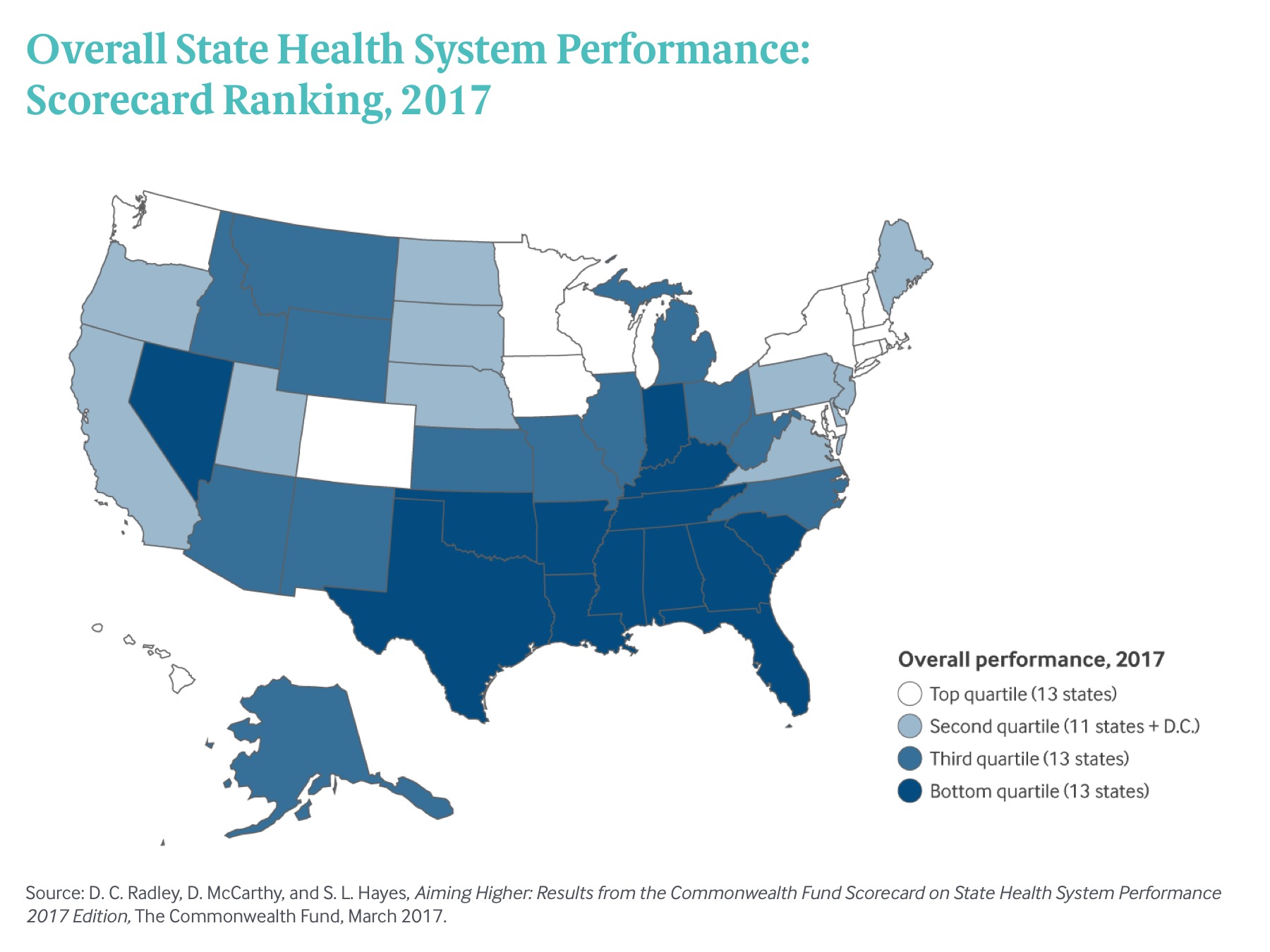
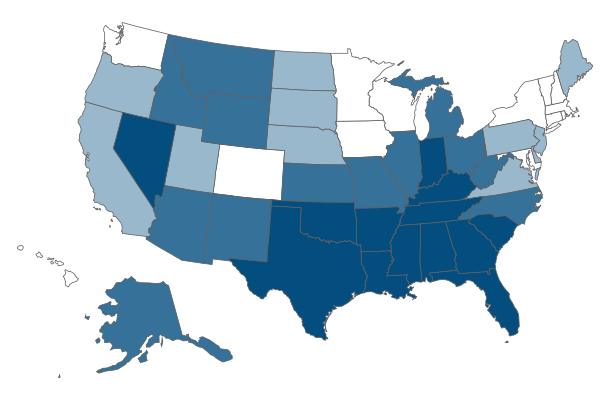
Vermont was the top-ranked state overall in this year’s Scorecard, followed by Minnesota, Hawaii, Rhode Island, and Massachusetts (Exhibit 1). California, Colorado, Kentucky, New York, and Washington made the biggest jumps in ranking, with New York moving into the top-performing group for the first time. Kentucky also stood out for having improved on more measures than any other state.

Exhibit 1Exhibit 1: Overall State Health System Performance: Scorecard Ranking, 2017

Using the most recent data available, the Scorecard ranks states on more than 40 measures of health system performance in five broad areas: health care access, quality, avoidable hospital use and costs, health outcomes, and health care equity. In reviewing the data, four key themes emerged:

  • There was more improvement than decline in states’ health system performance.
  • States that expanded Medicaid saw greater gains in access to care.
  • Premature death rates crept up in almost two-thirds of states.
  • Across all measures, there was a threefold variation in performance, on average, between top- and bottom-performing states, signifying opportunities for improvement.

By 2015, fewer people in every state lacked health insurance. Across the country, more patients benefited from better quality of care in doctors’ offices and hospitals, and Medicare beneficiaries were less frequently readmitted to the hospital. The most pervasive improvements in health system performance occurred where policymakers and health system leaders created programs, incentives, or collaborations to ensure access to care and improve the quality and efficiency of care. For example, the decline in hospital readmissions accelerated after the federal government began levying financial penalties on hospitals that had high rates of readmissions and created hospital improvement innovation networks to help spread best practices. (notes)

Still, wide performance variation across states, as well as persistent disparities by race and economic status within states, are clear signals that our nation is a long way from offering everyone an equal opportunity for a long, healthy, and productive life. Looking forward, it is likely that states will be challenged to provide leadership on health policy as the federal government considers a new relationship with states in public financing of health care. To improve the health of their residents, states must find creative ways of addressing the causes of rising mortality rates while also working to strengthen primary and preventive care.


What The Health? VA Secretary Out, Privatization In?

https://khn.org/news/podcast-khns-what-the-health-va-secretary-out-privatization-in/

Image result for khn what the health

David Shulkin, the secretary of Veterans Affairs, was fired Wednesday night by President Donald Trump. To replace him, Trump will nominate his White House physician, naval Rear Adm. Ronny Jackson. Shulkin, however, is not going quietly. He took to The New York Times op-ed page to claim he was pushed out by those who want to privatize VA health services for profit.

Meanwhile, two more states, Iowa and Utah, passed legislation that would sidestep some of the requirements of the Affordable Care Act. Iowa wants to allow the sale of health plans that cover fewer benefits — or restrict coverage for people with preexisting health conditions. Utah wants to expand Medicaid to those higher up the income scale — but not as high as prescribed by the ACA.

This week’s panelists for KHN’s “What the Health?” are Julie Rovner of Kaiser Health News, Anna Edney of Bloomberg News, Sarah Kliff of Vox.com and Alice Ollstein of Talking Points Memo.

Among the takeaways from this week’s podcast:

  • If Shulkin is right that the administration is keen on privatizing the VA, would it move to something akin to the Medicaid managed-care systems that many states have set up?
  • Veterans groups haven’t yet shown their cards on whether they think Jackson is a suitable choice to replace Shulkin.
  • Iowa is poised to allow farmers groups to offer health plans that could sidestep some of the consumer protections in the federal Affordable Care Act, such as requiring that preexisting conditions be covered. Tennessee has a program similar to what Iowa is implementing, and some consumer groups have complained it pulls healthy individuals out of the ACA marketplace and drives up premiums for those who remain.
  • Utah’s request for a federal waiver so that it can offer a Medicaid expansion program to people earning up to 100 percent of the federal poverty level — and not the 138 percent included in the ACA — will show whether the Trump administration has a different standard than the Obama administration. Obama officials rejected partial Medicaid expansion requests.
  • Sen. Elizabeth Warren (D-Mass.) introduced a bill that offers provisions to help middle-income customers buying insurance on the ACA marketplace. But it suggests Democrats are still not sure what is the best health care strategy heading into the midterm elections.


State and Federal Contraceptive Coverage Requirements: Implications for Women and Employers

State and Federal Contraceptive Coverage Requirements: Implications for Women and Employers

Image result for contraception coverage

Contraceptive Coverage under the Affordable Care Act (ACA) has made access to the full range of contraceptive methods affordable to millions of women. Since it was first issued in 2012, this provision has been controversial and has been the focus of two major cases that have reached the Supreme Court. Following the Hobby Lobby ruling, the Obama Administration took the stand that almost all women had an entitlement to the contraceptive benefit and developed an “accommodation” to assure they would still get coverage, even if their employer had religious objections to contraception. The Trump Administration, in contrast, has prioritized the rights of employers, and in October 2017, issued regulations that significantly broadened the exemption to nearly any employer with a religious or moral objection. The new regulations have been challenged by 8 states and have been blocked from being implemented pending the outcome of the litigation.

Before the ACA was passed, many states had enacted contraceptive equity laws that required plans to treat contraceptives in the same way they covered other services. In addition, since the ACA was passed, a number of states have enacted laws that basically codify in state legislation the ACA benefit rules (requiring all plans to cover, without cost-sharing each of the 18 FDA approved contraceptive methods). This issue brief provides an update on the status of the continuing litigation on the federal contraceptive requirement and explains the interplay between the federal and state contraceptive coverage laws and the implications for employers and women.

Background on State and Federal Contraceptive Coverage Requirements

Before the ACA, coverage for prescription contraceptives was generally widespread in the private and public sectors, but not universal, and certainly not free of cost-sharing. In 2000, a ruling by the Employment Equal Opportunity Commission found that employers that covered preventive prescription drugs and services but did not cover prescription contraceptives were in violation of the Civil Rights Act.1 Currently, 29 states and DC2 require insurance plans to cover contraceptives, with a wide range of coverage and cost-sharing requirements, and exemptions among these mandates (Appendix A). State laws, however, do not have authority over all plans; they only apply to state regulated (fully-insured) plans, but not self-funded plans under ERISA where 60% of covered workers are insured.3

The ACA is the first law to set preventive coverage requirements for health insurance across all markets – individual, small group, large group and self-insured plans. Starting in 2012, all new private plans were required to cover, without cost-sharing, the full range of contraceptive services and supplies approved by the Food and Drug Administration (FDA) as prescribed for women. Only employers that were classified as a “house of worship” were exempted from this requirement. While a number of states had contraceptive equity laws that required plans to cover some or all methods, cost-sharing typically applied. Fully-insured plans must comply with both state and federal laws. For some health services, the federal law may require a higher level of benefits, and for other services the state law may require a higher level of benefits.

Conclusion

The outcome of the litigation challenging the Trump Administration’s new regulations is not clear. Currently, the federal government is blocked from enforcing the new regulations. The new regulations would substantially expand the exemption to nonprofit and for-profit employers, as well as to private colleges or universities with religious or moral objections to contraceptive coverage. If the new regulations become effective, for women enrolled in fully-insured employer plans, the scope of their contraceptive benefits would depend on the coverage policies and exemptions established by state laws. Employers who qualify for the exemption under federal law would still need to comply with the state contraceptive requirement. Depending on the state law, employers may still have to provide no-cost coverage for some or all methods of contraception or a narrower set of contraceptive benefits. For women covered by fully-insured plans issued for employers with religious or moral exemptions, their choice of contraceptive methods would be determined by the scope of benefits and exemptions allowed by state law where they live.


State Regulation of Coverage Options Outside of the Affordable Care Act: Limiting the Risk to the Individual Market

http://www.commonwealthfund.org/publications/fund-reports/2018/mar/state-regulation-coverage-options-outside-aca?omnicid=EALERT1377329&mid=henrykotula@yahoo.com

Abstract

  • Issue: Certain forms of individual health coverage are not required to comply with the consumer protections of the Affordable Care Act (ACA). These “alternative coverage arrangements” — including transitional policies, short-term plans, health care sharing ministries, and association health plans — tend to have lower upfront costs and offer far fewer benefits than ACA-compliant insurance. While appealing to some healthy individuals, they are often unattractive, or unavailable, to people in less-than-perfect health. By leveraging their regulatory advantages to enroll healthy individuals, these alternatives to marketplace coverage may contribute to a smaller, sicker, and less stable ACA-compliant market. The Trump administration recently has acted to reduce federal barriers to these arrangements.
  • Goal: To understand how states regulate coverage arrangements that do not comply with the ACA’s individual health insurance market reforms.
  • Methods: Analysis of the applicable laws, regulations, and guidance of the 50 states and the District of Columbia.
  • Findings and Conclusions: No state’s regulatory framework fully protects the individual market from adverse selection by the alternative coverage arrangements studied. However, states have the authority to ensure a level playing field among coverage options to promote market stability.

Background

Recent federal actions have created the potential for instability in the individual health insurance market, through which approximately 18 million Americans currently purchase their health insurance coverage.1 In October 2017, President Trump issued an executive order to encourage the sale of health insurance products that do not comply with the consumer protections of the Affordable Care Act (ACA).2 In December, Congress repealed, effective in 2019, the tax penalty for individuals who can afford to maintain health insurance coverage but decline to do so (the individual mandate penalty).3

Prior to health reform, insurers in the individual market had wide latitude to deny coverage, charge an unaffordable premium, or limit benefits based on a person’s medical history. As a consequence, individual market health insurance routinely proved inadequate for consumers’ health and financial needs and was often inaccessible to those with even minor health problems.4 The ACA established numerous consumer protections designed to make it easier for consumers in the individual market to access affordable, adequate health insurance. The law requires insurers that sell individual health insurance to offer coverage to all individuals regardless of health status, requires coverage of preexisting conditions, and prohibits insurers from charging higher premiums based on a person’s medical history or gender. It also includes limits on cost-sharing and requires insurers to cover a minimum set of essential health benefits, including coverage for mental and behavioral health care, prescription drugs, and maternity services.

For these consumer protections to work as intended and to keep premiums affordable, they need to be paired with policies that encourage a broad and balanced risk pool. To promote continuous enrollment by the sick and healthy alike, the ACA imposes an individual mandate and provides financial assistance to make coverage more affordable for those with lower and moderate incomes. Importantly, the ACA also defines what types of coverage were sufficiently protective for purposes of satisfying the individual mandate. To prevent cherry-picking of individuals who are low health risks, it also requires all individual market insurers to play by the same rules.

In many ways, the ACA’s regulatory approach to the individual market has proven successful. During the most recent open enrollment period, approximately 11.7 million Americans signed up for coverage through the ACA marketplaces (also called exchanges), most of whom are eligible for subsidies to help with the cost of coverage.5 In turn, improved access to comprehensive individual health insurance under the ACA, along with the expansion of Medicaid, has helped to reduce the uninsured rate by a third, as of 2018, and lower consumers’ average out-of-pocket costs.6 And, despite insurers’ continued uncertainty over the possible repeal of the health law and the Trump administration’s approach to implementing the ACA, analysis showed that, on average, states’ individual markets were stabilizing, with some insurers reaching profitability.7

However, challenges remain. In the past two years, the individual market in most states has seen significant increases in premiums, coupled with decreases in the number of participating insurers.8 While the ACA’s premium subsidies insulate many consumers from these price hikes, many millions of consumers are not eligible for subsidies, and those individuals identify the cost of coverage as a significant barrier to care.9 And though marketplace sign-ups remain stable despite federal policy uncertainty and Trump administration actions seen as undermining the ACA, enrollment remains well below early expectations.10

These challenges are interrelated and can be attributed to many factors. Still, the availability of coverage options that are not compliant with the ACA’s rules, as well as confusion over them, likely has played an important contributing role.

Policy Implications

Although states’ approaches to implementing the ACA can sharply differ, the law’s consumer protections operate nationwide, and nearly all states have taken responsibility for enforcing these reforms in their jurisdictions. The insurance exchanges in most states have proven resilient in the face of significant change and uncertainty, with millions of Americans now able to depend on individual health insurance to protect them both medically and financially.

However, maintaining a stable individual market will become more challenging, thanks to an environment in which healthy consumers are not required to maintain insurance and federal regulations are loosened to promote coverage arrangements likely to weaken insurance risk pools and raise premiums. These developments may incline healthy individuals to look increasingly outside the compliant market for coverage, leaving those who remain to face higher costs and fewer plan choices.68

Based on our review of state laws and standards, it appears that no state maintains a regulatory environment that fully protects its individual health insurance market from being undermined by the alternative coverage options we have identified. However, states continue to be the primary regulators of private health insurance. Although the ACA set a federal floor of consumer protections for insurers that operate in the individual market, it did not curtail states’ power to regulate above these minimum standards and to exercise full authority over coverage arrangements that fall outside the scope of federal insurance law.

How We Conducted This Study

This analysis is based on a review of applicable laws, regulations, and guidance enacted or promulgated prior to February 1, 2018, by each of the 50 states and the District of Columbia. This review was supplemented by correspondence with state regulators in 48 states and the District of Columbia.

A number of states have taken steps to limit the availability of non-ACA-compliant products and protect against adverse selection. Massachusetts and New York promptly discontinued transitional coverage and effectively prohibit underwritten short-term policies, while several other states tightly restrict the duration of such plans. Significantly, Massachusetts also has its own individual mandate, requiring state residents to maintain coverage that meets minimum standards.69 Other states have begun to explore enactment of similar policies in anticipation of the federal mandate’s 2019 repeal.

On many fronts, states face a federal regulatory approach to the individual market that is significantly different from what was originally envisioned under the Affordable Care Act. In light of these changed circumstances, there may be value for states in considering regulatory options for protecting their individual insurance markets and their insured beneficiaries from the detrimental effects of non-ACA-compliant policies. The decisions states make will likely have a significant impact on their residents’ access to adequate and affordable coverage and on the stability of their individual health insurance markets.


Health Care and the 2018 Midterms, Attitudes Towards Proposed Changes to Medicaid

Kaiser Health Tracking Poll – February 2018: Health Care and the 2018 Midterms, Attitudes Towards Proposed Changes to Medicaid


KEY FINDINGS:
  • Medicaid continues to be seen favorably by a majority of the public (74 percent) and about half (52 percent) believe the Medicaid program is working well for most low-income people covered by the program.
  • When asked about proposed changes to the Medicaid program, attitudes are largely driven by party identification. A large majority of Democrats (84 percent) and most independents (64 percent) oppose lifetime limits for Medicaid benefits, while Republicans are more divided in their views with half (51 percent) believing Medicaid should only be available for a limited amount of time.

    Poll: Public split on whether adding work requirements for Medicaid beneficiaries aims at reducing spending (41%) or lifting people out of poverty (33%) 

  • Party identification also drives views on what individuals believe is the main reason behind some states imposing Medicaid work requirements. A larger share of Democrats and independents believe the main reason for these work requirements is to reduce government spending (42 percent and 45 percent, respectively) than believe it is to help lift people out of poverty (26 percent and 31 percent). On the other hand, a similar share of Republicans say it is to reduce government spending (40 percent) as say it is to help lift people out of poverty (42 percent). Individuals living in states pursuing Medicaid work requirements are also divided on the main reason for these limits, even when controlling for party identification.

    54% of the public now holds favorable views of the Affordable Care Act – the highest share in more than 80 tracking polls 

  • The February Kaiser Health Tracking Poll finds a slight increase in the share of the public who say they have a favorable view of the Affordable Care Act (ACA), from 50 percent in January 2018 to 54 percent this month. This is the highest level of favorability of the ACA measured in more than 80 Kaiser Health Tracking Polls since 2010. This change is largely driven by independents, with more than half (55 percent) now saying they have a favorable opinion of the law compared to 48 percent last month. Large majorities (83 percent) of Democrats continue to view the law favorably (including six in ten who now say they hold a “very favorable” view, up from 48 percent last month) while nearly eight in ten Republicans (78 percent) view the law unfavorably (unchanged from last month).
  • The majority of the public are either unaware that the ACA’s individual mandate has been repealed (40 percent) or are aware that it has been repealed but incorrectly think the requirement is not in effect in 2018 (21 percent). Few (13 percent) are aware the requirement has been repealed but is still in effect for 2018.
  • More than twice as many voters mention health care costs (22 percent) as mention repealing/opposing the ACA (7 percent) as the top health care issue they most want to hear 2018 candidates discuss in their campaigns. Health care costs are the top issue mentioned by Democratic voters (16 percent) and independent voters (25 percent), as well as one of the top issues mentioned by Republican voters (22 percent), followed by repealing or opposing the ACA (17 percent).

2018 Midterm Elections

With still a few months until the midterm elections are in full swing, the latest Kaiser Health Tracking Poll finds health care costs as the top health care issue mentioned by voters when asked what they want to hear 2018 candidates discuss. When asked to say in their own words what health care issue they most want to hear the candidates talk about during their upcoming campaigns, one-fifth (22 percent) of registered voters mention health care costs. This is followed by a series of other health care issues, such as Medicare/senior concerns (8 percent), repealing or opposition to the Affordable Care Act (7 percent), improve how health care is delivered (7 percent), increasing access/decreasing the number of uninsured (6 percent), or a single-payer system (5 percent). Health care costs is the top issue mentioned by Democratic voters (16 percent) and independent voters (25 percent), as well as one of the top issues mentioned by Republican voters (22 percent), followed by repealing or opposing the ACA (17 percent).

Figure 1: Health Care Costs Are Top Health Care Issue Voters Want 2018 Candidates to Talk About During Their Campaigns

Battleground Voters

Health care costs are also the top issue mentioned by voters living where there are competitive House, Senate, or Governor races. One-fourth (23 percent) of voters in areas with competitive elections mention health care costs when asked what health care issue they most want to hear candidates talk about. Fewer mention other health care issues such as improve how health care is delivered (9 percent) or increasing access/decreasing the number of uninsured (6 percent).

2018 Midterm Election Analysis

As part of Kaiser Family Foundation’s effort to examine the role of health care in the 2018 midterm elections, throughout the year we will be tracking the views of voters – paying special attention to those living in states or congressional districts in which both parties have a viable path to win the election. This group, referred to in our analysis as “voters in battlegrounds” is defined by the 2018 Senate, House, and Governor ratings provided by The Cook Political Report. Congressional and Governor races categorized as “toss-up” were included in this group. A complete list of the states and congressional districts included in the comparison group is available in Appendix A.

The Affordable Care Act

This month’s Kaiser Health Tracking Poll finds a slight increase in the share of the public who say they have a favorable view of the 2010 Affordable Care Act (ACA). The share of the public who say they hold a favorable view of the law has increased to 54 percent (from 50 percent in January 2018) while 42 percent currently say they hold an unfavorable view. This is the highest level of favorability of the ACA measured in more than 80 Kaiser Health Tracking Polls since 2010.  This change is largely driven by independents, with more than half (55 percent) now saying they have a favorable opinion of the law compared to 48 percent last month. Large majorities (83 percent) of Democrats continue to view the law favorably (including six in ten who now say they hold a “very favorable” view, up from 48 percent last month) while nearly eight in ten Republicans (78 percent) view the law unfavorably (unchanged from last month).

Figure 2: More of the Public Hold a Favorable View of the ACA

Public Awareness of the Repeal of the ACA’s Individual Mandate

The February Kaiser Health Tracking Poll finds a slight uptick (from 36 percent in January 2018 to 41 percent this month) in the share of the public who are aware that the ACA’s requirement that nearly all individuals have health insurance or else pay a fine, known commonly as the individual mandate, has been repealed. Yet, misunderstandings persist. The majority of the public (61 percent) are either unaware that this requirement has been repealed (40 percent) or are aware that it has been repealed but incorrectly think the requirement is not in effect in 2018 (21 percent of total). Few (13 percent) are aware the requirement has been repealed but is still in effect for 2018.

Figure 3: Confusion Remains on the Status of the ACA’s Individual Mandate

Medicaid

In recent months, President Trump’s administration has supported state efforts to make changes to their Medicaid programs, the government health insurance and long-term care program for low-income adults and children. Seven in ten Americans say they have ever had a connection to the Medicaid program either directly through their own health insurance coverage (32 percent) or their child being covered by the program (9 percent), or indirectly through a friend or family member covered by the program (29 percent).

Figure 4: Seven in Ten Americans Say They Have Ever Had A Connection to Medicaid

Majority of the Public Holds Favorable Views of Medicaid and Thinks the Program is Working Well

Overall, the majority of the public (74 percent) holds favorable views of Medicaid, including four in ten who have a “very favorable” view. About one-fifth of the public (21 percent) hold unfavorable views of the program. Unlike attitudes towards the ACA, opinions towards Medicaid are not drastically different among partisans and majorities across parties report favorable views. However, a larger share of Republicans do hold unfavorable views (29 percent) compared to independents (21 percent) or Democrats (13 percent).

Figure 5: Large Shares Across Parties Say They Have a Favorable Opinion of Medicaid

In addition, more believe the program is working well than not working well for most low-income people covered by the program. This holds true across partisans with about half saying the Medicaid program is “working well” and about one-third saying it is “not working well.”

Figure 6: Larger Shares Say Medicaid Is Currently Working Well for Most Low-Income People Covered by the Program

Support for Medicaid Expansion in Non-Expansion States

One of the major changes brought on by the ACA was the option for states to expand Medicaid to cover more low-income people. As of February 2018, 18 states have not expanded their Medicaid programs.

Figure 7: Status of Medicaid Expansion Among States

Among individuals living in states that have not expanded their Medicaid programs, most (56 percent) say they think their state should expand Medicaid to cover more low-income uninsured people while four in ten (37 percent) say their state should keep Medicaid as it is today. Slightly more than half of Republicans living in non-expansion states say their state should keep Medicaid as it is today (54 percent) while four in ten (39 percent) say their state should expand their Medicaid program. Majorities of Democrats (75 percent) and independents (57 percent) say their state should expand their Medicaid program.

Figure 8: Democrats and Independents Are More Likely to Want Their State to Expand Medicaid Than Republicans

Proposed Changes to Medicaid

SECTION 1115 WORK REQUIREMENT WAIVERS

In January, the Centers for Medicare and Medicaid Services (CMS) provided new guidance for Section 1115 waivers, which would allow states to impose work requirements for individuals to be covered by Medicaid benefits. As of February 21, CMS has approved work requirement waivers in two states (KY and IN) and eight other states have pending requests.1 When asked what they think the reasoning is behind these proposed changes to Medicaid, a larger share of the public (41 percent) believe the main reason is to reduce government spending by limiting the number of people on the program than say the main reason is to help lift people out of poverty (33 percent). There are differences among demographic groups with a larger share of Democrats and independents believing the main reason is to reduce government spending, while Republicans are more divided with similar shares saying the main reason is to lift people out of poverty (42 percent) as reduce government spending (40 percent).

Figure 9: Republicans Are Divided on the Main Reason Behind the Trump Administration Permitting Work Requirements

There are also differences between individuals living in states that have either filed a Medicaid waiver for a work requirement or have had a waiver approved and those living in states that do not have Medicaid work requirement waivers pending or approved.2 Individuals living in states with pending or approved Medicaid work requirements are divided on whether the main reason for these limits is to lift people out of poverty (37 percent) or reduce government spending (36 percent). This holds true even when controlling for other demographic variables such as party identification and income that may influence beliefs.

Figure 10: Those in States with Medicaid Work Requirements Are Divided on the Main Reason Behind Them

SECTION 1115 LIFETIME LIMIT WAIVERS

In addition to work requirement waivers, five states are currently seeking waivers from the Trump administration to impose Medicaid coverage limits. These “lifetime limits” would cap Medicaid health care benefits for non-disabled adults. When asked how they think Medicaid should work, two-thirds of the public say Medicaid should be available to low-income people for as long as they qualify, without a time limit, while one-third say it should only be available to low-income people for a limited amount of time in order to provide temporary help. The vast majority of Democrats (84 percent) and most independents (64 percent) say Medicaid should be available without lifetime limits, while Republicans are divided with similar shares saying they favor time limits (51 percent) as saying they do not favor such limits (47 percent). Seven in ten (71 percent) of individuals who have ever had a connection to Medicaid say they do not support lifetime limits compared to three in ten (28 percent) who say it should only be available for a limited amount of time in order to provide temporary help.

Figure 11: Majorities of Democrats and Independents Say Medicaid Should Be Available Without a Time Limit; Republicans Are Divided