Trump is reading the GOP base wrong on the Affordable Care Act

https://www.axios.com/trump-reading-base-wrong-aca-b6e2521c-d386-4c94-81e8-b018a6aaf3b1.html?utm_source=newsletter&utm_medium=email&utm_campaign=newsletter_axiosvitals&stream=top

Image result for Trump is reading the GOP base wrong on the Affordable Care Act


The only plausible explanation for President Trump’s renewed effort through the courts to do away with the Affordable Care Act, other than muscle memory, is a desire to play to his base despite widely reported misgivings in his own administration and among Republicans in Congress.

Reality check: But the Republican base has more complicated views about the ACA than the activists who show up at rallies and cheer when the president talks about repealing the law. The polling is clear: Republicans don’t like the ACA, but just like everyone else, they like its benefits and will not want to lose them.

The big picture: About three quarters of Republicans still have an unfavorable view of the ACA, and seven in 10 say repealing the law is a top health priority for Congress — higher than other priorities such as dealing with prescription drug costs. And yes, 7 in 10 Republicans still want to see the Supreme Court overturn the law.

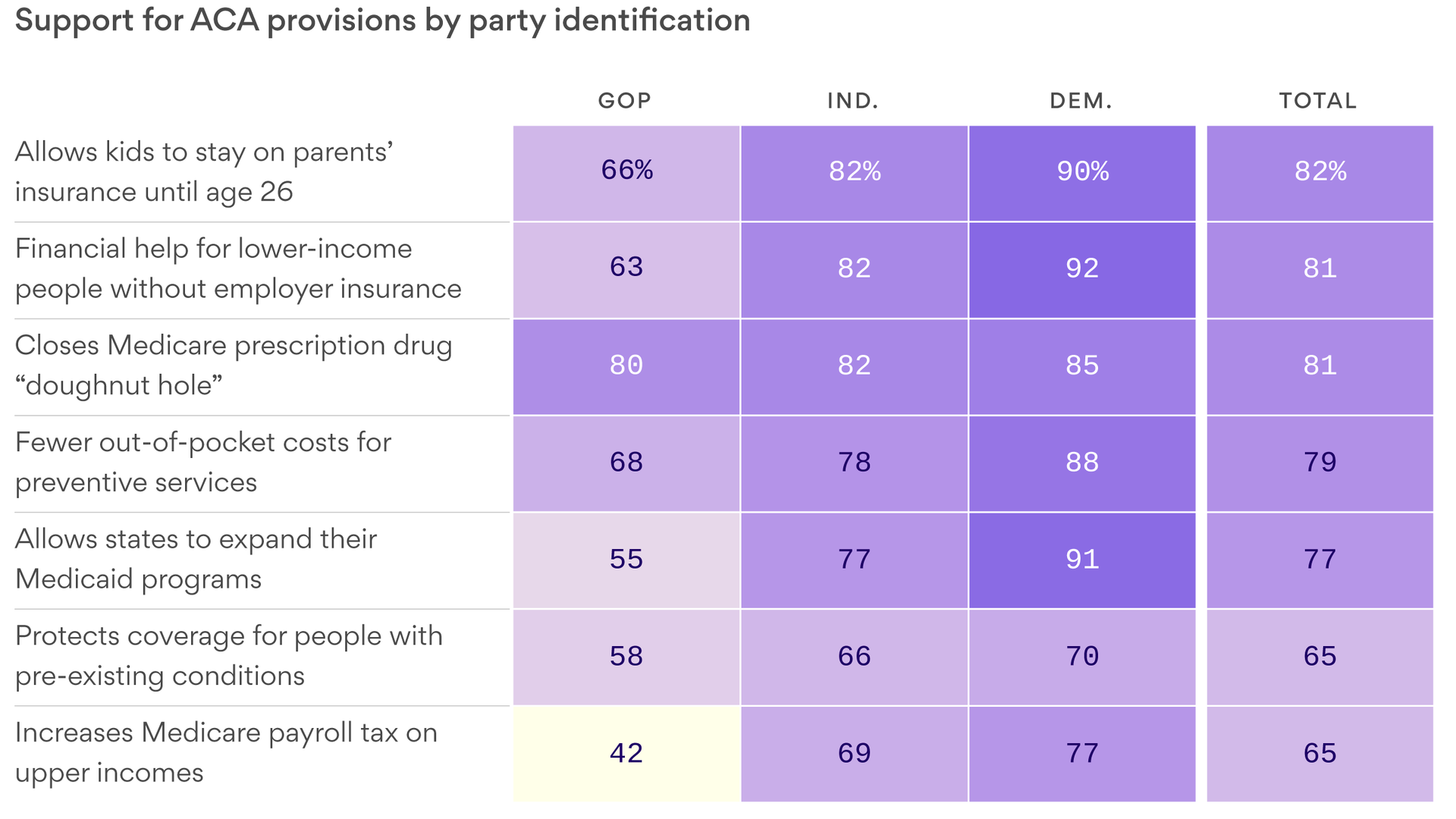
But as the chart shows, majorities of Republicans like many elements of the ACA —especially closing the “donut hole” in Medicare prescription drug coverage (80%), eliminating copayments for preventive services (68%), keeping young adults under 26 on their parents’ plans (66%) and subsidies for low and middle-income households (63%).

  • Nearly half of Republicans want the Supreme Court to keep the protections for pre-existing conditions (49%), and even more show general support for the pre-existing conditions protections (58%).
  • During the repeal and replace debate in 2017, even Republicans were nervous to hear that these sorts of things would go away. The 2020 campaign would drive home to the public, and to Republicans, what they have to lose — and it would become especially real to them if the 5th Circuit Court of Appeals upholds the ruling striking down the ACA.

Maybe Republicans would forget about these lost benefits if they could agree on a replacement plan they liked? But there isn’t one, and many of the ideas thought to be elements of one — such as cutting and block granting both Medicaid and ACA subsidies — are non-starters with Democrats and moderate Republicans on Capitol Hill. They’re unpopular with the public, too. 

The bottom line: It is widely accepted that a renewed debate about repeal hands Democrats a powerful new political opportunity. Deeper in the polling, it’s also clear that’s it’s more of a mixed bag for Republicans than President Trump may realize.  


Congress Warns Against Medicaid Cuts: ‘You Just Wait for the Firestorm’

Image result for Congress Warns Against Medicaid Cuts: ‘You Just Wait for the Firestorm’

WASHINGTON — If President Trump allows states to convert Medicaid into a block grant with a limit on health care spending for low-income people, he will face a firestorm of opposition in Congress, House Democrats told the nation’s top health official on Tuesday.

The official, Alex M. Azar II, the secretary of health and human services, endured more than four hours of bipartisan criticism over the president’s budget for 2020, which would substantially reduce projected spending on Medicaid, Medicare and biomedical research. Democrats, confronting Mr. Azar for the first time with a House majority, scorned most of the president’s proposals.

But few drew as much heat as Mr. Trump’s proposed overhaul of Medicaid. His budget envisions replacing the current open-ended federal commitment to the program with a lump sum of federal money for each state in the form of a block grant, a measure that would essentially cap payments and would not keep pace with rising health care costs.

Congress rejected a similar Republican plan in 2017, but in his testimony on Tuesday before the Health Subcommittee of the House Energy and Commerce Committee, Mr. Azar refused to rule out the possibility that he could grant waivers to states that wanted to move in that direction.

Under such waivers, Mr. Azar said, he could not guarantee that everyone now enrolled in Medicaid would keep that coverage.

“You couldn’t make that kind of commitment about any waiver,” Mr. Azar said. He acknowledged that the president’s budget would reduce the growth of Medicaid by $1.4 trillion in the coming decade.

Representative G. K. Butterfield, Democrat of North Carolina, said that “block-granting and capping Medicaid would endanger access to care for some of the most vulnerable people” in the country, like seniors, children and the disabled.

Mr. Trump provoked bipartisan opposition by declaring a national emergency to spend more money than Congress provided to build a wall along the southwestern border. If the president bypasses Congress and allows states to convert Medicaid to a block grant, Mr. Butterfield said, he could face even more of an outcry.

“You just wait for the firestorm this will create,” Mr. Butterfield said, noting that more than one-fifth of Americans — more than 70 million low-income people — depend on Medicaid.

As a candidate, Mr. Trump said he would not cut Medicare, but his new budget proposes to cut more than $800 billion from projected spending on the program for older Americans in the next 10 years. Mr. Azar said the proposals would not harm Medicare beneficiaries.

“I don’t believe any of the proposals will impact access to services,” Mr. Azar said. Indeed, he said, the cutbacks could be a boon to Medicare beneficiaries, reducing their out-of-pocket costs.

After meeting an annual deductible, beneficiaries typically pay 20 percent of the Medicare-approved amount for doctor’s services and some prescription drugs administered in doctor’s offices and outpatient hospital clinics.

Mr. Azar defended a budget proposal to impose work requirements on able-bodied adults enrolled in Medicaid. Arkansas began enforcing such requirements last year under a waiver granted by the Trump administration. Since then, at least 18,000 Arkansans have lost Medicaid coverage.

Mr. Azar said he did not know why they had been dropped from Medicaid. It is possible, he said, that some had found jobs providing health benefits.

Representative Joseph P. Kennedy III, Democrat of Massachusetts, said it would be reckless to extend Medicaid work requirements to the entire country without knowing why people were falling off the rolls in Arkansas.

If you are receiving free coverage through Medicaid, Mr. Azar said, “it is not too much to ask that you engage in some kind of community engagement.”

Representative Fred Upton, Republican of Michigan, expressed deep concern about Mr. Trump’s proposal to cut the budget of the National Cancer Institute by $897 million, or 14.6 percent, to $5.2 billion.

Mr. Azar said the proposal was typical of the “tough choices” in Mr. Trump’s budget. He defended the cuts proposed for the National Cancer Institute, saying they were proportional to the cuts proposed for its parent agency, the National Institutes of Health.

The president’s budget would reduce funds for the N.I.H. as a whole by 12.6 percent, to $34.4 billion next year.

Mr. Azar was also pressed to justify Mr. Trump’s proposal to cut federal payments to hospitals serving large numbers of low-income patients. Representative Eliot L. Engel, Democrat of New York, said the cuts, totaling $26 billion over 10 years, would be devastating to “safety net hospitals” in New York and other urban areas.

Mr. Azar said that the Affordable Care Act, by expanding coverage, was supposed to “get rid of uncompensated care” so there would be less need for the special payments.

While Democrats assailed the president’s budget, Mr. Azar relished the opportunity to attack Democrats’ proposals to establish a single-payer health care system billed as Medicare for all.

Those proposals could eliminate coverage provided to more than 20 million people through private Medicare Advantage plans and to more than 155 million people through employer-sponsored health plans, he said.

But Mr. Azar found himself on defense on another issue aside from the president’s budget: immigration. He said he was doing his best to care for migrant children who had illegally entered the United States, were separated from their parents and are being held in shelters for which his department is responsible.

He said he was not aware of the “zero tolerance” immigration policy before it was publicly announced in April 2018 by Attorney General Jeff Sessions. If he had known about the policy, Mr. Azar said, “I could have raised objections and concerns.”

Representative Anna G. Eshoo, Democrat of California and the chairwoman of the subcommittee, summarized the case against the president’s budget.

“The Trump administration,” she said, “has taken a hatchet to every part of our health care system, undermining the Affordable Care Act, proposing to fundamentally restructure Medicaid and slashing Medicare. This budget proposes to continue that sabotage.”


Trump continues his war on Americans’ health care to pay for his tax cuts

https://www.americanprogress.org/issues/economy/news/2019/03/11/467108/trumps-fy-2020-budget-exposes-false-promises-misplaced-priorities/

Image result for medicare cuts

After repeatedly trying and failing to repeal the ACA legislatively, President Trump and congressional Republicans have resorted to attacking and weakening the law through executive action, federal waivers to the states to undermine Medicaid expansion, and budget proposals to gut funding levels.

Once again, Trump’s budget proposes massive cuts—$777 billion over 10 years—from repealing the ACA and slashing Medicaid.

Like in his previous two budgets, Trump goes beyond these two measures to attack traditional Medicaid, seeking to restrict federal funding on a per-beneficiary basis or transition to block grant funding. Both of these things would lead to a significant decrease in federal funding and could cause millions of people to lose their health care coverage.

Like in last year’s budget, he encourages states to take Medicaid away from jobless and underemployed Americans, including laid-off workers, people who are going to school, and those who are taking care of children or family members. Medicaid is a lifeline for millions of Americans—including children, veterans, people with disabilities, and individuals affected by the opioid crisis. Tearing down this vital program will make it more difficult for people to access the health care they need to find work, including by preventing people with disabilities from accessing the long-term services and supports they need to participate in the labor market.

After he repeatedly promised to protect Medicare as a candidate, Trump makes changes to Medicare that would shrink the program by $845 billion over the coming decade.


Trump’s 2020 budget proposal: 5 healthcare takeaways

https://www.beckershospitalreview.com/finance/trump-s-2020-budget-proposal-5-healthcare-takeaways.html

Image result for medicaid cuts

President Donald Trump released his $4.75 trillion budget for fiscal year 2020 on March 11. The proposal, titled “A Budget for a Better America: Promises Kept. Taxpayers First,” calls for reductions to Medicare and Medicaid over 10 years and includes provisions related to drug pricing and many other health-related issues.

Below are five healthcare-related proposals in the president’s budget:

1. Discretionary funding for HHS. The budget requests $87.1 billion in discretionary spending for HHS, a 12 percent decrease from 2019 funding levels.

2. Efforts to curb HIV. Keeping with President Trump’s promise in his State of the Union address to end the spread of HIV in the U.S. over the next decade, the budget plan calls for HHS to receive $291 million next year to help curb the spread of the virus. A large portion of the funding — $140 million — would go to the CDC to improve diagnosis and testing for HIV in areas of the U.S. where the virus is continuing to infect people not getting proper treatment.

3. Broad overhaul of Medicaid. Under the budget, nearly $1.5 trillion would be cut from Medicaid over 10 years. However, the budget seeks $1.2 trillion over the next decade for block grants or per-person caps that would start in 2021, according to The Washington Post. The budget plan would also end funding for Medicaid expansion.

4. Medicare funding changes. Under the budget, Medicare spending would be reduced by an estimated $800 billion over 10 years. The budget would reduce the growth of various Medicare provider payments and includes changes aimed at addressing waste and abuse in healthcare and lowering drug prices, according to The Washington Post.

5. Medical research. The plan includes a proposal to cut $897 million from the National Cancer Institute’s budget and an additional $1 billion in cuts to other institutes that do medical research, according to Politico.

Read the full budget plan here.


Trump wants to bypass Congress on Medicaid plan

https://www.politico.com/story/2019/01/11/trump-bypass-congress-medicaid-plan-1078885?utm_source=Sailthru&utm_medium=email&utm_campaign=Newsletter%20Weekly%20Roundup:%20Healthcare%20Dive%2001-19-2019&utm_term=Healthcare%20Dive%20Weekender

Image result for medicaid block grant

Block grants for states would achieve conservative dream on health program for poor.

The Trump administration is quietly devising a plan bypassing Congress to give block grants to states for Medicaid, achieving a longstanding conservative dream of reining in spending on the health care safety net for the poor.

Three administration sources say the Trump administration is drawing up guidelines on what could be a major overhaul of Medicaid in some states. Instead of the traditional open-ended entitlement, states would get spending limits, along with more flexibility to run the low-income health program that serves nearly 75 million Americans, from poor children, to disabled people, to impoverished seniors in nursing homes.

Capping spending could mean fewer low-income people getting covered, or state-designated cutbacks in health benefits — although proponents of block grants argue that states would be able to spend the money smarter with fewer federal strings attached.

Aware of the political sensitivity, the administration has been deliberating and refining the plan for weeks, hoping to advance an idea that Republicans since the Reagan era have unsuccessfully championed in Congress against stiff opposition from Democrats and patient advocates. During the Obamacare repeal debate in 2017, Republican proposals to cap and shrink federal Medicaid spending helped galvanize public opposition, with projections showing millions would be forced off coverage.

In addition to potential legal obstacles presented by moving forward without Congress, the administration effort could face strong opposition from newly empowered House Democrats who’ve vowed to investigate the administration’s health care moves.

“Hell no,” Sen. Bob Casey (D-Pa.) wrote on Twitter on Friday evening, vowing to oppose the administration’s block grant plan “through legislation, in the courts, holding up Administration nominees, literally every means that a U.S. Senator has.”

The administration’s plan remains a work in progress, and sources said the scope is still unclear. It’s not yet known whether CMS would encourage states to seek strict block grants or softer spending caps, or if new limits could apply to all Medicaid populations — including nursing home patients — or just a smaller subset like working-age adults.

A spokesperson for CMS did not comment on the administration’s plans but indicated support for the concept of block grants.

“We believe strongly in the important role that states play in fostering innovation in program design and financing,” the spokesperson said. “We also believe that only when states are held accountable to a defined budget — can the federal government finally end our practice of micromanaging every administrative process.”

Republicans have sought to rein in Medicaid spending, especially as enrollment swelled under Obamacare’s expansion of the program to millions of low-income adults in recent years. CMS Administrator Seema Verma has warned increased spending on the Medicaid expansion population could force cutbacks on sicker, lower-income patients who rely on the program.

The administration wants to let states use waivers to reshape their Medicaid programs, but the effort could face legal challenges in the courts. Waivers approved by the Trump administration to allow the first-ever Medicaid work requirements for some enrollees, for example, are already being challenged in two states.

Also complicating the administration’s push: the newfound popularity of Medicaid, which has grown to cover about one in five Americans. Voters in three GOP-led states in November approved ballot measures to expand Medicaid, which has been adopted by about two-thirds of states. Newly elected Democratic governors in Kansas and Wisconsin are pushing their Republican-led legislatures to expand Medicaid this year.

Verma has been trying to insert block grant language into federal guidance for months but has encountered heave scrutiny from agency lawyers, two CMS staffers said. She mentioned interest in using her agency’s authority to pursue block grants during a meeting with state Medicaid directors in the fall but did not provide details, said two individuals who attended.

There is some precedent for the federal government capping its spending on the entitlement program. Former President George W. Bush’s health department approved Medicaid spending caps in Rhode Island and Vermont that would have made the states responsible for all costs over defined limits. However, those spending caps were set so high there was never really any risk of the states blowing through them.

In recent years, governors have complained about the rising costs of Medicaid, which is eating up a bigger share of their budgets. States jointly finance the program with the federal government, which on average covers 60 percent of the cost – though the federal government typically shoulders more of the burden in poorer states. The federal government covers a much higher share of the cost for Medicaid enrollees covered by the Obamacare expansion.

An official from a conservative state, speaking on background to discuss an effort not yet public, said states would consider a block grant as long as the federal government’s guidance isn’t overly prescriptive.

CMS is hoping to make an announcement early this year, but it could be further delayed by legal review, which has already been slowed by the prolonged government shutdown.

Some conservative experts said the administration’s plans ultimately may be limited by Medicaid statute, which requires the federal government to match state costs. However, they say the federal government can still try to stem costs by approving program caps.

“There’s no direct provision of authority to waive the way that the federal government pays the states,” said Joe Antos of the American Enterprise Institute, a right-leaning think tank. “However, that doesn’t mean that you can’t try to have some of the effects that people that like block grants would like to see, in terms of encouraging states to be more prudent with the ways they spend the money.”


KHN’s ‘What The Health?’ What Do The Budget, Idaho And FDA Chief Scott Gottlieb Have In Common?

https://khn.org/news/podcast-khns-what-the-health-what-do-the-budget-idaho-and-fda-chief-scott-gottlieb-have-in-common/?utm_campaign=KFF-2018-The-Latest&utm_source=hs_email&utm_medium=email&utm_content=60750320&_hsenc=p2ANqtz-_fH8PLw8MQcK5-6PQpM5hnAT-lUReNyxbqcVv3CQftN_JErkzwdKT74g8pG-zb0KDTi4MLTSaD8zofdRUaejz_MhZWpw&_hsmi=60750320

Image result for kaiser what the health


President Donald Trump released his first full budget proposal this week, with many recommended cuts and some major changes to health programs. But Congress has already agreed on most spending levels for next year, so this budget is even more likely to be ignored than a typical presidential budget plan.

Meanwhile, states are trying to cope with last year’s changes to the Affordable Care Act in very different ways. Several states, mostly led by Democrats, are considering whether to set penalties for people who don’t have insurance — a provision of the ACA that Congress repealed in December. Idaho, meanwhile, is offering to let insurers sell plans that don’t cover the ACA’s required set of benefits and discriminate against people with preexisting health conditions.

Plus, Scott Gottlieb, commissioner of the Food and Drug Administration, talks about getting generic drugs to market faster and how the agency is working with Congress on ways to help patients with terminal illnesses get easier access to experimental treatments.

This week’s panelists for KHN’s “What the Health?” are Julie Rovner of Kaiser Health News, Stephanie Armour of The Wall Street Journal, Paige Winfield Cunningham of The Washington Post and Margot Sanger-Katz of The New York Times.

Among the takeaways from this week’s podcast:

  • Even though few of the proposals in Trump’s budget are likely to be enacted, it does lay down some important markers for the administration. Those include backing sweeping changes to Medicaid and eliminating many of the ACA’s coverage requirements.
  •  Blue states considering stepping into the void left by Congress’ repeal of the individual insurance mandate penalties have limited time to act. Insurers start making decisions about whether to participate in the individual market in the spring.
  • The FDA’s Gottlieb tells Rovner and KHN’s Sarah Jane Tribble he expects there will be a compromise on Capitol Hill on “right-to-try” legislation that would make it easier for patients with terminal illnesses to gain access to experimental therapies.
  • Idaho is moving forward on its plan to allow insurers to offer policies that do not comply with the requirements of the Affordable Care Act. On Capitol Hill this week, Health and Human Services Secretary Alex Azar would not say whether the federal government will step up to stop them.

Trump’s Budget Would Cut HHS Funding 21%; Azar Approves

http://www.healthleadersmedia.com/leadership/trumps-budget-would-cut-hhs-funding-21-azar-approves?utm_source=edit&utm_medium=ENL&utm_campaign=HLM-Daily-SilverPop_02142018&spMailingID=12931448&spUserID=MTY3ODg4NTg1MzQ4S0&spJobID=1341286596&spReportId=MTM0MTI4NjU5NgS2#

Image result for health policy

The White House calls for an increase in funding for veterans healthcare services, while proposing cuts to HHS and a repeal of the Affordable Care Act.

President Donald Trump released his budget proposalMonday for fiscal year 2019. It includes overall reductions in nondefense spending while also increasing funding for veterans healthcare services.

The White House’s $4.4 trillion budget request to Congress comes days after a two-year, $300 billion bipartisan budget deal was signed into law following the second government shutdown in as many months.

Though Congress is unlikely to vote on a singular budget, the various provisions listed in the executive proposal outline the legislative agenda the Trump administration would like to pursue in 2018.

“I applaud President Trump for laying out his vision for the country in today’s budget request and welcome his partnership as the Energy and Commerce Committee works to tackle several shared priorities,” said Rep. Greg Walden, R-Ore., chairman of the House Committee on Energy and Commerce in a statement. “Many of the administration’s other proposals to lower health care costs complement our continued commitment to addressing the cost drivers across every facet of our nation’s health care system.”

Below is a breakdown of the proposals affecting the healthcare world, including cuts to the Department of Health and Human Services (HHS), Medicare, a repeal-and-replace plan for the Affordable Care Act (ACA), and more money for veterans healthcare.

Major cuts to HHS

The proposal features a $68.4 billion budgetary line for HHS, a 21% reduction in funding compared to FY 2017. The budget also proposes a $451 million cut to training programs for health professionals, arguing the initiatives “lack evidence that they significantly improve the nation’s health workforce.”

If adopted, the policies would extend Medicare’s solvency by eight years, according to the budget proposal. Current projections estimate Medicare will become insolvent by 2029. The Trump administration also proposed a limit on Medicaid reimbursements to federal providers at no more than the cost of providing services to beneficiaries.

“The President’s budget makes investments and reforms that are vital to making our health and human services programs work for Americans and to sustaining them for future generations,” said HHS Secretary Alex Azar in a statement. “In particular, it supports our four priorities here at HHS: addressing the opioid crisis, bringing down the high price of prescription drugs, increasing the affordability and accessibility of health insurance, and improving Medicare in ways that push our health system toward paying for value rather than volume.”

Bundled payments for community-based medication-assisted treatment would see an opportunity to expand through the budget proposal, with the White House highlighting a new Medicare reimbursement for methadone treatment.

Medicare beneficiaries would also be able to save for out-of-pocket costs by allowing tax deductible contributions to health savings accounts associated with high deductible health plans offered by employers or Medicare Advantage.

The budget proposes a ‘$5 returned for every $1 spent’ policy for the Medicare Health Care Fraud and Abuse Control, a $45 million increase compared to FY 2017 which totals $770 million,. The White House believes the additional funding will bolster the program’s efforts to “identify and prevent fraudulent or improper payments from being paid in the first place.”

Two-part ACA repeal

Arguing that “national healthcare spending trends are unsustainable,” the budget offers a solution in the form a two-part repeal of the Affordable Care Act.

Modeled on the Graham-Cassidy proposal, the first step would focus on providing block grants to states for healthcare spending plans.

The Market-Based Health Care Grant Program, the new block grant program, would offer states and consumers with options outside of the ACA’s “insurance rules and pricing restrictions.” The administration believes this will address high premium costs and rising deductibles.

The second part of the plan focuses on Medicaid reform, specifically the repeal of Medicaid expansion spurred on by the ACA, as well as reducing “state gimmicks” like provider taxes. This move would shift federal authority over healthcare access to states, which could in turn design individualized plans.

Major increase for veterans healthcare

Continuing with a campaign promise to address issues facing veterans, Trump’s budget proposal includes an increase in spending for veterans healthcare programs over the next three fiscal years.

For FY 2019, the Veterans Health Administration would receive $70.7 billion, a 9.6% increase compared to FY 2017. By 2020, that number rises to $75.6 billion in advance appropriations for VA medical care program costs.

This covers 9.3 million enrollees in the Veterans Affairs health system.

Additionally, the budget provides $8.6 billion for veterans mental health and suicide prevention programs, and $11.9 billion would be used to enhance and expand veterans’ access to high-quality community care.

The administration proposes the consolidation of the Veterans Choice Program and other community care programs into a new, unified program: the Veteran Coordinated Access & Rewarding Experiences program.


Trump budget seeks savings through ObamaCare repeal

Trump budget seeks savings through ObamaCare repeal

Trump budget seeks savings through ObamaCare repeal

The White House budget for fiscal 2019 seeks major savings by repealing ObamaCare and endorsed a Senate GOP bill as the best way to do so.

“The Budget supports a two-part approach to repealing and replacing Obamacare, starting with enactment of legislation modeled closely after the Graham-Cassidy-Heller-Johnson (GCHJ) bill as soon as possible,” the White House said in its budget request.

The legislation from Sens. Lindsey Graham (R-S.C.), Bill Cassidy (R-La.), Ron Johnson (R-Wis.) and Dean Heller (R-Nev.) would replace ObamaCare with a series of block grants to states.

The budget proposes over $90 billion in savings over 10 years if the policies in the Graham-Cassidy bill were enacted. Combined with other provisions like Medicaid changes, the White House projects there would be nearly $675 billion in savings over a decade tied to repealing ObamaCare.

Advocacy groups were quick to denounce the proposal, which is unlikely to gain traction in Congress.

“By asking Congress to revive the deeply unpopular Graham-Cassidy repeal bill that ended protections for Americans with pre-existing conditions, gutted Medicaid, ripped away coverage from millions, and raised costs for millions more, while also proposing drastic cuts to Medicare, Trump has chosen to ignore the American public’s overwhelming preference for a bipartisan path forward on health care,” said Protect Our Care campaign director Brad Woodhouse.

Republican leaders have signaled that they are not interested in diving back into the contentious ObamaCare repeal fight this year. The Senate last year failed to pass a repeal bill, and there is no indication that the votes have shifted since then.

A number of Republicans have even discussed taking bipartisan actions to stabilize ObamaCare markets and try to bring down premiums through actions such as funding known as reinsurance.

Graham has said he will continue fighting for his bill and is not completely alone. Sen. Ted Cruz (R-Texas) is also calling for Congress to not give up on repeal this year.


Trump suggests repealing ObamaCare mandate in tax bill

Trump suggests repealing ObamaCare mandate in tax bill

Related image

President Trump on Wednesday suggested using the GOP tax bill to repeal ObamaCare’s individual mandate.

“Wouldn’t it be great to Repeal the very unfair and unpopular Individual Mandate in ObamaCare and use those savings for further Tax Cuts,” Trump tweeted.

The idea is being pushed by Sen. Tom Cotton (R-Ark.) and also has the backing of House Freedom Caucus Chairman Mark Meadows (R-N.C.).

Meadows said Wednesday he supports repealing the mandate in tax reform and thinks “ultimately” it will be included because he is going to push for it. He said he has been talking to Cotton about it.

A Cotton spokeswoman told The Hill that Cotton and Trump spoke by phone about the idea over the weekend and “the President indicated his strong support.”

Senate Finance Committee Chairman Orrin Hatch (R-Utah) this week said that he wouldn’t rule out including repeal of the mandate in the tax legislation.

But other top Republicans have rejected the idea, including House Ways and Means Committee Chairman Kevin Brady (R-Texas), Senate Majority Whip John Cornyn (R-Texas) and Sen. John Thune (R-S.D.). They fear adding the ObamaCare change would jeopardize tax reform.

“Look, I want to see that individual mandate repealed,” Brady said during an interview with radio host Hugh Hewitt on Tuesday. “I just haven’t seen, no one has seen, 50 votes in the Senate to do it.”

Brady added that he would be open to adding a repeal of the mandate to the House bill if the Senate passed it first.

Asked Wednesday about the president’s tweet, Senate Majority Whip John Cornyn (R-Texas) threw cold water on the idea.

“I think tax reform is complicated enough without adding another layer of complexity,” Cornyn told The Hill.

Thune, meanwhile, said mandate repeal is “not currently a part of our deliberations.”

But Thune added that some members have expressed interest in the idea and said he was “somewhat” interested in it because of the revenue implications.

Sen. Mike Rounds (R-S.D.) on Tuesday also dismissed adding a repeal of the mandate to tax reform.

“If there was a way to do it, I’d be open to it, but I’m not going to pitch it because I want to focus on taxes in the tax reduction plan,” Rounds told reporters.

The Congressional Budget Office has estimated that repealing the mandate would save the government $416 billion over a decade.

The mandate requires people, with some exceptions, to pay a fine to the IRS if they do not have health insurance.

Experts have said repealing the mandate would result in massive premium spikes and a major increase in the number of uninsured people.

It could also send ObamaCare exchanges into a “death spiral” because it would discourage healthy younger individuals to sign up for insurance.

Asked about it on Wednesday after Trump’s tweet, Hatch again did not rule out the move, but cautioned that he wants to keep health care separate from tax reform, a point echoed by GOP aides.
“I think we ought to do tax reform. If they want to do something on health care they can do that separate,” Hatch said. It was not clear who “they” referred to.
“I’d have to really look at all sides of that. I’ve never been very excited about the individual mandate,” Hatch said.

A closer look at how the revised health bill would benefit key senators’ states

https://www.washingtonpost.com/news/powerpost/wp/2017/09/25/revised-health-bill-gives-states-limited-leeway-while-steering-more-money-to-alaska-maine/?_hsenc=p2ANqtz-_clpt8SgNxZ9kwl4KEWIyIxO-je4y4txwZTcf-IInlxUuZJsK0VGVNSt2v8TXrZ7Ec4rx3Jmad_zexDD63e8n4EmPw2A&_hsmi=56665328&utm_campaign=KHN%3A%20First%20Edition&utm_content=56665328&utm_medium=email&utm_source=hs_email&utm_term=.06260e61626c

Image result for Kaiser Health News: GOP Health Bill’s Changes Go Far Beyond Preexisting Conditions

The revised Republican health-care bill that senators unveiled Monday would partly even out wide gaps between states that would win and lose financially, providing more generous funding to states of some reluctant GOP lawmakers, but would give states less freedom to unwind federal health insurance rules.

The new version of the Cassidy-Graham legislation eliminates what had been one of the measure’s most controversial features, which would have enabled states to get federal permission to let insurers charge higher prices to customers with preexisting medical conditions. In addition, states now would not be able to allow health plans to impose annual or lifetime limits on coverage, as the original bill would have done.

Yet for the health-care standards that the bill would let states ignore if they wanted, the latest legislative language no longer would require states to get formal permission from the government through a waiver process. Instead, states would simply have to explain to federal officials what they intend to do. The standards that could be sidelined include the benefits that health plans sold to individuals and small businesses must cover and limits on how much more plans may charge older customers than younger ones.

While still giving states block grants for their programs and much more freedom to create their own rules than under the Affordable Care Act, this second draft of the plan would be less punitive financially than the first one for states that have most significantly expanded their residents’ access to insurance under the 2010 law. At the same time, the figures provide no indication that the bill’s chief sponsors have abandoned their plan to make steep cuts to Medicaid through a per-capita cap. Such a move would end up cutting federal funding by billions of dollars by 2026.

The plan update emerged late Sunday after its primary sponsors, GOP Sens. Bill Cassidy (La.) and Lindsey O. Graham (S.C.), worked through the weekend on changes designed to both bolster support on the right and win over a handful of centrists who have been balking.

The latest version would steer more money to states with key senators in a few ways.

One provision would direct $500 million in funding to states like Alaska — whose senior senator, Lisa Murkowski (R), is viewed as a crucial potential holdout — that have been granted waivers under a specific part of the ACA. Section 1332 aims to give states more flexibility in implementing the law, in order to set up a reinsurance program to help lower premiums on a state’s individual insurance market. With this provision included, Alaska will get to keep the federal funds it has been slated to receive.

Another part of the revised bill would give one-fourth of a $6 billion contingency fund to states with the lowest-density population — Alaska among them.

Separately, the law provides $750 million for states that expanded Medicaid after Dec. 31, 2015. That language means additional financial assistance for Montana and Cassidy’s home state of Louisiana.

Another addition to the plan, perhaps intended to appeal to another skeptical Republican, Maine Sen. Susan Collins, would require states to demonstrate that their health-care rules meet several federal standards, including parity for mental health care, reconstructive surgery after mastectomies and minimal hospital stays for newborns, among others.

To even out the checkerboards of winners and losers among states, the bill’s new version substantially revises the formula that would determine the allotment of money through block grants starting in 2020. Among other changes, the revision would spread the change over a decade, rather than the original half-dozen years.

Two of the states that now would fare the worst, Oregon and Minnesota, would lose 17 percent and 15 percent, respectively, of their federal funding between 2020 and 2026 relative to the current law. The two states have only Democrats in the Senate and in the governor’s mansion. It is a topic that is likely to come up on Monday during a Senate Finance Committee hearing on the bill; Sen. Ron Wyden (D-Ore.) is the panel’s ranking member.

The revised Cassidy-Graham legislation doesn’t change the total sum the federal government would spend on the block grants from 2020 to 2026. Instead, it tries to smooth over the formula of how the money would be distributed in an effort to put the states on a more equal footing.

Independent analysts had estimated a wide variation in block grant funding that states could get under the initial version of Cassidy-Graham: Mississippi would get 148 percent more relative to current law, while New York would get 35 percent less, according to an analysis by the Kaiser Family Foundation.

The range in state funding would now be narrower. South Dakota would see the largest funding increase at 88 percent, Oregon the greatest decrease.

The latest version notably retains more funding for states represented by key holdout senators. Kaiser had estimated that Maine would get 8 percent more under the initial Cassidy-Graham; it would get 43 percent more under the revised bill, according to the state-by-state summary.

But the state funding estimates don’t take into consideration the bill’s additional cuts to regular Medicaid spending. If those were considered, states like Alaska would still be losing out on federal funds overall. And the GOP estimates also assume that states would slash their own funding for coverage and then factor that into the final number as “state savings.”