Dr. Patrick Soon-Shiong failed to turn around Verity Health: 7 things to know about where the system stands now

https://www.beckershospitalreview.com/finance/dr-patrick-soon-shiong-failed-to-turn-around-verity-health-7-things-to-know-about-where-the-system-stands-now.html

Image result for chapter 11 bankruptcy

El Segundo, Calif.-based Verity Health filed for bankruptcy in August, just 13 months after billionaire entrepreneur Patrick Soon-Shiong, MD, bought a majority stake in its management company with a promise to revitalize the health system.

Here are seven things to know about Verity Health’s financial situation.

1. The health system filed for bankruptcy Aug. 31. It secured a $185 million loan to remain operational during the bankruptcy, which CEO Richard Adcock told Reuters could last at least a few years.

2. Verity is still seeking a buyer for all or some of the hospitals. Mr. Adcock told Reuters the system has been contacted by more than 100 potential buyers since July 9, when it announced it was exploring strategic options due to nearly $500 million in long-term debt. “We are exploring a number of options to deleverage our balance sheet and address challenges our hospitals face after a decade of deferred maintenance, poor payer contracts and increasing costs,” said Mr. Adcock.

3. The system’s financial issues pre-date Dr. Soon-Shiong’s investment but have not improved since. Mr. Adcock told Reuters that Verity has been hemorrhaging $175 million per year on cash flow basis. Verity has operated at a loss for at the least the past three years. Executives had planned to break even in the 12 months ended June 2018, however, the system reported its operating performance compared to the budget was unfavorable by $116 million, according to a report from Politico. In the 12 months ended June 2017, the system saw losses of $37 million, and the year prior marked nearly $200 million in operating losses.

4. Prior to filing for bankruptcy, Verity stopped all capital improvement projectsPolitico reported in the same article. However, the system needs millions of dollars in updates to meet California’s seismic standards by 2019. Approximately 94 percent of California’s hospitals already comply with this major legal requirement, according to the report. Verity Health needed an estimated $66 million in improvements. Since November, the system has put $5.1 million toward compliance. If Verity does not meet deadlines for compliance in 2019, its hospitals can no longer be used for patient care.

5. The health system’s spending on charity care declined 28 percent at five of its six hospitals in the first quarter of 2018, compared to the same period the year prior. The sixth hospital reported an error in its financials. Dr. Soon-Shiong updated the health system’s financial assistance policy in December to exclude services from more than 50 hospital departments, according to Politico. Preliminary data from the second quarter of 2018 suggests this trend has continued.

6. The health system is spending millions on an Allscripts EHR implementation. Dr. Soon-Shiong served as interim CEO of Verity in 2017, during which the system signed a contract to implement a new Allscripts Sunrise EHR by 2019. Verity spent $12.8 million on the EHR through June, according to Politico. Sources told Politico the final cost could range from $20 million to $100 million.

7. The EHR investment faces scrutiny due to Dr. Soon-Shiong’s close ties to Allscripts. Dr. Soon-Shiong bought a $100 million stake in Allscripts in 2015, and Allscripts had a $200 million stake in NantHealth, his precision medicine company, Politico reported. Allscripts and NantHealth also had an agreement to work together to promote precision medicine technology. This agreement was restructured in 2017, when the value of NantHealth’s stock was down, according to the report. Allscripts returned NantHealth’s stock, and in return, NantHealth transferred ownership of some of its software to Allscripts and agreed to deliver $95 million worth of business to the EHR vendor. Allscripts President Rick Poulton told Politico the Verity Health EHR deal does not count against the $95 million in promised business, and the health system had already been considering Allscripts before Dr. Soon-Shiong assumed leadership.



Healthcare bankruptcies more than triple in 2017

https://www.beckershospitalreview.com/finance/healthcare-bankruptcies-more-than-triple-in-2017.html

Image result for hospital bankruptcies

Regulatory changes, the rise of high-deductible health plans and advances in technology are a few of the factors that have taken a toll on healthcare companies’ finances, and these challenges may lead many hospitals and other medical companies to restructure their debt or file for bankruptcy in the coming year, according to Bloomberg.

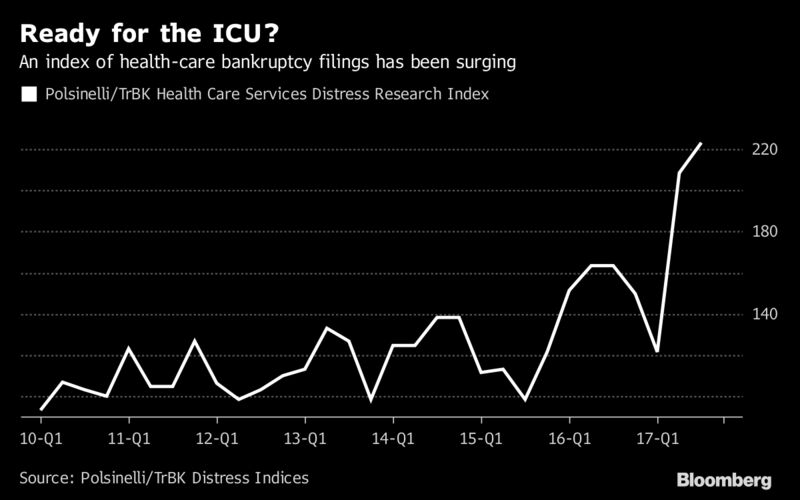
Although hospitals are expected to face financial challenges in the year ahead, many healthcare companies are already struggling. According to data compiled by Bloomberg, healthcare bankruptcy filings have more than tripled in 2017. Healthcare bankruptcies are on the rise as filings across the broader economy have fallen since 2010, according to the report.

The challenges in the healthcare sector may hit rural hospitals the hardest due to the reduction in Disproportionate Share Hospital payments.

The ACA calls for annual ggregate reductions to DSH payments from fiscal year 2014 through fiscal year 2020. Subsequent legislation delayed the start of the reductions until fiscal year 2018, which began Oct. 1, and pushed the end date back to fiscal year 2025.

David Neier, a partner at Winston & Strawn, told Bloomberg the cuts to DSH payments may “single-handedly throw hospitals into immediate financial distress.”


Next U.S. Restructuring Epidemic: Sick Health-Care Companies

https://www.bloomberg.com/news/articles/2017-11-27/next-u-s-restructuring-epidemic-sick-health-care-companies

  • Rural hospitals seen as among hardest hit by regulatory change
  • Technological shifts and urgent care reshaping industry

A growing number of health-care companies may face near-death experiences of their own.

 A wave of hospitals and other medical companies are likely to restructure their debt or file for bankruptcy in the coming year, following the recent spate of failing retailers and energy drillers, according to restructuring professionals. Regulatory changes, technological advances and the rise of urgent-care centers have created a “perfect storm” for health-care companies, said David Neier, a partner in the New York office of law firm Winston & Strawn LLC.
Some signs are already there: Health-care bankruptcy filings have more than tripled this year according to data compiled by Bloomberg, and an index of Chapter 11 filings by companies with more than $1 million of assets has reached record highs in four of the last six quarters, according to law firm Polsinelli PC. Junk bonds from companies in the industry have dropped 1.4 percent this month, a steeper decline than the broader high-yield market, according to Bloomberg Barclays index data.
The pain for the sector comes as bankruptcy filings across the broader economy have plunged since 2010.
Hospitals, including private rural ones, may be among the hardest hit, Winston & Strawn’s Neier said. The Affordable Care Act, known as Obamacare, reduced payments to hospitals that serve a large number of poor and uninsured patients, known as “disproportionate share hospitals,” on the theory that more patients would be insured under the law. Congress delayed those cuts several times, but didn’t do so for the current fiscal year, which may “single-handedly throw hospitals into immediate financial distress — many operate on less than one day’s cash,” he said in an interview.

“Smaller hospitals have already been struggling for years,” said Kristin Going, a partner in the New York office of Drinker, Biddle & Reath LLP. Both lawyers declined to discuss specific companies. Since 2010, a growing number of patients have enrolled in high-deductible health plans that force them to shoulder more of costs when they get treatment, according to the U.S. Centers for Disease Control and Prevention. That has translated into more bad debt from customers for hospitals and other providers.

Some publicly traded hospital companies that were already under pressure from high debt loads have been further buffeted by this year’s hurricanes. Community Health Systems Inc., with $1.9 billion in debt maturing in 2019, has suffered doctor revolts over crumbling, cash-strapped facilities, as well as losses linked to the storms in Texas and Florida earlier this year. A representative for Community Health didn’t return a call seeking comment.

Signs of Distress

Jorian Rose, partner in the New York office of Baker & Hostetler LLP, said many health-care restructurings are already going on under the radar right now. Rose, Going and Neier are members of the Turnaround Management Association, a group for bankruptcy and restructuring professionals.

The Polsinelli Health Care Services Distress Research index, which tracks bankruptcy filings for companies with more than $1 million in assets, shows that activity has surged 123 percent since the fourth quarter of 2010. By comparison, the law firm said, the general index that tracks Chapter 11 filings in the U.S. is down nearly 58 percent from 2010. The Affordable Care Act, which Republican lawmakers have been looking to repeal, replace, defund, or otherwise change, was cited as one of the systemic changes rocking the sector.

Since 1997, health-care cases have made up only 5.25 percent of all U.S. bankruptcy filings, according to Bloomberg data. Year to date, they already comprise 7.25 percent of all filings. Emergency-room operator Adeptus Health, cancer-care provider 21st Century Oncology, and cancer treatment specialist California Proton Treatment are the largest filings. Those statistics exclude pharmaceutical company Concordia, which is restructuring in Canada, and Preferred Care Inc., one of the U.S.’s largest nursing home groups, operating 108 assisted living facilities.

Problems for the sector aren’t limited to U.S. companies. Israeli drugmaker Teva Pharmaceutical Industries Ltd., saddled with debt that’s more than double its market value, is putting together a “detailed restructuring plan” after the company has slashed its profit forecasts, cut its dividend, signaled it may sell new shares, and reduced its goal for paying down debt this year. It announced a management shakeup on Monday.

Distress among health-care companies can spread to other parts of the economy. Quality Care Properties Inc., for example, is a real estate investment trust with a struggling tenant, HCR Manorcare Inc. Moody’s Investors Service said in an October report that if HCR Manorcare files for bankruptcy, Quality Care could also need to amend the terms of its own debt. Representatives for HCR Manorcare and Quality Care didn’t return calls seeking comment.

The Hidden Dangers of Leading Change

http://johngself.com/self-perspective/2017/09/hidden-dangers-leading-change/?utm_source=Self+Perspective+from+JohnGSelf+%2B+Partners%2C+Inc.&utm_campaign=3b361ba89c-RSS_EMAIL_CAMPAIGN&utm_medium=email&utm_term=0_70effc545f-3b361ba89c-88600789#.Wbge8ciGMdU


People hate change. They dislike it so much that otherwise nice people will resort to some uncharacteristic behaviors — gossiping, lying and personal defamation against the person leading the change. This is a real threat to senior executives, especially those involved in organizational turnarounds.

Important progress can be slowed or derailed. Executive careers can be tarnished if not ruined.

This negative phenomenon is not new. In fact, evidence can be found in the Old Testament of the Bible. What is new is that we live in a digital age where malicious rumors and gossip can be spread, sometimes anonymously, over the Internet like wind-fed wildfire. It can blow up so fast that an unsuspecting, perhaps naive, executive can be tried and convicted before they are aware that the malignant campaign to discredit them even exists. Their attention, after all, is focused on more pressing issues.

Everyone has strengths and weaknesses, including the opponents of change, those who typically use a leader’s weaknesses to stop that which they distrust and makes them uncomfortable. Now here is where I think executives can and must do a better job in protecting themselves against repetitional attacks — they must become more self aware and to begin using the digital tools and modern communications strategies to their advantage. Unfortunately, far too many CEOs, especially those who engage in challenging business turnarounds, are so focused on their plan that they fail to insulate themselves from the inevitable pushback. In fact, it is surprising how many CEOs reject any involvement in social media activities until they have lost their job and are looking for a new one.

Years ago, during the course of a major CEO search, an extraordinarily qualified candidate disclosed a background issue that was potentially problematic. He was such a superb candidate that I refused to eliminate this individual from the field. I disclosed it to the board of directors and, with an open mind and the recognition of this person’s outsized talent, they asked me to vet the issue more thoroughly. In the end, he got the job. Ultimately we made the decision to disclose the background issue, no longer material to leadership performance, because we knew that those who would most certainly oppose the changes that had to be made — some entrenched employee groups — would use it against the executive when it inevitably surfaced. They would have attacked the leader using the information as a blunt weapon to slow or halt changes and they would most certainly have accused the board of an unconscionable cover-up. We neutralized that issue and this executive went on to lead a highly successful turnaround.

The advantage in this situation is that we knew about the issue and took action. Far too often executives are the last to learn that they are the targets of a smear campaign. They frequently find themselves in a reactive mode and that alone can aggravate the bad optics even more.