65 financial benchmarks for hospital executives

http://www.beckershospitalreview.com/finance/65-financial-benchmarks-for-hospital-executives-022117.html

Image result for financial benchmarks

Hospitals leaders across the nation use benchmarking as a way to determine the areas of their business that need improvement. The continuous process of benchmarking allows hospital executives to see how their organizations stack up against local and regional competitors as well as national leaders.

Here are 65 benchmarks related to one of the most important day-to-day areas hospital executives oversee — finance.

Key ratios
Source: Moody’s Investors Service, “U.S. Not-for-Profit Hospital 2015 Medians” report, September 2016.

The medians are based on an analysis of audited 2015 financial statements for 340 freestanding hospitals, single-state health systems and multi-state health systems, representing 81 percent of all Moody’s-rated healthcare entities. Children’s hospitals, hospitals for which five years of data are not available and certain specialty hospitals were not eligible for inclusion in the medians.


Are CEOs Less Ethical Than in the Past?

https://www.strategy-business.com/feature/Are-CEOs-Less-Ethical-Than-in-the-Past?gko=50774&utm_source=itw&utm_medium=20170516&utm_campaign=resp

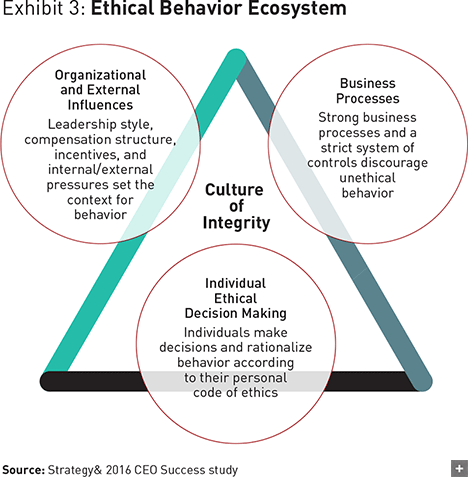
The job of a chief executive officer at a large publicly held company may seem to be quite comfortable — high pay, excellent benefits, elevated social status, and access to private jets. But the comfortable perch is increasingly becoming a hot seat, especially when CEOs and their employees cross red lines.

As this year’s CEO Success study shows, boards of directors, institutional investors, governments, and the media are holding chief executives to a far higher level of accountability for corporate fraud and ethical lapses than they did in the past. Over the last several years, CEOs have often garnered headlines for all the wrong reasons: for misleading regulators and investors; for cutting corners; and for failing to detect, correct, or prevent unethical or illegal conduct in their organization. Some high-profile cases, involving some of the world’s largest corporations, have featured oil companies bribing government officials and banks defrauding customers.

To be sure, the number of CEOs who are forced from office for ethical lapses remains quite small: There were only 18 such cases at the world’s 2,500 largest public companies in 2016. But firings for ethical lapses have been rising as a percentage of all CEO successions. (We define dismissals for ethical lapses as the removal of the CEO as the result of a scandal or improper conduct by the CEO or other employees; examples include fraud, bribery, insider trading, environmental disasters, inflated resumes, and sexual indiscretions. See “Methodology,” below.) Globally, dismissals for ethical lapses rose from 3.9 percent of all successions in 2007–11 to 5.3 percent in 2012–16, a 36 percent increase. The increase was more dramatic in North America and Western Europe. In our sample of successions at the largest companies there (those in the top quartile by market capitalization globally), dismissals for ethical lapses rose from 4.6 percent of all successions in 2007–11 to 7.8 percent in 2012–16, a 68 percent increase.

http://www.beckershospitalreview.com/hospital-management-administration/ceo-turnover-for-misbehavior-up-36-worldwide.html


Why do CEOs get fired or leave organizations anyway?

https://interimcfo.wordpress.com/2015/01/09/why-do-ceos-get-fired-or-leave-organizations-anyway/

In my previous post, I made reference to comments written by ‘TiredofTheOverpaidFailures’ in response to a Becker Review article.

Among other things, this writer said, “As a healthcare staffer for 35 years from entry-level employee to Director, I’ve literally never seen any CFO or CEO leave our organizations for any reason other than to “spend more time with my family”.  It’s true, because in every case they collected an inflated golden parachute for the next 2-3 years and indeed manage to take off time to spend with their family or most of the time do part-time consulting at some other organization where they have no idea the horrific failure they were in the previous position. For that matter, what shape they left the organization in.  They usually consider them “the expert” because they are from somewhere else.”

Clearly, he or she  was very bitter about what they had observed in the front office of their organization over a long period of time.

It is true that some of the folks occupying C-suite offices are not that stellar but more often than not, when they leave it is rarely because they are an idiot.  The system does a pretty good job of weeding out idiots before they can reach positions of such power and influence although I have seen a number of suspects among the casts of characters I have dealt with in healthcare administration.  So if the CEO is not an idiot, why let him go?  I will discuss a variety of situations that I have seen that I believe explain in part why CEO turnover in healthcare is so high.

I frequently hear complaints about what a Board is and is not doing with respect to the organization and the CEO.  A healthcare organization is not much different from a professional sports team.  The Board is the owner and the CEO is the coach.  In the end, like a sports team, the Board only has one switch or lever to use to guide the organization; hire the coach or fire the coach.  As long as the Board has not decided to fire the coach (CEO), by default they are supporting or at least tolerating him.  He is still their guy until the notice is delivered which can happen on the same date that an incentive award is given.  If you do not like what you see the CEO doing, it is not necessarily his fault.  Look to the Board for responsibility for the actions and results of their CEO.

Why an Interim Leader Might Be Right for Your Hospital Now

http://go.healthtechs3.com/webmail/65212/301376317/512fd82f27c1c374fcb87b63770e819d

Upcoming Webinar

Hospitals face difficult transitions every time a leader departs; maintaining momentum, restoring trust with the board, physicians and staff, financial turnarounds, and more.  The right interim leader – at the right time – can provide the expertise and guidance to steer the hospital through difficult straits, often providing the right combination of new strength and leadership for rapid financial or operational turnarounds (or even just a cultural change) when it would be tough for an incumbent to make the necessary changes.  While transitions can be somewhat scary, the right interim can ease the fears of the hospital and the community just by having a “seasoned” pro ready to step in when you need expert help.

Upon completion of the webinar, participants will understand:

  • What the right interim can mean for your organization
  • How s/he can provide unbiased continuity and stability for the institution and its staff and do the sometimes necessary “heavy lifting”
  • How to define what the right interim leader looks like – traits, skills, and fit

Please click here to view details and register.
Register

Cleveland Clinic’s Toby Cosgrove to step down, search begins for new president and CEO

http://www.fiercehealthcare.com/healthcare/cleveland-clinic-s-toby-cosgrove-to-step-down-search-begins-for-new-president-and-ceo?utm_medium=nl&utm_source=internal&mrkid=959610&mkt_tok=eyJpIjoiTm1Oak9EZzNZMkZoTVdKaSIsInQiOiJZY0d6WGVEUmR2S3dTaW5uMFBUWTZWXC9YekZySGpibUJNUWR0Mks3cVZORVZ2ZUZxQVdlcGRseCtiR0JhYUZoVXo0c0RsRHZ0eUVrZzJqRVNDZEdTcVU3S0JTNGEycktPOFNyYkFCeTdRNFpPK3pTNE1wRE1jWHZYbzJKbHp2dVkifQ%3D%3D

Cosgrove_At_State_Of_The_Clinic(Credit:Stephen_Travarca/Cleveland_Clinic)

One of the country’s most influential healthcare leaders plans to hang up his hat later this year.

Toby Cosgrove, M.D., who has served as president and CEO of the Cleveland Clinic for nearly 13 years, announced this morning he intends to step down. He will continue serving as an adviser for the multispecialty academic hospital.

The organization will begin the search for his successor immediately. In keeping with its model as a physician-led institution, the new president and CEO will also be a practicing physician.

Cosgrove was a cardiac surgeon for nearly 30 years before becoming CEO of Cleveland Clinic in 2004. Since then, he has led initiatives that have gained international and national recognition, particularly his focus on improving the patient experience and reorganizing clinical services into a patient-centered care model.

Cosgrove coined the phrase “Patients First” at the institution and was the first to hire a chief patient experience officer, a position that is now a fixture in many hospitals across the country. He also has implemented same-day medical appointments for patients who request them.

“It is an honor and a privilege to be a part of an extraordinary and forward-thinking organization that puts patients at the center of everything we do,” Cosgrove said in an announcement. “Cleveland Clinic’s world-class reputation of clinical excellence, innovation, medical education and research was created and will be maintained by the truly dedicated caregivers who work tirelessly to provide the best care to our patients.”

Under his direction, the Cleveland Clinic has grown into an $8 billion health system with locations in Ohio, Florida, Nevada, Canada and Abu Dhabi. It also will open a facility in London in 2020. The organization is Ohio’s largest employer with more than 50,000 caregivers.

Cleveland Clinic is also a leader in patient care. It was ranked No. 2 in the nation last year by U.S. News & World Report, which also ranked its heart program as No. 1 in America for 10 years in a row.

“The goal of any leader is to leave an institution better than you found it. Without a doubt, Toby has done that,” Cleveland Clinic Board of Directors Chairman Bob Rich said in the announcement. “Our world-class reputation has only grown over the past 13 years, as he has led Cleveland Clinic through a period of dramatic growth and worldwide expansion.”

In recent years, Fortune has also named Cleveland Clinic one of the best workplaces in healthcare. During his tenure, Cosgrove has led major wellness initiatives for both patients and employees, banning smoking on all campuses, adopting a policy not to hire smokers, offering employees free memberships to Weight Watchers and gyms, eliminating fried foods from the hospital cafeteria, opening weekly farmer’s markets in the summer and fall and creating an employee health insurance program that offers discounts for physical activity or for enrollment in a disease management program.

He was a frontrunner twice to serve as the secretary of the Department of Veteran Affairs, most recently as President Trump’s pick to oversee the embattled agency. But he had to turn down the position because he couldn’t get out of his commitment to the Cleveland Clinic.

Counsel’s Corner: President Trump, Potential Conflicts and Health System Boards

https://www.bna.com/counsels-corner-president-n57982083221/?utm_campaign=LEGAL_NWSLTR_Health+Care+Update_020317&utm_medium=email&utm_source=Eloqua&elqTrackId=0fe48d4501e044f0a1358b0e9518ca3d&elq=257cee302d8f4e8cae5761612eb6e82b&elqaid=7556&elqat=1&elqCampaignId=4506

Image result for conflicts of interest

Political biases aside, the transition process for the new administration—both as to President Donald Trump and his Cabinet nominees and White House advisers—does a great service for nonprofit health systems by highlighting critical conflict-of-interest concerns. The last several weeks’ headlines provide health system general counsel with a rare opportunity to offer practical board education based on current events.

The president’s personal asset divestiture plan, announced on Jan. 11, along with the broader public scrutiny of key administration members’ business interests, present an important teaching moment on identifying, resolving and managing conflict-of-interest issues. And that’s a subject on which many health system boards could use continuing guidance, given the strictures of the duty of loyalty.

Neither the particulars of the administration’s potential conflict issues nor the details or adequacy of the president’s divestiture plan needs to be addressed here. Instead, the issues themselves provide something of a checklist that can help health system boards ensure their internal conflict-of-interest policies and processes are as fulsome as possible. Strong conflict-of-interest inquiries are critical to protect the reputation of the organization and its board members, and to sustain key business arrangements.

It is important to note that the rapid growth of health systems, the equally rapid diversification of their businesses and investment portfolios, and the expanding diversity of board members’ backgrounds in board membership significantly complicate the conflict-of-interest review process.

The “Trump Transition” conflicts checklist logically could include the following:

CONCLUSION

The landscape that encompasses the totality of the president’s family business interests and those of his Cabinet appointees—and their relationship to the ethics of government—is many layered. It nevertheless offers certain valuable analogies for the health system board—for which the duty of loyalty is sacrosanct. It isn’t all that great a leap to go from Trump’s transition issues to the conflict-of-interest policies of a nonprofit health system board. And it should be noted that the breadth of scrutiny of transition-related conflicts of interest likely hasn’t gone unnoticed by health-care industry regulators, including but not limited to state charity officials. Regulators may be far more likely than before to apply greater sensitivity to issues and relationships that may present conflict issues and their broader legal implications.

Hospital leaders support keeping many elements of ACA

http://www.revenuecycleinsights.com/news/hospital-leaders-support-keeping-many-elements-aca?mkt_tok=eyJpIjoiWWpCaU1USXhZbVEzWkRCaiIsInQiOiJURzlCeG5tb05KNjN5QU9UMGIrVFBoZkxiS3Q2WHdPZDZRNXJ0TFQzemdXdVwvS3pPa3UrcWNOQTVxanpaVW5mMFFoUzk4OXc0ejg2dSs2SkRGWHErZDlqUjlhd1dTQit3c2VBaXdGSDdPK1IzQXEwdWNNaWt6YjFRQ2xyR3JZNloifQ%3D%3D

An overwhelming majority of hospital C-suite and pharmacy executives support preserving the protections in the Affordable Care Act (ACA) for patients with preexisting conditions, according to a post-election survey.

Member-based healthcare performance improvement company Vizient conducted the survey to assess how member hospitals were reacting to the planned repeal of the ACA by the Trump administration and Republican leaders in Congress. Vizient also asked executives about their top concerns for the future as well as their priorities for 2017.

Nearly 90 percent of C-suite leaders (89.5 percent) and 96 percent of hospital pharmacy executives surveyed said the ACA’s protections for patients with preexisting conditions should be kept in place.

Other findings from the survey show:

  • 68 percent of hospital C-suite leaders and 35 percent of hospital pharmacy executives want to keep incentives for expanding Medicaid coverage
  • 56 percent of hospital executives and 46 percent of hospital pharmacy leaders want to continue subsidies to help consumers pay for insurance
  • 52 percent of hospital C-suite leaders and 39 percent of pharmacy executives want to continue value-based reimbursements.

The top three priorities for all executives this year were 1) reducing clinical variation across care delivery 2) migrating toward value-based models, and 3) the integration of existing technology systems, Vizient said.

“In reviewing the survey results, central themes come through: uncertainty and concerns about financial viability,” Byron Jobe, president and chief administrative officer for Vizient, said in a statement. “There are many open questions about the future of the ACA, and what a repeal and replacement strategy could look like. As Congress wrestles with these decisions, it’s important to ensure reimbursement levels are enough to allow hospitals to continue their mission of caring for patients in their communities. Equally important, hospitals must quickly gain a clear understanding of where health policy is heading so they can begin to prepare.”

Thank-you notes from the C-suite: 9 health system CEOs express gratitude to staff

http://www.beckershospitalreview.com/hospital-management-administration/thank-you-notes-from-the-c-suite-9-health-system-ceos-express-gratitude-to-staff.html

Image result for Leadership Giving Thanks


Community hospitals: What’s your long-term game plan?

http://www.beckershospitalreview.com/facilities-management/community-hospitals-what-s-your-long-term-game-plan.html

Related image

The volume of hospital M&A deals has doubled over the past six years, with fewer and fewer community hospitals still going it alone. For the remaining holdouts, they are at an important juncture: Should they continue fighting for independence or join a larger system?

This heavily-debated question is at the core of many board meetings. While the answer is unique to each institution, in either scenario, the community hospital that proactively controls its own destiny — instead of losing that control to market forces — can come out ahead.

Whether the future holds independence or acquisition, here is what leadership needs to know to position their hospitals for future growth.

What does it take to stay independent?
For efficient facilities with ample cash on hand, there’s an understandable allure to remaining independent. After all, the board of directors at a community hospital is typically made up of individuals from the local area who can continue to focus exclusively on addressing the needs of the local community rather than answer to a distant corporate team.

But a lean and high-volume operation today just isn’t a strong enough indicator to choose independence for the long term. Leadership must consider broader questions that take into account a host of internal and external factors:

CFOs explain changing role, see collaboration key as healthcare changes

http://www.healthcarefinancenews.com/news/cfos-explain-changing-role-see-collaboration-key-healthcare-changes?mkt_tok=eyJpIjoiTlRBeU5EUTRNemMxTmpabSIsInQiOiJqTlZNaWFSY2Vid2c4T3JEeU1FNlkwOFwvcmp0U21idDZBU0w2NWZzTWM5Y0RDQWoxYzdLRjdKUkh4WFhvakZcL014Wk50eHR6ZnkybmY3VnNsOXBISElhS2FpazdXbW5LNWZiT2tKOVpRYzcwPSJ9

Image result for CFO changing role

While the old image of a healthcare chief financial officer centered on accounting, budgeting and overseeing the financial operations in general of a healthcare system, changes to the industry are turning that idea on its head. As clinical quality and technological prowess now have direct effects on the financial health of a hospital, the modern CFO must have a far more overreaching set of skills to perform at the highest level in their jobs.

To illustrate that, Healthcare Finance spoke to three CFOs in the field about how they got to the top and how that role has evolved during their tenures. All of them said the job demands more strategizing, collaboration and concern over quality than ever before.