What is CHIP? 7 things to know about the Children’s Health Insurance Program

http://www.ajc.com/news/health-med-fit-science/what-chip-things-know-about-the-children-health-insurance-program/yRU5elqPuB7VwIgm3FFNNL/

Related image

Amid efforts to unsuccessfully repeal and replace the Affordable Care Act in the fall, lawmakers let the Children’s Health Insurance Program (or CHIP) to expire on Sept. 30.

And now, doctors and patients are worried that money for the program, which provides 9 million kids across the country with low-cost health insurance, will run out.

In fact, according to the Kaiser Family Foundation, 16 states expect to run out of CHIP reserve funds by the end of January, and three-quarters of the states expect to run out by March.

Here are 7 things to know about CHIP:

What is CHIP?

According to HealthCare.gov, CHIP is a no-cost or low-cost health insurance program that provides coverage to children in families that earn too much money to qualify for Medicaid, but who can’t afford private coverage.

The program is funded by both states and the federal government, but it is state-administered, meaning each state sets their own guidelines on eligibility and services.

In Georgia, the CHIP program is PeachCare for Kids.

CHIP’s history

In 1997, Congress passed Title XXI of the Social Security Act, which enabled states to create programs for the growing number of uninsured children in the country.

The program was created during the Clinton administration by the Balanced Budget Act of 1997. At the time, 10 million children were without health insurance and many of those children were part of working families with incomes slightly above states’ Medicaid eligibility levels, according to the Medicaid and CHIP Payment and Access Commission.

The Children’s Health Insurance Program Reauthorization Act (CHIPRA) reauthorized CHIP in April 2009.

The next year, the Affordable Care Act contained provisions to strengthen the program and later extended CHIP funding until September 30, 2015. It also required states to maintain eligibility standards through 2019.

By 2015, 18 years after its enactment, 3.3 million children in the U.S. were without health insurance.

In October 2017, however, Congress missed a deadline to reauthorize CHIP, which expired on Sept. 30.

“Lawmakers and staffers in Congress say CHIP funding will likely be included in an end-of-year spending bill,” NPR reported Tuesday. “But as of now, there is no CHIP funding bill scheduled for consideration.”

Who is eligible for CHIP?

Eligibility varies by state, but in most states, children up to age 19 with a family income up to $49,200 per year (for a family of four) may qualify for Medicaid or CHIP, according to insurekidsnow.gov.

But even if your family income is higher, children may still qualify.

Some states (Colorado, Missouri, New Jersey, Rhode Island and Virginia) also provide coverage to pregnant women through CHIP.

Coverage is for U.S. citizens and certain lawfully present immigrants.

What does CHIP cover?

State benefits may vary, but all states provide comprehensive coverage for routine check-ups, immunizations, doctor visits, prescriptions, dental/vision care, inpatient /outpatient hospital care, laboratory/X-ray services and emergency services.

How much does CHIP cost?

The cost depends on family income. Many families may get free health insurance coverage for their kids and others may have to pay a modest enrollment fee or premiums, as well as copayments for specific services.

But according to healthcare.gov, you won’t have to pay more than 5 percent of your family’s income for the year.

How do you apply for CHIP?

There are three ways to apply. You can either call 1-800-318-2596 (1-855-889-4325 for TTY), fill out an application through the health insurance marketplace or apply directly with your state’s CHIP agency.

How many children get health insurance from CHIP?

Nine million kids get health insurance under CHIP.

The CHIP Program Is Beloved. Why Is Its Funding in Danger?

Laquita Gardner, a sales manager at a furniture rental store here, was happy to get a raise recently except for one problem. It lifted her income just enough to disqualify her and her two young sons from Medicaid, the free health insurance program for the poor.

She was relieved to find another option was available for the boys: the Children’s Health Insurance Program, known as CHIP, that covers nearly nine million children whose parents earn too much for Medicaid, but not enough to afford other coverage.

But CHIP, a program that has had unusually strong bipartisan support since it was created in 1997, is now in limbo — an unexpected victim of the partisan rancor that has stymied legislative action in Washington this year. Its federal funds ran out on Sept. 30, and Congress has not agreed on a plan to renew the roughly $14 billion a year it spends on the program.

“I’m kind of shocked, because this is something for kids,” Ms. Gardner said Thursday as her 7-year-old, Alexander, braced for a flu shot at a bright, busy neighborhood clinic run by the Nemours Children’s Health System. Ms. Gardner pays $25 a month for her sons’ CHIP coverage, with no deductible or co-payments.

Congressional leaders may provide some temporary relief to a handful of states that expect to exhaust their CHIP funds before the end of this year. It would be tucked into a short-term spending bill intended to avert a government shutdown after Friday. Lawmakers from both parties hope to provide more money for CHIP in a separate, longer-term deal on federal spending. But Republicans will almost surely need Democratic votes to pass such legislation, and the antagonism between President Trump and Democrats in Congress is so great that no one can be sure of the outcome.

The uncertainty has been unsettling to parents, pediatricians and state officials around the country. States are weighing whether to freeze enrollment in CHIP, shut down their programs or find money from other sources. Last week Colorado sent letters to CHIP families, advising them to start researching private health insurance options because there was “no guarantee” that Congress would continue the program. Texas has drawn up a detailed “termination timeline” under which the state could begin mailing insurance cancellation notices on Dec. 22, three days before Christmas.

“It crushes me to think we’re in an environment where kids’ health is up for debate — that this somehow got tossed into the wrangling,” said Dr. Todd Wolynn, a pediatrician in Pittsburgh and a member of the American Academy of Pediatrics. “There are kids on protocols and regimens and treatment plans, and their families have got to try to figure out, what are we going to do?”

Here in Delaware, health officials anticipate running out of money for CHIP at the end of January if Congress does not act.

“I’ve been around a while and I’ve never seen a program that is this popular, and that goes across the aisle,” said Stephen Groff, director of the state’s Division of Medicaid and Medical Assistance. “To be having this discussion, that we may be in a funding crisis, is beyond belief.”

Members of both parties in the House and the Senate agree that Congress should provide money for CHIP for five years, through 2022. But they disagree over how to pay for it.

In early November, the House passed a bill to extend the CHIP program. But most Democrats voted against it because the legislation would have cut funds for other public health programs and ended insurance coverage for several hundred thousand people who had failed to pay their share of premiums for insurance purchased under the Affordable Care Act.

In the Senate, senior members of the Finance Committee say they have been making progress toward a bipartisan deal on CHIP, but they have been preoccupied for several weeks with their tax bill. The committee approved a five-year extension of funding for the program in early October, but did not specify a way to pay for the measure.

As Congress dithered, Minnesota received an emergency infusion of federal funds to continue CHIP for October and November, but is expected to be the first state to run out of federal money for the program. Emily Piper, the commissioner of the Minnesota Department of Human Services, said the state would use its own funds to fill the gap temporarily.

“I don’t think Washington is working the way anyone in the country expects it to work right now,” she said. “A dysfunctional Washington has real consequences for people.”

Oregon, which expects to exhaust its federal CHIP funds this month, will also use state funds to continue coverage, said Gov. Kate Brown, a Democrat. “As Congress rebuffs its responsibilities, it is up to us, Oregonians, to stand up for our children,” she said.

Colorado was the first state to send warning letters to families with CHIP coverage. “We felt it was important that folks covered by CHIP understand what’s happening,” said Marc Williams, a spokesman for the state Department of Health Care Policy and Financing.

In Texas, more than 450,000 children could lose CHIP coverage on Feb. 1 unless the state can obtain $90 million. Even if it comes through, supporters of the program worry about the effect of cancellation warnings.

“It gets very, very complicated once the state sends those letters out and starts walking down that road,” said Laura Guerra-Cardus, deputy director of the Children’s Defense Fund-Texas. “It can really affect trust in the program. So many families still don’t realize this is coming, and the few I’ve informed, they go immediately into a state of alarm.”

Representative Greg Walden, Republican of Oregon and the chairman of the Energy and Commerce Committee, which is responsible for the program, said last week that “we need to get CHIP done” because “states are in a real mess right now.”

Democrats said Congress should have provided money for CHIP months ago, but that Republicans had placed a higher priority on dismantling the Affordable Care Act and cutting taxes.

“Because Congress failed to do its job — a bunch of elected officials who have insurance paid by taxpayers failed to do their job — children here in America are about to be kicked off of their health insurance,” said Senator Sherrod Brown, Democrat of Ohio.

Senator Orrin G. Hatch, Republican of Utah and the chairman of the Senate Finance Committee, insisted: “We’re going to get CHIP through. There is no question about that.”

Mr. Hatch led efforts to create the program in collaboration with Senator Edward M. Kennedy, Democrat of Massachusetts, in 1997. “Nobody believes in the CHIP program more than I,” Mr. Hatch said on the Senate floor last week. “I invented it.”

Doctors at the Nemours/Alfred I. duPont Hospital for Children, here in Wilmington, were continuing to see CHIP patients last week at the flagship of a system that treats 15,000 children with CHIP coverage each year. Dr. Jonathan Miller, chief of the system’s Division of General Pediatrics, said many receive therapy for developmental delays and treatment for chronic conditions like asthma and obesity.

“It provides specialized care for children that’s more comprehensive than a lot of private coverage,” he said, “which is really designed with adults in mind.”

Research has also found CHIP increasingly helps people whose employer-provided insurance is too expensive for their entire family. Ariel Haughton, a mother of two in Pittsburgh, said it would cost more than $100 more a month to put her two children on the plan her husband gets through his job as an apprentice plumber, which also requires them to pay a high deductible before the coverage kicks in. Without CHIP, Ms. Haughton said, she might have delayed visiting the pediatrician this summer when her daughter had a fever and rash that turned out to be Lyme disease.

“It makes it so much easier for me to actually take good care of my children,” said Ms. Haughton. “We’ve had a rocky last few years, but at least I can take them to the doctor without having to be like, ‘Their fever isn’t 105 so I guess I’d better skip it.’”

Olivia Carrow, who had brought her 2-year-old to the children’s hospital here to test for an infection, said her other three children were newly uninsured and she had heard they might qualify for CHIP. The 2-year-old, William, qualifies for Medicaid because of a serious condition that causes his trachea to collapse.

The rest of the family had insurance through Ms. Carrow’s job as a nurse, but lost it after she cut back her hours this fall. She and her husband started a chicken farm this year and delayed exploring other coverage options, she said, partly because of the protracted fight in Congress over proposals to repeal the Affordable Care Act.

“Not knowing how things are going to go — I feel that way about health coverage in general,” Ms. Carrow said. “It doesn’t surprise me, but it gets very sad.”


Congress floats temporary patch for CHIP funding shortfalls

https://www.fiercehealthcare.com/cms-chip/congress-floats-temporary-patch-for-chip-funding-shortfalls?mkt_tok=eyJpIjoiTkdKallqUmhOV1prTmpZMyIsInQiOiIzV0NnWXA2amJKeHRybHVFTWl3bCtXMHpQXC92SXRnZyt0WGV0VFFUTkxoQk1UTHlyMGRlTFZkc3V2aXM0cGY5Q1Fndmh0ck5venI0OVJVMWhpNHQrakJWSytReEVBc2N4Y1lwRXBHQmZ2RGR6bk9cLzJxREZIbDk2VWQ2bzFKSmZvIn0%3D&mrkid=959610&utm_medium=nl&utm_source=internal

Image result for kicking the can down the road


In its short-term appropriations bill, Congress has included a provision aimed at helping states keep their Children’s Health Insurance Programs afloat while lawmakers try to pass a longer-term measure. But that gesture may not go nearly far enough.

The bill would direct the secretary of Health and Human Services to allocate previously unused CHIP funding first to “emergency shortfall states”—or ones that are in danger of running out of money—before other states. The federal government has already been redistributing funding from past years to states that were facing shortfalls in October and November.

Those shortfalls exist because federal funding for CHIP expired Sept. 30, and Congress’ efforts to pass funding reauthorization measure have been stalled by partisan disputes over how to pay for it. The Senate Finance Committee has advanced its version of a CHIP bill—which doesn’t outline any offsets—while a companion bill, containing cuts to other healthcare programs, cleared the House despite Democrats’ objections.

If Congress fails to pass a long-term CHIP funding measure, at least five states and the District of Columbia predict they will run out of money for the program by the end of 2017 or early in January, according to a survey from the Georgetown University’s Center for Children and Families. Some states have already sent notices to families advising them to start researching private health insurance options.

The center’s executive director, Joan Alker, also isn’t impressed by the CHIP provision in the short-term appropriations bill, calling it a sign Congress is trying to “kick the can down the road.”

“The longer Congress postpones action on long-term CHIP funding, the more states will be forced to waste time and money developing contingency plans,” she wrote in a blog post, adding, “the more states that send out notices, the more likely it will be that some kids will fall through the cracks.”

Healthcare Triage News: Lots of Children Are About to Lose Their Health Coverage

Healthcare Triage News: Lots of Children Are About to Lose Their Health Coverage

Image result for Health Triage: Lots of Children Are About to Lose Their Health Coverage

Budget authorization for the Children’s Health Insurance Program in the US ran out a couple of months ago, and there’s no reauthorization in sight. A LOT of kids are insured through this program.

Podcast: ‘What The Health?’ Tax Bill Or Health Bill?

https://khn.org/news/podcast-what-the-health-tax-bill-or-health-bill/?utm_campaign=KFF-2017-The-Latest&utm_source=hs_email&utm_medium=email&utm_content=58570997&_hsenc=p2ANqtz-90FnDooDrGIdtTTHP8VfZovw1vS_Y_js4RdDwCCIwslKGDgrqu1yZ6bbcLJ5AbWfyJaM2B3HhQ9fR9txLD5dY-TnO3HA&_hsmi=58570997

Image result for kaiser podcast what the health?


Republican efforts to alter the health law, left for dead in September, came roaring back to life this week as the Senate Finance Committee added a repeal of the “individual mandate” fines for not maintaining health insurance to their tax bill.

In this episode of “What the Health?” Julie Rovner of Kaiser Health News, Sarah Kliff of Vox.com, Joanne Kenen of Politico and Alice Ollstein of Talking Points Memo discuss the other health implications of the tax bill, as well as the current state of the Affordable Care Act.

Among the takeaways from this week’s podcast:

  • The tax bill debate proves that Republicans’ zeal to repeal the Affordable Care Act is never dead. The new congressional efforts to kill the penalties for the health law’s individual mandate could seriously wound the ACA since the mandate helps drive healthy people to buy insurance.
  • One of the most overlooked consequences of the tax debate is that it could trigger a substantial cut in federal spending on Medicare.
  • A $25,000 MRI? That’s what one family paid to go out of their plan’s network to get the hospital they wanted for the procedure for their 3-year-old. Such choices are again drawing complaints about narrow networks of doctors and hospitals available in some health plans.
  • Although they don’t likely say it in front of cameras, many Democrats are relieved at President Donald Trump’s choice to head the Department of Health and Human Services, former HHS official Alex Azar.
  • Federal officials have given 10 states and four territories extra money to keep their Children’s Health Insurance Programs running but it’s not clear what couch they found the money hidden in.
  • And in remembrance of Uwe Reinhardt, a reminder that he always stressed that a health care debate was about more than money — it was about real people.

Plus, for “extra credit,” the panelists recommend their favorite health stories of the week they think you should read, too.

Poll: Ahead of House Tax Reform Vote, Americans are More Likely to Rank Children’s Health Care, Hurricane Relief and Other Issues as Top Priorities for Washington

http://connect.kff.org/poll-ahead-of-house-tax-reform-vote-americans-are-more-likely-to-rank-childrens-health-care-hurricane-relief-and-other-issues-as-top-priorities-for-washington?ecid=ACsprvumAORaSTpZGqmqhYQaXpeqtZoXjMxf6lbzmdUaIsV8vQ82Gwn_2PBBsI5zIiSuUzZ5w8-C&utm_campaign=KFF-2017-November-Poll-Tax-Reform-Vote&utm_source=hs_email&utm_medium=email&utm_content=58466081&_hsenc=p2ANqtz-8Cag0QgNSRgFKsxX_UJAz_sPw8ZG2hIH2l7nv8vGW9Dn5a8w_Mcy5njs5Hwf79zPT3e9Z8cecPnIWqwTXGvfb_qKXqRg&_hsmi=58466081

tax reform poll chart 2.png

Controlling Immigration Tops Republicans’ Priority List, With Tax Reform among a Number of Second-Tier Issues Including Hurricane Relief and ACA Repeal

Most of the Public Initially Favors Getting Rid of the ACA’s Individual Mandate As Part of Tax Reform, But Some Become Opponents When Presented with Facts and Arguments for Keeping the Mandate

As the House prepares to vote Thursday on its tax reform bill, a new Kaiser Family Foundation poll finds almost three in 10 Americans (28%) view tax reform as a top priority for President Trump and Congress.

That’s significantly fewer than the share that say the same about reauthorizing funding for the Children’s Health Insurance Program (62%), hurricane recovery funding (61%), stabilizing the Affordable Care Act’s insurance marketplaces (48%) and addressing the prescription painkiller epidemic (43%).  Two immigration-related issues – strengthening controls to limit who enters the country (35%) and passing legislation to allow the Dreamers to legally stay (34%) – also rank higher, while a similar share (29%) say repealing the Affordable Care Act is a top priority.

Among Republicans, half (51%) say reforming the tax code is a top Washington priority, behind strengthening immigration controls (69%) but similar to the share who consider hurricane recovery funding (52%), repealing the Affordable Care Act (50%), stabilizing the insurance marketplaces (46%) and reauthorizing CHIP funding (46%) to be top priorities.

In a tweet Monday, President Trump called on Congress to end the Affordable Care Act’s individual mandate, which requires most Americans to have health insurance or pay a tax penalty and has long been the least popular provision in the law. While the House tax reform bill does not currently address the mandate, key Republican senators said Tuesday that they will include such a provision in their version of the bill.

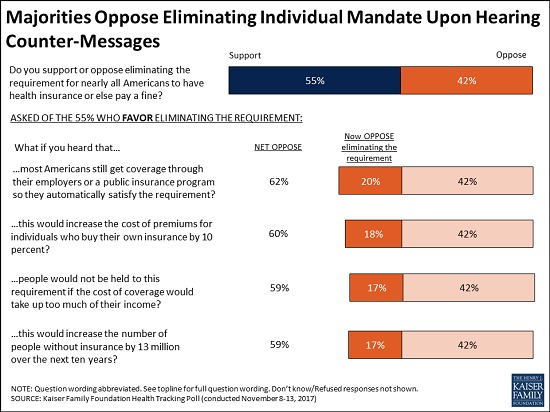
The new poll finds that most Americans (55%) initially support eliminating the mandate as part of tax reform, while four in 10 (42%) oppose it. Most Republicans (73%) and independents (58%) support ending the mandate, while most Democrats (59%) oppose it.

These views are malleable, with about a third of supporters (representing a fifth of the public overall) switching to oppose the mandate’s repeal when presented with facts and arguments about who is impacted and potential consequences of its repeal.

For example, the share who oppose eliminating the mandate can rise as high as 62 percent when initial supporters hear that most Americans get coverage through their employers or government programs that meets the mandate’s requirements. Similar majorities ultimately oppose eliminating the mandate when presented with other arguments against it, including that premiums for people who buy their own health insurance would go up, that people are exempted from the mandate if the cost of coverage takes up too much of their income and that getting rid of the mandate would result in 13 million more people being uninsured over the next 10 years, as the Congressional Budget Office has estimated.

One provision in the House bill would eliminate a tax deduction that allows people with high medical costs to deduct any medical and dental expenses that exceed 10 percent of their income.  A majority (68%) of the public – including majorities of Democrats (77%), independents (66%), and Republicans (61%) oppose eliminating the tax deduction for individuals who have high health care costs.

More than four in 10 (44%) of the public think eliminating the deduction for high medical costs will affect them and their families, though in reality a much smaller share of the public uses that deduction in any given tax year. According to the Internal Revenue Service, about 17 percent of taxpayers who file itemized deductions use this deduction (approximately 6% of all taxpayers and 3% of the public).

Looking ahead to the 2018 midterm elections, the public is divided over whether not passing a tax reform plan or not repealing the ACA would be a bigger deal for President Trump and Republicans. Nearly half of the public say it will be a bigger problem if the president and Republicans are unable to pass their tax reform plan (47%), similar to the share who say it will be a bigger problem if they are unable to revive a repeal of the ACA (44%). Republicans are also divided, with similar shares saying   it would be a bigger deal if President Trump and Republicans are unable to repeal the ACA (50%) and if they are unable to pass tax reform (45%).

Designed and analyzed by public opinion researchers at the Kaiser Family Foundation, the poll was conducted from November 8 – 13, 2017 among a nationally representative random digit dial telephone sample of 1,201 adults. Interviews were conducted in English and Spanish by landline (415) and cell phone (786). The margin of sampling error is plus or minus 3 percentage points for the full sample. For results based on subgroups, the margin of sampling error may be higher.

What’s Next for CHIP?

http://www.commonwealthfund.org/publications/blog/2017/oct/whats-next-for-chip


The Children’s Health Insurance Program (CHIP) offers a critical health insurance pathway for children living in families with modest means. These families’ incomes exceed the basic Medicaid eligibility standard for children but they lack access to employer insurance for their children, either because none is offered or because of a phenomenon known as the “family glitch,” which bars working parents with affordable employer coverage for themselves from getting marketplace subsidies for their children.

CHIP fills these gaps, reaching nearly 9 million children. And because of its popularity, as well as a streamlined enrollment process built into the original law in 1997 and expanded under Affordable Care Act, CHIP has had a remarkable impact on children’s access to health insurance. By 2016, just 4 percent of U.S. children lacked health insurance. Yet Congress has still not reauthorized federal funding for this program.

Unlike Medicaid, which rests on a permanent federal funding authorization, CHIP funding authority must be periodically renewed. Administering CHIP is complex for states because they typically offer CHIP in two forms: coverage through Medicaid for children with incomes just above the Medicaid eligibility cutoff and a separate, companion program for children living in families with slightly higher incomes. As a result, there is a need to transition children between two sources of insurance coverage (and potentially separate managed care plans and provider networks) as family incomes fluctuate.

Fundamental to smooth program operation is reliable federal funding, which accounts for the lion’s share of CHIP program costs. The most recent federal extension came in 2015 as part of legislation that extended funding through September 30, 2017. Congress has therefore known about CHIP’s 2017 funding cliff for more than two years.  States have been unequivocal about the need for steady financing in order to avert coverage interruptions. In the face of continued financial instability, their agencies may need to cease enrollment and freeze coverage — and therefore access to care — for children already enrolled (along with some 370,000 pregnant women also covered through CHIP).

Congress failed to take up CHIP in advance of the deadline because the winter, spring, and summer were consumed by the ACA repeal-and-replace battle. CHIP never was part of this fight; none of the bills considered — even the proposals that would have fundamentally impaired Medicaid’s ability to function effectively for the nation’s 36 million poorest children — proposed to end CHIP. Indeed, the Graham-Cassidy bill would have built on CHIP. But only at the end of September, when the Senate set aside Graham-Cassidy, did Congress return to CHIP.

On October 4, committees in both the House of Representatives and the Senate completed their work on a CHIP extension. Both the House and Senate measures would extend federal CHIP funding for five years and both sides are in agreement on the proper federal CHIP funding level. In other words, the two committees are aligned on the policy.

The House CHIP measure also contains provisions to address other pressing matters such as a delay in scheduled reductions in federal Medicaid payments to hospitals that treat a disproportionate percentage of low-income patients and an increase in federal Medicaid payments to Puerto Rico to help the Commonwealth’s recovery from Hurricane Maria. The House CHIP measure is also part of a suite of other noncontroversial bills expected to move at the same time, including extension of the Health Center Grant Fund, which provides basic grant funding to the nation’s nearly 1,400 federally funded community health centers.

Congress still needs to determine the final contours of the bill, including whether to proceed with the controversial spending offsets the House has identified, in particular a $6.3 billion cut over 10 years to the Prevention and Public Health Trust Fund, which supports core public health services. As yet there is no word on next steps, even as states begin to fall over the edge of the fiscal cliff. Children covered through Medicaid CHIP are safe for the moment, although declining CHIP funding for Medicaid-enrolled children can be expected to trigger other offsetting Medicaid program cuts. But coverage for approximately 4 million children enrolled in separate CHIP programs is very much on the line.

Many hard decisions in a jam-packed fall schedule await Congress. Given the strong bipartisan support for CHIP and its totally predictable expiration, it is surprising — and unfortunate — that CHIP remains on the Congressional docket.

Hospitals Brace For Unpaid Bills If GOP Balks On Children’s Healthcare

https://www.forbes.com/sites/brucejapsen/2017/10/05/hospitals-brace-for-unpaid-bills-if-gop-balks-on-childrens-healthcare/#6b40118272e9

Image result for children's health insurance program (chip)


Hospitals are bracing for an increase in unpaid medical bills and related uncompensated care after the Republican-led Congress let funding for the Children’s Health Insurance Program lapse.

Congressional committees this week are working on language to renew the CHIP program after federal funding expired Saturday, Sept. 30, leaving coverage of 9 million children in doubt. What was thought to be a done deal with bipartisan agreement a month ago that CHIP would be renewed for five years has lately become bogged down in Congressional gridlock and charges of ineptitude against Republicans and the Trump White House.

U.S. Speaker of the House Rep. Paul Ryan (R-WI) (L) speaks as Senate Majority Leader Sen. Mitch McConnell (R-KY) (3rd L), Sen. Ted Cruz (R-TX) (2nd L) and Sen. Pat Toomey (R-PA) (R) listen during a press event on tax reform September 27, 2017 at the Capitol in Washington, DC. (Photo by Alex Wong/Getty Images)

“States will not have access to additional funds and either will have to scramble to find money to pay for the health care costs for some of the most vulnerable patients or hospitals likely will experience a surge in uncompensated care,” Mizuho Securities USAresearch director Sheryl Skolnick said in a report Wednesday. “The need to reauthorize CHIP was well-known and the failure seems symptomatic of the larger issue of a dysfunctional political process.”

Some states could begin to run out of money to cover children over the next three months, triggering an uptick in medical bills that could lead to layoffs and a freeze on capital spending.

Hospitals generally account for CHIP funds in their Medicaid revenues, which can be 10% and 20% of some facility revenues. For-profit hospital operators like Tenet Healthcare, HCA Holdings and Community Health Systems, though, have less than 10% of their operations funded by Medicaid, Mizuho’s report this week shows.

Since the Affordable Care Act expanded coverage to more than 20 million Americans, hospital charity care and related uncompensated care expenses that include bad debt have dropped significantly.

Uncompensated care costs for the nation’s 4,862 hospitals dropped below 5% to 4.2%, or $35.7 billion in 2015, the American Hospital Association’s most recent tally showsThe 2015 level of uncompensated care costs were the lowest amount since 2007 , the AHA figures show.

But a loss in money from millions of children covered by CHIP would reverse the uncompensated care trend and certainly hit hospitals hard.

The healthcare industry was still hopeful momentum would return in Congress and CHIP funding would be renewed before providers and their patients would be harmed.

“Given CHIP’s immensely positive impact on children’s health, MHPA is very gratified that the House language released on Monday, October 2 extends the CHIP funding for another five years,” Medicaid Health Plans of America said in a letter to Congress. “We also appreciate that the language acknowledges any changes to funding must be made carefully and over time by gradually reducing the temporary 23 percent increase to 11.5 percent in October 2019, before allowing the program to resume the regular CHIP funding in October 2020. MHPA also appreciates that the funding, once extended, will be retroactive thus ensuring states’ current budgets will not be negatively affected.”

MHPA members include Aetna, Centene, Cigna and UnitedHealth Group.

States Gird for Worst as Congress Wrestles with Children’s Insurance Program

Image result for pennies for children

Federal officials on Monday approved a $3.6 million emergency infusion for Minnesota after the state’s human services chief warned that pregnant women and some children were at imminent risk of losing health care coverage under the Children’s Health Insurance Program.

Utah, meantime, has formally requested authority to “eliminate eligibility and services under CHIP” if the state does not have enough money to continue coverage.

In statehouses around the country, officials are preparing for the worst as lawmakers in Washington struggle to find money for the popular Children’s Health Insurance Program, which insures nearly nine million children but lost its spending authority on Sunday, with the start of the new fiscal year.

Congress has known for two years that federal funds for the Children’s Health Insurance Program were expiring this fall. But only on Wednesday are two congressional panels — the Senate Finance Committee and the House Energy and Commerce Committee — tentatively scheduled to vote on legislation that would provide money for the program for another five years.

And the two chambers have not agreed on how to pay for the measures.

“We know that there is a desire in Congress to provide the funds, but we have heard that same sentiment all through the spring and the summer,” said Nathan Checketts, the deputy director of the Utah Health Department. “Congress needs to get this done as soon as possible, so states do not have to begin notifying people that their coverage may end.”

The Utah program covers 19,000 children.

Most states still have unspent funds that will last several months. But some are drafting contingency plans in case Congress does what it has done so often: fails to reach an agreement. A federal panel that advises Congress on the Children’s Health Insurance Program says that more than half the states are expected to exhaust all their CHIP funds within six months.

By the end of this year, Arizona, Minnesota and North Carolina are likely to run out of money for their programs, according to the panel, the Medicaid and CHIP Payment and Access Commission.

By March 2018, it said, CHIP funds will be exhausted in 27 additional states, including California, Colorado, Connecticut, Florida, Massachusetts, New York, Ohio, Oregon and Pennsylvania. Another 19 states are expected to use up their money from April to June 2018, with one state exhausting its funds from July to September 2018.

Gov. Andrew M. Cuomo of New York, a Democrat, said Tuesday that Congress’s failure to act jeopardized coverage for 330,000 children in the state.

Representative Pete Sessions, Republican of Texas, said the need was “not dire or urgent.” Republicans, he said, intend to provide the funds, so “the money that is necessary to keep this program going is not in jeopardy.”

But Democrats accused Republicans of willful inattention.

“If making sure that every child in America has access to health care, if that is not a priority, what is?” asked Representative Jan Schakowsky, Democrat of Illinois. “Families are waiting anxiously while their health security is hanging in the balance.”

Action in the Senate was delayed for several weeks as Republicans made repeated unsuccessful attempts, in July and September, to pass legislation that would have repealed much of the Affordable Care Act.

CHIP is for children in families that make too much to qualify for Medicaid but not enough to afford other coverage. Nearly 90 percent of children in the program had family incomes less than twice the poverty level (less than about $40,000 a year for a family of three).

Even if congressional committees can agree, it is not clear how soon legislation will emerge from Congress. The Senate plans to be in recess next week, and the House is expected to be in recess in the following week.

The Senate bill is a bipartisan measure, drafted by Senators Orrin G. Hatch, Republican of Utah, and Ron Wyden, Democrat of Oregon. Mr. Hatch, now the chairman of the Finance Committee, helped create the child health program in 1997 and says he is eager to extend it.

In the House, some Democrats have expressed concerns about the bill drafted by House Republicans because, they say, it would pay for continuation of the CHIP program by cutting other health spending. Some House Democrats have suggested offsets that would instead reduce payments to pharmaceutical companies.

Under federal law, states receive annual allotments of federal CHIP funds. They have two years to spend their allotments, and unspent money is then available for redistribution to other states. The money sent to Minnesota this week came from that pool of unspent funds.

The Senate and House bills would each provide a total of $118.5 billion over five years, but under arcane budget rules, Congress needs to offset less than 10 percent of that cost. The Congressional Budget Office assumes that if the program ended, some children would become uninsured, but the federal government would help provide coverage for others, through Medicaid or through private insurance subsidized under the Affordable Care Act.

The federal government and the states have historically shared the cost of CHIP, with Washington paying approximately 70 percent of the cost in a typical state. The Affordable Care Act increased the federal share by 23 percentage points, with the result that the federal government has been paying the entire cost in 11 states.

The Senate and House bills would continue the 23 percentage point bonus in 2018 and 2019, cut it in half in 2020 and eliminate it in 2021 and 2022.

Senate Budget Won’t Let GOP Pursue Full Obamacare Repeal

https://www.bloomberg.com/news/articles/2017-09-29/senate-budget-allows-1-5-trillion-tax-cut-not-full-aca-repeal

Image result for Obamacare Repeal

Senate Republicans unveiled a fiscal 2018 budget resolution Friday that they intend to use to push through as much as $1.5 trillion of tax cuts in the coming months, but it won’t allow the GOP to pursue a full repeal of Obamacare.

The budget proposal would still allow Republicans to pursue a much narrower attack on the Affordable Care Act, including repealing the individual mandate to purchase coverage. The resolution also would let the GOP use the fast-track process to open up drilling in the Arctic National Wildlife Refuge.

The budget, authored by Senate Budget Chairman Mike Enzi, forecasts a balance in nine years through $5 trillion in largely unspecified spending cuts. Unlike the House budget proposed in July, Enzi’s blueprint doesn’t call for cuts to Medicaid or a partial privatization of Medicare.

“A pro-growth tax plan will move the U.S. economy forward and help to produce better jobs and bigger paychecks for every American,” Enzi, of Wyoming, said in an emailed statement.

The Senate draft is to be voted on by the Budget Committee next week, with floor votes planned later in October and a conference to resolve differences with the House after that. The House plans a floor vote on its budget plan next week.

Tax Cut

Once in place, the budget resolution would allow Republicans to bring up a tax-cut bill that would increase deficits by as much as $1.5 trillion, compared with a Congressional Budget Office baseline. Under the fast-track process, the GOP-controlled Senate could pass the proposal with no Democratic votes.

The budget sets a target for the Senate Finance to report back with its draft tax bill by Nov. 13.

“The Senate budget resolution drafted by Budget Committee Chairman Mike Enzi is a critical step to advance President Trump’s agenda to provide tax relief for the middle-class and unleash economic prosperity for all Americans,” said White House budget director Mick Mulvaney in a statement. “I urge the Senate to pass this resolution and come to a swift agreement with the House so President Trump can sign America-first tax relief into law this year.”

Senate Democratic leader Chuck Schumer of New York said the GOP plan would “blow a huge hole in the deficit and stack up debt, leading to cuts in programs that middle-class Americans rely on.”

Individual Tax Rate

President Donald Trump and Republican leaders announced a tax-cut plan Wednesday that would cut the top individual rate to 35 percent from the current 39.6 percent. It would let Congress decide whether to create a higher bracket for those at the top of the income scale. The rate on corporations would be set at 20 percent, down from the current 35 percent. Under Senate rules, any tax cuts that increase the deficit would have to expire in 10 years because the budget process can’t be used for long-term deficit increases.

The provision making it easier for Congress to allow oil and gas drilling in part of the Arctic National Wildlife Refuge was sought by Alaska Republican Dan Sullivan. Under the proposal, royalties from oil and gas production in the wildlife refuge would be raise revenue that could help offset at least $1 billion in tax cuts over a decade.

The proposal’s instructions to the Finance Committee could allow a partial repeal of Obamacare, although panel Chairman Orrin Hatch has said he will keep that separate from a tax overhaul. Republican leaders have said they won’t try again on the health-care law until fiscal 2019.

Balanced Budget

When Republicans attempted to use the 2017 budget process to repeal Obamacare earlier this year, they didn’t provide a 10-year plan for reducing the deficit.

The new Senate plan proposes a balanced budget within nine years, while leaving it to other committees to figure out how to achieve that. The proposal calls for $4.8 trillion in spending cuts over 10 years and $1.635 trillion in revenue losses, including the tax cuts. Balance by 2026 is achieved by assuming $1.2 trillion in economic growth, in part due to the tax cuts. Enzi claims to achieve a $197 billion surplus in 2027.

The Republican assumptions of robust economic benefits from the budget were called into question by a separate CBO analysis. CBO predicted that the budget would reduce economic growth in the first two years and slightly increase it in later years.

CBO estimated that annual real GDP growth in the first two years would average 1.3 percent, down from an average of 1.6 percent in CBO’s baseline. In later years, real GDP growth would be 2.0 percent, compared with 1.9 percent in the CBO baseline.

The budget, unlike the one proposed by Trump in May, would hold defense spending at the current budget cap instead of the president’s proposed $489 billion defense increase over 10 years. Non-defense discretionary appropriations — which fund domestic agencies like the Agriculture Department and National Institutes of Health — would be cut by $632 billion over 10 years compared with $1.6 trillion in Trump’s budget request.

While the Trump and House budget proposals contain a number of nonbinding policy suggestions to carry out their spending cuts, Senate Republicans — weary of policy infighting — are keeping things vague.

Medicare, Medicaid

The House budget seeks to make $203 billion in cuts in entitlements such as Medicare, Medicaid and food stamps, and it could be used to fast-track changes to the Dodd-Frank financial law. The Senate plan avoids those options.

The Senate proposal does allow adjustments to increase the defense spending caps. It also urges senators to revise the Children’s Health Insurance Program, improve management of wildfire-prevention funding, prevent private-pension bailouts and improve services to veterans.

The budget resolution doesn’t address Social Security, which will run a trillion-dollar-plus deficit in the coming 10 years. In the past, Republicans have sought to balance a “unified budget” that includes the program. This time, they are keeping it “off-budget.”

CBO says that without the Social Security accounting move, Enzi’s budget would never balance and would show a $424 billion deficit in 2027.

The nonpartisan Committee for a Responsible Federal Budget said in a statement it prefers the House budget. “We encourage the Senate to look to the House Budget Committee, which passed a budget calling for revenue-neutral tax reform and at least $200 billion of mandatory spending cuts on top of that,” it said.

Dynamic Scoring

The Senate plan renews authority for the CBO and Joint Committee on Taxation to use so-called dynamic scoring when evaluating bills — a move allowing lawmakers to assume that tax cuts will cause economic growth that would offset some of the revenue loss.

And it changes several rules to allow senators to rush a tax bill through, including abolishing the need for a CBO analysis at least 28 hours before a vote.

The Senate plan avoids other tricks, though. Enzi included provisions to keep appropriators from using phantom cuts known as “changes to mandatory programs” to offset discretionary spending increases.

The chairman also rejected pressure from some lawmakers to use a baseline number for tax revenue that would allow $450 billion in additional tax cuts. Instead, he stayed with the baseline used by the CBO.