Georgia approved Children’s Healthcare of Atlanta’s certificate-of-need application to replace the 325-bed children’s hospital in Atlanta with a larger one containing 446 beds, also located in Atlanta, according to Georgia Health News.
Here are three things to know:
1. Children’s Healthcare of Atlanta received the approval in early November after filing the CON in June. No other hospital system opposed the construction. The $1.5 billion project is the largest in Georgia’s CON program history.
2. Children’s Healthcare of Atlanta’s CEO Donna Hyland said in a statement to Georgia Health News the hospital is “pleased that the Department [of Community Health] recognized the long-term value of this new hospital for Georgia’s current and future generations of children. We remain laser-focused on top-quality patient care and operational excellence at all of our facilities as we plan to start construction on the new hospital in early 2020.”
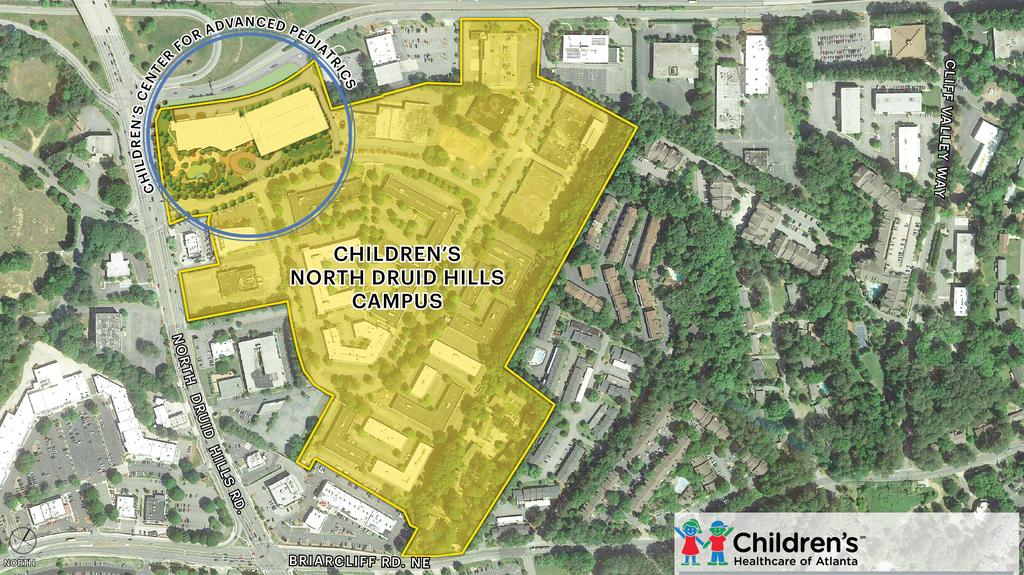
3. To meet growing demand, Children’s Healthcare of Atlanta announced plans for its new hospital in November 2017. The proposal includes an advanced pediatrics center, support buildings, over 20 acres of green space, walking trails, a central energy plant, parking decks and funding for nearby road improvements.
Doctors in Oakland are revolting against the much-hyped partnership that combined UCSF Benioff Children’s Hospital and Children’s Hospital Oakland, saying the four-year-old deal is turning the world-renowned East Bay hospital into a second-class facility to its San Francisco sibling.
Doctors are fleeing the East Bay hospital, claiming UCSF has prioritized San Francisco, locating most of its specialists and leadership atits new Mission Bay campus over the Oakland facility.
Fewer kids are being hospitalized in Oakland, down about 11 percent since the 2014 merger, according to doctors. Currently, no new patients can get routine psychiatric appointments or can see a lung specialist in Oakland, a community with the highest rate of asthma in Alameda County, the doctors say.
The doctors say a new 89,000-square-foot outpatient clinic opening this month predated the affiliation and hides the problems.“There’s a lot of anger. The anger is palpable,” said Dr. Stephen Long, a pediatric anesthesiologist who has worked at the Oakland hospital for four years and has represented his colleagues in communication with UCSF executives. “At the time (of the affiliation), it was sold to us in a different way. We were told we’d be stronger not weaker. They sold it to us like a healthy marriage, but where it is now feels like a Cinderella adoption.”
Hospital officials dispute the claim saying the Oakland facility is a valued partner and the deal has improved the care and finances.
“There’s a strong commitment in the entire organization to keep a strong presence in the East Bay,” said David Durand, Oakland’s chief medical officer. “We’ve been here for 100 years and we anticipate being here another 100 years.”
Durand said hospital care is shifting to outpatient care rather than treating people inside a hospital, and the Oakland facility saw a 12 percent increase in outpatient care from two years ago, treating about 220,000 kids last year and sending them home.
The new outpatient clinic will increase capacity to 99 exam and treatment rooms, he said, adding that surgical services in the East Bay increased 7 percent over the last two years.
“If UCSF truly values outpatient care, then why are there no (lung specialist) or psychiatry appointments?” Long said, speaking of two departments that have been integrated, others are in the works. “Why has it become so difficult to retain doctors in Oakland or recruit new ones to serve our community?”
Durand said there’s a national shortage in pediatric lung specialists and far fewer mental health providers than patients need in any community. The hospital has about 60 mental health providers, and last year Oakland handled about 60,000 outpatient mental health visits, he said, but there’s always more need.
He added that the Oakland doctor uprising may also be tied to contract negotiations.
Kristof Stremikis, director of market analysis and insight for the California Health Care Foundation, said the UCSF integration is not unique.
“It’s something happening not only across Northern California, but across the state and country,” he said.
Stremikis said the consolidation can create more efficiency and allow the joint venture to command a market and leverage that into higher prices.
The long simmering unrest reached a head on March 6 when Oakland doctors sent a letter, signed by 120 physicians, to UCSF Chancellor Sam Hawgood, addressing their concerns.
The doctors declared “no confidence” in the integration plan and expressed concerns the changes would increase a “health disparity.”
UC
Hawgood wrote back, saying change can be “difficult,” but that the Oakland hospital plans to improve its finances, the facility and the care to the area’s most needy children.
“Our combined mission of service to all children is not — and will not — be compromised,” Hawgood wrote.
Juan Luis Chavez was frustrated that his 2-year-old son Juan Pablo needed an emergency to get required surgery for his lung condition because he had to wait four months to see a lung specialist in Oakland.
The boy, diagnosed with a lung disease called bronchopulmonary dysplasia, was scheduled for surgery in March to close a hole that had developed between his stomach and his skin, but his surgery was canceled when there were no available appointments, his father said.
“We were concerned,” Chavez said. “We had planned for it for quite awhile … when he leaked it was messing up his skin pretty badly.”
Meanwhile, continued meetings between UCSF management and Oakland doctors have not assuaged concerns.
Dr. Julie Saba, a senior cancer scientist at the Research Institute, said the research arm of the Oakland facility has suffered “catastrophically” since the transition. She said so many researchers have left that there is a 30 percent occupancy in available research space, which has led to a major funding drop.
“It has devastated our ranks,” she said. “Our scientific environment is at a catastrophic level.”
She’s worried with insured patients funneled to San Francisco and poorer patients seen at Oakland, the East Bay facility will suffer financially, which will impact the type of care those kids get in Oakland.
“I don’t want to put any intention behind it, all I know is without a significant change with the current plans, this will end up being a second class hospital with poor physician retention and no paying patients,” Saba said. “Like something out of the 1950s.”
Children’s Healthcare of Atlanta is planning a $1 billion project to replace its Henrietta Egleston Hospital for Children with a larger medical campus in North Druid Hills, according to The Atlanta Journal-Constitution.
The proposal includes a 446-bed hospital, an advanced pediatrics center, support buildings, over 20 acres of green space, walking trails, a central energy plant, parking decks and funding for nearby road improvements.
The plan for the hospital, which will be constructed as two patient towers, also includes an attached medical office building and cancer and blood disorders center. Public hearings on the development will be held in December.
Under the proposal, the system’s Egleston location will shift inpatient operations to the new North Druid Hills campus in 2025. The hospital aims to begin construction by 2020 and finish by 2026.
“We intend to be a catalyst for long-awaited transportation and infrastructure improvements along this corridor,” said Donna Hyland, CEO of Children’s Healthcare of Atlanta.
Hospitals are bracing for an increase in unpaid medical bills and related uncompensated care after the Republican-led Congress let funding for the Children’s Health Insurance Program lapse.
Congressional committees this week are working on language to renew the CHIP program after federal funding expired Saturday, Sept. 30, leaving coverage of 9 million children in doubt. What was thought to be a done deal with bipartisan agreement a month ago that CHIP would be renewed for five years has lately become bogged down in Congressional gridlock and charges of ineptitude against Republicans and the Trump White House.
U.S. Speaker of the House Rep. Paul Ryan (R-WI) (L) speaks as Senate Majority Leader Sen. Mitch McConnell (R-KY) (3rd L), Sen. Ted Cruz (R-TX) (2nd L) and Sen. Pat Toomey (R-PA) (R) listen during a press event on tax reform September 27, 2017 at the Capitol in Washington, DC. (Photo by Alex Wong/Getty Images)
“States will not have access to additional funds and either will have to scramble to find money to pay for the health care costs for some of the most vulnerable patients or hospitals likely will experience a surge in uncompensated care,” Mizuho Securities USAresearch director Sheryl Skolnick said in a report Wednesday. “The need to reauthorize CHIP was well-known and the failure seems symptomatic of the larger issue of a dysfunctional political process.”
Some states could begin to run out of money to cover children over the next three months, triggering an uptick in medical bills that could lead to layoffs and a freeze on capital spending.
Hospitals generally account for CHIP funds in their Medicaid revenues, which can be 10% and 20% of some facility revenues. For-profit hospital operators like Tenet Healthcare, HCA Holdings and Community Health Systems, though, have less than 10% of their operations funded by Medicaid, Mizuho’s report this week shows.
Since the Affordable Care Act expanded coverage to more than 20 million Americans, hospital charity care and related uncompensated care expenses that include bad debt have dropped significantly.
But a loss in money from millions of children covered by CHIP would reverse the uncompensated care trend and certainly hit hospitals hard.
The healthcare industry was still hopeful momentum would return in Congress and CHIP funding would be renewed before providers and their patients would be harmed.
“Given CHIP’s immensely positive impact on children’s health, MHPA is very gratified that the House language released on Monday, October 2 extends the CHIP funding for another five years,” Medicaid Health Plans of America said in a letter to Congress. “We also appreciate that the language acknowledges any changes to funding must be made carefully and over time by gradually reducing the temporary 23 percent increase to 11.5 percent in October 2019, before allowing the program to resume the regular CHIP funding in October 2020. MHPA also appreciates that the funding, once extended, will be retroactive thus ensuring states’ current budgets will not be negatively affected.”
MHPA members include Aetna, Centene, Cigna and UnitedHealth Group.
There is still hope that Congress will approve a reauthorization quickly, but state leaders are concerned if Congress doesn’t act soon they will run out of money for the program, which is mostly paid for with federal funds. House and Senate lawmakers have said they will pursue CHIP legislation this week.
The Medicaid and CHIP Payment and Access Commission (MACPAC) estimated that if CHIP isn’t reauthorized three states and the District of Columbia will run out of program funding by the end of the year and another 27 states will run dry in the first quarter of 2018.
Dive Insight:
MACPAC warned that stopping CHIP funding will impact state budgets and force states to decide whether to continue coverage on their own dime. If states limit or stop CHIP coverage, hospitals and providers could feel the brunt of fewer insured children and more bad debt. This is especially true for children’s hospitals.
Jim Kaufman, vice president of public policy at Children’s Hospital Association (CHA), recently told Healthcare Dive that CHIP is important for children’s hospitals. “CHIP is good for kids, and that makes it good for children’s hospitals and children’s providers,” Kaufman said.
Not reauthorizing CHIP quickly could especially be an issue for the three states (Arizona, Minnesota and North Carolina) and the District of Columbia, which are expected to run out of CHIP money by the end of the year.
There was hope last month that Congress might be able to reauthorize the program in time. A bipartisan group of senator agreed on a reauthorization bill in September that would have extended CHIP for another five years. However, momentum for that bill stalled when Capitol Hill turned its attention to the Graham-Cassidy ACA repeal legislation. Graham-Cassidy died without a floor vote, and Congress didn’t take up CHIP reauthorization before the deadline.
CHIP, which costs about $14 billion annually, was created in 1997 as a way to provide more health insurance coverage to children of families with low and moderate incomes. The federal government sends CHIP money to states annually, based on previous spending of the funds and populations factors. The states must spend the federal money within two years. Money that isn’t used goes back to the federal government to reallocate to states with CHIP funding shortfalls.
Congress has reauthorized the program periodically since its creation. CHIP has wide support and studies have shown the program helps reduce hospitalizations and child mortality and increase quality of care. When the program was created, 15% of children were uninsured. That number is now about 5% because of CHIP, the Affordable Care Act and Medicaid expansion.
Phoenix Children’s collaborative approach to value-based care relies on community input, big data analytics, and a physician-driven quality measurement program.
Mergers, acquisitions, and new partnerships can be a scary prospect for healthcare organizations, no matter which side of the negotiating table they are occupying.
In addition to potential cultural changes, staffing adjustments, and new workflows to adopt, organizations joining forces in the era of value-based care often have to adopt to new electronic health record systems and accept different strategies for measuring their quality, productivity, and outcomes.
While a successful union can rescue revenue cycles, and bring renewed vitality to flagging providers, healthcare organizations must carefully navigate the delicate acquisition process to ensure that new members of the team have the skills and tools required to reach their full potential.
At Phoenix Children’s, one of the largest pediatric health systems in the country, a desire to offer comprehensive care to the community has led to a firm reliance on big data analytics to gather actionable financial and clinical insights from a rapidly growing provider network.
Over the last three years, Phoenix Children’s has brought more than 100 independent practices into the fold, says Chad Johnson, Senior Vice President and Executive Director of the Phoenix Children’s Care Network – and full data transparency is a fundamental requirement for each and every new member of the team.
The ability to use big data analytics to measure productivity, quality, and financial success within a comprehensive network of care will be vital for Phoenix Children’s as it continues an ambitious move into value-based reimbursements.
“During 2017, we’re moving around 100,000 lives into fully risk-based models,” Johnson explained to HealthITAnalytics.com. “We’re doing this because we believe that the way to truly influence outcomes is to own the medical management of our populations. Hospitals will need to have a much larger footprint – a larger, integrated network – that includes independent primary care and specialty groups under one umbrella.”
“We want to move aggressively down this path because we feel that unless you’re willing to take that step, you’re never going to be able to really bend that cost curve,” he added. “We’re confident that we can step up to the plate and succeed in a risk-based environment with the strategies we’re cultivating.”
Number one on the list of challenges as the health network shoulders more financial risk is how to accurately and consistently measure quality across so many disparate locations and provider types.
“We’ve had to integrate data from these practices, which are all using a variety of EHRs, and then figure out how to consume that data and present it so that it can be used for optimizing care and to verify quality improvements across the network,” Johnson said.
“We use this data to target interventions, and to improve the management of our populations, our performance on quality metrics, our utilization, and total cost of care. That data becomes the number one essential driver of many of the decisions that we’re going to make within our pediatric health enterprise.”
More than doubling its current size, the expanded children’s hospital will transform the patient experience through family-centered design and technological innovation, while setting new standards for sustainability in hospital design
Palo Alto, Calif. – Nearly a decade in the making, Lucile Packard Children’s Hospital Stanford announces its countdown to the debut of its new pediatric and obstetric hospital campus, slated to open in December 2017. With a mission to lead the way in family-centered care, the Packard Children’s expansion will more than double the size of the existing campus by linking the original hospital with a new main building, bringing the total hospital space to measure 844,000 square feet.
“This will be the nation’s most technologically advanced, environmentally sustainable and family-friendly hospital for children and expectant mothers,” said Christopher G. Dawes, chief executive officer. The top-ranked children’s hospital in Northern California is at the center of the Stanford Children’s Health enterprise, which is the largest in the Bay Area exclusively dedicated to pediatric and obstetric care.
The new, 521,000 square foot facility and surrounding 3.5 acres of healing green space and gardens were designed in partnership with patients, families, and every level of hospital staff and faculty to ensure all areas of need were accounted for.
“When my mother founded this hospital, she envisioned a place where children and families could receive truly healing care,” said Susan Packard Orr. “She saw the power that nature had to heal and uplift. I’m proud that we have carried her vision forward, with world-class sustainability and holistic elements throughout the new hospital. Everything we do at this hospital will have an eye to ensuring that generations to come will be healthier.”
By initiating partnerships to build 11 pediatric specialty centers throughout the Bay Area, Stanford Children’s has not only protected its turf, but it has helped community hospitals and families keep more cases local.






 HENRY KOTULA