KFF Health Tracking Poll – January 2019: The Public On Next Steps For The ACA And Proposals To Expand Coverage

KFF Health Tracking Poll – January 2019: The Public On Next Steps For The ACA And Proposals To Expand Coverage

Key Findings:

  • Half of the public disapproves of the recent decision in Texas v. United States, in which a federal judge ruled that the 2010 Affordable Care Act (ACA) is unconstitutional and should not be in effect. While the judge’s ruling is broader than eliminating the ACA’s protections for people with pre-existing conditions, this particular issue continues to resonate with the public. Continuing the ACA’s protections for people with pre-existing conditions ranks among the public’s top health care priorities for the new Congress, along with lowering prescription drug costs.
  • This month’s KFF Health Tracking Poll continues to find majority support (driven by Democrats and independents) for the federal government doing more to help provide health insurance for more Americans. One way for lawmakers to expand coverage is by broadening the role of public programs. Nearly six in ten (56 percent) favor a national Medicare-for-all plan, but overall net favorability towards such a plan ranges as high as +45 and as low as -44 after people hear common arguments about this proposal.

    Poll: Majorities favor a range of proposed options to expand public health coverage, including Medicare buy-in and #MedicareForAll 

  • Larger majorities of the public favor more incremental changes to the health care system such as a Medicare buy-in plan for adults between the ages of 50 and 64 (77 percent), a Medicaid buy-in plan for individuals who don’t receive health coverage through their employer (75 percent), and an optional program similar to Medicare for those who want it (74 percent). Both the Medicare buy-in plan and Medicaid buy-in plan also garner majority support from Republicans (69 percent and 64 percent­).


Figure 1: Most Americans Are Unaware Of Federal Judge’s Ruling That ACA Is No Longer Valid

Texas v. United States: The Future of the Affordable Care Act

On December 14, 2018, a federal district court judge in Texas issued a ruling challenging the future of the 2010 Affordable Care Act (ACA).The judge sided with Republican state attorneys general and ruled that, since the 2017 tax bill passed by Congress zeroed out the penalty for not having health insurance, the ACA is invalid. Democrat attorneys general have already taken actions to appeal the judge’s ruling in the case and, due to the government shutdown, the 5th Circuit Court of Appeals has paused the case. Currently, the ACA remains the law of the land. If this ruling is upheld, the consequences will be far-reaching.1 Less than half of the public (44 percent) are aware of the judge’s ruling that the ACA is unconstitutional and most (55 percent) either incorrectly say that the judge ruled in favor of the ACA (20 percent) or are unsure (35 percent).

Overall, a larger share of the public disapprove (51 percent) than approve (41 percent) of the judge’s ruling that the ACA is not constitutional. This is largely divided by party identification with a majority of Republicans (81 percent) approving of the decision while a majority of Democrats disapproving (84 percent). Independents are closely divided (49 percent disapprove v. 44 percent approve).

Figure 2: Partisans Divided On Whether They Approve Or Disapprove Of Federal Judge’s Ruling That The ACA Is No Longer Valid

The Trump administration had originally announced that as part of Texas v. United States, it would no longer defend the ACA’s protections for people with pre-existing medical conditions. While the judge’s ruling was broader than just the ACA’s pre-existing condition protections, KFF polling finds attitudes can shift when the public hears that these protections may no longer exist. Among those who originally approve of the federal judge’s ruling, about three in ten (13 percent of the public overall) change their mind after hearing that this means that people with pre-existing conditions may have to pay more for coverage or could be denied coverage, bringing the share who disapprove of the judge’s ruling to nearly two-thirds (64 percent) of the public.2

Fewer – but still about one-fifth (8 percent of total) – change their minds after hearing that as a result of this decision, young adults would no longer be able to stay on their parents’ insurance until the age of 26, bringing the total share who disapprove of the judge’s ruling to 60 percent.

Figure 3: Majorities Disapprove Of Judge’s Ruling After Hearing How It Impacts Protections For Pre-Existing Conditions And Young Adults

Overall, a slight majority of the public hold a favorable view of the ACA (51 percent) while four in ten continue to hold unfavorable views. (INTERACTIVE)

Public’s Views of Democratic Health Care Agenda

With the new Democratic majority in the U.S. House of Representatives, this month’s KFF Health Tracking Poll examines the public’s view of Congressional health care priorities including a national health plan.

Proposals to Expand Health Care Coverage

Most of the public favor the federal government doing more to help provide health insurance for more Americans and one way for lawmakers to expand coverage is by broadening the role of public programs, such as Medicare or Medicaid. The Kaiser Family Foundation has been tracking public opinion on the idea of a national health plan since 1998 (see slideshow). More than twenty years ago, about four in ten Americans (42 percent) favored a national health plan in which all Americans would get their insurance from a single government plan. In the decades that followed, there has been a modest increase in support – especially since the 2016 presidential election and Bernie Sanders’ rallying cry for “Medicare-for-all.” The most recent KFF Health Tracking Poll finds 56 percent of the public favor “a national health plan, sometimes called Medicare-for-all, where all Americans would get their insurance from a single government plan” with four in ten (42 percent) opposing such a plan.

Figure 5: Majorities Across Partisans Favor Medicare Buy-In And Medicaid Buy-In

MALLEABILITY IN ATTITUDES TOWARDS NATIONAL HEALTH PLAN AND LINGERING CONFUSION ABOUT POSSIBLE IMPACTS

This month’s KFF Health Tracking Poll finds the net favorability of attitudes towards a national Medicare-for-all plan can swing significantly, depending on what arguments the public hears.

Depending on what arguments people hear, the public’s views of #MedicareForAll can swing from 71% in favor to 70% opposed highlighting the importance of any future legislative debate 

Net favorability towards a national Medicare-for-all plan (measured as the share in favor minus the share opposed) starts at +14 percentage points and ranges as high as +45 percentage points when people hear the argument that this type of plan would guarantee health insurance as a right for all Americans. Net favorability is also high (+37 percentage points) when people hear that this type of plan would eliminate all premiums and reduce out-of-pocket costs. Yet, on the other side of the debate, net favorability drops as low as -44 percentage points when people hear the argument that this would lead to delays in some people getting some medical tests and treatments. Net favorability is also negative if people hear it would threaten the current Medicare program (-28 percentage points), require most Americans to pay more in taxes (-23 percentage points), or eliminate private health insurance companies (-21 percentage points).

Figure 8: Four In Ten Say Medicare-For-All Plan Would Not Have Much Impact On People Like Them

MEDICARE-FOR-ALL AND SENIORS

On October 10th, 2018, President Trump wrote an op-ed in USA Today arguing that a Medicare-for-all plan would “end Medicare as we know it and take away benefits they have paid for their entire lives.”3 One-fourth of adults 65 and older (26 percent) say seniors who currently get their insurance through Medicare would be “worse off” if a national Medicare-for-all plan was put into place. Four in ten Republicans, ages 65 and older, say seniors who currently get health coverage through Medicare would be “worse off” under a national Medicare-for-all plan. Overall, a larger share of the public say a Medicare-for-all plan will “not have much impact” on seniors (39 percent) or say that they would be “better off” (33 percent) than say seniors would be “worse off” (21 percent).

Figure 10: Democrats Want House Democrats To Focus On Improving And Protecting The ACA Rather Than Passing Medicare-For-All

PARTISANS HAVE DIFFERENT HEALTH PRIORITIES FOR CONGRESS, EXCEPT FOR PRESCRIPTION DRUG PRICES

A majority of the public say it is either “extremely important” or “very important” that Congress work on lowering prescription drug costs for as many Americans as possible (82 percent), making sure the ACA’s protections for people with pre-existing health conditions continue (73 percent), and protecting people with health insurance from surprise high out-of-network medical bills (70 percent). Fewer – about four in ten – say repealing and replacing the ACA (43 percent) and implementing a national Medicare-for-all plan (40 percent) are an “extremely important” or “very important” priority. When forced to choose the top Congressional health care priorities, the public chooses continuing the ACA’s pre-existing condition protections (21 percent) and lowering prescription drug cost (20 percent) as the most important priorities for Congress to work on. Smaller shares choose implementing a national Medicare-for-all plan (11 percent), repealing and replacing the ACA (11 percent), or protecting people from surprise medical bills (9 percent) as a top priority. One-fourth said none of these health care issues was their top priority for Congress to work on.

Figure 11: Continuing ACA Pre-Existing Conditions Protections And Prescription Drug Costs Top Public’s Priorities For Congress

Continuing the ACA’s pre-existing condition protections is the top priority for Democrats (31 percent) and ranks among the top priorities for independents (24 percent) along with lowering prescription drug costs, but ranks lower among Republicans (11 percent). Similar to previous KFF Tracking Polls, repealing and replacing the ACA remains one of the top priority for Republicans (27 percent) along with prescription drug costs (20 percent).

Table 1: Pre-Existing Condition Protections and Prescription Drug Costs Top Public’s Health Care Priorities for Congress; Republicans Still Focused on ACA Repeal
Percent who say the following is the top priority for Congress to work on: Total Democrats Independents Republicans
Making sure the ACA’s pre-existing condition protections continue 21% 31% 24% 11%
Lowering prescription drug costs for as many Americans as possible 20 20 20 20
Implementing a national Medicare-for-all plan 11 20 8 3
Repealing and replacing the ACA 11 3 7 27
Protecting people from surprise high out-of-network medical bills 9 4 10 8
Note: If more than one priority was chosen as “extremely important,” respondent was forced to choose which priority was the “most important.”

The Role of Independents in the Democratic Health Care Debate

One of the major narratives coming out of the 2018 midterm elections was the role that health care was playing in giving Democratic candidates the advantage in close Congressional races. Consistently throughout the election cycle, KFF polling found health care as the top campaign issue for both Democratic and independent voters. While a majority of Democrats want the new Democratic majority in the U.S. House of Representatives to focus on improving and protecting the ACA, Democratic-leaning independents have more divided opinions of the future of 2010 health care law. These individuals – who tend to be younger and male – would rather Democrats in Congress focus efforts on passing a national Medicare-for-all plan (54 percent) than improving the ACA (39 percent) – which is counter to what Democrats overall report. In addition, when asked whether House Democrats owe it to their voters to begin debating proposals aimed at passing a national health plan or work on health care legislation that can be passed with a divided Congress and a Republican President, Democrats are divided (49 percent v. 44 percent) while Democratic-leaning independents prioritize House Democrats working on bipartisan health care legislation (53 percent) over debating national health plan proposals (39 percent).


Federal Shutdown Has Meant Steep Health Bills For Some Families

https://www.npr.org/sections/health-shots/2019/01/18/686003135/federal-shutdown-has-meant-steep-health-bills-for-some-families

Joseph Daskalakis’ son Oliver was born on New Year’s Eve, a little over a week into the current government shutdown, and about 10 weeks before he was expected.

The prematurely born baby ended up in a specialized neonatal intensive care unit, the only one near the family’s home in Lakeville, Minn., that could care for him.

But Daskalakis, who works as an air traffic controller outside Minneapolis, has an additional worry: The hospital where his newborn son is being treated is not part of his current insurer’s network and the partial government shutdown prevents Daskalakis from filing the paperwork necessary to switch insurers, as he would otherwise be allowed to do.

As a result, he could be on the hook for a hefty bill — all the while not receiving pay. Daskalakis is just one example of federal employees for whom being unable to make changes to their health plans really matters.

Although the estimated 800,000 government workers affected by the shutdown won’t lose their health insurance, an unknown number are in limbo like Daskalakis — unable to add family members such as spouses, newborns or adopted children to an existing health plan; unable to change insurers because of unforeseen circumstances; or unable deal with other issues that might arise.

“With 800,000 employees out there, I imagine that this is not a one-off event,” says Dan Blair, who served as both acting director and deputy director of the federal Office of Personnel Management during the early 2000s and is now senior counselor at the Bipartisan Policy Center. “The longer this goes on, the more we will see these types of occurrences.”

While little Oliver Daskalakis is getting stronger every day — he’s now out of the ICU, according to his father’s local air traffic union representative — it’s unclear how the situation will affect his family’s finances.

That’s because out-of-network charges are generally far higher than being in-network, and NICU care is enormously expensive,no matter what. Those bills could add up, especially as the family’s current insurance plan has an out-of-pocket maximum of $12,000 annually. Because Oliver was born before the new year, the family could face that amount twice — for 2018 and for 2019.

And Daskalakis still isn’t getting paid.

“I don’t know when I’ll be able to change my insurance, or when I’ll get paid again,” Daskalakis wrote to Sen. Tina Smith, D-Minn., who shared the letter on Facebook and before her Senate colleagues last week.

Other families are also worried about paperwork delays, and the financial and medical effects a prolonged shutdown could cause.

Dania Palanker, a health policy researcher at Georgetown’s Center on Health Insurance Reforms, studies what happens when families face insurance difficulties. Now she’s also living it.

After arranging to reduce her work hours because of health problems, Palanker knew her family would not qualify for coverage through her university job. No problem, she thought, as she began the process in December of enrolling her family in coverage offered by her husband’s job with the federal government.

But there was a hitch.

We could not get the paperwork in time to apply for special enrollment through the government and get it processed before the shutdown,” Palanker says.

Georgetown allowed her to boost her work hours this month to keep the family insured through January, but Georgetown’s share of her coverage will end in February.

Palanker’s treatments are expensive, so she is likely to hit or exceed her annual $2,000 deductible in January — then start over with another annual deductible once the family secures new health coverage.

“I’m postponing treatment in hopes that it is just a month and I’m back on the federal plan in February,” says Palanker, who has an autoimmune disease that causes nerve damage. “But I can’t postpone indefinitely, as my condition will get worse.”

Overseeing federal health benefits programs is within the purview of the Office of Personnel Management, whose data hub is operational, according to a spokeswoman. But getting information to that data hub to make the kind of changes Daskalakis, Palanker and others need depends on the individual agencies that employ government workers.

The OPM has told government agencies “that they should have [human resources] staff available during the lapse, specifically to process” such requests, which are called “qualifying life events,” the spokeswoman says.

Workers enrolled in plans under the Blue Cross Blue Shield Association, which covers about 5 million federal workers and retirees in the Federal Employees Health Benefits Program, can make qualifying life event changes directly with the insurer if they can’t get it processed by their workplace, an association spokesman said Friday.

In a written statement Wednesday, Smith said: “Oliver’s story is a powerful reminder that hundreds of thousands of real families have had their financial and personal lives turned upside down by this unnecessary shutdown.” The Minnesota senator called onthe president to come back to the negotiating table.

For Daskalakis, there’s been some recent good news.

His union representative, Tony Walsh, says both the OPM website and Daskalakis’ insurer now indicate that the family’s request to change to an insurance plan that classifies the hospital as “in-network” will be retroactive to Oliver’s birthday — so the out-of-network charges may not play a role.

Just to be safe, “Joe is currently working on an insurance appeal based on no in-network care [being available],” Walsh reports in an emailed statement.

Still, the family has already received an initial $6,000 bill from the hospital, Walsh notes. He says that $6,000 does not include costs associated with Oliver’s birth or his stay in the intensive care unit — those charges likely are still to come.

Walsh says the shutdown is affecting a broad swath of employees in ways many lawmakers never anticipated.

The workers “are essential to the system,” he says, “and it’s unfair they are being treated this way.”


State Efforts to Protect Consumers from Balance Billing

https://www.commonwealthfund.org/blog/2019/state-efforts-protect-consumers-balance-billing?omnicid=EALERT1547609&mid=henrykotula@yahoo.com

Image result for balance billing

Health insurance rates for working-age Americans have improved over the past decade. But not everyone with health insurance today has adequate financial protection. About one-fourth of insured Americans are underinsured because they have significant coverage gaps or high out-of-pocket costs. And all consumers are vulnerable to surprise medical bills, or balance bills for out-of-network care. These balance bills arise when insurance covers out-of-network care, but the provider bills the consumer for amounts beyond what the insurer pays and beyond cost-sharing, as well as in situations where out-of-network care is not normally covered but the selection of provider is outside the consumer’s control.

Consumers are most likely to receive surprise medical bills from health providers outside their insurance plan’s network after receiving emergency care or medical procedures at in-network facilities. In the latter cases, for example, consumers may select a surgeon and facility in network, but discover that other providers, such as an anesthesiologist or surgical assistant, are out of network. These unexpected medical bills are a major concern for Americans, with two-thirds saying they are “very worried” or “somewhat worried” that they or a family member will receive a surprise bill. In fact, these bills are the most-cited concern related to health care costs and other household expenses.

While employers and insurers may voluntarily protect employees or enrollees from some types of balance billing, no federal law regulates charges submitted by out-of-network providers. States can help protect enrollees from unexpected balance bills. However, state protections are limited by federal law (ERISA), which exempts self-insured employer-sponsored plans, covering 61 percent of privately insured employees, from state regulation.

Despite Recent State Activity, Consumers in Most States Are Not Protected from Balance Billing

We conducted a study, published in June 2017, that found that 21 states had laws offering consumers at least some protections in a balance billing situation. But only six of those states — California, Connecticut, Florida, Illinois, Maryland, and New York — had laws meeting our standard for “comprehensive” protections.

Critical elements of state laws that offer “comprehensive” protections against balance billing:

  • Extend protections to both emergency department and in-network hospital settings
  • Apply laws to all types of insurance, including both HMOs and PPOs
  • Protect consumers both by holding them harmless from extra provider charges — meaning they are not responsible for the charges — and prohibiting providers from balance billing, and
  • Adopt an adequate payment standard — a rule to determine how much the insurer pays the provider — or a dispute-resolution process to resolve payment disputes between providers and insurers.

In 2017 and 2018, states continued taking steps to protect consumers. Four states — Arizona, Maine, Minnesota, and Oregon — created balance-billing consumer protections for the first time, and two states — New Hampshire and New Jersey — substantially expanded existing protections. We now classify New Hampshire, New Jersey, and Oregon as states offering comprehensive protections against balance billing. As of December 2018, 25 states have laws offering some balance-billing protection to their residents, and nine of them offer comprehensive protections.

New Jersey has met our criteria for comprehensive protection by creating a strong dispute-resolution process to establish a payment amount for the out-of-network service. Other states have recently acted to protect consumers from balance billing in a more limited way that does not meet our criteria. For example, Missouri’s protections against balance billing apply only if the provider and insurer voluntarily agree to participate in the process.

Interest in a Federal Solution to Balance Billing

At the same time, interest has grown in federal measures, in part, because only federal legislation can protect those in self-funded insurance plans that are exempt from state regulation. During the 115th Congress, proposals were released by Senator Bill Cassidy (R–La.)Senator Maggie Hassan (D–N.H.)Representative Lloyd Doggett (D–Texas), and Representative Michelle Lujan Grisham (D–N.M.). The Cassidy proposal has bipartisan support, with three Democrats and two other Republicans as cosponsors.

Federal approaches vary along some of the same lines as state laws. For example, the Hassan bill relies most heavily on a dispute-resolution approach. By contrast, the Cassidy proposal relies on a payment standard that is the greater of a) the median in-network rate paid by the insurer or b) 125 percent of the average allowed amount across payers. Several federal proposals make protections contingent on failure of providers to notify the consumer that they could be billed by an out-of-network provider. States that have enacted protections have mostly viewed such contingent protections as an insufficient means of protecting consumers. Federal proposals also vary in the degree to which they allow a state role in implementing protections.

Some federal proposals, like some state laws, have potential gaps. For example, some address balance bills only from hospital-based physicians such as anesthesiologists and radiologists. Also, state laws and federal proposals mostly do not address ground or air emergency transport providers.

Looking Forward

The bipartisan interest in the surprise billing issue offers the potential for federal action in the new Congress. States are frustrated by their inability to address all insurance plans. And states without laws have often faced opposition from stakeholder groups, even when there is a consensus around protecting consumers. A federal solution could offer a more comprehensive approach, while giving states appropriate flexibility to seek an approach fitting their particular market environments.


ACA lawsuit puts GOP in an awkward position

https://www.axios.com/affordable-care-act-lawsuit-republicans-2c0aff0e-e870-49af-a15e-554d34d3ad62.html

Image result for aca lawsuit

A lawsuit that threatens to kill the entire Affordable Care Act could be a political disaster for the GOP, but most Republicans aren’t trying to stop it — and some openly want it to succeed.

Between the lines: The GOP just lost the House to Democrats who campaigned heavily on health care, particularly protecting people with pre-existing conditions, but the party’s base still isn’t ready to accept the ACA as the law of the land.

The big picture: A district judge ruled last month that the ACA’s individual mandate is unconstitutional and that the whole law must fall along with it. That decision is being appealed.

  • A victory for the Republican attorneys general who filed the lawsuit — or for the Trump administration’s position — would likely cause millions of people with pre-existing conditions to lose their coverage or see their costs skyrocket.

Some Republicans want the lawsuit to go away.

  • Rep. Greg Walden, ranking member of the Energy and Commerce Committee, supports fully repealing the ACA’s individual mandate, which the 2017 tax law nullified. That’s what sparked this lawsuit, and formal repeal would likely put the legal challenge to rest.
  • Sen. Susan Collins laughed when I asked her whether she hopes the plaintiffs win the case. “No. What a question,” she said.

But other Republicans say they see an opportunity.

  • If the lawsuit prevails, “it means that we could rebuild and make sure that we have a health care system that is going to ensure that individuals are in charge of their health care,” Rep. Cathy McMorris Rodgers said.
  • Sen. David Perdue said that “of course” he wants the challengers to win, which would “give us an opportunity to get at the real problem, and that is the cost side of health care.”
  • Sen. Shelley Moore Capito said she views the lawsuit “as an opportunity for us to assure pre-existing conditions and make sure that we fix some of the broken problems,” but that she doesn’t know if it’d be good if the plaintiffs win.

The bottom line: “The longer we’re talking about preexisting conditions, the longer we’re losing. We need to focus on a message that can win us voters in 2020. The debate of preexisting conditions was a stone-cold loser for us in 2018,” said Matt Gorman, the communications director for House Republicans’ campaign arm during the 2018 cycle.


Industry Voices—Beyond benefit design, provider billing policies hit families hardest

https://www.fiercehealthcare.com/payer/industry-voices-beyond-benefit-design-it-s-provider-billing-hits-families-hardest?mkt_tok=eyJpIjoiWWpZNU4yTTROREExWlRsaSIsInQiOiJjZHh5VGpsWnhSN3RLQjNHbDNsWUROQkg0Y2EzOFZ3OFY2Z0Z1a1dFNVhwNkRXNTE3dTNMK0U2TloxUnFKT1RDU29cL3NEZ0gwMTdJbUptaTFxamFTbFg1cG1PbFRHbTQ2TmQzRHhYZERqcUZXQ1B0YVF1aW1QODBDb2g3aHA1cEwifQ%3D%3D&mrkid=959610&utm_medium=nl&utm_source=internal

What happens when record increases in health insurance premiums and deductibles put too much stress on patients’ pocketbooks? They delay needed care out of fear they’ll be unable to shoulder an unexpected medical expense for themselves or their families.

Now more than ever, patients worry about their ability to cover out-of-pocket healthcare costs, a recent Commonwealth Fund survey shows. The percentage of patients who believe they could afford the care they need is falling, and many say satisfying their financial obligations for care has become more difficult.

But these data only tell part of the story. Our own research shows that while 68% of patients want to discuss financing options that could ease their minds about mounting healthcare expenses, providers are falling short—and families, especially, are feeling the pinch.

Feeling the pinch

According to our survey, 27% of households with children are likely to delay care because they can’t afford to pay for it. Families are also less likely to pay their out-of-pocket costs for care in full—and their chances of having their account sent to collections are twice as high.

It’s not that families and individuals don’t want to cover their out-of-pocket costs. In fact, half of the patients surveyed were willing to select providers based on the availability of financing plans that stretch out their obligation into more manageable monthly payments. The trouble is, providers have been slow to adopt flexible payment plans. They are even slower to discuss financing options with patients or publicize them more broadly.

It’s time for a new approach to patient billing—one that takes into account patients’ desire to fulfill their financial obligations for care, addresses their concerns from the point of service, and demonstrates a willingness to meet them where they are.

The experience of one new mother in Florida illustrates the gains hospitals can make when they take a compassionate approach to patient collections. As she prepared to give birth to her daughter, she found herself facing a financial dilemma. The hospital required her to “reserve” her spot in its labor and delivery unit—for a $1,000 deposit. With no money in reserve and a baby on the way, she feared she wouldn’t be able to deliver her baby at the hospital.

She asked hospital representatives whether the hospital might consider a payment plan instead of a lump-sum payment. To her relief, the hospital allowed her to extend the payment over 12 months—interest-free. It’s an option that relieved the stress of the financial burden of care during what should be a joyous time for her family.

Making a difference through flexible payments

Offsetting the impact of out-of-pocket medical costs for individuals and families doesn’t require an overhaul of a hospital’s patient financial services program. Instead, hospitals can take simple steps to help patients more easily fulfill their financial obligations for care—and reduce their costs to collect as well as bad debt in the process.

Consider offering a variety of options for payment, such as low-interest and no-interest loans that all patients qualify for, without the fear of credit reporting or negative consequences. Setting the program up so that patients have a choice and opt into the program significantly helps the patient experience. Discuss their estimated out-of-pocket expense with patients before or at the point of care, and share information on payment plans widely, both onsite and online. Lastly, a program that is consumer friendly with easy ways to pay their bills and manage their accounts will go a long way to increase patient satisfaction.

Taking a more proactive approach to affordability is not only the right thing to do for patients but also the smart choice in protecting an organization’s long-term financial health.


Older Americans worried about insurance coverage, health costs as they approach retirement

https://www.fiercehealthcare.com/payer/older-americans-worried-about-insurance-coverage-and-health-costs-as-they-approach-retirement?mkt_tok=eyJpIjoiTXpGak0yVmtNamN6TnpkaCIsInQiOiJtQnVtUmFtN0RYbHMzb2hyM1wvXC93N1kwRDJ6RmlNSjg5Q2VsYkFFSTJpZlptKzc2b1ByYTcrVzNxNUtcL3BwVWVIbzJBWThSWmY4ZXpHK1RBUWdWODhqdkxYMXZQRnJtNWV4TWc4aFJqVUdiXC9sWWh0MEdJK2NPckNzVDQ3ZlhoUEgifQ%3D%3D&mrkid=959610&utm_medium=nl&utm_source=internal

A sizable percentage of Americans between the ages of 50 and 64 are worried about their healthcare coverage as they head toward retirement, according to a new poll from the University of Michigan.

Although some of these concerns include things people can’t directly control, such as policy changes, many are focused on maintaining current coverage provided through an employer while reducing personal healthcare expenses.

“The ACA’s insurance coverage expansion was intended, in part, to reduce ‘job lock’ and allow individuals to change or leave their job without concern about becoming uninsured,” the report says. “However, data from this poll suggest that many adults age 50–64 still worry about maintaining employer-sponsored health insurance and keeping a job for that reason.”

About a quarter (27%) of respondents fear they won’t be able to afford their insurance over the next year, and nearly half (45%) expressed little to no confidence in being able to afford their insurance when they retire.

Meanwhile, 13% of those surveyed postponed medical care within the last year due to cost concerns. Another 15% postponed procedures until they could change their plan the following coverage year—so it would be covered, to incur lower out-of-pocket costs or to see a specific doctor in-network. Additionally, 8% of respondents between the ages of 60 and 64 reported delaying a procedure until they could get Medicare.

Nearly 1 in 5 (19%) said they were keeping a job, delaying retirement or considering delaying retirement to keep their employer-sponsored insurance. With that in mind, 71% of retirees were confident in their ability to afford insurance—a much higher percentage than those who were working (54%) or not working (49%).

Men were more confident than women that they could afford insurance at retirement (61% vs. 50%). Those in “excellent” health were more confident than those in “good” or “fair/poor” health (62% vs. 54% and 42%), as were those with a college degree compared to those without.

Nearly 8 in 10 respondents (79%) said they were very confident in their ability to navigate the health insurance landscape, though about 3 in 10 (29%) indicated little or no confidence that they could determine the out-of-pocket costs associated with a prospective service.

The study indicates Americans are closely watching and responding to challenges to the Affordable Care Act, such as a ruling by a federal judge in Texas striking down the law. Over the weekend, the judge issued a stay on the ruling, saying the healthcare law should remain in effect as appeals weave their way through the courts.

Half of those surveyed said they closely follow news about the ACA, Medicare or Medicaid, and 68% said they are worried about how their coverage may change due to federal policies.

“Regardless of potential federal policy changes, patients and their health care providers should discuss the out-of-pocket costs of health care, such as medical procedures, tests, or medications. Such discussions can help inform decisions about their health insurance options and the timing, choice, and appropriateness of health care services,” it concluded.


Short-Term Health Plans Hold Savings For Consumers, Profits For Brokers And Insurers

https://www.thelundreport.org/content/short-term-health-plans-hold-savings-consumers-profits-brokers-and-insurers?mc_cid=87537ae734&mc_eid=1d14ffb322

Sure, they’re less expensive for consumers, but short-term health policies have another side: They’re highly profitable for insurers and offer hefty sales commissions.

Driven by rising premiums for Affordable Care Act plans, interest in short-term insurance is growing, boosted by Trump administration actions to ease Obama-era restrictions and possibly make federal subsidies available to consumers to purchase them.

That’s good news for brokers, who often see commissions on such policies hit 20 percent or more.

On a policy costing $200 a month, for example, that could translate to a $40 payment each month. By contrast, ACA plan commissions, which are often flat dollar amounts rather than a percentage of premium, can range from zero to $20 per enrollee per month.

“Customers are paying less and I’m making more,” said Cindy Holtzman, a broker in Woodstock, Ga., who said she gets 20 percent on short-term plan commissions.

Large online brokers also are eagerly eyeing the market.

Ehealth, one such firm, will “continue to shift our focus to selling short-term plans and non-ACA insurance packages,” CEO Scott Flanders told investors in October. The firm saw an 18 percent annual jump in enrollment in short-term plans this year, he added.

Insurers, too, see strong profits from plans because they generally pay out very little toward medical care when compared with the more comprehensive ACA plans.

Still, some agents like Holtzman have mixed feelings about selling the plans, because they offer skimpier coverage than ACA insurance. One 58-year-old client of Holtzman’s wanted one, but he had health problems. She also learned his income qualified him for an ACA subsidy, which currently cannot be used to purchase short-term coverage.

“There’s no way I would have considered a short-term plan for him,” she said. “I found him an ACA plan for $360 a month with a reduced deductible.” (A federal district court judge in Texas issued a ruling Dec. 14 striking down the ACA, which would among other things impact the requirements of ACA coverage and subsidies. The decision is expected to face appeal.)

Short-term plans can be far less expensive than ACA plans because they set annual or lifetime payment limits. Most exclude people with medical conditions, they often don’t cover prescription drugs, and policies exclude in fine print some conditions or treatments. Injuries sustained in school sports programs, for example, often are not covered. (These plans can be purchased at any time throughout the year, which is different than plans sold through the federal marketplaces. The open enrollment period for those ACA plans in most states ends Dec. 15.)

Consequently, insurers providing short-term plans don’t have to pay as many medical bills, so they have more money left over for profits. In forms filed with state regulators, Independence American Insurance Co. in Ohio shows it expects 60 percent of its premium revenue to be spent on its enrollees’ medical care. The remaining 40 percent can go to profits, executive salaries, marketing and commissions.

A 2016 report from the National Association of Insurance Commissioners showed that, on average, short-term plans paid out about 67 percent of their earnings on medical care.

That compares with ACA plans, which are required under the law to spend at least 80 percent of premium revenue on medical claims.

Short-term plans have long been sold mainly as a stopgap measure for people between jobs or school coverage. While exact figures are not available, brokers say interest dropped when the ACA took effect in 2014 because many people got subsidies to buy ACA plans and having a short-term plan did not exempt consumers from the law’s penalty for not carrying insurance.

But this year it ticked up again after Congress eliminated the penalty for 2019 coverage. At the same time, the premiums for ACA plans rose on average more than 30 percent.

“If I don’t want someone to walk out of the office with nothing at all because of cost, that’s when I will bring up short-term plans,” said Kelly Rector, president of Denny & Associates, an insurance sales brokerage in O’Fallon, a suburb of St. Louis. “But I don’t love the plans because of the risk.”

The Obama administration limited short-term plans to 90-day increments to reduce the number of younger or healthier people who would leave the ACA market. That rule, the Trump administration complained, forced people to reapply every few months and risk rejection by insurers if their health had declined.

This summer, the administration finalized new rules allowing insurers to offer short-term plans for up to 12 months — and gave them the option to allow renewals for up to three years. States can be more restrictive or even bar such plans altogether.

Administration officials estimate short-term plans could be half the cost of the more comprehensive ACA insurance and draw 600,000 people to enroll in 2019, with 100,000 to 200,000 of those dropping ACA coverage to do so.

And recent guidance to states says they could seek permission to allow federal subsidies to be used for short-term plans. Currently, those subsidies apply only to ACA-compliant plans.

Granting subsidies for short-term plans “would mean tax dollars are not only subsidizing commissions, but also executive salaries and marketing budgets,” said Sabrina Corlette of Georgetown University Center on Health Insurance Reforms.

No state has yet applied to do that.

For now, brokers are focusing on getting their clients into some kind of coverage for next year. Commissions on both ACA and short-term plans are getting their attention.

After several years of declining commissions for ACA plans — with some carriers cutting them altogether a couple of years ago — brokers say they are seeing a bit of a rebound.

Among Colorado ACA insurers, “it’s gone from about $14 to $16 per enrollee [a month] to $16 to $18,” said Louise Norris, a health policy writer and co-owner of an insurance brokerage.

Rector, in Missouri, said an insurer that last year paid no commissions has reinstated them for 2019 coverage. For her, that doesn’t really matter, she said, because once carriers started reducing or eliminating commissions, she began charging clients a flat rate to enroll.

Norris noted that some states changed their laws so brokers could do just that.

At least one state, Connecticut, ruled that insurers had to pay a commission, which she thinks is protective for consumers.

“Insurance regulators need to step in and make sure brokers are getting paid,” said Norris, or some brokers, “out of necessity,” might steer people to higher-commission products, such as short-term plans, that might not be the best answer for their clients.

Her agency does not sell short-term or some other types of limited-benefit plans.

“I don’t want to have a client come back and say I’ve had a heart attack and have all these unpaid bills,” she said.


Misconceptions About Health Costs When You’re Older

Misconceptions About Health Costs When You’re Older

Image result for Misconceptions About Health Costs When You’re Older

Some significant expenses decline as we age: Most mortgages are eventually paid off, and ideally children grow up and become self-supporting.

But health care is one area in which costs are almost certain to rise. After all, one of the original justifications for Medicare — which kicks in at age 65 — is that older people have much higher health care needs and expenses.

But there are a few common misunderstandings about health costswhen people are older, including the idea that money can easily be saved by reducing wasteful end-of-life spending.

Half our lifetime spending on health care is in retirement, even though that represents only about 20 percent of a typical life span. Total health care spending for Americans 65 and older is about $15,000 per year, on average, nearly three times that of working-age Americans.

Don’t expect Medicare to provide complete protection from these expenses.

Traditional Medicare has substantial gaps, leaving Americans on the hook for a lot more than they might expect. It has no cap on how much you can pay out of pocket, for example. Such coverage gaps can be filled — at least in part — by other types of insurance. But some alternatives, such as Medicare Advantage, aren’t accepted by as many doctors or hospitals as accept traditional Medicare.

On average, retirees directly pay for about one-fifth of their total health care spending. Some spend much more.

One huge expense no Medicare plans cover is long-term care in a nursing home.

Over half of retirement-age adults will eventually need long-term care, which can cost as much as $90,000 per year at a nursing home. Although most who enter a nursing home don’t stay long, 5 percent of the population stays for more than four years. You can buy separate coverage outside the Medicare program for this, but the premiums can be high, especially if you wait until near retirement to buy.

Although Medicare is thought of as the source of health care coverage for retirees, Medicaid plays a crucial role.

Medicaid, the joint federal-state heath financing program for low-income people, has long been the nation’s main financial backstop for long-term care. Over 60 percent of nursing home residents have Medicaid coverage, and over half of the nation’s long-term care is funded by the program.

That isn’t because most people who require long-term care have low incomes. It’s because long-term care is so expensive that those needing it can frequently deplete their financial resources and then must turn to Medicaid.

recent working paper from the National Bureau of Economic found that, on average, Medicaid covers 20 percent of retiree health spending. The figure is larger for lower-income retirees, who are more likely to qualify for Medicaid for more of their retirement years.

A widely held view is that much spending is wasted on “heroic” measures taken at the end of life. Are all the resources devoted to Medicare and Medicaid really necessary?

First, let’s get one misunderstanding out of the way. The proportion of health spending at the end of life in the United States is lower than in many other wealthy countries.

Still, it’s a tempting area to look for savings. Only 5 percent of Medicare beneficiaries die each year, but 25 percent of all Medicare spending is on individuals within one year of death. However, the big challenge in reducing end-of-life spending, highlighted by a recent study in Science, is that it is hard to know which patients are in their final year.

The study used all the data available from Medicare records to make predictions: For each beneficiary, it assigned a probability of death within a year. Of those with the very highest probability of dying — the top 1 percent — fewer than half actually died.

“This shows that it’s just very hard to know in advance who will die soon with much certainty,” said Amy Finkelstein, an M.I.T. economist and an author of the study. “That makes it infeasible to make a big dent in health care spending by cutting spending on patients who are almost certain to die soon.”

That does not mean that all the care provided to dying patients — or to any patient — is valuable. Another study finds that high end-of-life spending in a region is closely related to the proportion of doctors in that region who use treatments not supported by evidence — in other words, waste.

“People at high risk of dying certainly require more health care,” said Jonathan Skinner, an author of the study and a professor of economics at Dartmouth. “But why should some regions be hospitalizing otherwise similar high-risk patients at much higher rates than other regions?”

In 2014, for example, chronically ill Medicare beneficiaries in Manhattan spent 73 percent more days in the hospital in their last two years of life than comparable beneficiaries in Rochester.

“There absolutely is waste in the system,” said Ashish Jha, director of the Harvard Global Health Institute. But, he argues, waste is present throughout the life span, not just at the end of life: “We have confused that spending as end-of-life spending is somehow wasteful. But that’s not right because we are terrible at predicting who is going to die.”

Of course, beyond any statistical analysis, there are actual people involved, and wrenching individual decisions that need to be made.

“We should do all we can to push waste out of the system,” Dr. Jha said. “But spending more money on people who are suffering from an illness is appropriate, even if they die.”


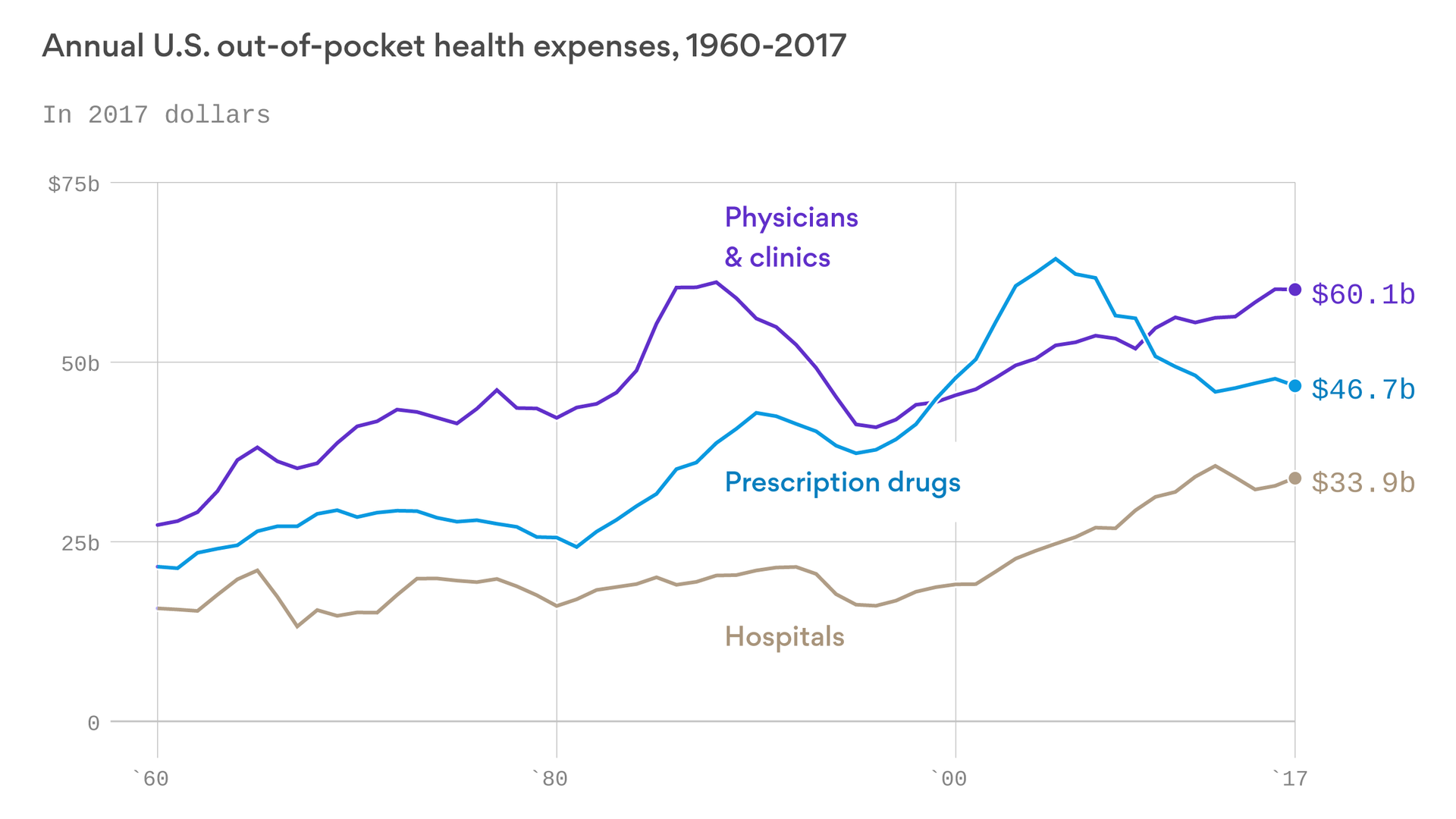
Hospitals smallest part of out-of-pocket costs

https://www.healthsystemtracker.org/interactive/?utm_campaign=KFF-2018-Peterson&utm_source=hs_email&utm_medium=email&utm_content=68267802&_hsenc=p2ANqtz–ktue7Wpa6NlVV1m5K05fMVx7jZNGoCLlk_ATmPS8Y6TgyNwDww1IGCz7sUIjYm69FTQmPft_pPBXXoE4h62JNKY1rEA&_hsmi=68267802&display=U.S.%2520%2524%2520Billions&service=Hospitals%252CPhysicians%2520%2526%2520Clinics%252CPrescription%2520Drug&source=Out%2520of%2520Pocket&tab=0

Image result for Hospitals smallest part of out-of-pocket costs


We spend more on hospital care than any other type of health care service, but hospitals make up the smallest amount of out-of-pocket spending.

  • That means insurers are passing on a smaller percentage of hospital costs to enrollees, although they indirectly pay for hospital care through premiums.

Between the lines:

  • “A big role of patient cost-sharing is to discourage use of inappropriate or unnecessary services. So much of hospital care is non-discretionary from the perspective of patients,” Kaiser Family Foundation’s Larry Levitt says.
  • Levitt adds that insurance tends to pay a bigger part of hospital bills versus other services because hospital bills tend to be large, causing patients to blow through their deductible or hit their out-of-pocket maximum.


20% of Americans are deferring healthcare because of cost, poll finds

https://www.beckershospitalreview.com/finance/20-of-americans-are-deferring-healthcare-because-of-cost-poll-finds.html?origin=rcme&utm_source=rcme

Related image

Americans are delaying medical care as they struggle with its affordability, according to the latest NPR-IBM Watson Health poll.   

The survey of more than 3,000 U.S. households in July found about 20 percent of respondents or someone in their household had postponed or canceled a healthcare service due to cost in the prior three months. 

Younger respondents were more likely to put off their healthcare needs. Thirty-four percent of respondents under 35 said they deterred care because of cost, compared with 8 percent of respondents 65 and older.

The poll also found 26 percent of respondents or someone in their household had difficulty paying for some type of healthcare service in the prior three months.

Again, younger respondents were more likely to experience trouble. Forty-one percent of respondents under 35 said they or a member of their household struggled to pay for a healthcare service, compared to 11 percent of respondents 65 and older and 26 percent of respondents ages 35 to 64.

The poll found 66 percent of respondents said they received a prescription in the prior three months, and 97 percent of those respondents had it filled. Of the respondents who said they had a prescription filled, 19 percent reported they had trouble paying for it.

Access the full poll results here.