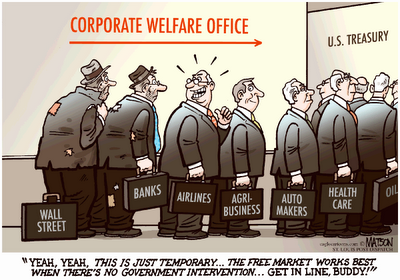
The debate over the Affordable Care Act is really a debate over wealth redistribution

https://www.washingtonpost.com/politics/the-debate-over-the-affordable-care-act-is-really-a-debate-over-wealth-redistribution/2017/03/07/36b7d048-034e-11e7-ad5b-d22680e18d10_story.html?hpid=hp_hp-top-table-main_repeal-710a%3Ahomepage%2Fstory&utm_term=.3b250a1c6c4b

Image result for wealth redistribution

Redistribution of wealth — one of the most radioactive subjects in American politics — has moved from being a subtext in the national debate over health care to being the core of it.

Politicians prefer to talk about health reform in terms of benefits — extending medical coverage to those who lack it, curbing increases in costs and improving quality.

They offer gauzy, have-it-all promises to make the system better, more efficient and more generous, as though it can all be done without anyone having to sacrifice anything.

House Republicans, led by Speaker Paul D. Ryan (R-Wis.), say that the measures they introduced Monday will increase competition and give consumers more choices.

What makes the latest health-care battle different from past ones is that it is not about building a new government program. This time, the question is whether to abolish one — and replace it with something else.

That means it is harder to gloss over a bedrock philosophical and ideological question that has always been in the background of any argument about the government’s role in health care: What is the minimum that society should provide for its poorest, most vulnerable citizens, and how much should be taken from the rich and powerful to do it?

“Even though it is a technical discussion, it’s a really big value discussion,” said Robert Blendon, a professor of health policy and political analysis at Harvard University.

Democrats, who had passed the seven-year-old system known as Obamacare without a single Republican vote, say that the GOP proposal to repeal more than 20 taxes enacted under the law amounts to a windfall for the rich and for corporate interests.

The Republican plan also probably would make Medicaid, the program that provides coverage to the poor, less generous.

Overall, it would be “a big transfer. This is a massive tax cut for unpopular industries and wealthy individuals,” said Andy Slavitt, who was acting administrator of the Centers for Medicare and Medicaid Services during the final years of the Obama administration. “It is about cutting care for lower-income people, seniors, people with disabilities and kids to pay for the tax cut.”

Meanwhile, conservative critics argue that the blueprint goes too far the other way. In their view, for instance, the individual tax credits included in the Ryan-backed plan to offset the cost of insurance are actually a new entitlement, not all that different from the subsidies provided under the Affordable Care Act.

“The House Republican proposal released last night not only accepts the flawed progressive premises of Obamacare but expands upon them,” said Michael Needham, the chief executive of Heritage Action for America.

However, economic historian Bruce Bartlett, who served in the administrations of Ronald Reagan and George H.W. Bush, said that argument ignores that health insurance itself is a means of spreading the cost of health-care around.

“Republicans argue that redistribution is inherently immoral without acknowledging that the very nature of insurance is per se redistributive,” Bartlett said. “You’re taking money from people whose houses don’t burn down to give it to the people whose houses do burn down.”

There were many ways that Obamacare also redistributed the burden of medical costs — from the sick to the healthy, with provisions such as the one denying insurers the ability to refuse coverage to people with preexisting conditions; from the old to the young, with a mandate that everyone have coverage or pay a penalty; from the rich to the poor, with an array of new taxes.

By contrast, “the Republican plan, as outlined right now, really is centrally about income redistribution, of the reverse Robin Hood variety,” said Austan Goolsbee, a University of Chicago economics professor who was chairman of Obama’s Council of Economic Advisers.

Democrats are framing their argument against the Republican approach in precisely that way.

“If Republicans have their way, working families, older Americans, and people with disabilities will face huge new health costs. Families across America are going to be pushed off their health coverage just so Republicans can hand a massive tax break to the wealthy,” House Democratic leader Nancy Pelosi (Calif.) said in a statement.

By producing their own proposal, Republicans are wandering into a familiar political thicket.

“The problem that the Republicans are going to have is anything they do makes them the inheritor of anger at the health system. That’s not a pleasant place to be, and now, they’re going to own it. All the Democrats know exactly how that feels,” Goolsbee said.

White House press secretary Sean Spicer insisted that widespread dissatisfaction is going to help the Republicans pass their plan to replace the Affordable Care Act. Health-care costs have continued to rise, and in many states, insurance companies are pulling out of the health-care exchanges that were set up under the law.

“What we’ve seen over the last few years with Obamacare is you can have an insurance card, but that doesn’t mean that someone’s going to take it, and it sure doesn’t mean that it’s going to be affordable,” Spicer said.

“When it comes to communication, I think, one of the things that’s really helpful is that part of the sell is done for us,” Spicer said. “We don’t have to explain the problem: People are living it.”

The question now is how to come to grips with the fact that it will not be painless to fix it.

Medicaid overhaul faces tough test in Trump country

http://www.politico.com/story/2017/06/18/medicaid-overhaul-kentucky-matt-bevin-trump-country-239655

Image result for medicaid overhaul

Kentucky Gov. Matt Bevin’s planned overhaul of Medicaid is running into the unforgiving reality of impoverished small towns like this one, which voted overwhelmingly for President Donald Trump.

Making adults work as a condition for getting health benefits is popular with the conservatives running many state capitals and Washington, D.C. But here in Magoffin County, where one of the last coal mines shuttered two years ago, there is little work to be had.

Trump’s Health and Human Services Department is expected to bless Bevin’s plan requiring poor adults to work to enroll in Medicaid in a first test of the GOP idea nationwide. Arizona, Arkansas, Indiana, Maine and Wisconsin have already asked the federal government for similar permissions, or will do so soon.

Trump’s top health officials, along with many Blue Grass Republicans, argue the work and other new requirements would bring much-needed discipline to a program that’s grown by more than 11 million people nationally under Obamacare’s coverage expansion.

“If I had my way, everybody who is able to work would be required to work for any program there is,” said Sen. Rand Paul (R-Ky.). “I think work is a good thing, not a bad thing. I don’t think work is punishment.”

“I think it incentivizes people to get out there,” agreed Kentucky state Sen. Ralph Alvarado, a physician, who said that able-bodied individuals relying on public assistance should find ways to give back to their communities.

Medicaid was never meant for “able-bodied” adults who obtained coverage under Obamacare and the program must be protected for more vulnerable populations, Alvarado said.

Under Kentucky’s proposal, able-bodied, low-income adults would be required to work up to 20 hours per week, or pursue activities such as job training or volunteer work to be eligible for Medicaid coverage. The state is also seeking federal approval for other conservative policies, including instituting monthly premiums ranging from $1 to $15 for certain low-income adults and parents, and co-pays if individuals miss premium payments.

ObamaCare: Six key parts of the Senate bill

ObamaCare: Six key parts of the Senate bill

Image result for Obamacare: Six Key Parts of the Senate Bill

While Senate Republicans are drafting their healthcare plan behind closed doors, they’ve given reporters a general idea of what might be in it.

The bill is shaping up to have a similar structure as the House’s bill, while more reflecting the principles of centrist Republicans in both chambers.

Senators are still hashing out the specifics, but here’s a look at where they appear to be headed.


U.S. Health Care Under Trump: Former Medicaid/Medicare Chiefs Square Off

https://www.commonwealthclub.org/events/2017-06-27/us-health-care-under-trump-former-medicaidmedicare-chiefs-square

Image - U.S. Health Care

Tue, Jun 27 2017 – 6:30pm

Gail Wilensky, Ph.D., Senior Fellow, Project HOPE; Former Administrator Under President George H.W. Bush, Health Care Financing Administration
Andy Slavitt, Senior Advisor, Bipartisan Policy Center; Former Acting Administrator President Barack Obama, Centers for Medicare and Medicaid Services
Mark Zitter, Chair, the Zetema Project—Moderator

Where is health care in the U.S. headed under the Trump administration? What do recent changes mean, and how will they affect consumers? Where should we be heading and why?

Now that the American Health Care Act (AHCA) has passed in the House, health care reform remains a hotter topic than ever. House Speaker Paul Ryan (R-WI) has proposed turning Medicare into a voucher program and funding Medicaid through block grants to states. Congress continues to discuss eliminating the individual mandate and providing more flexibility in terms of which benefits insurers must offer. Conservatives claim these changes would provide greater choice to consumers and more value to the federal budget, while progressives argue that these changes would reduce access to care and worsen health outcomes.

We’ll hear from two former senior officials on the ongoing efforts to repeal or repair the Affordable Care Act (ACA). Andy Slavitt recently stepped down as acting administrator for the Center for Medicare and Medicaid Services under President Barack Obama. Gail Wilensky held the same post under President George H.W. Bush. Both experts continue to speak out from differing perspectives on Medicare and Medicaid as well as broader reform issues. Join us for a spirited discussion on the problems and prospects of U.S. health care.

Location: 555 Post St., San Francisco
Time: 5:30 p.m. check-in, 6:30 p.m. program
Notes: 
In association with the Zetema Project

Teaching Hospitals Cost More, but Could Save Your Life

Teaching Hospitals Cost More, but Could Save Your Life

Image result for teaching hospitals

Perhaps not evident to many patients, there are two kinds of hospitals — teaching and nonteaching — and a raging debate about which is better. Teaching hospitals, affiliated with medical schools, are the training grounds for the next generation of physicians. They cost more. The debate is over whether their increased cost is accompanied by better patient outcomes.

Teaching hospitals cost taxpayers more in part because Medicare pays them more, to compensate them for their educational mission. They also tend to command higher prices in the commercial market because the medical-school affiliation enhances their brand. Their higher prices could even cost patients more, if they are paying out of pocket.

To save money, insurers have started establishing hospital networks, and policy makers are considering ways to steer patients away from teaching hospitals. Those efforts may well save patients and taxpayers money. But how will that affect the quality of care?

One answer is provided in a new study of over 21 million hospital visits paid for by Medicare in 2012 and 2013. Teaching hospitals save lives. For every 83 elderly patients seen by a major teaching hospital, one more is alive 30 days after discharge than if those patients had been admitted to a nonteaching hospital. This is a large mortality effect.

“It’s about half the size of a breakthrough medical therapy like stenting for heart-attack patients,” said Amitabh Chandra, an economist with the Harvard Kennedy School and a longtime skeptic of the value of teaching hospitals, who wasn’t involved in this study.

“Minor” teaching hospitals — which also have educational missions but are not members of the Council of Teaching Hospitals and Health Systems — also outperformed nonteaching hospitals, but by a smaller margin.

The study, published in the Journal of the American Medical Association, adjusted for other factors that could have skewed the results, like demographics, patients’ diagnoses, hospital size and profit status. Because mortality rates differ geographically, it compared teaching with nonteaching hospitals within the same state. Even after such adjustments, it found mortality rates are lower at teaching hospitals for 11 of 15 common medical conditions and five of six major surgical conditions. The more doctors in training per bed a hospital had, the lower its mortality rate.

Given the importance of this issue, you’d think we would already know the mortality differences between teaching and nonteaching hospitals. But the seminal studies on the subject are based on data at least two decades old. Other, more recent studies focus on only a few types of patients or offer conflicting results.

“We thought the comparative performance of teaching and nonteaching hospitals was worth a fresh look because medicine has changed considerably since those older studies,” said Laura Burke, the lead author on the study and an emergency physician with the Harvard T.H. Chan School of Public Health. “And the more recent studies don’t settle the question.” (I am a co-author on the study, along with Dr. Burke and other Harvard colleagues Dhruv Khullar, E. John Orav and Ashish Jha. Dr. Khullar is also an Upshot contributor.) The study was funded by the American Association of Medical Colleges, which had no editorial control over analysis or publication.

Though the study revealed mortality differences by teaching status, it could not illuminate the cause of those differences. Perhaps teaching hospitals attract higher-quality practitioners, more closely follow best practices, or use medical technology more effectively.

Other studies suggest teaching hospitals do not offer higher quality more broadly. For example, an analysis led by Jose Figueroa, a physician with the Harvard T.H. Chan School of Public Health, found that teaching hospitals were more likely to be penalized by Medicare for low quality compared with nonteaching hospitals. Another study found teaching hospitals were more likely to be penalized for higher hospital readmission rates.

An examination of Massachusetts hospitals found comparable quality performance at teaching and nonteaching hospitals. The state has a goal — codified in a 2012 state law — of bringing health care spending growth in line with overall economic growth. The Massachusetts Health Policy Commission has highlighted the high costs of teaching hospitals as part of this effort.

The new study did not assess the cost of the benefits in mortality that teaching hospitals deliver.

“The typical teaching hospital is at least 30 percent more expensive,” Mr. Chandra said. “Is 1 percent fewer deaths worth that price?” It’s a question few like to ask, but spending more on hospital care means less for other things we value — and that are known to improve health and welfare, too — like education and nutrition programs.

About 26 percent of hospitals are teaching hospitals, accounting for just over half of all admissions. Unsure which hospitals in your area are teaching hospitals? It’s something most of them make a point of mentioning, so you can often find a hospital’s teaching status on its website. If not, an inquiry to the hospital should settle the matter. If you use one, the cost of your care will be higher, but it might save your life.

Put Medicaid on Welfare

http://www.realclearhealth.com/articles/2017/06/07/put_medicaid_on_welfare_110620.html

Image result for Medicaid on Welfare

The American Health Care Act (AHCA), which was recently passed by the House of Representatives, proposes a radical change in Medicaid funding. Bill Clinton-era welfare reform served as a guide for the latest health care reform push—but to be successful, we must draw the correct lessons from those efforts in the 1990s.

Aid to Families with Dependent Children (AFDC), the pre-welfare reform cash assistance program for the poor, was a joint state-federal program, just as Medicaid is. Under this arrangement, Washington provides much of the funding and states operate the programs. Funds are distributed via matching grants, under which each dollar spent by states is matched by dollars from Washington. Medicaid varies the matching rate from between one and three dollars, with lower income states getting more. Notably, the Medicaid match has been open-ended–meaning as states spend more on approved coverage, they continue to receive more federal money.

The welfare reform signed by President Clinton in 1996 replaced AFDC with Temporary Assistance to Needy Families (TANF). TANF shares federal dollars using block grants, under which the federal transfer to a state in a given year is fixed, with relatively few strings attached. The AHCA proposes a slight variation on the block grant principle, with states receiving a fixed dollar amount per beneficiary beginning in 2020 (within five benefit categories). Federal assistance adjusts based on the number of enrollees. The AHCA also gives states the option of a straight block grant just as with TANF.

Block grants have been an important reason why there are 10 million fewer Americans on welfare today than in the early’90s, all without an increase in child poverty as critics of reform then feared. Matching grants create perverse incentives for states, which bear neither the full costs of over-generous programs nor retain the full amount of any savings from improved efficiency. As half or more of any Medicaid cost increase is paid for by Washington, state legislators are generous when spending federal dollars. Conversely, states only get to keep at most half of any savings from reducing Medicaid waste or abuse, thus there is little incentive to undertake any such efforts.

With block grants, meanwhile, states pay the full cost of expanding a program and keep all of the savings from reducing waste. The amount of federal assistance remains the same either way. State legislators must weigh the full cost of their generosity in such a system, enhancing efficiency in how they spend tax dollars.

Matching grants also impose conditions on state programs for eligibility, such as which groups of persons and types of care must be covered under Medicaid. Under AFDC’s matching grant system, states could not craft work requirements that best suited their population and economy without running afoul of federally imposed conditions.

Block grants, by contrast, allow states flexibility in designing programs to meet local needs and conditions. In the case of welfare reform, moving to block grants allowed states to tailor work requirement policies for local conditions.

Opponents of welfare reform in 1996 feared that some states would drastically slash benefits, forcing remaining states to do the same or become welfare magnets. This “race to the bottom” did not materialize because welfare reform wisely included maintenance-of-effort provisions, which limited potential state cuts in benefit levels. This safeguard prevented a wholesale diversion of the block grants to other state spending.

Also key to the success of welfare reform were the policy experiments that occurred before the 1996 law was signed. The innovative policies that transitioned millions of Americans from welfare to work emerged from waiver programs under the old AFDC. Similar recent experiments under Medicaid waivers suggest that the time may now be right for Medicaid reform.

One weakness of welfare reform was the rather narrow application of the block grants. TANF is but one of dozens of means-tested assistance programs. The benefits of welfare reform would have been greater if more assistance programs had been combined into one super block grant. Given the close connections between medical expenses and health choices, broad block grants would be particularly valuable for Medicaid.

A Medicaid program made more efficient due to block grants would be unlikely to produce the same reduction in enrollees as seen with TANF, which helped transition Americans off of welfare and into work. But block grants are a useful tool even when reducing enrollees is not the goal. A more likely outcome for Medicaid is better coverage for core beneficiary groups. States currently choose to cover optional treatments in pursuit of matching dollars, spreading available federal dollars very thin and contributing to the chronic problem of low Medicaid reimbursement rates.

In sum, block grants are not a panacea for federal and state budget woes, nor can they magically eliminate the cost of providing medical care to the nation’s poor—but their provision of flexibility and incentives for fiscal discipline allowed states to get welfare spending under control. It’s now time to put Medicaid on welfare.

Editorial: It’s now or never to fix next year’s insurance exchange rates

http://www.modernhealthcare.com/article/20170603/MAGAZINE/170609997/editorial-its-now-or-never-to-fix-next-years-insurance-exchange-rates

Image result for it's now or never

As the ad hoc committee of 13 Republican senators rethinks the increasingly unpopular American Health Care Act, Congress and the administration face a more pressing question. Will they stabilize the individual insurance market for 2018?

Preliminary rate filings for next year suggest that some states are entering the first phases of the much-dreaded death spiral, where rising rates and declining enrollments feed on each other to climax in a collapsed market. Where last year it was mostly rural areas that suffered from a dearth of carriers offering exchange plans, major urban areas like Kansas City and Knoxville, Tenn., are now among the regions reporting no insurers interested in offering coverage.

Meanwhile, carriers are requesting double-digit rate hikes in many areas of the country. Increase requests as high as 50% have been reported.

Republicans blame the Affordable Care Act. But, in fact, blame rests squarely with the Trump administration and the Republican-controlled Congress, who’ve created tremendous uncertainty around the policies that make the ACA’s individual market work.

The biggest single problem is Congress’ failure to appropriate the $7 billion owed insurers for underwriting cost-sharing reductions for low-income plan purchasers. That affects about 7 million of the 13 million people who signed up for individual plans.

Last year, Congress also put a one-year hold on the surcharge on health insurance premiums that supports ACA subsidies. Without further action, the tax, which was slated to raise about $100 billion over the next decade, will go into effect in 2018.

From a budgetary perspective, the move is a wash. The increased tax collection will be offset by the increased subsidies given low-income people who buy plans. People who are unsubsidized—those most likely to be bitter opponents of Obamacare—will be hit dollar-for-dollar with the rate hike.

President Donald Trump​ also contributed to uncertainty over next year’s enrollment period. First, he halted media promotion of the 2017 open enrollment. Then, in February, he issued an executive order waiving the individual mandate, which is key to getting millions of younger, relatively healthy people into the individual market pool.

While Politico reported last month that the Internal Revenue Service didn’t carry out the president’s order this year, the atmospherics around these pronouncements will ensure that fewer people sign up for individual plans in 2018. Insurers are assuming they will be covering an older, sicker population, a surefire path to higher rates.

Last week, Bradley Wilson, CEO of Blue Cross and Blue Shield of North Carolina, dissected how these compounding uncertainties contributed to its request for a 22.9% rate hike. About half the increase came from the missing cost-sharing reduction subsidies; about a third from an expected increase in medical losses, driven by rising costs and a sicker pool; and the rest from the expected tax.

This Republican Congress and the administration could quickly solve these problems without sacrificing their political principles. The administration could signal it will enforce the mandate since it is still the law. Congress could appropriate the money for the cost-reduction subsidies. This would preserve the House’s lower court victory in its suit challenging the Obama administration’s lacking an appropriation.

And, in a nod to their goal of protecting people with pre-existing medical conditions, Congress could create a reinsurance program to cover the extraordinary expenses of high-cost patients in the individual market. Unlike state-run high-risk pools, which have never worked, a federally funded reinsurance program would preserve everyone’s access to health insurance in the individual market at affordable rates.

It’s up to Congress now. Insurers face a June 21 deadline for notifying HHS about participation in the exchanges, and final rates are due from states by Aug. 16; there’s not much time to act. We’ll soon find out if Trump and this Congress intend to deny millions of people access to affordable health insurance next year.


The ‘Kimmel test’ could be a good health care yardstick for the GOP

The ‘Kimmel test’ could be a good health care yardstick for the GOP

Should the “Kimmel test” help shape the health care bill that the US Senate is now working on behind closed doors? Republican senators could easily use it to vet the bill while staying true to their conservative roots.

Last month, talk show host and comedian Jimmy Kimmel shared with his audience a story about his son, Billy, who had been born a few days earlier with a heart defect called the tetralogy of Fallot and needed open heart surgery at three days old.

“If your baby is going to die, and it doesn’t have to, it shouldn’t matter how much money you make,” pleaded Kimmel in an impassioned take on health insurance that has been viewed by millions.

Not long afterward, Republican Senator Bill Cassidy, a physician who represents Louisiana, said that any Republican health care legislation would need to pass the “Jimmy Kimmel test.” Morally and politically, Cassidy is right.

Every day in my work in a pediatric emergency department, I see firsthand that the Affordable Care Act, the law that the Republican House and Senate are determined to replace, saves lives. Before the ACA, children born with pre-existing conditions were often uninsurable, their families left to struggle with an unmanageable economic burden.

Kimmel thinks the solution is easy: “Don’t give a huge tax cut to millionaires like me and instead leave it [the ACA] how it is.” But the solution is far from easy.

As a physician, a conservative Republican, and a health insurance scholar, I believe that government intrusion into private insurance has had serious consequences. Families across America are paying thousands of dollars a year more in higher health insurance premiums. Insurers, which have been losing money, have started abandoning entire markets. The House of Representatives passed the American Health Care Act in early May, believing it had to do so to stabilize markets and reduce premiums. But the Congressional Budget Office finally reported that the AHCA strips away most protections for pre-existing conditions and pushes an estimated 23 million more Americans into being uninsured.

Can we Republicans pass the Kimmel test, improving on the AHCA while still ensuring the sustainability of American health care? Senate Republicans have expressed skepticism, but I believe we can. The key is to stay true to our roots by adhering to four conservative principles.

First, private markets must remain free. Healthy people will need to help pay for sick people — that’s how health insurance works — but they must be allowed to choose their own insurance. The ACA coerced the healthy into paying above-market rates for insurance, and so it prohibited the lower-premium catastrophic plans that make sense for most families.

Second, the poor should never pay for government benefits to the wealthy. The main way the ACA tries to help families with pre-existing conditions is by regulating insurance premiums, but that means its benefits are indiscriminate. The young and healthy, many of whom are struggling economically, pay more. The elderly, many of whom need help but some of whom are wealthy, pay less. We should use America’s progressive tax system, where the wealthy pay more in taxes, to implement a means-tested health insurance system that specifically helps the needy. Republicans don’t love taxes, but a hidden tax is worse than a visible one, and it is utter anathema that the ACA moves even a single dollar from the poor to the rich.

Third, redistribution must be transparent. The ACA mainly forces higher costs onto private insurance plans, which invisibly pass those costs to healthy consumers. Democrats may prefer this hidden tax politically, but to abide by conservative principles, a subsidy must come with a budget that can be seen, understood, and voted on.

Fourth, health insurance subsidies must be structured to reduce expenditures over time. Just as welfare should be a bridge to independence for individuals, subsidies should be a bridge to sustainability for the health care industry.

The ACA introduced some promising cost-reductions, like financial responsibility provisions for hospitals and limits on luxury plan tax deductions. The Senate needs to continue these efforts. Subsidized care must be adequate and compassionate, but it should insist on using generic drugs (when available) rather than brand-name ones, and it should not cover newly constructed hospitals or low-value services. Medicine must de-intensify, helping patients receive care at home instead of in hospitals when appropriate and using social workers to meet social needs. We also need to help subsidized patients take more responsibility for their health — showing up for appointments, taking prescribed medications, and, if needed, quitting smoking and receiving treatment for addiction.

In my view, the best way to accomplish these four goals would be through either a federally funded expansion of Medicaid or a federally run high-risk pool, which would offer families a means-tested option to buy in once medical bills reach a certain point. Such a plan would intentionally have high deductibles and copays, but it would offer extra assistance to needy families. The private insurance market would be free to compete on price and quality, innovating new ways to deliver value.

I am not writing to advocate for any specific plan. Instead, I offer conservative principles as a yardstick: Does the program provide compassionate, adequate coverage to the sick? Is it transparent, fair, and sustainable? Are the healthy still free to choose their own insurance?

Republicans can craft sensible, conservative subsidies to protect our most vulnerable citizens while also preventing hidden taxes and blank checks. Kimmel is right: No parents should have to choose between bankruptcy and saving their child’s life. Nor does our nation have to choose between fiscal irresponsibility and compassion for our most vulnerable.

Are Republicans ready to give up on repeal? Here’s what might happen next.

https://www.washingtonpost.com/blogs/plum-line/wp/2017/06/06/are-republicans-ready-to-give-up-on-repeal-heres-what-might-happen-next/?utm_term=.064d61593064

Senate Republicans are moving into high gear on their effort to repeal the Affordable Care Act, making it likely that within the next few weeks they’ll either pass something and keep the process hurtling forward, or abandon it altogether.

Judging from what they’re saying, it looks like the latter is the most likely scenario: They fail to pass their version of repeal, then say, “Well, we tried,” shake that albatross off their shoulders, and move on to the rest of their agenda. It would leave many in the party infuriated, but it might be the best of the bad options available to them.

The latest developments suggest Senate Majority Leader Mitch McConnell (R-Ky.) may be hoping to rip the Band-Aid off as quickly as possible and get this whole thing behind them.

After spending a month deliberating over a response to the House’s passage of a bill to repeal the law, Senate Majority Leader Mitch McConnell (R-Ky.) is accelerating the party’s stagnant work as a jam-packed fall agenda confronts congressional leaders and President Donald Trump. Republican leaders want resolution to the tumultuous Obamacare repeal debate by the Fourth of July recess, Republican sources said, to ensure that the whole year isn’t consumed by health care and that the GOP leaves room to consider tax reform.

It’s a gut-check situation for Republicans, who are about to be confronted with tough choices that may result in millions fewer people with insurance coverage as a condition for cutting taxes and lowering some people’s premiums.

While it’s possible that McConnell is pushing this accelerated schedule because he thinks it’ll produce a bill that passes before anyone has a chance to realize what’s happening, that seems like a long shot, particularly given how many Republicans are expressing doubts about whether they can get the 50 votes they need to pass it (the current GOP margin in the Senate is 52 to 48):

  • McConnell himself said “I don’t know how we get to 50 at the moment” in an interviewtwo weeks ago.
  • “I don’t think there will be” a successful vote this year, said Sen. Lindsey O. Graham (R-S.C.). “I just don’t think we can put it together among ourselves.”
  • Sen. Richard Burr (R-N.C.) said the same thing last week: “I don’t see a comprehensive health-care plan this year.”
  • And Sen. Jeff Flake (R-Ariz.) said: “There are some still saying that we’ll vote before the August break. I have a hard time believing that.”

That’s a whole lot of skepticism. One big problem they’re facing is that there are multiple factions and working groups among Senate Republicans, all potentially coming up with their own very different versions of the bill. That’s a result of McConnell’s decision not to run the bill through the ordinary committee process, since he didn’t want there to be public hearings at which Democrats would have a chance to speak and question witnesses. In that vacuum, everyone wants to exercise their own influence. So apart from the 13-member group that McConnell appointed, there’s also a group led by Sen. Susan Collins (R-Maine) and Sen. Bill Cassidy (R-La.), and a group led by Sen. Rob Portman (R-Ohio).

But the intractable problems are likely to be substantive. Can senators from states that have benefited hugely from the ACA’s Medicaid expansion — such as West Virginia, where 28 percent of the state population is now enrolled in Medicaid, including 170,000 citizens who got it because of the expansion — come to an agreement with senators such as Ted Cruz (Tex.) and Mike Lee (Utah) who would like to see Medicaid undermined if not utterly destroyed? And can they all agree on something that can also get a majority in the House, where ultra-conservative Freedom Caucus members wield so much power?

So here are the potential outcomes:

With Spotlight on Obamacare, Public’s Opinion of Drugmakers Softens

https://morningconsult.com/2017/06/05/spotlight-obamacare-publics-opinion-drugmakers-softens/

Consumer perceptions of several major pharmaceutical companies have softened in recent months amid an industry push to counter public uproar over high drug prices, Morning Consult Brand Intelligence data show.

Large drugmakers this spring have seen a decline in the the percentage of Americans who view them unfavorably, according to weekly national surveys of thousands of U.S. adults.

The Pharmaceutical Research and Manufacturers of America, the industry’s largest trade group, took action in January to revamp its public image by rolling out a multiyear ad campaign that promotes breakthrough medicines. The drug lobby, which consistently outspends other industries in an effort to exert influence on Capitol Hill, spent $245 million last year, an increase of more than $18 million since 2013, according to the Center for Responsive Politics.

The shift in public opinion has occurred amid GOP efforts to overhaul the nation’s health insurance system and the high-profile battle over the Affordable Care Act. The White House has prioritized replacing the 2010 ACA over lowering drug prices, though newly installed Food and Drug Administration Commissioner Scott Gottlieb announced last month that his agency is looking for ways to reduce some costs to consumers.

Since the House GOP health care legislative effort began in earnest in March, some of the most unpopular drugmakers have seen declines in the percentage of Americans who view them unfavorably. Still, favorability rankings for drugmakers have not improved significantly.

Some of the most-liked drugmakers include Johnson & Johnson and Bayer — the most well-known drug manufacturers among U.S. consumers.

Results are based on online surveys, with a nationally representative sample of adults, that ask participants if they have a favorable or unfavorable impression of certain companies.

Pfizer, which last year killed a proposed $160 billion merger with Allergan after the Obama administration announced new rules on tax inversions, had the highest unfavorability percentage among drugmakers tracked in March, at 29 percent. As of June 5, that figure had fallen to 12 percent.

Another drugmaker – Bristol-Myers Squibb – saw its unfavorability decline 13 percentage points during the same time period, from 23 percent in March to 10 percent in June. Merck had its unfavorable views peak at 25 percent in March before falling to 12 percent in June.