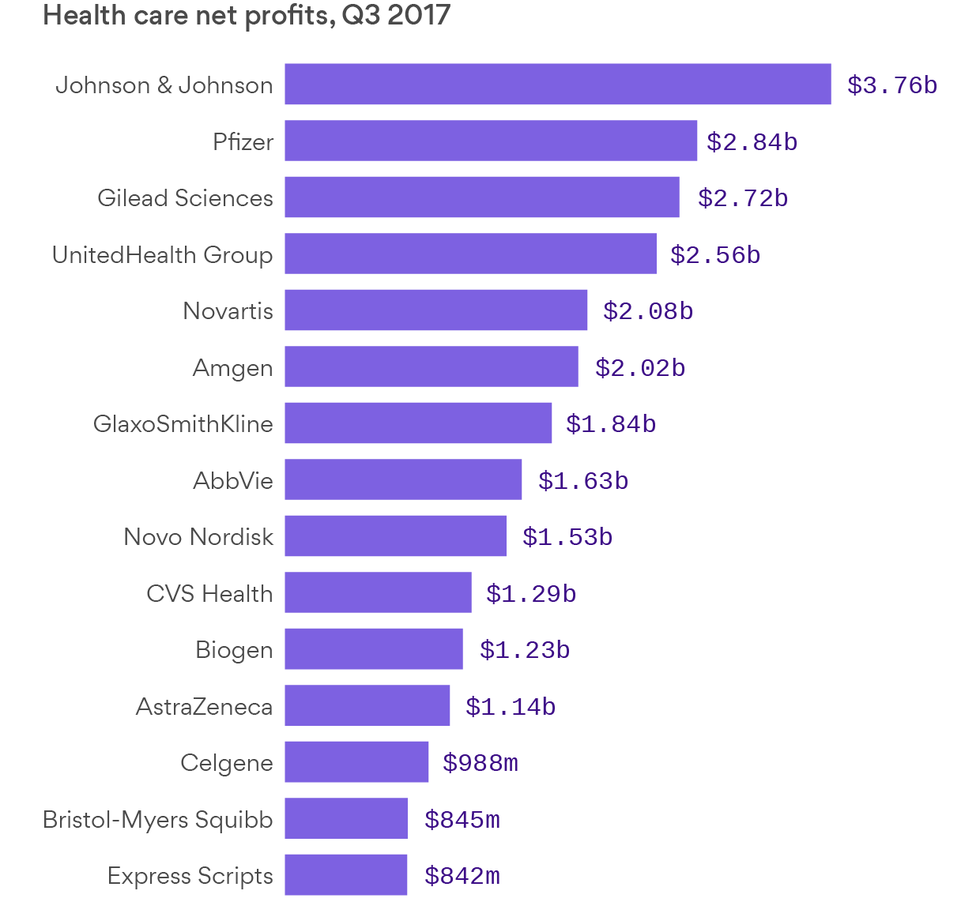
​Pharma’s big quarter

Data: SEC filings; Chart: Andrew Witherspoon / Axios

Axios’ Bob Herman has been tracking the health care industry’s financials over the third quarter, in which the 99 largest publicly traded health care companies cumulatively collected $33 billion of profit and $577 billion of revenue worldwide.

Winners: Pharmaceutical companies collected more than 60% of those profits, but only 22% of the revenue.

  • No health care company netted more profits than Johnson & Johnson, the behemoth maker of drugs, medical devices and consumer products like Band-Aids and Tylenol. Its net profit was $3.8 billion in the quarter.
  • 8 of the 15 highest net profit margins were at drug companies.
  • 12 of the 15 highest net profit totals were at drug companies.

Poll: Ahead of House Tax Reform Vote, Americans are More Likely to Rank Children’s Health Care, Hurricane Relief and Other Issues as Top Priorities for Washington

http://connect.kff.org/poll-ahead-of-house-tax-reform-vote-americans-are-more-likely-to-rank-childrens-health-care-hurricane-relief-and-other-issues-as-top-priorities-for-washington?ecid=ACsprvumAORaSTpZGqmqhYQaXpeqtZoXjMxf6lbzmdUaIsV8vQ82Gwn_2PBBsI5zIiSuUzZ5w8-C&utm_campaign=KFF-2017-November-Poll-Tax-Reform-Vote&utm_source=hs_email&utm_medium=email&utm_content=58466081&_hsenc=p2ANqtz-8Cag0QgNSRgFKsxX_UJAz_sPw8ZG2hIH2l7nv8vGW9Dn5a8w_Mcy5njs5Hwf79zPT3e9Z8cecPnIWqwTXGvfb_qKXqRg&_hsmi=58466081

tax reform poll chart 2.png

Controlling Immigration Tops Republicans’ Priority List, With Tax Reform among a Number of Second-Tier Issues Including Hurricane Relief and ACA Repeal

Most of the Public Initially Favors Getting Rid of the ACA’s Individual Mandate As Part of Tax Reform, But Some Become Opponents When Presented with Facts and Arguments for Keeping the Mandate

As the House prepares to vote Thursday on its tax reform bill, a new Kaiser Family Foundation poll finds almost three in 10 Americans (28%) view tax reform as a top priority for President Trump and Congress.

That’s significantly fewer than the share that say the same about reauthorizing funding for the Children’s Health Insurance Program (62%), hurricane recovery funding (61%), stabilizing the Affordable Care Act’s insurance marketplaces (48%) and addressing the prescription painkiller epidemic (43%).  Two immigration-related issues – strengthening controls to limit who enters the country (35%) and passing legislation to allow the Dreamers to legally stay (34%) – also rank higher, while a similar share (29%) say repealing the Affordable Care Act is a top priority.

Among Republicans, half (51%) say reforming the tax code is a top Washington priority, behind strengthening immigration controls (69%) but similar to the share who consider hurricane recovery funding (52%), repealing the Affordable Care Act (50%), stabilizing the insurance marketplaces (46%) and reauthorizing CHIP funding (46%) to be top priorities.

In a tweet Monday, President Trump called on Congress to end the Affordable Care Act’s individual mandate, which requires most Americans to have health insurance or pay a tax penalty and has long been the least popular provision in the law. While the House tax reform bill does not currently address the mandate, key Republican senators said Tuesday that they will include such a provision in their version of the bill.

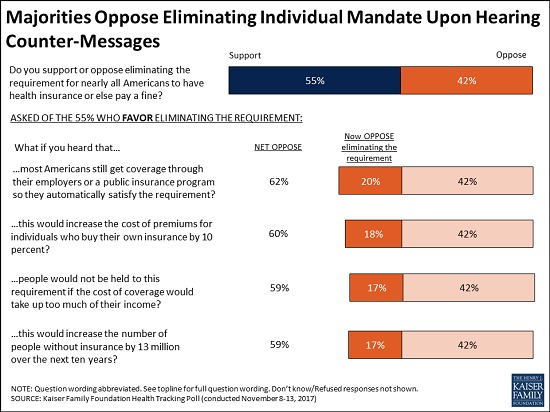
The new poll finds that most Americans (55%) initially support eliminating the mandate as part of tax reform, while four in 10 (42%) oppose it. Most Republicans (73%) and independents (58%) support ending the mandate, while most Democrats (59%) oppose it.

These views are malleable, with about a third of supporters (representing a fifth of the public overall) switching to oppose the mandate’s repeal when presented with facts and arguments about who is impacted and potential consequences of its repeal.

For example, the share who oppose eliminating the mandate can rise as high as 62 percent when initial supporters hear that most Americans get coverage through their employers or government programs that meets the mandate’s requirements. Similar majorities ultimately oppose eliminating the mandate when presented with other arguments against it, including that premiums for people who buy their own health insurance would go up, that people are exempted from the mandate if the cost of coverage takes up too much of their income and that getting rid of the mandate would result in 13 million more people being uninsured over the next 10 years, as the Congressional Budget Office has estimated.

One provision in the House bill would eliminate a tax deduction that allows people with high medical costs to deduct any medical and dental expenses that exceed 10 percent of their income.  A majority (68%) of the public – including majorities of Democrats (77%), independents (66%), and Republicans (61%) oppose eliminating the tax deduction for individuals who have high health care costs.

More than four in 10 (44%) of the public think eliminating the deduction for high medical costs will affect them and their families, though in reality a much smaller share of the public uses that deduction in any given tax year. According to the Internal Revenue Service, about 17 percent of taxpayers who file itemized deductions use this deduction (approximately 6% of all taxpayers and 3% of the public).

Looking ahead to the 2018 midterm elections, the public is divided over whether not passing a tax reform plan or not repealing the ACA would be a bigger deal for President Trump and Republicans. Nearly half of the public say it will be a bigger problem if the president and Republicans are unable to pass their tax reform plan (47%), similar to the share who say it will be a bigger problem if they are unable to revive a repeal of the ACA (44%). Republicans are also divided, with similar shares saying   it would be a bigger deal if President Trump and Republicans are unable to repeal the ACA (50%) and if they are unable to pass tax reform (45%).

Designed and analyzed by public opinion researchers at the Kaiser Family Foundation, the poll was conducted from November 8 – 13, 2017 among a nationally representative random digit dial telephone sample of 1,201 adults. Interviews were conducted in English and Spanish by landline (415) and cell phone (786). The margin of sampling error is plus or minus 3 percentage points for the full sample. For results based on subgroups, the margin of sampling error may be higher.

How the GOP Tax Bill Could Trigger $25 Billion in Medicare Cuts in 2018

Image result for Medicare Cuts

As they look to advance their tax bills, Congressional Republicans will have to work through — or around — a few potentially problematic budget rules. One is the Senate’s Byrd Rule, which says that any legislation passed by a simple majority, as the Republicans plan to do with the tax bill, can’t add to the deficit beyond the 10-year budget window. The other obstacle comes from “Pay As You Go,” or PAYGO, rules that require across-the-board cuts to certain mandatory spending programs when enacted legislation increases the deficit over the course of a year.

Because the GOP tax plan would add $1.5 trillion to the debt over the next decade, those automatic cuts would kick in, meaning that the government would have to slash spending by $150 billion a year for 10 years — including about $25 billion annually from Medicare, plus billions more from agricultural subsidies, Customs and Border Patrol, student loans and other programs.

The full accounting gets a bit more complicated. Because the official PAYGO scorecard shows a positive balance of $14 billion for 2018, spending would only have to be cut by $136 billion next year — but because only certain programs can be cut, that number is impossible to reach, as the Congressional Budget Office explained in a letter Tuesday. Besides the $25 billion from Medicare, the Office of Management and Budget would still need to find $111 billion in other reductions, but CBO estimated that only $85 to $90 billion in cuts are available.

The Senate does have another option, though. It can waive the PAYGO rules and avoid the automatic spending cuts, as it has done in the past, but that would require 60 votes. As The Washington Post’s Heather Long notes, that could give Democrats their only point of leverage in the tax reform process. “Congressional staff on both sides of the aisle admit that it’s unlikely Democrats would stand by and allow those painful cuts to popular programs to happen,” Long reports. “But Democratic leaders, including Sen. Minority Leader Charles E. Schumer (D-N.Y.), are well aware they could have leverage in this situation if they can convince the public that it would be Republicans, not them, who would be to blame” for the cuts.

Such a waiver could also threaten the support of some fiscally conservative Republicans. And even if the PAYGO rules are waived again, it’s a safe bet that Democrats and fiscal hawks will continue to warn about the longer-term costs of deficit-financed tax cuts. Many on the left have warned that the GOP tax plan and its increased deficits will lead to renewed GOP calls for cuts to social safety net programs.

Senate Tax Plan Aims to Repeal Obamacare Mandate

The Obamacare repeal debate is on again. Senate Republicans decided on Tuesday to include the elimination of the Affordable Care Act’s individual mandate in their tax plan, a risky move that would raise hundreds of billions of dollars to help pay for their desired tax cuts but is also sure to reignite intense clashes over health care coverage. Here’s a quick look at this latest twist in the tax reform effort:

Why They’re Doing It: Repealing the mandate, which requires individuals to buy health insurance or pay a penalty, helps solve the difficult math problems Senate tax-writers faced. The Senate tax bill can add up to $1.5 trillion to the debt over 10 years, and it can’t add to the deficit after that period. President Trump and some Senate Republicans had urged that the mandate repeal be included in the tax plan since it saves a projected $338 billion over 10 years, according to the Congressional Budget Office.

“Repealing the mandate pays for more tax cuts for working families and protects them from being fined by the IRS for not being able to afford insurance that Obamacare made unaffordable in the first place,” Sen. Tom Cotton (R-AR), who had proposed the move, said after the decision was announced. And if the repeal passes as part of a tax cut package, Trump and congressional Republicans would deliver on two promises to voters in one bill.

What It Means: Repealing the mandate may help Republicans chalk up a big win on taxes, but it also comes at a cost. The move raises revenue because it would lead to 13 million fewer people having health insurance, according to the CBO, and thus reduces the amount the government must shell out for insurance subsidies and care. Analysts also warn that, without the mandate, premiums will rise and some insurers might not participate in Obamacare markets that require them to cover pre-existing conditions. “Eliminating the individual mandate by itself likely will result in a significant increase in premiums, which would in turn substantially increase the number of uninsured Americans,” a coalition of insurers, hospitals and doctors wrote in a letter to congressional leaders on Tuesday.

Those expected effects carry significant political risk. For one thing, it could reawaken the liberal base that mobilized so effectively against Obamacare repeal and turn their focus to the tax bill. Michael Linden, a liberal policy expert, tweeted that “Reducing the corporate tax rate to 23% instead of 20% generates the SAME savings as repealing the ACA mandate. They could cut taxes for corporates just a little less, but instead they’re cutting health care.” Democratic leaders are already slamming the decision. “Republicans just can’t help themselves,” Sen. Chuck Schumer said. “They’re so determined to provide tax giveaways to the rich that they’re willing to raise premiums on millions of middle-class Americans and kick 13 million people off their health care.”

Will It Pass? A “skinny” Obamacare repeal bill that would have eliminated the individual mandate failed in the Senate in July when Republican Sens. John McCain, Lisa Murkowski and Susan Collins voted against it. But Senate Majority Leader Mitch McConnell told reporters that including the repeal provision would make it easier for the tax bill to pass. As part of the deal, the Senate would also reportedly vote on another bill to restore federal payments to insurers that the president had halted last month. Sen. John Thune (R-SD) said that a whip count had been done and expressed confidence that Republicans had the 50 votes they need.

Health Economist Uwe Reinhardt Dies

https://www.medpagetoday.com/publichealthpolicy/healthpolicy/69273?xid=nl_mpt_DHE_2017-11-15&eun=g885344d0r&pos=0&utm_source=Sailthru&utm_medium=email&utm_campaign=Daily%20Headlines%202017-11-15&utm_term=Daily%20Headlines%20-%20Active%20User%20-%20180%20days

Related image


Frequent critic of the U.S. healthcare system.

Famed health economist Uwe Reinhardt, PhD, has died, according to media reports.

Reinhardt, 80, was a professor of political economy at Princeton, specializing in healthcare spending, hospital prices, and comparative health systems. He was a regular contributor to major medical and health policy journals, including JAMA and the New England Journal of Medicine as well as Health Affairs

Reinhardt was born in Germany but emigrated to Canada and received a Bachelor’s degree in commerce from the University of Saskatchewan; he was awarded a PhD in economics from Yale University in 1970 and began teaching at Princeton that same year. His doctoral dissertation, which discussed the economics of physician practices, included a list of acknowledgements featuring Reinhardt’s typical wry humor: “One of the inevitable byproducts of a dissertation is that the author’s friends are drawn into the topic far more deeply than they might wish. Among my friends who suffered this fate are … ”

He also was a frequent critic of the American healthcare system, once observing that “If you want to guarantee access to care, always wear Gucci loafers. No ER turns away someone wearing Gucci loafers.” Reinhardt told Modern Healthcare in 2016 that Sen. Bernie Sanders’ (I-Vt.) proposal for a Medicare-for-all single-payer system would be “dead on arrival in Congress” because “[p]olitically, you cannot legislate what rationally makes perfect sense.”

Reinhardt served on the Physician Payment Review Commission (a precursor to the Medicare Payment Advisory Commission) and was a member of what is now the National Academy of Medicine. He was also a member of the Kaiser Family Foundation Commission on Medicaid and the Uninsured and a past president of the Association of Health Services Research.

Reinhardt was married to Tsung-mei (May) Cheng, a health policy researcher and co-founder of the annual Princeton Conference on health policy; they had three children.

A nation of McHospitals?

https://www.politico.com/agenda/story/2017/11/08/hospital-chains-dominate-health-care-000574

Franchises-Lede-ByNeilWebb.jpg

For years, the nation’s hospital chains worked to get bigger, bigger, bigger. In the 1980s and 1990s, for-profit companies like HCA and Tenet emerged as juggernauts, snapping up local hospitals and opening clinics in one town after another. Their ambitious not-for-profit cousins, the big academic medical centers like Harvard-affiliated Partners Healthcare, scooped up smaller rivals in response. Just four years ago, the Tennessee-based Community Health Systems spent $7.6 billion to buy a competitor and become the nation’s largest for-profit hospital company, with more than 200 hospitals in 29 states.

Today, in any town or city, in any region of the country, you’ll almost certainly see the same scenario: Only a handful of hospitals, sometimes owned and operated by a company thousands of miles away.

As the pace and scale of consolidation picked up, the outcome long appeared inevitable: an American future in which a handful of hospital chains dominate American health care, with brands like Tenet and Catholic Health Initiatives and the Mayo Clinic competing for patients the way Panera and Chipotle and the Olive Garden compete for diners.

But something happened on the way to becoming a nation of McHospitals. That ambitious growth, driven by dreams of dominating a transformed health care landscape and recently fueled by Obamacare revenues, hit a wall.

In the past year, two of the nation’s three largest for-profit hospital systems, Tenet and Community Health Systems, began selling off dozens of their hospitals while entertaining bids to break up their entire companies. Prominent not-for-profit chains like Partners Healthcare are reporting nine-digit losses. Even Mayo Clinic is pulling back from some rural locations in the Midwest.

In part, the shift is just a typical business cycle working its way through the health care industry. “There are these testosterone-driven waves of deal making” in health care, said Jeff Goldsmith, a hospital consultant. “And then there are waves of post-coital regret that follow.”

But in part, the change is driven by policy decisions being made in Washington — how health care is paid for, and who has access to it. And as that shift unfolds, it’s raising questions that will shape American health care for a generation: What will the future of hospital ownership look like? What should it look like?

Even at the height of merger mania, no one could quite agree on whether the McHospital trend was a good thing or not. Some people — mostly in the hospital industry — argued that consolidation was long overdue, and that large companies’ deeper pockets and economies of scale would keep costs down and improve the quality of care for patients. Obamacare gave hospitals financial incentives to manage entire populations, rather than just get paid patient-by-patient — an effort that required building big data sets and buying up other services too, like physician practices.

But others were concerned about the growing concentration of ownership of the nation’s hospitals by a shrinking number of companies. It put local hospitals’ decades-long relationship with their communities at risk, as important local institutions started reporting to shareholders or distant nonprofit boards. These worriers foresaw a future in which just a handful of chains competed to carve out the most lucrative segments of health care, like cardiac procedures and orthopedic surgery, and offered substandard care for everyone else. And despite the chains’ promises, years of reports have shown that when hospitals combine, their prices tend to go up.

Providers’ growing market power has “been the leading reason for the [rise] in health care spending” for decades, Bob Berenson, a former Carter and Clinton administration official said in 2015. (“And in conventional political circles,” he added, “it’s still being overlooked.”)

But the changes underway are starting to transform the nature of the hospital itself — and could open the door to a landscape even more different than we imagine.

Radical shifts

The direction of the American hospital has shifted radically over time. Initially, hospitals were charity wards where the poor went to die. But as cities grew, and health care became more expensive and capital-intensive, hospitals became destinations for wealthier patients: Top hospitals were the ones that could afford the latest medical technologies and perform the most complex surgeries. The creation of Medicare in 1967 fueled new revenue and attracted more competitors, leading to the birth of major chains.

Today, about two-thirds of the nation’s 5,000 hospitals are parts of chains, up from about half of hospitals just 15 years ago, and the share of for-profit hospitals has steadily climbed — more than one in five hospitals are now owned by investors, rather than run as a not-for-profit or by the government. Established hospitals are grappling with how to balance institutional advantages like high-end facilities and expensive technologies with the need to stay nimble and adapt to health care’s changes. It’s a hard balance to strike, and after a few boom years, the industry is experiencing its worst financial performance since the great recession.

It’s always been expensive to own and operate a hospital. Preparing for possible emergencies requires round-the-clock staffing and immense sunk costs. Most major hospitals also try to offer dozens of different business lines, from cardiac surgery to behavioral health care — but that’s only gotten harder as niche competitors chip away at the most lucrative high-end services. It also got pricier thanks to the latest merger mania, as hospital chains collectively took on billions of dollars in debt to buy up their competitors and acquire other services, like physician offices.

An industry that had already consolidated in the 1980s and 1990s — seeking new efficiencies and to get bigger when negotiating with insurance companies — received new incentives under Obamacare, as millions of newly insured patients entered the market and hospital chains raced to capture the new customers. But the Affordable Care Act also accelerated changes to health care payments in ways that made hospitals seem a little outmoded.

Medicare, other federal programs and insurance companies are increasingly shifting away from fee-for-service reimbursement — in which doctors and hospitals are rewarded for the number of procedures they perform — toward “alternative payment models” with more incentives for follow-up care and improved long-term outcomes. That’s encouraged hospitals to make new investments, like buying up nursing homes and hiring more workers to deliver home-based and long-term care. Some hospital leaders are actively talking about trying not to fill their beds, which would’ve sounded like heresy in the industry just a decade ago.

Charlie Martin, a legendary health care investor who founded two hospital companies, said the old model is doomed as new technologies allow care to be delivered outside of the hospital — leaving behind large, costly facilities that are better suited to 1990 than 2020.

“Half the business that’s in there is going to go away,” Martin said. “This is going to be a beatdown like we’ve never seen before.”

Martin said he’s now investing in services like post-acute care and home health, which are more agile and positioned to take advantage of the changes in payment. In this emerging world, a low-cost aide who can keep an elderly patient out of the hospital may end up being more profitable for Martin than paying a team of doctors when that patient breaks a hip and needs days of hospital care.

“The hospitals of today are too expensive to be health care facilities” in the long run, Martin said. “I can’t carry the carcass around.” (He added that consolidation’s benefits are overrated. “There are other ways to get scale now, like purchasing groups” that allow hospitals to get bulk discounts despite not having a common owner, Martin argued. “A lot of the advantages that came through the multihospital systems are now available for anybody.”)

Too big to fail?

So, are big hospitals — and big hospital chains — destined to go the way of Sears, an institution decimated by smaller and nimbler competitors? Not necessarily. There’s still a viable path — and often a need — for big hospitals themselves, typically the largest employers in their cities and towns. While fee-for-service payment is slowly getting phased down, it isn’t going away overnight, if ever. A decade after policymakers began pushing hospitals to adopt alternative payment models, those models still represent less than 30 percent of payments to the average health care provider. Fee-for-service remains the most common way of getting paid.

And local hospitals have an advantage that many businesses don’t: They’re often so important to their towns and cities that lawmakers and other local leaders don’t want to let them fail, even if their margins suffer. And in markets where there isn’t much competition, hospitals continue to charge huge rates that have very little connection to quality of care. Yale researcher Zack Cooper and colleagues have found that hospitals with effective monopolies have prices more than 15 percent higher than hospitals in markets with four or more competitors.

What that all means: The hospitals that Martin and others see as lumbering dinosaurs don’t all need to evolve to virtual campuses just yet. No one’s forcing them to. The old model of going to a hospital for surgery and other intensive services will persist for years or decades, barring major technological leaps ahead, and it may stay lucrative for the most prominent, dominant facilities. There’s no easy, obvious disruptor that wants to start building hospitals and compete for these services, at least for these now.

So then the question is: Who’s going to own them? Many experts think the near future, at least, will belong to regional health systems. They’re able to take advantage of local monopolies that allow them to raise prices, while not being burdened by the debt and expenses that can go along with aggressive acquisitions of national chains. And from North Carolina to California, many of these local chains continue to thrive and edge out national competitors with better financial performance. Indiana University Health System last month announced it’s expanding into Fort Wayne, the state’s second-largest city, even as Community Health Systems – a national chain that operates a hospital network in the city – has seen local profits fall and anger rise, as doctors and employers claim the chain has neglected its facilities and should sell hospitals that have become dirty and dingy. (Community’s president told doctors in 2016 that the chain would pull out of Fort Wayne, Bloomberg reported, although the company rejected a subsequent buyout offer and now says it’s committed to staying.)

What’s good for these regional chains may not be good for patients or the insurance system that pays for their care, though, as lower levels of competition mean higher prices. Martin Gaynor, an economist at Carnegie Mellon and former FTC official who studies consolidation, points to UPMC’s decision this month to spend $2 billion to build three new specialty hospitals in the Pittsburgh area, further cementing its control of the local market — even if experts question whether large, specialty facilities are needed at all. “Don’t forget that residents of Western Pennsylvania are the ones who will mostly pay for this,” Gaynor tweeted after the announcement.

“There’s a near-stranglehold on these markets by dominant health systems,” said Gaynor, noting that many regions get carved up between two or three major chains. “Some means need to be developed to free that up.”

It’s not clear how that would happen or who wants to do it. The Trump administration has gestured toward unlocking those markets, with a few lines in a recent executive orderpromising to limit “excessive consolidation.” The Federal Trade Commission under the Obama administration also jumped in to aggressively block hospital mergers, too. But taking on the hospital industry has been viewed as a political nonstarter for years. And hospitals don’t have much reason to loosen their own monopolies, at least in the short run.

There’s an intriguing possibility that some consultants are wrestling with: What if a company like Walmart or Apple decides to go for the health care market — and really go for it, as executives from each company have hinted in the past — and set up outpatient centers in their stores around the country. Hospitals would suddenly face new pressures from a well-capitalized competitor that already gets a lot of foot traffic, like Walmart, or has been ruthlessly committed to growth, like Apple. Patients frustrated with the traditional medical system might start opting for these retail alternatives, disrupting the entire chain of how Americans get care.

A dramatic move like that would shake up how health care is delivered. It would also flip the paradigm. Rather than hospitals desperately trying to expand and establish themselves as a national brand, an existing national brand — not a health care brand, but a big consumer brand — could suddenly have a health care presence in many major markets.

But a move like that remains some distance off. Walmart’s effort to quickly scale up small retail health clinics has stalled. Apple has publicly flirted with investing in a health care facility for so long, it raises the question of why the company hasn’t.

And that points to the most likely outcome for hospitals in the next 30 years. Boring as it may be, many of them aren’t going anywhere. No one else is competing for the expensive, high-end services that only hospitals can offer. They’re still too big to fail — just so long as they don’t get any bigger.


CMS Cut to Outpatient Drugs Will Hit Some 340B Hospitals Hard

http://www.healthleadersmedia.com/finance/cms-cut-outpatient-drugs-will-hit-some-340b-hospitals-hard?spMailingID=12347580&spUserID=MTY3ODg4NTg1MzQ4S0&spJobID=1281228729&spReportId=MTI4MTIyODcyOQS2#

Image result for 340b drug pricing program

The 340B program is intended to help safety net hospitals, but some others have taken advantage. A lack of transparency and accounting led to deep cuts for all participants.

Hospitals receiving drug discounts will take a big financial hit in January when the federal government sharply reduces the Medicare payment for outpatient drugs, effectively cutting a subsidy that some hospitals use to provide needed medications to those who cannot afford them.

The affected hospitals are bracing for a significant drain on their bottom lines, and some serve the neediest populations. However, some other hospitals have used the program to increase profits rather than to help underserved populations.

The U.S. Department of Health and Human Services, Centers for Medicare & Medicaid Services released a final Medicare Outpatient Prospective Payment System (OPPS) ruleNovember 1 that cuts Medicare reimbursement for separately payable outpatient drugs purchased by hospitals under the 340B program, which helps certain hospitals and other healthcare entities pay for covered outpatient drugs. The 340B program requires pharmaceutical companies to sell drugs to these hospitals at a discount, but CMS reimburses the hospitals as if there were no discount.

CMS will cut the reimbursement rate from the current average sales price (ASP) plus 6% to ASP minus 22.5%, starting January 1, 2018.

CMS estimates that the change will result in a $1.6 billion reduction in OPPS payments to 340B hospitals for separately payable drugs. The new reimbursement rate was derived from a May 2015 Medicare Payment Advisory Commission (MedPAC) Report to Congress, which estimated that the ASP minus 22.5% rate was the “lower bound of the average discount” on drugs paid under the Medicare OPPS. However,MedPAC’s March 2016 Report to Congress recommended a less drastic reduction in payment to ASP minus 10%. Under that rate, most 340B hospitals could still see a financial benefit from the program.

Instead, the adopted rate will negatively affect all 340B hospitals, says Keely Macmillan, general manager of bundled payments for care improvement with Archway Health, a Boston-based firm that works with providers to manage bundled payments.

How the elections could put the brakes on anti-ACA plans

https://www.axios.com/how-the-elections-could-put-the-brakes-on-anti-aca-plans-2508099820.html

Image result for How the elections could put the brakes on anti-ACA plans


The most important issue in an election is sometimes, but seldom, the factor that actually determines the outcome of the election. That’s what we saw happen in Virginia this week. Health was the top issue in the Virginia race, according to exit polls, but it was only one of many factors that drove the election.

The bottom line: The election may have been more of a referendum on President Trump than health care — but the results in Virginia and in the Maine referendum on Medicaid expansion will still have a practical impact on what happens next, including the appetite for Affordable Care Act repeal and for cutting Medicaid to pay for tax cuts.

The details: Voters in Virginia named health care as far and away their top issue in the election in the network exit poll. It’s not surprising that the issue was at the top of their minds; they have been hearing all about the ACA in the news for months and about Medicaid expansion in their state.

Yes, but: Notably, the exit poll did not include the economy on the list of issues voters could choose. Fox News did ask about the economy and, as the chart shows, it and health were statistically tied in their poll.

Between the lines: When voters rank health care as a top issue in an election, it does not necessarily mean health care drove their vote. Voters’ views of the candidates themselves are generally a bigger factor. The candidates were also proxies for voters’ feelings about President Trump, and many more voters in Virginia said they were voting to express opposition to Trump than their support for him (34% vs. 17%).

Most voters who chose health care as their top issue in Virginia voted for Northam, possibly signaling that Democrats may be able to campaign on health care and the ACA in upcoming elections.

What to watch: The Maine vote on Medicaid expansion was a different story. Maine voters cast their ballots on a specific referendum to expand the Medicaid program, and it won resoundingly. The result speaks to a lesson learned in the repeal and replace debate: Medicaid and Medicaid expansion are far more popular than Republicans seem to think they are, largely because Medicaid now covers 74 million Americans and matters to a broad cross section of the American people.

The impact: The immediate political implication is that it will be much tougher to cut Medicaid to help pay for tax cuts. Another lesson is that expanding Medicaid could be a winner in other states, especially with the federal government picking up 90 percent of the costs and the Trump administration ready to let red states put a conservative stamp on their programs. Medicaid is not Social Security or Medicare yet, but politically it is a lot closer than Republicans may realize.

A lot can and probably will happen between now and 2018. But for now, the prominence of health care in the Virginia election could throw a scare into moderate Republicans about continuing to pursue ACA repeal. And the Maine referendum on Medicaid expansion could make them more cautious about cutting Medicaid.

Virginia’s Electoral Changes Boost Medicaid Expansion Odds

https://www.nytimes.com/aponline/2017/11/09/us/ap-us-medicaid-expansion.html?_r=0&utm_campaign=KHN%3A%20First%20Edition&utm_source=hs_email&utm_medium=email&utm_content=58310492&_hsenc=p2ANqtz-8FETd55dWOAkXIqN9VEtDM5B0mIguwSbSdPof0YgErwa4jr8wshN4WOfBp1I5pAQyyzUMjVyOy3fpdQpPQ1XKv3bg5rQ&_hsmi=58310492

Related image

This week’s groundswell of political change in Virginia has improved the odds of Medicaid expansion becoming law there. The long-stalled liberal priority gained new life after Democrats nearly wiped out Republicans’ overwhelming majority in the House of Delegates.

For years Medicaid expansion, a key part of former President Barack Obama’s health care law, has been a non-starter in the Old Dominion. Republicans, who controlled two-thirds of Virginia’s House seats, have fiercely rejected expansion. Democrats have only made perfunctory pushes on the issue since 2014, when they lost a months-long showdown with the GOP.

That all changed Tuesday as Democrats won at least 15 House seats. Control of the chamber is still up in the air as a couple of close races have yet to be called — an outcome few but the most optimistic Democrats were expecting.

Democratic House Leader David Toscano said the election has “totally changed the dynamic” on Medicaid expansion, shifting it from a lost cause to something with serious momentum.

“It’s not dead on arrival anymore,” he said.

Toscano said expansion is by no means guaranteed but he believes Democrats could swing the needed handful of Republicans even if the GOP maintained slight control of the House.

Democratic Gov.-elect Ralph Northam, who made Medicaid expansion a part of his campaign platform, said Wednesday he’s eager to work with GOP lawmakers to get it approved. Republican state Sen. Emmett Hanger has previously expressed support for expansion. That theoretically provides enough votes to get it passed in the narrowly spilt state Senate.

But Republican leaders in both chambers said Thursday the election has not changed their opposition to the expansion. They say it would be fiscally irresponsible, even with the federal government promising to cover most of the new costs.

“Free and guaranteed money from Washington is neither free nor guaranteed,” said Parker Slaybaugh, a spokesman for Republican House Leader Kirk Cox.

Supporters of Medicaid expansion, including the state’s hospitals and much of the medical community, say it will boost the state’s economy in addition to helping poor people. Julian Walker, spokesman for the Virginia Hospital and Healthcare Association, said his group “stands ready to work” with lawmakers “to enhance coverage and alleviate the impact of uncompensated care of the state.”

The issue is gaining traction outside of Virginia.

In a public referendum Tuesday, Maine voters defied their state’s Republican governor and decided they wanted to expand Medicaid to some 70,000 citizens. Maine would join 31 other states in expanding the program. Similar referendum campaigns are planned in at least three other states.

At the federal level, Republicans have had little success trying to undo Medicaid expansion, despite President Donald Trump’s campaign promises to “repeal and replace” his predecessor’s law. GOP bills that would have repealed Medicaid expansion and limited future federal financing for the entire Medicaid program failed to pass Congress and drew opposition from some Republican governors.

Overall, about 11 million people in the country have gotten health coverage through the expansion of Medicaid.

The mystery of a 1918 veteran and the flu pandemic

https://theconversation.com/the-mystery-of-a-1918-veteran-and-the-flu-pandemic-86292?utm_medium=email&utm_campaign=Latest%20from%20The%20Conversation%20for%20November%209%202017%20-%2087627308&utm_content=Latest%20from%20The%20Conversation%20for%20November%209%202017%20-%2087627308+CID_39875ee4af1bb4acf1d1c57209a48369&utm_source=campaign_monitor_us&utm_term=The%20mystery%20of%20a%201918%20veteran%20and%20the%20flu%20pandemic

Vaccination is underway for the 2017-2018 seasonal flu, and next year will mark the 100-year anniversary of the 1918 flu pandemic, which killed roughly 40 million people. It is an opportune time to consider the possibility of pandemics – infections that go global and affect many people – and the importance of measures aimed at curbing them.

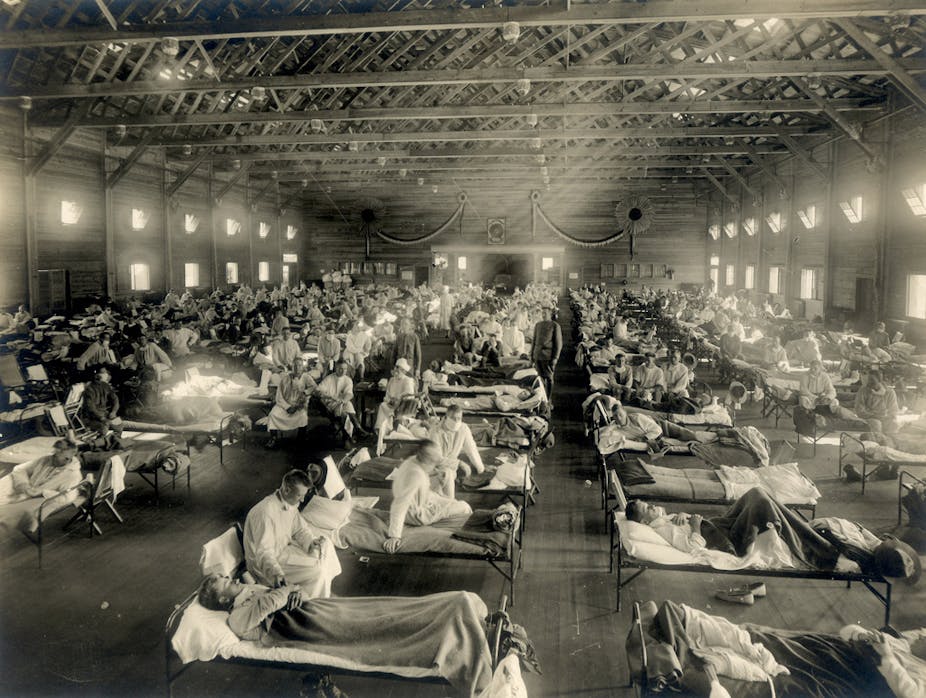
The 1918 pandemic was unusual in that it killed many healthy 20- to 40-year-olds, including millions of World War I soldiers. In contrast, people who die of the flu are usually under five years old or over 75.

The factors underlying the virulence of the 1918 flu are still unclear. Modern-day scientists sequenced the DNA of the 1918 virus from lung samples preserved from victims. However, this did not solve the mystery of why so many healthy young adults were killed.

I started investigating what happened to a young man who immigrated to the U.S. and was lost during World War I. Uncovering his story also brought me up to speed on hypotheses about why the immune systems of young adults in 1918 did not protect them from the flu.

The 1918 flu and World War I

Certificates picturing the goddess Columbia as a personification of the U.S. were awarded to men and women who died in service during World War I. One such certificate surfaced many decades later. This one honored Adolfo Sartini and was found by grandnephews who had never known him: Thomas, Richard and Robert Sartini.

The certificate was a message from the past. It called out to me, as I had just received the credential of certified genealogist and had spent most of my career as a scientist tracing a gene that regulates immune cells. What had happened to Adolfo?

To follow up, I posted a query on the “U.S. Militaria Forum.” Here, military history enthusiasts explained that the Army Corps of Engineers had trained men at Camp A. A. Humphreys in Virginia. Perhaps Adolfo had gone to this camp?A bit of sleuthing identified Adolfo’s ship listing, which showed that he was born in 1889 in Italy and immigrated to Boston in 1913. His draft card revealed that he worked at a country club in the Boston suburb of Newton. To learn more, Robert Sartini bought a 1930 book entitled “Newton War Memorial” on eBay. The book provided clues: Adolfo was drafted and ordered to report to Camp Devens, 35 miles from Boston, in March of 1918. He was later transferred to an engineer training regiment.

While a mild flu circulated during the spring of 1918, the deadly strain appeared on U.S. soil on Tuesday, Aug. 27, when three Navy dockworkers at Commonwealth Pier in Boston fell ill. Within 48 hours, dozens more men were infected. Ten days later, the flu was decimating Camp Devens. A renowned pathologist from Johns Hopkins, William Welch, was brought in. He realized that “this must be some new kind of infection or plague.” Viruses, minuscule agents that can pass through fine filters, were poorly understood.

With men mobilizing for World War I, the flu spread to military installations throughout the U.S. and to the general population. It hit Camp Humphreys in mid-September and killed more than 400 men there over the next month. This included Adolfo Sartini, age 29½. Adolfo’s body was brought back to Boston.

His grave is marked by a sculpture of the lower half of a toppled column, epitomizing his premature death.

The legacy of victims of the 1918 flu

The quest to understand the 1918 flu fueled many scientific advances, including the discovery of the influenza virus. However, the virus itself did not cause most of the deaths. Instead, a fraction of individuals infected by the virus were susceptible to pneumonia due to secondary infection by bacteria. In an era before antibiotics, pneumonia could be fatal.

Recent analyses revealed that deaths in 1918 were highest among individuals born in the years around 1889, like Adolfo. An earlier flu pandemic emerged then, and involved a virus that was likely of a different subtype than the 1918 strain. These analyses engendered a novel hypothesis, discussed below, about the susceptibility of healthy young adults in 1918.

Support for this hypothesis was seen with the emergence of the Hong Kong flu virus in 1968. It was in “Group 2” and had severe effects on people who had been children around the time of the 1918 “Group 1” flu.Exposure to an influenza virus at a young age increases resistance to a subsequent infection with the same or a similar virus. On the flip side, a person who is a child around the time of a pandemic may not be resistant to other, dissimilar viruses. Flu viruses fall into groups that are related evolutionarily. The virus that circulated when Adolfo was a baby was likely in what is called “Group 2,” whereas the 1918 virus was in “Group 1.” Adolfo would therefore not be expected to have a good ability to respond to this “Group 1” virus. In fact, exposure to the “Group 2” virus as a young child may have resulted in a dysfunctional response to the “Group 1” virus in 1918, exacerbating his condition.

To 2018 and beyond

What causes a common recurring illness to convert to a pandemic that is massively lethal to healthy individuals? Could it happen again? Until the reason for the death of young adults in 1918 is better understood, a similar scenario could reoccur. Experts fear that a new pandemic, of influenza or another infectious agent, could kill millions. Bill Gates is leading the funding effort to prevent this.

Flu vaccines are generated each year by monitoring the strains circulating months before flu season. A time lag of months allows for vaccine production. Unfortunately, because the influenza virus mutates rapidly, the lag also allows for the appearance of virus variants that are poorly targeted by the vaccine. In addition, flu pandemics often arise upon virus gene reassortment. This involves the joining together of genetic material from different viruses, which can occur suddenly and unpredictably.

An influenza virus is currently killing chickens in Asia, and has recently killed humans who had contact with chickens. This virus is of a subtype that has not been known to cause pandemics. It has not yet demonstrated the ability to be transmitted from person to person. However, whether this ability will arise during ongoing virus evolution cannot be predicted.

The chicken virus is in “Group 2.” Therefore, if it went pandemic, people who were children around the time of the 1968 “Group 2” Hong Kong flu might have some protection. I was born much earlier, and “Group 1” viruses were circulating when I was a child. If the next pandemic virus is in “Group 2,” I would probably not be resistant.

It’s early days for understanding how prior exposure affects flu susceptibility, especially for people born in the last three to four decades. Since 1977, viruses of both “Group 1” and “Group 2” have been in circulation. People born since then probably developed resistance to one or the other based on their initial virus exposures. This is good news for the near future since, if either a “Group 1” or a “Group 2” virus develops pandemic potential, some people should be protected. At the same time, if you are under 40 and another pandemic is identified, more information would be needed to hazard a guess as to whether you might be susceptible or resistant.