CMS to allow states to define essential health benefits

http://www.modernhealthcare.com/article/20171027/NEWS/171029872/cms-to-allow-states-to-define-essential-health-benefits

Image result for end run

The CMS proposed a rule late Friday aimed at giving states more flexibility in stabilizing the Affordable Care Act exchanges and in interpreting the law’s essential health benefits as a way to lower the cost of individual and small group health plans.

In the 365-page proposed rule issued late Friday, the agency said the purpose is to give states more flexibility and reduce burdens on stakeholders in order to stabilize the individual and small-group insurance markets and improve healthcare affordability.

The CMS said the rule would give states greater flexibility in defining the ACA’s minimum essential benefits to increase affordability of coverage. States would play a larger role in the certification of qualified health plans offered on the federal insurance exchange. And they would have more leeway in setting medical loss ratios for individual-market plans.

“Consumers who have specific health needs may be impacted by the proposed policy,” the agency said. “In the individual and small group markets, depending on the selection made by the state in which the consumer lives, consumers with less comprehensive plans may no longer have coverage for certain services. In other states, again depending on state choices, consumers may gain coverage for some services.”

However, the CMS acknowledged it’s unclear how much money the new state flexibility will save. States are not required to make any changes under the policy.

The CMS urged states to consider the so-called spillover effects if they choose to pick their own benefits. These include increased use of other services, such as increased used of emergency services or increased use of public services provided by the state or other government entities.

The agency in 2017 proposed standardized health plan options as a way to simplify shopping for consumers on the federally run marketplaces. The CMS said it would eliminate standardized options for 2019 to maximize innovation. “We believe that encouraging innovation is especially important now, given the stresses faced by the individual market,” the proposed rule states.

The CMS proposes to let states relax the ACA requirement that at least 80% of premium revenue received by individual-market plans be spent on members’ medical care. It said states would be allowed to lower the 80% medical loss ratio standard if they demonstrate that a lower MLR could help stabilize their individual insurance market.

The CMS also said it intended to consider proposals in future rulemaking that would help cut prescription drug costs and promote drug price transparency.

The Trump administration hopes to relax the ACA’s requirements and provide as much state flexibility as possible through administrative action, following the collapse of congressional Republican efforts this year to make those changes legislatively.

The proposed rule comes after months of calls from health insurers and provider groups for the federal administration to help stabilize the struggling individual insurance market. The fifth ACA open enrollment is slated to begin Nov. 1, and experts have predicted fewer sign-ups in the wake of a series of actions by the Trump administration to undercut the exchanges.

In the proposed rule, the CMS also proposes to exempt student health insurance from rate reviews for policies beginning on or after Jan. 1, 2019. The CMS said student health insurance coverage is written and sold more like group coverage, which is already exempt from rate review, and said the change would reduce regulatory burden on states and insurance companies.

The ACA requires that insurers planning to increase premiums by 10% or more submit their rates to regulators for review. The CMS proposed to increase the rate review threshold to 15% “in recognition of significant rate increases in the past number of years.”

The rule also tweaks a requirement that enrollees need to have prior coverage before attempting to get coverage via special enrollment after moving to a new area. Under the proposal, a person who lived in an area with no exchange qualified health plans will be able to obtain coverage.

Trump tells Senate to fix taxes — not Obamacare

https://www.politico.com/story/2017/10/24/trump-obamacare-taxes-senate-republicans-244124

Image result for ACA

The bipartisan effort to stabilize insurance markets gets pushed to the end of the year.

President Donald Trump on Tuesday steered Senate Republicans toward tax reform and away from health care, pushing off any deal to fund controversial Obamacare subsidies to the end of the year at best.

Trump joined Senate Republicans at their weekly policy lunch but gave no direction on what he wants to see in a health care bill. He praised Sen. Lamar Alexander’s (R-Tenn.) work on a bipartisan deal meant to stabilize the Obamacare markets, but his emphasis on taxes led senators in the room to believe Trump doesn’t want a stand-alone Obamacare vote anytime soon.

“There isn’t anything else other than taxes,” said Sen. John Cornyn (R-Texas).

A filibuster-proof majority backs the bipartisan deal Alexander brokered with Sen. Patty Murray (D-Wash.), but conservatives and the White House oppose it, meaning it won’t even come up for a vote in the Senate.

Without a clear directive from the president, Republicans are still debating whether to work with Democrats to fund Obamacare’s “cost-sharing” program, which helps low-income people pay their out-of-pocket medical bills. Trump abruptly cut off the subsidies — the subject of a court battle — earlier this month. Insurers still have to make the payments, and many boosted their premiums for 2018 to take those costs into account.

Alexander’s stabilization bid got even more muddled when a pair of top Republicans said they would release a different bill — rivaling the bipartisan proposal — to fund the subsidies. But their version would neuter the individual mandate for five years, a nonstarter for Democrats who would be needed to get a bill through the Senate.

The new version “proves that we should be focused on tax reform right now, because obviously we haven’t gotten our act together on health care,” said Sen. John Thune (R-S.D.).

Republicans are increasingly confident that the subsidies will get rolled into a large, year-end bill to fund the government and raise the nation’s debt limit. But there is no agreement on what exactly that will look like, and leadership-level negotiations on the year-end bill are weeks away.

The lack of clarity left Senate Republicans with enough wiggle room to interpret Trump’s Obamacare comments as they see politically fit.

Cornyn saw a “shoutout” by Trump to Alexander as encouragement for his bill. “He wasn’t specific, but that’s the way I interpreted it,” he said.

But Sen. Ted Cruz (R-Texas) — an Alexander-Murray skeptic — said Trump didn’t offer any clear support for the proposal over the GOP’s competing ideas.

“There was not significant discussion on Alexander-Murray,” Cruz said.

Sen. Orrin Hatch (R-Utah), another foe of Alexander-Murray, walked away with the same conclusion.

“He didn’t get into that in great depth — put it that way,” Hatch said. “All I can say is that he wasn’t too definitive.”

During the lunch meeting, Trump focused more on getting tax reform done so that the GOP can take another shot at repealing Obamacare in the future, instead of what should be done to stabilize the health care law in the interim.

“If we get taxes done, we’ll have momentum for health care,” said Sen. Lindsey Graham (R-S.C.), summing up Trump’s position. “He talked a lot about doing health care again.” Trump has repeatedly stated recently that the GOP now has the votes for repeal in the Senate — but senators say that’s not the case, that no one has flipped.

The meeting marked Trump’s first visit to the Senate GOP’s weekly policy lunch as president, and it came amid a rift with Sen. Bob Corker (R-Tenn.) and growing concern within the GOP that lawmakers will go into the 2018 midterm election without a legislative accomplishment. That’s amped up the pressure in the GOP to do tax reform.

But many Republican senators said after the lunch meeting that there was no discussion of petty politics and that Trump was focused on notching some GOP wins.

“It was the complete opposite of what I thought it would be — the atmosphere in the room and his complete focus,” said one senator.

The conservative Obamacare bill introduced Tuesday came from Hatch, the chairman of the Senate Finance Committee, and House Ways and Means Chairman Kevin Brady.

That bill, which would fund the cost-sharing program for two years, is designed to appeal to Republicans who want to fund the Obamacare program but feel that Alexander didn’t get enough conservative concessions in his negotiations with Murray.

It would eliminate Obamacare’s individual mandate penalties through 2021 and expand the use of health savings accounts. The Hatch-Brady bill would also exempt businesses from the employer mandate for 2015 through 2017 and apply certain “pro-life protections” to the cost-sharing funding.

“We must include meaningful structural reforms that provide Americans relief,” Hatch said. “This agreement addresses some of the most egregious aspects of Obamacare.”

Some of the provisions in the proposal — like the expansion of HSAs and employer mandate exemption — mirror the changes that the White House requested be made to the Alexander-Murray bill.

Alexander said he was encouraged by a growing consensus Congress should fund the payments to insurers for two more years.

“We’ve gone from a position where everybody was saying we can’t do cost sharing to responsible voices like Sen. Hatch and Chairman Brady saying we should,” he said.

But any cost-sharing bill will need 60 votes to get through the Senate, meaning Republicans will have to get at least eight Democrats to sign on. Undoing the mandates in the future would be a nonstarter for many Democrats.

“If it were just a matter of getting Republicans to agree with each other, we would have repealed and replaced Obamacare by now,” said a Senate GOP aide.

How Premiums Are Changing In 2018

How Premiums Are Changing In 2018

Related image

The premiums for 2018 Marketplace plans were recently released to give consumers a chance to look at their plan options before open enrollment begins on November 1. Premiums are rising significantly in many counties across the country, in part due to the decision of the Trump Administration to cease payments to insurers for cost-sharing reductions. Insurer participation also declined in many areas, leaving more counties with only one insurer, which likely contributed to the high rate of premium growth.

The map below illustrates how premiums changed for 2018 by looking at the change in the lowest-cost bronze, silver and gold plans by county in states participating in the federal Marketplace. Results are shown for a 40-year-old paying the full premium and for a 40-year old with an income of $25,000 (207% of poverty), $30,000 (249% of poverty), $35,000 (290% of poverty), and $40,000 (332% of poverty), who would be eligible for a premium tax credit.

Percent Change in Lowest-Cost Metal Plan Before and After Tax Credit, 2017-2018

Nationally, the unsubsidized premium for the lowest-cost bronze plan in the federal Marketplace is increasing an average of 17% between 2017 and 2018, the lowest-cost silver plan is increasing an average of 35%, and the lowest-cost gold plan is increasing an average of 19% (Table 1). These average increases are weighted by the number of plan selections by county in 2017 (see Methods). Premiums for silver plans are rising much more than those for bronze or gold plans because in many states insurers loaded the cost from the termination of the cost-sharing reduction payments entirely on the silver tier.

For consumers who receive premium tax credits, the amounts that they will have to pay will often be lower in 2018 (Table 2). The particularly large increase in premiums for silver plans means that tax-credit-eligible Marketplace enrollees will see much higher premium tax credits (which are calculated based on the second-lowest-cost silver plan in each area). These large credits make gold plans more easily attainable and make bronze plans much cheaper (or even available at no additional premium). In fact, after these increases, the lowest-cost gold premium is lower than the lowest-cost silver premium in 459 counties.

For example, a 40-year-old individual making $35,000 (249% of poverty) and eligible for a tax credit will on average pay 39% less in 2018 for their share of the premium for the lowest-cost bronze plan, 7% less for the lowest-cost silver plan, and 13% less for the lowest-cost gold plan. The savings are greater for subsidized enrollees with lower incomes and less for those with higher incomes (Table 2). The premiums for bronze plans may be particularly attractive to many people eligible for premium tax credits. For example, the tax credit for a 40-year-old individual making $25,000 covers the full cost of the premium for the lowest-cost bronze plan in 1,540 counties.

Counties Where the Lowest-Cost Bronze Plan Premium Costs Zero Dollars After the Tax Credit in 2018

The map below shows counties where the unsubsidized premium for the lowest-cost gold plan has a lower or comparable premium to the lowest-cost silver plan in 2018.

Counties Where the Lowest-Cost Gold Plan Costs Less than the Lowest-Cost Silver Plan

Discussion

The differences in premium changes across plan types and the peculiar effect these differences have on plan costs for both unsubsidized and subsidized enrollees makes it important that consumers shop around and carefully consider their options. Although CMS will no longer be paying insurers for reducing the cost sharing for lower-income enrollees, insurers remain obliged to provide the reduced cost sharing policies to eligible Marketplace enrollees. These policies generally have higher actuarial values than gold plans for enrollees with incomes below 200% of poverty so consumers will need to carefully consider whether it makes sense to switch even though gold-plan premiums may be comparable or less than silver plans. Consumers eligible for cost sharing reductions also will need to weigh the much lower premiums they would pay for a bronze plan with the much higher cost sharing they could encounter if they need care.

Republicans go toe-to-toe, again, with competing ACA bills

https://www.axios.com/vitals-2501052572.html?utm_source=newsletter&utm_medium=email&utm_campaign=newsletter_axiosvitals&stream=health-care

Image result for aca repeal


Now the Senate has two competing plans to fund the ACA’s cost-sharing subsidies — which could mean it won’t be able to pass either one. Senate Finance chair Orrin Hatch and House Ways and Means chair Kevin Brady outlined a new proposal yesterday as an alternative to the bipartisan ACA bill led by Sens. Lamar Alexander and Patty Murray.

The details: It’s hard to call these competing ACA stabilization bills. Although they’d both fund cost-sharing reduction (CSR) subsidies for two years, Hatch-Brady would also waive the law’s individual mandate for five years — effectively replacing one source of rising premiums with another.

  • Conservatives are not happy with Alexander-Murray. They’ve argued that if they’re going to keep the law’s cost-sharing payments flowing, they should be able to extract severe regulatory reforms in exchange.
  • Hatch-Brady is definitely more conservative than Alexander-Murray. The big unknown is whether its presence will stop more Republicans from accepting Alexander-Murray as “The Bill” — especially in the House, where its standing is weaker than in the Senate.
  • What they’re saying: “Sad attempt at relevancy by health care staff on Finance who are upset that their boss is entirely focused on tax reform, as he should be,” a senior GOP aide told my colleague Caitlin Owens.

The odds: 100% of the available evidence, from the entire Trump administration to date, suggests very strongly that Republicans are not capable of passing a health care bill on their own. They couldn’t do it with 50 votes in the Senate, and either one of these bills would need 60.

  • Alexander-Murray has 60 votes in the Senate.
  • Hatch-Brady would have an extremely hard time getting there. Waiving the individual mandate will be too much to ask from most, if not all, Democrats.
  • Leadership will likely face a choice between passing Alexander-Murray, with only minor modifications; or not passing anything at all.
  • All of this still probably comes down to December, when lawmakers have to deal with a host of thorny must-pass bills.

Instead of health care for all, Assembly has a do-nothing committee

http://www.sacbee.com/opinion/op-ed/soapbox/article179847606.html

Image result for Medicare for All

With the turmoil and chaos caused by the ceaseless efforts of Congress and the Trump administration to shred the Affordable Care Act, shouldn’t our legislators show more urgency to provide health security for Californians?

On Monday, an Assembly select committee will hold its first hearing “to determine the best and quickest path forward toward universal health care,” in the words of Assembly Speaker Anthony Rendon.

However, the committee has no authority to act on legislation. It is essentially a discussion group designed to give the appearance of moving forward on reform, rather than act on an existing bill, Senate Bill 562, which would guarantee health care for all Californians without huge out-of pocket costs hurting so many.

A legislative study has already concluded that a Medicare for all/single-payer approach, as SB 562 advances, is superior to all other models of health care financing.

Further, a study released in June documented the bill’s additional cost to the state budget is closer to $100 billion, not the misleading $400 billion cited by opponents. The study also offered financing proposals under which nearly all families and businesses would pay less for health care than they do now.

It is also troubling that select committee co-chairmen Jim Wood, a Healdsburg Democrat, and Joaquin Arambula, a Fresno Democrat, are the two of the three largest Assembly recipients of campaign contributions from the health care and insurance industries.

Unlike the powerless committee, SB 562 has the enormous advantage of having already passed the state Senate in June. The Assembly can take it up immediately early next year with any amendments members want to propose.

Further delays leave Californians at the mercy of the Trump administration. Consider the latest executive orders to encourage the sale of insurance plans that evade the extensive protections established by California legislators, and to cancel subsidy payments to insurers to sabotage the ACA marketplaces.

Premiums in California for “silver” plans, by far the most common under Covered California, are going up by 25 percent on average. Anthem Blue Cross rates are jumping by 37 percent, and it is pulling out of about half of California counties.

The specific impact on individuals and families varies depending on where you live, your income, how much coverage you want, and who your current insurer is. Or you may need to shop around for a non-silver plan – all with differing levels of coverage, deductibles and co-pays and that may or may not include your doctor, hospital, or other providers in its network.

Or Congress may or may not pass supplemental legislation to reverse Trump’s orders, which he may or may not support, with its own set of uncertain impacts. Everyone clear?

There’s a fix that would end Californians’ anxiety over their health coverage and cost, and establish protection for all. The people are ready. Earlier this month, nearly 1,000 activists attended 100 events in all 80 Assembly districts to talk to their neighbors about SB 562, and 10,000 people signed petitions urging its approval.

Concord resident Emily Chandler was among them. She told us she pays $800 a month for insurance but sometimes avoids going to the hospital because she can’t afford the co-pays and deductibles. She is one of 15 million Californians who, even under the ACA, are without coverage or who don’t get the care they need due to rising costs.

Californians don’t need a committee that can do little more than talk. They need real relief, SB 562.

The President’s Executive Order: Less Than Meets The Eye?

http://healthaffairs.org/blog/2017/10/20/the-presidents-executive-order-less-than-meets-the-eye/

Image result for less than meets the eye

The executive order (EO) signed by President Donald Trump on October 12 directs the Departments of Health and Human Services (HHS), Labor, and Treasury to develop federal regulations that could allow new and less expensive health insurance options for employers and consumers.

The EO marks a shift in the administration’s strategy on health care. After failing to get legislation through Congress to repeal and replace the Affordable Care Act (ACA), the administration is now attempting to move away from the ACA’s heavily-regulated markets through changes that can be implemented without a change in the law.

The executive order does not itself change any federal regulations. Instead, it sets into motion a policy development process that could lead to new regulations or regulatory guidance within the confines of current law. Although the EO gives general policy direction, the specific content of future regulations depends on legal and technical analysis to be conducted by the agencies.

The policy themes are familiar: expand access to lower-cost insurance outside of the ACA’s exchange mechanism and enhance the use of financing vehicles to help workers pay for their care. The extent of possible changes is limited. For example, the EO seeks to allow the sale of insurance across state lines, but relies on potentially expanding the ability of employers to form Association Health Plans (AHPs) under the Employee Retirement Income Security Act (ERISA). Individuals purchasing their own insurance would continue to be subject to federal and state insurance market rules.

An Uncertain And Potentially Lengthy Timeline

The timeline for producing rule changes is uncertain. The EO gives the agencies 60 days to “consider proposing regulations or revising guidance” without specifying the date when a proposed rule would be released. It typically takes months, and sometimes years, to put a new federal regulation into effect.

The Administrative Procedures Act specifies that agencies must follow an open public process when they issue regulations. Following an often-lengthy internal clearance process, a proposed rule is issued that invites public comments. The final rule taking those comments into consideration must be developed and cleared before publication. Less time is required if an agency determines that it can issue an interim final rule without first publishing a proposed rule. Interim final rules generally take effect immediately.

Even if the federal agencies move expeditiously, it is unlikely that new regulations could affect the marketplace for health insurance in 2018. ACA exchange plans have been finalized in time for this year’s open enrollment period, starting November 1. Most employers will have signed contracts for their insurance plans for next year well before the end of 2017 as well. Most Americans will be required to select next year’s coverage before the end of this year. Realistically, any new rules are likely to be effective starting in 2019 or later.

Major Policy Areas

The EO targets three policy areas for change.

Association Health Plans (AHPs)

Republicans have long supported the use of AHPs to give small employers some of the advantages that large employers have in purchasing insurance for their workers. AHPs potentially could allow small firms to operate as one large employer plan, giving them scale economies and greater market power than they have purchasing insurance as separate companies. In addition, AHPs could be exempted from some of the ACA’s requirements (including essential health benefits and community-rated premiums). However, as the law is now interpreted, AHPs are subject to the same state and federal regulations that apply to the small group and individual insurance markets, largely eliminating their usefulness.

The EO directs the Labor Department, which oversees the regulation of employer plans, to look for ways to make it easier for small businesses to join AHPs. The existing rules for multi-employer insurance plans are complex, but it may be possible that ERISA could be reinterpreted to make AHPs more effective and attractive than they are today. The EO raises the possibility that AHPs could be formed among employers operating in the same geographic area or industry. Details may not be available for some time.

Whatever changes are pursued will be heavily scrutinized and likely challenged in court. Insurers selling in ACA-regulated markets might oppose the new regulations if they expect AHPs to attract healthier individuals from more comprehensive (and more expensive) exchange plans.

It is not clear that AHPs would be a better option for small employers than they have today. Forming larger groups can help spread insurance risk and administrative costs. Larger plans can also use their leverage to push better managed care protocols into their insurance plans, and thus cut costs. However, the voluntary nature of AHPs could result in plans competing for healthier groups of workers rather than investing the resources necessary to make health care more efficient and effective.

Small employers may have the option of joining more than one AHP or staying in the regulated market. Competing AHPs might structure their coverage to attract firms with younger, healthier workers. The press statement accompanying the EO states that employers would not be allowed to discriminate among workers based on their health status. But small employers would not be forced to join AHPs, and the rules for joining might be written in ways that implicitly and subtly target firms with healthier workers.

AHPs could add value to the health system if they moved people out of expensive, unmanaged fee-for-service insurance with high administrative costs into better-run managed care plans that cut expenses through economies of scale and elimination of unnecessary use of services. The Trump administration might find a way within current law to make these kinds of AHPs available without shifting higher premiums onto less healthy workers. But the history of AHPs and related types of organizations is not promising. Many previous multi-employer plans have suffered from undercapitalization, and have gone insolvent. It will not be easy to secure the necessary capital to build a viable AHP in a market in which small employers may have several insurance options.

Short-Term, Limited Duration Insurance (STLDI)

Short-term health insurance policies offer coverage to individuals who are unable to obtain other forms of health insurance but want to be protected for a specific period of time. STDLI plans are not subject to the ACA’s insurance rules. They do not have to cover the ACA’s essential health benefits, they do not cover pre-existing conditions, and they are not required to cover people in poor health. One study found that STDLI plans are one-third the price of exchange plans. These plans have generally been viewed as niche products, sold primarily to people who are between jobs.

The EO calls on HHS, Labor, and Treasury to reverse decisions of the Obama administration that restricted the availability of STLDI plans. A regulation issued on October 31, 2016 limits their duration to no more than three months, and the plans are not renewable. Moreover, enrollment in an STLDI plan does not constitute coverage under the ACA’s individual mandate. It seems likely that the agencies have the authority under current law to allow STLDI plans to cover an individual for up to one year and to be renewable.

STLDI plans are clearly not for everyone but could prove attractive to some customers. Low-cost coverage should be made available to individuals who change jobs and those who are unable to buy exchange coverage after the open season has ended. Consumers enrolled in STLDI plans who develop a serious medical condition would probably not be able to renew their coverage but would have access to higher-premium plans offered on the ACA-regulated marketplace.

An open question is whether the Trump administration will also attempt to exempt STLDI enrollees from the individual mandate’s tax penalties. That would make short-term plans more attractive for healthy people and thus exacerbate the adverse selection that is already driving up premiums for ACA-compliant plans.

Health Reimbursement Arrangements (HRAs)

HRAs allow employers to reimburse workers for their families’ medical expenses, including deductibles and other cost-sharing payments and health items not covered by insurance. Unlike health savings accounts, workers do not contribute to HRAs. Payments made by an employer through an HRA are not treated as taxable income for the worker. The Obama administration required HRAs to be used solely in conjunction with ACA-compliant health plans.

The EO directs the agencies to propose ways to expand the availability and use of HRAs. The EO specifically states an intention to allow HRAs to be used for workers purchasing their own non-group coverage. The administration may be planning to allow HRA funds to be used to pay premiums and cost-sharing in the individual insurance market, including plans that are not ACA-compliant. Those plans might include AHP plans and STDLI, depending on other regulatory changes that might result from the EO.

For some small employers, an expanded role for HRAs may be an attractive way to help pay insurance premiums for their workers without sponsoring an insurance plan themselves. But it is far from clear how much authority there is under current law to make this kind of change. Moreover, even if the administration were able to create a larger role for HRAs, workers in small firms may not be eager to get their insurance through the ACA exchanges instead of through their place of work.

Premature Predictions

Several commentators have said that the Trump administration’s EO would result in risk segmentation that would drive up premiums and could eventually lead to dismantling the ACA exchanges. That prediction seems premature. AHPs as they exist today do not pose a threat to the ACA. It remains to be seen if the administration can make room for a viable AHP option, and whether or not that option will adversely affect the ACA exchanges. The STLDI plans are a niche market today. While it is possible their role could expand, their value is limited and attractive to only a small segment of the market. The administration’s vision for HRAs is not clear enough to predict how any changes would affect the existing ACA markets.

Each of the changes contemplated by the Trump EO would take time to put into effect. Once the rules are changed, the private sector would need to make investments to change their business practices. It is doubtful there would be a rapid transition.

Millions of consumers are enrolled in ACA-compliant plans today. The ACA exchanges face an elevated level of adverse selection. But those markets remain the only real game in town primarily because the ACA’s generous premium subsidies are only available through the exchanges. The President’s EO cannot change this reality. Whatever is done in response to the EO is likely to have a less dramatic effect on the market than some in the administration now hope, and others now fear.


No rush to stabilize ACA markets


President Trump’s decision to cut off the Affordable Care Act’s cost-sharing reduction subsidies doesn’t seem to have added much new urgency to the push to stabilize states’ insurance markets — which would likely include a guarantee to keep the subsidy payments flowing.

  • Bad sign: GOP Senate leadership didn’t talk about the CSR issue at all last night in their weekly meeting, at least while staff was in the room, a senior aide told Axios’ Caitlin Owens. To them, it’s still all about tax reform.
  • “They’re focused on tax reform,” Alexander, who’s been spearheading the stabilization effort, said of GOP leaders. “What I’ve asked the Republican leadership to do is to give us a chance to see if we can develop consensus among Republicans as well as Democrats.”
  • “The sooner the better,” Alexander said. “We want whatever agreement we have to benefit people in 2018 by holding down increasing premiums and to lower them in 2019.”

Yes, but: Affecting 2018 premiums will be a tough task — the window to begin signing up for 2018 coverage begins in two weeks.

  • Pennsylvania regulators announced yesterday that they’ve approved new premium hikes, more than 20% higher than the increases that were already on the books, because of the loss of CSR subsidies.
  • If Congress reaches a deal in time, one senior GOP aide told Caitlin, states and insurers could look to options such as rate re-filings and rebates to help consumers next year.
  • But the Kaiser Family Foundation’s Larry Levitt said turbulence for 2018 will likely be minimal. Most insurers had already planned for the payments to end, and therefore don’t need to make any changes.
  • The Trump administration appears to be allowing new increases by insurers that didn’t plan for CSR payments to disappear, Levitt said.
  • “Terminating the CSR payments is producing a lot of confusion, but the market will operate reasonably fine and the effect on consumers will be modest,” Levitt said. “If this was intended to end Obamacare, it’s probably not going to work. The real question at this point is the longer term effect of the administration’s overall strategy to undermine the marketplaces.”
One more problem: Even if a deal is struck, and it could muster 60 votes in the Senate, there’s a very real question of how it passes. Voting on the bill by itself, without being part of a larger package, would be difficult for Republicans. Most legislation that needs to get passed before the end of the year is expected to be clumped into one big bill in early December.

Who will pay more without CSR subsidies

https://www.axios.com/vitals-2497054515.html

Good morning … Last week gave us an executive order and an end to cost-sharing payments. Can’t wait to find out what the health policy universe has in store for us this week.

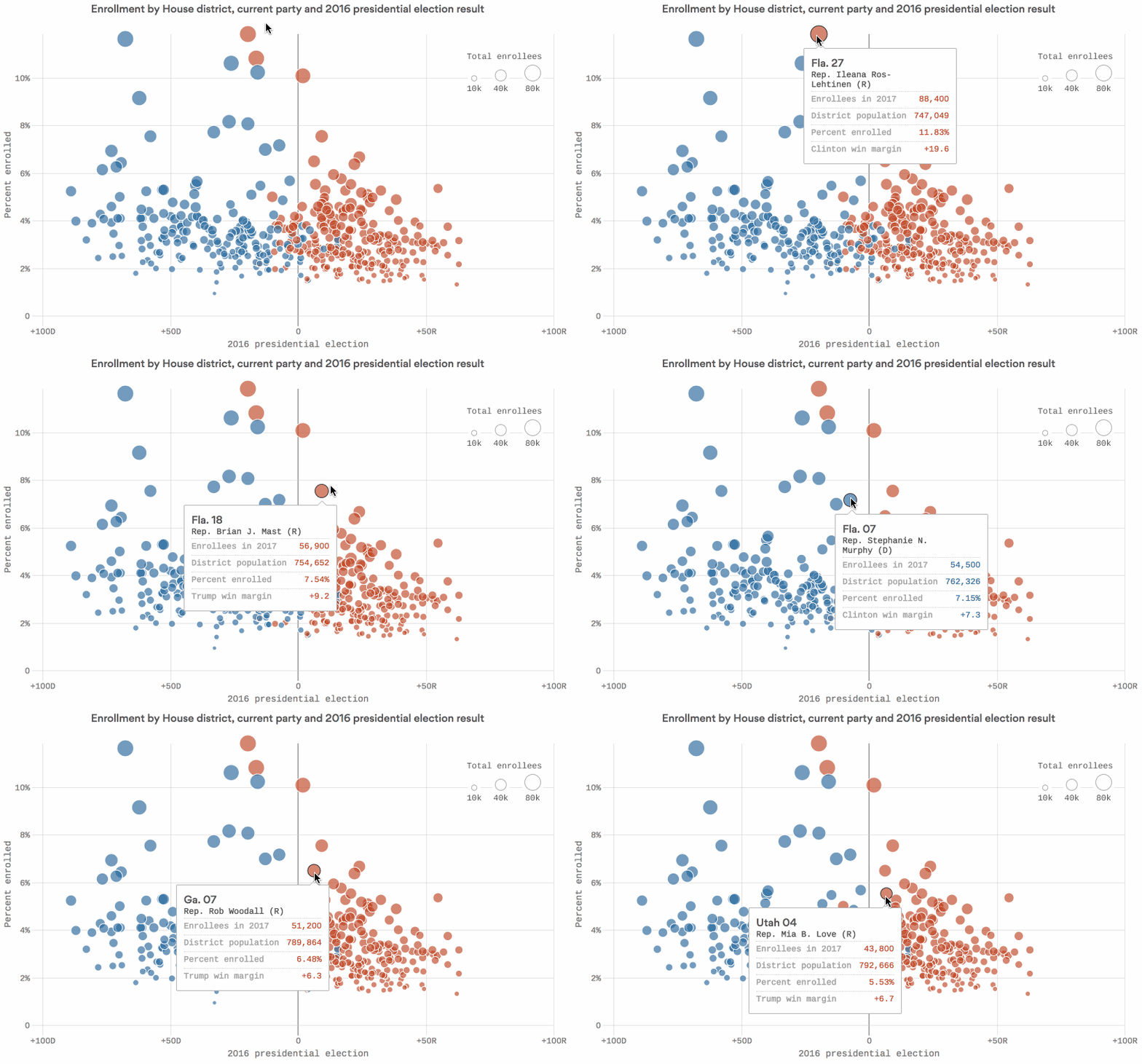
Who will pay more without CSR subsidies

Data: Kaiser Family Foundation; Daily Kos Elections; Census Bureau; Chart: Chris Canipe / Axios

The Trump administration’s decision to stop paying the Affordable Care Act’s cost-sharing reduction subsidies will affect ACA customers in Republican-leaning congressional districts as well as Democratic ones. Here’s a look at how many people could feel the impact in districts that voted for President Trump, compared with those in districts that voted for Hillary Clinton.

The details: This year, 11.1 million people were enrolled in ACA marketplace plans or in a Basic Health Plan created by the law. Of those, 5.9 million live in Republican-held congressional districts and 5.2 million live in districts held by Democrats, per the Kaiser Family Foundation.

The impact: The CSR subsidies are going to 58% of the people who are enrolled in ACA marketplace plans. In all, about 7 million people don’t receive any financial assistance with their premiums, so they’d pay the full cost when health insurance companies raise their rates. But others could be affected if health insurers decided to pull out of the markets rather than deal with the instability.

The flaws in Trump’s legal rationale

There are broader implications of the Trump administration’s decision to lean so heavily on a legal rationale for cutting off the CSR subsidies: institutional divisions between the executive and legislative branches.

Between the lines: The White House said it was ending the payments in part because of a ruling last spring that said it was unconstitutional to make the payments without an explicit appropriation from Congress. As part of that process, Attorney General Jeff Sessions wrote a memo saying, in effect, there was no point appealing that ruling.

  • “Opening the door to lawsuits initiated by Congress over the specifics of how the executive branch spends tax dollars would be a marked change and a potential threat to the White House,” the New York Times’ Carl Hulse noted over the weekend.
  • Trump might particularly wish he hadn’t conceded that point if Democrats retake control of the House and/or Senate while he’s still president. Divided government is how this lawsuit started, after all.

Real talk: Former White House strategist Steve Bannon, speaking at the Values Voters Summit over the weekend, cut to the heart of Trump’s decision: “Not going to make the CSR payments, going to blow that thing up; going to blow those exchanges up, right?”

Administration’s Ending Of Cost-Sharing Reduction Payments Likely To Roil Individual Markets

http://healthaffairs.org/blog/2017/10/13/administrations-ending-of-cost-sharing-reduction-payments-likely-to-roil-individual-markets/

Yesterday, October 12, 2017, the White House press office announced that the administration will no longer be reimbursing insurers for the cost-sharing reductions they are legally required to make for low-income individuals. The Affordable Care Act requires insurers to reduce cost sharing for individuals who enroll in silver plans and have household incomes not exceeding 250 percent of the federal poverty level. These provisions reduce the out-of-pocket limit for these enrollees—particularly for those with incomes below 200 percent of poverty—and sharply reduce deductibles, coinsurance, and copayments. The reductions cost insurers around $7 billion a year currently.

The press secretary’s statement said:

Based on guidance from the Department of Justice, the Department of Health and Human Services has concluded that there is no appropriation for cost-sharing reduction payments to insurance companies under Obamacare. In light of this analysis, the Government cannot lawfully make the cost-sharing reduction payments. The United States House of Representatives sued the previous administration in Federal court for making these payments without such an appropriation, and the court agreed that the payments were not lawful. The bailout of insurance companies through these unlawful payments is yet another example of how the previous administration abused taxpayer dollars and skirted the law to prop up a broken system. Congress needs to repeal and replace the disastrous Obamacare law and provide real relief to the American people.

Acting HHS Secretary Hargan and CMS Administrator Verma issued a similar statement:

It has been clear for many years that Obamacare is bad policy. It is also bad law. The Obama Administration unfortunately went ahead and made CSR payments to insurance companies after requesting—but never ultimately receiving—an appropriation from Congress as required by law. In 2014, the House of Representatives was forced to sue the previous Administration to stop this unconstitutional executive action. In 2016, a federal court ruled that the Administration had circumvented the appropriations process, and was unlawfully using unappropriated money to fund reimbursements due to insurers. After a thorough legal review by HHS, Treasury, OMB, and an opinion from the Attorney General, we believe that the last Administration overstepped the legal boundaries drawn by our Constitution. Congress has not appropriated money for CSRs, and we will discontinue these payments immediately.

The Legal Background

In fact, the ACA requires the federal government to reimburse insurers for these reductions. This is not a bailout. It is rather a statutory obligation of the federal government to pay insurers for services they have provided as required by law. In 2014, the House of Representatives sued the Obama administration in House v. Burwell (now House v. Price) claiming that the cost-sharing reduction (CSR) payments to insurers had never been appropriated by Congress and were thus illegal. A district court judge accepted this argument in the spring of 2016 and enjoined their payment, as President Trump’s statement says, but stayed her order pending appeal. The Obama administration appealed, arguing that there was in fact an appropriation. Until yesterday, the Trump administration had not taken a position on whether there was an appropriation or not.

The appeal is still pending, with the House and the Trump administration having agreed to stay the appeal several times. At the end of August, the D.C. Circuit Court of Appeals allowed 19 state attorneys general to intervene to protect their citizens. For more on the CSR backstory see here and here; for more on the intervention, see here; and for Health Affairs Blog posts on cost-sharing reduction payments, see here.

The Consequences Of Ending The CSR Payments

The effect of terminating the payments has been well analyzed, including a report from the Congressional Budget Office. It will drive up premiums as insurers attempt to cover the cost of the reductions. As premiums go up, so will premium tax credits. Indeed, the government will probably pay more in premium tax credits than it saves in cost-sharing reduction payments. Individuals who earn too much to receive tax credits will be particularly hard hit by the premium increases. Some of these could decide to pursue new forms of coverage that might be made available under the measures announced in President Trump’s October 12 executive order.

Ending the CSR payments could also drive some insurers out of the exchanges. Under their contract with the federal exchange, insurers may terminate participation if cost sharing reduction payments are terminated, but they are still subject to state laws on market withdrawal, which limit their ability to do so. They may not terminate their exchange enrollees unless they fail to pay their premiums, which many likely would do once an insurer left the exchange and premium tax credits were no longer available.

The effect of CSR payment termination, however, will depend heavily on how insurers deal with the change. In several states, including California, insurers have anticipated the termination and have already loaded the lost payments into their on-exchange silver plansIn other states, however, insurers have to date been instructed to assume that the payments will be made, or have been given no instructions whatsoever. In these states, the change is likely to cause considerable confusion. Insurers will have to refile their rates and will likely not be able to do so before open enrollment begins in three weeks. For more on the different responses insurers may have take, see here.

What Might Happen Now

It is possible that the states that have intervened in the House v. Price appeal will seek to block the withdrawal of the funds. It is also very possible that the state attorneys general or a consumer or insurer will sue to block the CSR withdrawal. New York Attorney General Eric Schneiderman issued a press release yesterday threatening legal action if President Trump withdraws the payments, and the California Attorney General has also threatened suit.

It is also possible that Congress will adopt a specific appropriation to fund the CSRs, putting to rest the question of whether such an appropriation exists. The Senate Health, Education, Labor, and Pension Committee held hearings on bipartisan solutions to health reform problems in September and virtually every witness, including insurance commissioners and governors supported removing the uncertainty around the payments and making it clear that they would continue. Support for continuing CSR funding has come from insurers, consumers, the National Association of Insurance Commissioners, and virtually all other stakeholders. The President’s statement, and the likely consequent chaos in the individual marketplaces, may be enough to finally prompt action.

In any event, ending the CSR payments is another sign that President Trump is doing what he can to undermine the stability of the individual market under the ACA. This action will have a much more immediate impact than the measures Trump announced in yesterday’s executive order.

The High Cost of Trump’s Controversial Obamacare Decision

Image result for sabotaging aca

The Trump administration announced late Thursday that it would stop paying subsidies to insurers that help cover the cost for about 6 million low-income customers on the Obamacare exchanges. The Department of Health and Human Services said that the cost sharing reduction (CSR) payments “will be discontinued immediately.”

Although eliminating the payments will save several billion dollars in the short run – the payments cost roughly $7 billion in 2017 and were set to rise to $10 billion in 2018 – the federal government will end up spending more on Obamacare subsidies due to the higher cost of health insurance. A CBO analysis from August found that terminating the payments “would increase the federal deficit, on net, by $194 billion from 2017 through 2026.”

Here’s what the controversial decision means:

Trump is clearly looking to destroy Obamacare: Combined with Trump’s executive order Thursday undercutting Affordable Care Act markets, this move represents taking a sledgehammer or a chainsaw to Obama’s signature law. “President Trump left little doubt yesterday that he intends to do as much damage as he can to the Affordable Care Act’s insurance markets,” Axios’s Sam Baker writes. “And he can do a lot.”

Many Americans, and insurers, will be hurt: Insurers have locked in their rates for 2018, but some may try to secure increases or decide to pull out of some markets. “This action will make it harder for patients to access the care they need. Costs will go up and choices will be restricted,” the Blue Cross Blue Shield Association and the health insurance trade association said in a joint statement. If premiums do jump as expected, low-income enrollees who get federal subsidies to cover the cost of their plans won’t feel the pinch, but millions of Americans who earn too much to qualify for the subsidies will face sharply higher costs.

It’s hard to find any winners here: “Trump’s new policy will increase premiums by 20%, cost the government $194 billion, increase the deficit, destabilize insurance markets, and increase the number of uninsured Americans,” Vox’s Ezra Klein tweeted. “There is nothing it makes better; it’s pure policy nihilism.”

Though some call it a win for the Constitution: The administration justified its move by citing a Justice Department decision that the payments were illegal without Congressional appropriation, a question at the heart of a lawsuit by House Republicans. “Today’s decision … preserves a monumental affirmation of Congress’s authority and the separation of powers,” the House Speaker Paul Ryan said in a statement late Thursday.

Not every Republican is pleased: “Cutting health care subsidies will mean more uninsured in my district. @potus promised more access, affordable coverage. This does opposite.” – Rep. Ileana Ros-Lehtinen (R-FL) tweeted. And Nevada Gov. Brian Sandoval said, “It’s going to hurt people. It’s going to hurt kids. It’s going to hurt families. It’s going to hurt individuals. It’s going to hurt people with mental health issues. It’s going to hurt veterans. It’s going to hurt everybody.”

And Democrats want to make sure Trump owns health care now – and “will pay the price for it”: “Sadly, instead of working to lower health costs for Americans, it seems President Trump will single-handedly hike Americans’ health premiums. It is a spiteful act of vast, pointless sabotage leveled at working families and the middle class in every corner of America,” House Minority Leader Nancy Pelosi (D-CA) and Senate Minority Leader Chuck Schumer (D-NY) said in a joint statement. “Now, millions of hard-working American families will suffer just because President Trump wants them to.”

Lawsuits are already in the works: “A coalition of U.S. states lined up on Friday to sue” to prevent the subsidy cuts, Reuters reports. Democratic attorneys general in New York and California are joining with other states, including Kentucky, Massachusetts and Connecticut, to file suit in federal court in California. Insurers, who are required by Obamacare to reduce out-of-pocket costs for low-income enrollees, could also sue to get the compensation the law promises in return.

The pressure will be on Congress to step in: “President Trump is once again the bull in the china shop, telling Congress, ‘I broke it, you buy it,’” ABC News says. Congress can have the subsidies resume by appropriating money for them, and Sens. Lamar Alexander (R-TN) and Patty Murray (D-WA) are negotiating an Obamacare fix that would include that, but they reportedly still have a long way to go to reach an agreement.

And Trump may still be open to a deal: “I will say the Democrats should come to me, I would even go to them,” Trump said Friday. “I’m only interested in one thing: getting great health care for this country.” But Mick Mulvaney, director of the White House Office of Management and Budget, said Friday that Trump would oppose a compromise along the lines of the one being negotiated. The question then is what else Trump might want in return.