6-hospital Verity Health files for bankruptcy

https://www.beckershospitalreview.com/finance/6-hospital-verity-health-files-for-bankruptcy.html

Image result for hospital bankruptcy

El Segundo, Calif.-based Verity Health, which operates six hospitals in Northern and Southern California and maintains ties to billionaire former surgeon Patrick Soon-Shiong, MD, filed for bankruptcy Aug. 31, Reuters reports.

Verity Health CEO Richard Adcock told Reuters he expects the system to remain in bankruptcy protection for at least a few years as it restructures and continues working with potential buyers.

The bankruptcy announcement comes on the heels of several deals that left the system with more than $1 billion in pension liabilities and bond debt. Verity Health reportedly secured a $185 million loan to remain operational.

Mr. Adcock added the system has been losing nearly $175 million per year on a cash flow basis.

In July, Verity Health revealed it is examining all strategic options, including a sale, of some or all of its hospitals. Mr. Adcock told Reuters the system has received a number of offers, including from several large national hospital operators.

Dr. Soon-Shiong, who has founded and sold several biotech companies and recently purchased the Los Angeles Times and other newspapers for $500 million, acquired Verity Health’s management company in 2017. At the time, he said his goal was to revitalize the health system, which has come to employ 6,000-plus people as of 2017.

Mr. Adcock said the health system is re-examining all of its contracts, including the management deal with Dr. Soon-Shiong, Reuters reports.


6 latest hospital bankruptcies

https://www.beckershospitalreview.com/finance/6-latest-hospital-bankruptcies-082018.html

Image result for hospital bankruptcies

From reimbursement landscape challenges to dwindling inpatient volumes, many factors lead hospitals to file for bankruptcy.

Here are six hospitals that have filed for bankruptcy protection since Jan. 1:

1. Rockdale, Texas-based Little River Healthcare, its parent company and several of its affiliated entities entered Chapter 11 bankruptcy July 24. One of the hospitals included in the bankruptcy filing, Crockett, Texas-based Timberlands Hospital, closed in 2017.

2Florence (Ariz.) Hospital at Anthem entered Chapter 11 bankruptcy in late May after it failed to contest an involuntary bankruptcy petition from creditors within the required 21-day timeline.

3. Gilbert (Ariz.) Hospital, which is affiliated with Florence Hospital at Anthem, entered Chapter 11 bankruptcy May 24.

4. The Miami Medical Center, a 67-bed hospital that suspended services in October 2017, filed for Chapter 11 bankruptcy protection March 9. The hospital was sold in auction in late June.

5. Iron County Medical Center, a critical access hospital in Pilot Knob, Mo., filed for Chapter 9 bankruptcy Feb. 21. The hospital is owned by the Iron County Hospital District.

6. Surprise Valley Health Care District, which operates 26-bed Surprise Valley Hospital in Cedarville, Calif., filed for Chapter 9 bankruptcy Jan. 4.


‘No profit, no mission’ — Why this CEO believes every healthcare leader needs a strong understanding of finance

https://www.beckershospitalreview.com/hospital-management-administration/no-profit-no-mission-why-this-ceo-believes-every-healthcare-leader-needs-a-strong-understanding-of-finance.html

No automatic alt text available.

In this special Speaker Series, Becker’s Healthcare caught up with Mark R. Anderson, CEO of AC Group, a healthcare technology and advisory research firm based in Montgomery, Texas.

Mr. Anderson will speak on a panel at Becker’s Hospital Review 7th Annual CEO + CFO Roundtable titled “The CEO paradox: Can you really have volume and value?” at 12:00 p.m. on Monday, Nov. 12. Learn more about the event and register to attend in Chicago.

Question: What keeps you excited and motivated to come to work each day?

Mark Anderson: The knowledge that we are finally moving away from fee-for-service billing to value-based reimbursement. For example, at AC Group, we have been able to cut medical costs for diabetic patients by 38 percent just by tracking blood sugar levels at home. Pay for results — don’t pay for just seeing the patient.

Q: What major challenges, financial or otherwise, are affecting hospitals in the markets you serve? How is your hospital responding?

MA: With hospital bankruptcies on the rise, we need to change how we deliver cost effective care and how we are paid. Because of high deductible health plans, the patient portion of the bill has increased from 9.4 percent in 2019 to 26.9 percent in 2017. How do we collect from the patient? How can we share clinical information about the patient with all providers without hurting our financial position?

Q: What initially piqued your interest in healthcare?

MA: It was my high school graduation present from my father. I wanted a trip to Hawaii and all I got was a letter stating, “Congratulations for finishing in the top 4 percent of your high school class. For your reward, you start work on Monday as the statistician for the hospital CEO.” Forty-five years and 250 hospitals later, I am still in hospital executive management.

Q: What is one of the most interesting healthcare industry changes you’ve observed in recent years?

MA: To name a few: Moving to electronic billing in 1985, moving from spending 2.1 percent on IT in 2005 to over 6.5 percent today (was it worth it?), forcing physicians to become data entry clerks so we can maximize coding with very little improvement in “health,” and moving to value-based reimbursement from fee-for-service so we are finally paid on quality, outcomes and our ability to lower costs through care coordination and remote patient monitoring. The four walls of the hospital are not the only care delivery system. Ninety-five percent of healthcare is delivered in the home.

Q: What is one piece of professional advice you would give to your younger self?

MA: Don’t enter the healthcare market without a strong financial knowledge base. Healthcare is a business. As the nuns told me back in 1976, no profit — no mission to help the poor and disadvantaged.


Hospital Distress to Grow If Congress Closes Door to Muni Market

https://www.bloomberg.com/news/articles/2017-12-08/hospital-distress-to-grow-if-congress-closes-door-to-muni-market

  • Small, lower-rated facilites could see costs rise 1-2 percent
  • At least 26 non-profit hospitals already in default, distress

As Congress moves to assemble the final version of its tax plan, projects like Spooner, Wisconsin’s 20-bed hospital hang in the balance.

The rural community, about 110 miles (177 kilometers) northeast of Minneapolis, sold tax-exempt bonds to build the $26 million facility it opened last May. The hospital’s chief executive officer said that if its access to such low cost financing had been cut off it would have paid over $6 million more in interest.

That may soon be an expense that other hospitals across the country will have to shoulder. The House’s tax legislation revokes non-profit hospitals’ ability to raise money in the municipal market, where investors are willing to accept lower interest rates because the income is exempt from federal taxes. That’s threatening to saddle health-care providers with higher borrowing costs at a time when their finances are already under pressure.

“Should tax-exempt financing not be available in the future, it may really harm our ability to build affordable senior housing and assisting living facilities,” said Michael Schafer, Spooner Health’s CEO.

For small, rural hospitals across the country, labor, drug, and technology costs are increasing faster than the revenue and patients’ unpaid debts are on the rise. Higher financing costs would be one more challenge.

David Hammer, head of municipal bond portfolio management for Pacific Investment Management Co., said the loss of the tax-exemption could raise borrowing costs by 1 to 2 percentage points at small facilities with a BBB rating or below. That “could have a meaningful impact on their balance sheets,” he said.

At least 26 non-profit hospitals are already either in default or distress, meaning they’ve notified bondholders of financial troubles that make bankruptcy more likely, according to data compiled by Bloomberg. That includes falling short of financial terms set by their debt agreements and having too little cash on hand.

Many of them are based in rural communities where the populations tend to be “older, poorer and sicker,” according to Margaret Elehwany, the vice president of government affairs and policy at the National Rural Health Association. She estimates that about 44 percent of rural hospitals operate at a loss. There have been at least seven municipal bankruptcy filings by hospitals since last year, the most of any municipal sector excluding Puerto Rico.

The risk that Congress will prevent hospitals from accessing the municipal market worries Dennis Reilly, the executive director of the Wisconsin Health & Educational Facilities Authority, an agency that issues debt for non-profits such as Spooner Health.

“All of us in the industry were completely blindsided by the House proposal,” Reilly said in an interview from Washington, where he was meeting with members of Congress about the proposed bill.

“Without tax-exempt financing, not-for-profits across the country will have increased borrowing costs of 25 to 35 percent because they’ll have to access the taxable market,” he said. “For many of the rural providers like Spooner, much of their project they would not have been able to do with the higher cost of capital.”

A Rush to Beat the Clock

Hospitals are among those rushing to issue tax-exempt debt while they still can. Mercy Health, a Catholic health-care system that operates in Ohio and Kentucky, is scheduled to sell $585 million tax-exempt bonds next week. The deal, originally planned for early next year, was moved up after the release of the House proposal.

Spending more on debt would cut into the funds available for facilities, equipment and charitable outreach, like programs for opioid addiction, according to Jerome Judd, Mercy’s senior vice president and treasurer. “Things like that are impacted,” he said.

At least some members of Congress share the hospital executives’ concerns. Last month, some Republican lawmakers sent a letter to leadership pushing for the final plan to preserve the ability of hospitals and other entities, like affordable housing agencies and universities, to issue tax-exempt bonds.

“Private activity bonds finance exactly the sort of private public partnerships of which we need more of, not less,” they wrote. “These changes are incompatible with President Trump’s priority for infrastructure investment in the United States.”

It’s Tough to be Small

Some hospitals already opt to sell their bonds in the taxable municipal market to avoid disclosures and restrictions over how the proceeds are used, though they are typically larger entities that can secure advantageous rates because of the size of their deals. Patrick Luby, a municipal analyst at CreditSights, said smaller clinics with only a few million of bonds to sell would have a hard time accessing that market, which attracts corporate debt investors accustomed to big issues.

“Even what we would consider a large deal in the muni market is almost an odd lot in corporate bonds,” he said. “Very large hospital chains, large household name universities — global investors will buy those names, but they’re not going to buy a $15, $25, $50 million local hospital.”

If the House plan is enacted, hospitals “will have a really difficult time accessing the market,” he said.


The benefits of bankruptcy? How one hospital found redemption in Chapter 11

http://www.healthcarefinancenews.com/news/benefits-bankruptcy-how-one-hospital-found-redemption-chapter-11?mkt_tok=eyJpIjoiWkRObE1XWmhNemt3TjJFNCIsInQiOiJuWXNFaDk2M2RINGpwRlZ6ck1oekJyVkg0clVSUjlQek9TUExrdVVYUlNubjAzU2pkS0FtNndPODc0dVpBaTkvUEFKd05aK01mMXp6dDc5NzVTNDVQZmVZWmFXTjFCd08xMnRKWGljZzNGTEFPSHFIY21UT1Y2TnYwTk5QWWVGUCJ9

Image result for hospital bankruptcies

Filing for bankruptcy might make hospital finance executives cringe with desperation, if not failure, but strategically pursuing Chapter 11 can actually lay the foundation for a brighter future.

In fact, Morehead Memorial Hospital in Eden, North Carolina, actually owes its future to its leader’s decision to file for Chapter 11. Like so many rural hospitals, whose ranks are shrinking fast, Morehead faced common problems including flat or declining populations, migration of patients who find work in other communities and get care there, as well as the prevalence of Medicare and Medicaid in payer mixes that cause financial losses and vulnerabilities.

The albatross: Old debt

Morehead CEO Dana Weston’s original inclination was to look for a buyer, but after a year of searching a realization sunk in: the large amount of debt attached to the hospital was a liability akin to a brick wall between Morehead and a path forward.

Weston said they got consistent feedback that organizations felt it wasn’t in their current strategy to acquire a struggling rural hospital, since many systems already have more than one such facility under their umbrella. Most of the debt was at least a decade old, and addressing it was really the only way to make themselves attractive to potential buyers.

So Weston and the executive team did something that sounded more like an end than a beginning: Morehead filed for Chapter 11 bankruptcy on July 10.

Navigating Chapter 11, especially for a struggling rural hospital with limited resources and personnel must be done properly for the strategy to succeed.

And Morehead had some unique complexities, according to Ron Winters, managing director of hospital and healthcare services management firm Healthcare Management Partners. Winters has followed Morehead’s case and pointed out that the hospital is near a state border so they deal with different insurers from other states and are within 90 minutes of several larger competing hospitals, which didn’t help. Even worse, the size and scope of the their complex debt picture, including a $34 million U.S. Department of Housing and Urban Development loan that offered limited flexibility on repayment, really limited their options, Winters said.

“You couldn’t just go to HUD and say let’s make a deal,” Winters explained. “You needed the bankruptcy code to make a transaction happen.”

That’s because when a hospital enters bankruptcy, Winters said it is effectively drawing a line in the sand on the very day it files. Chapter 11 code dictates that any obligation incurred after the petition date is superior to anything owed prior to the petition date. So new debt legally takes priority over old in terms of what will be covered by proceeds from a transaction. Moreover, bankruptcy rules state that any buyer that acquires an entity that went through chapter 11 proceedings is assured no creditor can come after them for the acquired hospital’s debt. They only pay what they agreed to for the transaction, providing security and alleviating risk.

Eliminating the risk of old debt is the precise upside Morehead leveraged to make itself attractive to a prospective buyer.

Common misperceptions

The phrase Chapter 11, and this is true in any industry, hits an organization’s reputation pretty hard.

The legalese is hard to translate to employees and the community, and Weston said the sale of assets, which is how their bankruptcy transaction is referred to, caused quite a stir because it sounded like a liquidation.

“People had this picture in their mind of an auction where the furniture, equipment, everything was just gonna be sold off to the highest bidder,” Weston said. “That’s not the case at all.”

She insisted that the board’s decision to file for Chapter 11 was the right one because it removed one of the major barriers to interest in buying Morehead by addressing the debt through bankruptcy and shedding that liability.

Without a partner, Morehead simply had no future.

Avoiding bankruptcy’s downside

Winters warned that there is a risk to bankruptcy and two main drawbacks are costs and the consequences of not being prepared with a plan. First, a debtor must hire a bankruptcy lawyer and other experts such as a patient care ombudsman to monitor the care provided to patients and look after patient rights. If a hospital doesn’t have available assets to pay for those things, that’s a problem.

“It’s ideal to have some unpledged assets to use as liquidity for the proceedings or have a buyer lined up the very first day,” Winters said.

Having a buyer lined up on the first day would seem an ideal scenario, and is called a stalking horse purchaser. Bankruptcy code provides that a debtor must create protections so that the stalking horse can’t be easily outbid or outbid at all. A winning bidder that beats the stalking horse must do so by a minimum amount, for instance, and reimburse them for costs related to establishing stalking horse status.

Without a buyer ready to go or other financing plans laid out, creditors get worried, Winters said. “With financing, your creditors should be satisfied that all obligations following the bankruptcy petition will be satisfied.”

Hospitals would do well to start thinking about options like seeking a partner or bankruptcy while they still have some amount of liquidity and unpledged assets. “When you have none left you’re not going to be able to drive an attractive transaction and you run the greatest risk of collapsing,” Winters said.

The new future

Weston’s plan worked and Morehead’s survival is now all but assured.

On Nov. 13, a federal bankruptcy judge chose UNC Health Care as the winning bidder for Morehead, setting a course for emergence from Chapter 11 for early 2018.

The closing is expected to take 60 days, and Morehead will operate as usual during the transition. UNC personnel will be visiting Morehead in the coming weeks to start building relationships with hospital staff and the community.

Collapsing was never an option, according to Weston. The first-time CEO said there was far too much at stake. She said what keeps her up at night are the employees at Morehead and the community it serves. The hospital is vitally important to its hometown and to Rockingham County. It’s the biggest employer in Eden and the 4th or 5th largest in the county.

“The most valuable thing for me in this role is for the 700 who work here to trust that I am in this with them,” Weston said. “This community is my family.”

Healthcare bankruptcies more than triple in 2017

https://www.beckershospitalreview.com/finance/healthcare-bankruptcies-more-than-triple-in-2017.html

Image result for hospital bankruptcies

Regulatory changes, the rise of high-deductible health plans and advances in technology are a few of the factors that have taken a toll on healthcare companies’ finances, and these challenges may lead many hospitals and other medical companies to restructure their debt or file for bankruptcy in the coming year, according to Bloomberg.

Although hospitals are expected to face financial challenges in the year ahead, many healthcare companies are already struggling. According to data compiled by Bloomberg, healthcare bankruptcy filings have more than tripled in 2017. Healthcare bankruptcies are on the rise as filings across the broader economy have fallen since 2010, according to the report.

The challenges in the healthcare sector may hit rural hospitals the hardest due to the reduction in Disproportionate Share Hospital payments.

The ACA calls for annual ggregate reductions to DSH payments from fiscal year 2014 through fiscal year 2020. Subsequent legislation delayed the start of the reductions until fiscal year 2018, which began Oct. 1, and pushed the end date back to fiscal year 2025.

David Neier, a partner at Winston & Strawn, told Bloomberg the cuts to DSH payments may “single-handedly throw hospitals into immediate financial distress.”


Next U.S. Restructuring Epidemic: Sick Health-Care Companies

https://www.bloomberg.com/news/articles/2017-11-27/next-u-s-restructuring-epidemic-sick-health-care-companies

  • Rural hospitals seen as among hardest hit by regulatory change
  • Technological shifts and urgent care reshaping industry

A growing number of health-care companies may face near-death experiences of their own.

 A wave of hospitals and other medical companies are likely to restructure their debt or file for bankruptcy in the coming year, following the recent spate of failing retailers and energy drillers, according to restructuring professionals. Regulatory changes, technological advances and the rise of urgent-care centers have created a “perfect storm” for health-care companies, said David Neier, a partner in the New York office of law firm Winston & Strawn LLC.
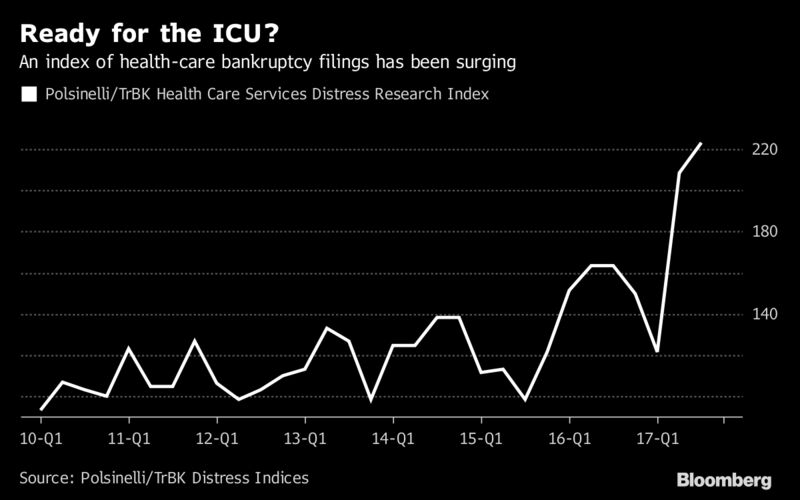
Some signs are already there: Health-care bankruptcy filings have more than tripled this year according to data compiled by Bloomberg, and an index of Chapter 11 filings by companies with more than $1 million of assets has reached record highs in four of the last six quarters, according to law firm Polsinelli PC. Junk bonds from companies in the industry have dropped 1.4 percent this month, a steeper decline than the broader high-yield market, according to Bloomberg Barclays index data.
The pain for the sector comes as bankruptcy filings across the broader economy have plunged since 2010.
Hospitals, including private rural ones, may be among the hardest hit, Winston & Strawn’s Neier said. The Affordable Care Act, known as Obamacare, reduced payments to hospitals that serve a large number of poor and uninsured patients, known as “disproportionate share hospitals,” on the theory that more patients would be insured under the law. Congress delayed those cuts several times, but didn’t do so for the current fiscal year, which may “single-handedly throw hospitals into immediate financial distress — many operate on less than one day’s cash,” he said in an interview.

“Smaller hospitals have already been struggling for years,” said Kristin Going, a partner in the New York office of Drinker, Biddle & Reath LLP. Both lawyers declined to discuss specific companies. Since 2010, a growing number of patients have enrolled in high-deductible health plans that force them to shoulder more of costs when they get treatment, according to the U.S. Centers for Disease Control and Prevention. That has translated into more bad debt from customers for hospitals and other providers.

Some publicly traded hospital companies that were already under pressure from high debt loads have been further buffeted by this year’s hurricanes. Community Health Systems Inc., with $1.9 billion in debt maturing in 2019, has suffered doctor revolts over crumbling, cash-strapped facilities, as well as losses linked to the storms in Texas and Florida earlier this year. A representative for Community Health didn’t return a call seeking comment.

Signs of Distress

Jorian Rose, partner in the New York office of Baker & Hostetler LLP, said many health-care restructurings are already going on under the radar right now. Rose, Going and Neier are members of the Turnaround Management Association, a group for bankruptcy and restructuring professionals.

The Polsinelli Health Care Services Distress Research index, which tracks bankruptcy filings for companies with more than $1 million in assets, shows that activity has surged 123 percent since the fourth quarter of 2010. By comparison, the law firm said, the general index that tracks Chapter 11 filings in the U.S. is down nearly 58 percent from 2010. The Affordable Care Act, which Republican lawmakers have been looking to repeal, replace, defund, or otherwise change, was cited as one of the systemic changes rocking the sector.

Since 1997, health-care cases have made up only 5.25 percent of all U.S. bankruptcy filings, according to Bloomberg data. Year to date, they already comprise 7.25 percent of all filings. Emergency-room operator Adeptus Health, cancer-care provider 21st Century Oncology, and cancer treatment specialist California Proton Treatment are the largest filings. Those statistics exclude pharmaceutical company Concordia, which is restructuring in Canada, and Preferred Care Inc., one of the U.S.’s largest nursing home groups, operating 108 assisted living facilities.

Problems for the sector aren’t limited to U.S. companies. Israeli drugmaker Teva Pharmaceutical Industries Ltd., saddled with debt that’s more than double its market value, is putting together a “detailed restructuring plan” after the company has slashed its profit forecasts, cut its dividend, signaled it may sell new shares, and reduced its goal for paying down debt this year. It announced a management shakeup on Monday.

Distress among health-care companies can spread to other parts of the economy. Quality Care Properties Inc., for example, is a real estate investment trust with a struggling tenant, HCR Manorcare Inc. Moody’s Investors Service said in an October report that if HCR Manorcare files for bankruptcy, Quality Care could also need to amend the terms of its own debt. Representatives for HCR Manorcare and Quality Care didn’t return calls seeking comment.

5 hospital bankruptcies, closures so far in 2017

http://www.beckershospitalreview.com/finance/5-hospital-bankruptcies-closures-so-far-in-2017.html

Image result for hospital bankruptcies

Here are five hospitals that filed for bankruptcy protection or closed since Jan. 1, beginning with the most recent.

1. Humble (Texas) Surgical Hospital filed for Chapter 11 bankruptcy Feb. 24. The hospital filed its bankruptcy petition after a judge ordered it to pay Hartford, Conn.-based Aetna $51.4 million in a seven-year-old court battle over the hospital’s out-of-network charges.

2. Louisiana Heart Hospital in Lacombe closed Feb. 10. The 134-bed hospital and its affiliated medical group filed for Chapter 11 bankruptcy Jan. 30.

3. Gardens Regional Hospital and Medical Center, a 137-bed hospital in Hawaiian Gardens, Calif., closed Feb. 1. The hospital, which served mostly low-income patients and was part of Los Angels County’s safety net, faced financial troubles for years and filed for Chapter 11 bankruptcy in 2016.

4. North Texas Medical Center in Gainesville, which is owned by the Gainesville Hospital District, filed for Chapter 9 bankruptcy Jan. 17. With the hope of regaining its financial footing, the hospital’s board approved a partnership with King of Prussia, Pa.-based Universal Health Services in December.

5. The public trust that operates Atoka (Okla.) County Medical Center filed for Chapter 9 bankruptcy Jan. 10. The critical access hospital is about $16 million in debt.

6 latest hospital bankruptcies, closures

http://www.beckershospitalreview.com/finance/6-latest-hospital-bankruptcies-closures-020717.html

Image result for hospital bankruptcies

From reimbursement landscape challenges to dwindling inpatient volumes, many factors lead hospitals to file for bankruptcy or close.

Here are six hospitals that have filed for bankruptcy or closed since Dec. 1, starting with the most recent.

1. Louisiana Heart Hospital in Lacombe and its affiliated medical group filed for Chapter 11 bankruptcy Jan. 30 and will close by the end of February. The hospital has faced financial challenges in recent years, as it struggled to balance shrinking reimbursements with rising operating costs.

2. North Texas Medical Center, which is owned by the Gainesville Hospital District, filed for Chapter 9 bankruptcy Jan. 17. The hospital’s board approved a partnership agreement with King of Prussia, Pa.-based Universal Health Services in December. On Jan. 24, the bankruptcy court approved a debtor-in-possession loan that will allow UHS to provide financial support to North Texas Medical Center during the course of the bankruptcy case.

3. The public trust that operates Atoka (Okla.) County Medical Center filed for Chapter 9 bankruptcy Jan. 10. The critical access hospital is about $16 million in debt.

4. North Philadelphia Health System filed for Chapter 11 bankruptcy Dec. 30 after years of financial troubles. NPHS currently operates two facilities in Philadelphia: Girard Medical Center, a 168-bed psychiatric hospital, and Goldman Clinic, a substance abuse treatment center.

5. Marshalltown-based Central Iowa Healthcare, which includes a 49-bed acute care hospital, an outpatient center and four primary care clinics, filed for Chapter 11 bankruptcy Dec. 20. Interested parties are bidding on CIH’s assets. A hearing to approve a sale to the highest bidder is scheduled for March 17.

6. Indianapolis-based Community Health Network closed Community Westview Hospital Dec. 16 after a gradual step-down of services over the past few years. When the hospital closed, many of its services were relocated to other Community Health Network sites in the area.

Bankrupt North Philadelphia Health System to sell shuttered hospital

http://www.beckershospitalreview.com/hospital-transactions-and-valuation/bankrupt-north-philadelphia-health-system-to-sell-shuttered-hospital.html

Image result for north philadelphia health system

North Philadelphia Health System, which filed for Chapter 11 bankruptcy Dec. 30, has inked a deal to sell St. Joseph’s Hospital in Philadelphia, which closed in March 2016, according to a motion filed in bankruptcy court Monday.

According to the sales contract attached to the motion, NPHS has agreed to sell the hospital to MMP Hospital Partners in Philadelphia for $8.12 million. NPHS filed the motion Monday to sell the hospital free and clear of liens.

The closing of the sale is conditioned on NPHS receiving approval from the bankruptcy court, and the system said the sale is slated to take place within two weeks of the entry of a court order approving the motion. A hearing on the motion is scheduled for March 22 at 11:00 a.m.

NPHS currently operates two facilities in Philadelphia: Girard Medical Center, a 168-bed psychiatric hospital, and Goldman Clinic, a substance abuse treatment center.